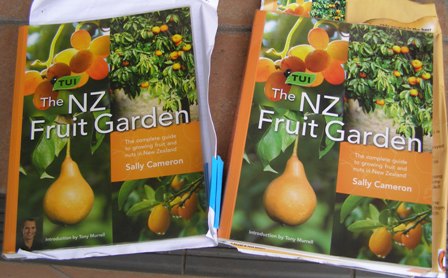
The first version to the left, the revised edition to the right.

After due consideration, Mark's verdict was an emphatic thumbs down
I am married to a patient and kind man but he has been looking ever more exasperated over the last two weeks. I put The Tui NZ Fruit Garden in front of him for comment because his experience with growing fruit and nuts is greater. As he dipped in and out of various chapters, he was finally moved to exclaim that he could not fathom why Tui, Tony Murrell and Rachel Vogan would put their names to this book and give it a credibility that it does not deserve.
If this seems slightly familiar to you, dear Reader, that is not a surprise. This book is the sequel – the revised edition, it tells us on the frontispiece (but not the cover). The first version was the subject of a piece I wrote this time last year, backed up by a lead story on the front page of our newspaper and picked up extensively by national media. There was a little problem with plagiarism by the author, Sally Cameron. Well, quite a big problem really – in fact an enormous one. The publishers, Penguin, pulled the book from sale immediately, mere days after it had been released. Nobody associated with the book ever commented on that withdrawal from sale so the general assumption was it had all died a natural death. No. Little did we know, they were preparing for a second coming. And here it is. It looks the same. The author is the same. The cover has been recycled. So is it the same?
I think the plagiarised sections have gone. I didn’t do an exhaustive analysis but I would guess that they have been quite thorough, given there are legal issues to be considered. But the plagiarism was only half the problem. In reviewing the original version, I was equally critical of the woeful lack of experience and knowledge by the author. And the rewrite has highlighted this even more. At least when the author was cutting and pasting information from the internet, she was generally getting it from credible sources even if they were from overseas. Now that it is in her own words, it often plumbs new depths. “A Chilean guava, pomegranate or feijoa bush can offer hedging that is just as effective as a Buxus.” Really? Shame the pomegranate is deciduous and if you clip your feijoa like you clip your buxus, you will be taking off all next year’s fruiting tips. Or, when writing about grapevines needing support: “This can be shaped or manipulated at leisure to provide a sculptured habitat for the vines to drape from.”
Even worse is the advice on protecting your grapes: “Broad pieces of netting with holes wide enough to let the sun in but keeping, bugs, diseases and birds out help let the fruit ripen nicely on the vine.” Leaving aside the description of broad pieces, since when has any netting kept out diseases and what fine grade of mesh would you need to keep out bugs? Wasps don’t even rate a mention but they are one of the biggest problems, in our experience. The sort of information that the reader needed and deserved to be told is that Albany Surprise is an excellent selection for marginal and humid conditions. Because it has a tougher skin, if you can net the birds out then the wasps can’t pierce the skin and get in to the fruit.
At least lychees, mangoes and pineapples have been consigned to a brief two page spread at the end of the book, under the title of “Fruit not commonly grown in New Zealand owing to climatic restrictions” but it is hard to understand why carambola or star fruit, which is equally marginal, remains with a four page spread of its own in the main body of the text. Maybe the author wanted to show off her recipe for pickled carambola? Proper cranberries (Vaccinium macrocarpum) should have been grouped with the lychees and mangoes too. Equally hard to understand is why tomatoes are included in a book about fruit gardens. Yes, botanically they are a fruit but every home gardener and cook regards them as a vegetable and they are grown in the veg garden, not the orchard. Doing a cut and paste of the tomato chapter from the companion volume, the Tui NZ Vegetable Garden, could be described as having a bob each way but it is unnecessary padding in a book about growing fruit. Some of the other inclusions are odd – the medlar, introduced to this country by the early settlers, is a fairly decorative tree but not worth the space in the orchard as a fruiting tree. Given that you have to wait until the small fruit are nearly rotten before you eat them, why would you bother when we can grow apples and pears so well? Peanuts are a novelty crop grown in the vegetable garden and limited to the hottest and driest parts of the country. But don’t expect too much of that sort of information in this book. In most cases, the author lacks the experience to know what is important and to sift the information accordingly.
Take kiwifruit as an example. For starters, where can you grow them? According to this book, “The kiwifruit is an appropriate crop wherever citrus fruits, peaches and almonds are successful, though the leaves and flowers are more sensitive to cold than those of orange and peach trees.” Right. So this means kiwifruit need more warmth than citrus? But refer to the entry on almonds and it says: “Almonds happily grow in areas with warm summers and cool winters.” So I guess we are talking Hawkes Bay, Marlborough and Central Otago? Refer to peaches and it says: “… a long chilling time ensures a good fruiting crop in summer.” Even we became confused about where you can grow kiwifruit successfully but at least we know that it is a warm temperate to subtropical crop.
If you are a novice and you can deduce whether your area is suitable for growing kiwifruit, what you need to know is that it is a rampant vine and if you don’t prune it thoroughly every year, it will swamp your section and choke out everything else very quickly. The book does at least tell you that kiwifruit are not self fertile so you need both male and female though it fails to mention that only the female vine produces any fruit. I will quote the section on pruning verbatim, so readers can assess for themselves whether they would understand how to prune kiwifruit from this information (including the fact that male kiwifruit vines are pruned differently to female ones). “Pruning: After fruiting has finished, the vines should be pruned in late winter, before the spring warmth. Shoots from summer pruning will not be laden with fruit until the following year after dormancy. Male plants will yield more pollen in the spring if new shoots are pinched out to leave five to seven buds during the summer. Winter pruning renews the fruiting arms, enabling plants to fruit well each year.” Got that, have you? Now you know how to prune your kiwifruit?
Another burning question about kiwifruit which most people want to know is where to buy the new yellow cultivars. The fruit is illustrated but it doesn’t tell you that you can’t buy plants. Hort Research and Zespri, who own all the research on new cultivars, keep very tight control of plants and they are not available to the home gardener. But the book does recommend Cocktail Kiwi, an unproven novelty variety – a rampant grower which is distinctly shy on setting fruit and when it does come it is about half the size of your thumb.
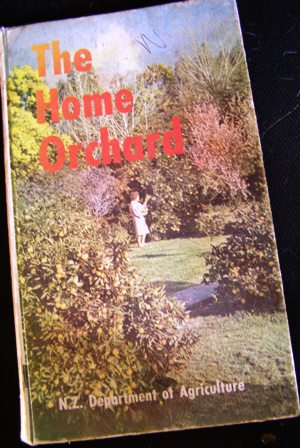
Ever so modest but well thumbed. I can not think that the Tui NZ Fruit Garden will still be around in 40 years time.
Kiwifruit is just one example. The book is full of chapters which are similarly inadequate. But according to Penguin, “this book contains all the essential information you need” and “it will become the reference for gardeners of all skill levels….” We wish that were true. Had this been the first release of the Tui NZ Fruit Garden, Sally Cameron and Penguin Publishers might just have got away with it, marginal though it is. To have a second shot at the same book using the same author, it needed to be very good indeed. It isn’t. We will be keeping to our old tried and true modest volume called The Home Orchard, published by the NZ Department of Agriculture in 1973. It is not glossy or trendy but at least it is by people who knew what they were writing about and it only cost us $2.25 to buy at the time.
The Tui NZ Fruit Garden, by Sally Cameron with Rachel Vogan. (Penguin; ISBN: 978 0 14 356536 9).
For the earlier story on mark one of this book, click on The Tui NZ Fruit Garden – dear oh dear.
-39.042098
174.300314