Tag Archives: gardening

In the garden this week: Friday 15 April, 2011

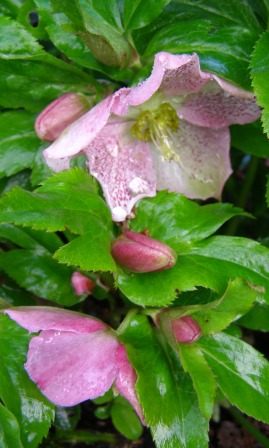
A little attention now will ensure a better winter display from hellebores

A little attention now will ensure a better winter display from hellebores

* It is time to give hellebores (winter roses) a little attention. We go through at this time and cut all the old leaves off, removing them to the compost heap. This gets rid of any aphid infestations, allows the flowers which will start emerging in a few weeks to be visible and the fresh foliage is much more attractive than tired old leaves. You can go through with a slasher if you wish. A weedeater is faster but tends to leave chewed looking stems. Feed and mulch the crowns.

* Most hellebores, particularly the common H.orientalis, are not the most amenable plants to divide. They take several years to build up to a good size so if you plan to divide a clump, make them large divisions. We prefer to go through and remove all the seedlings to prevent too much competition, leaving the large plants alone.

* Autumn is a good time for pruning and shaping most woody trees and shrubs.

* Sow lawns without delay while the weather is still mild. If you don’t do it straight away, you will have to wait until spring because grass seed won’t grow in winter.

* In response to phone calls, the pumpkin crop we grew for hull-less pumpkin seed was called Austrian Oil Seed and we bought it from Kings Seeds. Only the seeds are edible although the pumpkin may be suitable for stock food.

* In the curious world of vegetables, Sydney daughter reports that amongst the various bok choy/ pak choi variants at the market, she found a different veg called kang kong which she thought looked like a weed so she bought some to try. She says it was “quite nice”. Upon looking it up, she worked out why it looked like a weed. It is a convolvulus. I have yet to see kang kong offered here. Most Asian green leafy vegetables are quick maturing so ideal for a short term crop.

* While on the topic of seeds, the new autumn catalogue from Franchi Seeds is available on line at http://www.italianseedspronto.co.nz. These are predominantly summer crops but you may like to browse the traditional tastes of Italy in anticipation of sowing seed later in the year. Mark is planning to try some of the tomato crops and I am encouraging him in this because the most delicious tomatoes I have ever eaten were in the south of Italy. By no means are all tomatoes equal in the flavour stakes. Make the most of the pleasant autumnal weather which is brilliant for gardening. We frequently get the first wintery blast over Easter. No matter when Easter falls, the weather gods spy the event, not the date.

Tikorangi Notes:

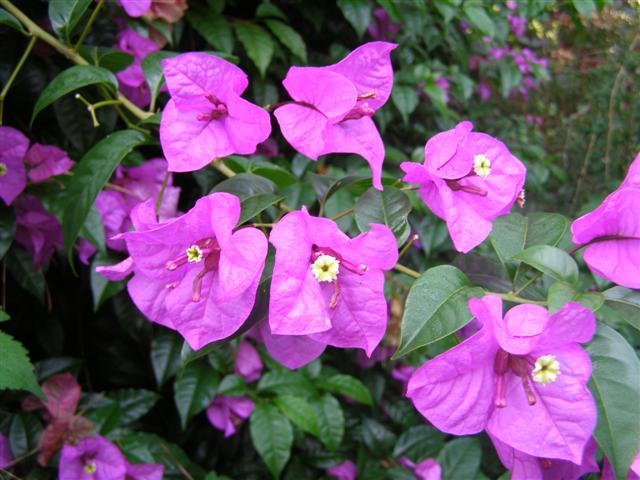
Decidedly rampant, extremely spiny but quite spectacular - the bougainvillea

The Battle of the Bougainvillea

Latest posts: Friday 8 April, 2011

1) One of the very best ornamental oxalis (or wood sorrel, if you prefer euphemisms) – purpurea alba in Plant Collector this week. And it is not in the least bit invasive so comes with our recommendation as garden safe.
2) Nostalgia rules, but it takes time. Relearning the old ways while getting to grips with new technology (aka freezing tomatoes and making grape jelly while learning about power points) – Abbie’s column.
3) Garden tasks for this week – from gathering swan plants and walnuts to sowing green crops.

Tikorangi Notes: Saturday 9 April, 2011

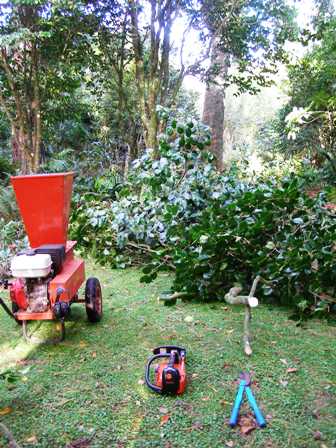
Dealing with the mountains of debris

Dealing with the mountains of debris

Ours is a typical large New Zealand garden in that we maintain a fair area with a minimum number of people. In our case it is about 25 acres or 10 hectares, although only 7 acres of that is intensively maintained garden but we do that with only three of us. Inevitably there are areas that we maintain but do not intensively garden. By that I mean we tidy, prune and groom, keep the area weed free, mulch it and refill large gaps but we do not spend large amounts of time actually beavering away gardening it in detail. But as we plan relatively large new gardens (these ideas can be slow in the gestation phase), I feel the need to make sure we can manage the area we already have. For the past sixteen months, this has meant a major reworking of well established areas. I am now well on the way in the Avenue Gardens which is a bit like the last major frontier. It never ceases to amaze me how much we can prune, saw, rake, trim and haul out from the borders to be cleared away without it being obvious at all what has gone. That, of course, is precisely the result we are aiming for. The gap between woodland garden and impenetrable forest is only a few years. Today has been the Battle of the Bougainvillea and those who have never grown one of these plants may not realise that they are armed with extremely sharp spikes all over. Allied to ambitions for world domination. The pruning is done. Now I am just deeply grateful that our Lloyd will be back at work on Monday. He is a whizz when it comes to dealing with garden rubbish – abracadabra and soon there is nothing remaining.

Relearning the old ways while getting to grips with new technology

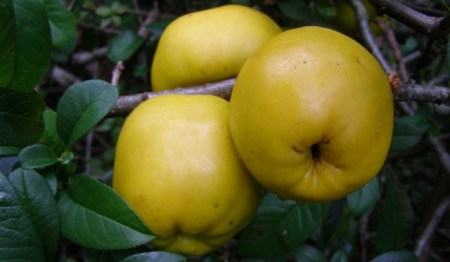
The chaenomeles - attractive and aromatic but not overly versatile when it comes to doing anything with them
The chaenomeles - attractive and aromatic but not overly versatile when it comes to doing anything with them

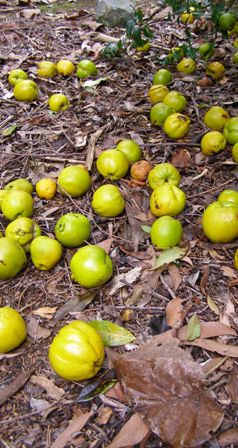
Feeling guilt at wasting the windfall chaenomeles

Feeling guilt at wasting the windfall chaenomeles

It is in the nature of Mark’s and my life that we receive a certain number of invitations to be guest speakers. Not that we are on the celebrity speaker circuit, I hasten to add. Nobody is offering to pay us $4000 to listen to our gems of wisdom. We might be a great deal more enthusiastic if they were. These days we decline most such invitations – it takes a great deal of time and effort to prepare a talk, quite aside from the travel time to go and deliver it. But I relented and accepted an invitation from outside the area to speak to a horticulturally inclined group this week. The reason was quite simple. I needed to learn how to put together a power point presentation and this would force the issue. Which it has done, but not without stress. A quick lesson from power point-savvy daughter at Christmas more or less equipped me to start. I put together a sequence of images on a theme of learning about summer gardens from England and the garden design debt to Moorish Spain. So far so good. We headed out to check that it all worked with a friend who regularly gives such talks. But there was a problem and it was a case of the semi sighted leading the nearly blind as we tried to solve it. We had to have another glass of wine instead and the next day, I returned to the problem of trying to fit photo images to screen size. Spending all day in front a computer screen is not the norm for me, so I tend to fluff around and multi task. There I am, laptop on power point stretching me beyond my technology skills, while starting to cook dinner and making fresh grape jelly when Mark asks: “What are you going to do with the passion fruit crop?

To be fair to Mark, his question was not unreasonable. He has cooked, skinned (I dislike cooked tomato skins) and frozen large quantities of home grown tomatoes. He has taken corn off the cob, blanched it and quick chilled it, and packed it in meal sized portions. He has been cleaning and drying beans. He consulted with me about how many tins of tomato we might buy throughout the winter and spring and how often we might eat corn. I suggested up to 70 servings of tomato (twice a week) and maybe 40 of corn. Having reached that target, he started worrying about what to do with the remainder. Meanwhile the avalanche of autumn produce continues. What to do with the many bucket loads of pears, a variety without keeping qualities and rather too blemished to appeal to others? And the grapes? Our tastes have matured to the point where we are no longer so desperate as to make homemade wine. We haven’t even started on the apples yet and the feijoas will be starting soon. The chaenomeles are falling. Fortunately the pumpkins and potatoes just need sorting and storing but there are other crops shouting for attention and basil and tarragon seem to be going to waste. There is such a lot of pressure in this self sufficiency drive.
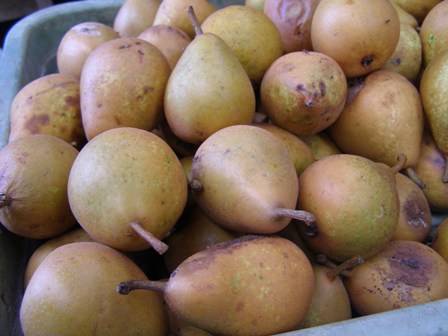
The crop of motley looking pears

The crop of motley looking pears

Back in the late seventies, the world clock of peace ticked, apparently inexorably, towards the midnight which would signal the onset of the feared nuclear holocaust, petrol rose dramatically in price and home interest rates were up to 24% for second mortgages. Along with others, we felt the drive to simplify life and to be less dependent on outside supplies. We bottled and dried and froze food, ate largely from our own garden and shunned all tinned and pre packaged options. I will even admit to doing macramé (it was the age of macramé, an aesthetic aberration that has probably bypassed younger generations). The knotted sisal rope holders I constructed for our stereo speakers were a tour de force. I made elaborate patchwork dresses from old fabric (called vintage these days) which I smocked and embroidered and sold to a local craft shop. Mark produced handsome woodturning and I bought him a book on how to make sandals from leather and old car tyres. The sandals never eventuated but we were children of the land. In modern parlance, our carbon footprint was very low indeed. So we are not without experience in this field of partial self sufficiency even if it has taken us thirty years to return to the practices.

But my goodness, hasn’t the Christchurch earthquake been a timely lesson for us all on considering how we might cope in a similar disaster? True, all Mark’s tomatoes and corn would defrost. Depending on the freezer for food storage means one is also dependent on electricity. But we are not going to build our daily lives around a worst case scenario and it takes even more time (and indeed expense) to preserve food by bottling.
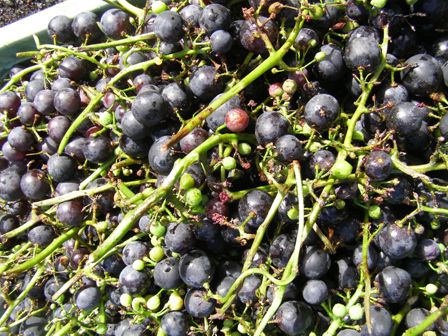
What to do with a surplus of grapes when home made wine does not appeal?

What to do with a surplus of grapes when home made wine does not appeal?

Interestingly, it is the time element that we had forgotten about. It takes a great deal of time both to grow food at home in sufficient volume to come anywhere near meeting one’s needs and then it takes even more time to prepare and store that food. If you don’t derive pleasure from doing it, the commitment is more likely to seem like an unnecessary burden. If you measure your time in dollar values, it is hugely more economical to simply hop in your car and go out to buy the food you require. But it is not the same. There is no way anyone could derive the same sense of satisfaction from unpacking supermarket bags and putting away packets and tins as one can from stowing away home grown food. Squirrel Nutkin Syndrome, I call it. The woodshed is full, the freezer is filling, and the pantry has a wide range of food options, even if it is a lifestyle choice which will not appeal to some. Mark also comments frequently that it takes a lot of land to produce a surplus of food and some of the extremely low estimates of how much area you need have him perplexed. And that is without even attempting to grow our own grains.

Should we suffer a natural disaster on a par with Christchurch, you can be sure of tomato and corn chowder here for about the first week. It may be cooked over an open fire but there should be plenty of it. However, the problem of what to do with the passion fruit harvest remains. As do the pears.

Plant Collector: Oxalis purpurea alba

Oxalis purpurea alba - one of the very best forms

Oxalis purpurea alba - one of the very best forms

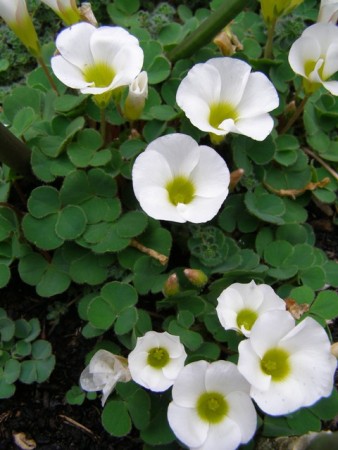
At this time every year, I embark on a crusade to win new converts to the world of oxalis. The whole oxalis family suffers from the bad habits of just two or three members and it means that many people miss out on the seasonal delights of some of the highly ornamental forms. Purpurea alba is one of the very best. It is not in the least bit invasive and I have no problem at all in recommending it for sunny spots in the garden where it forms a flat mat of slightly hairy, clover-like foliage topped with big white flowers with a yellow throat. Where it excels above most others is in the length of its flowering season. It is one of the first to flower and continues through to pretty much the end of the season in winter.

Oxalis purpurea is a highly variable species. The red leafed form with big pink flowers comes into growth much later and is invasive. Decorative but dangerous so keep it confined to a pot. The green leafed form with big pink flowers shares a long flowering season almost on a par with alba and does not appear to be invasive. There are apparently yellow forms of this species too. Overall, there are large numbers of different oxalis. They occur in both South America and South Africa but it is the African ones which give us most of the showy varieties for garden use. Most come into growth with the autumn rains and they have to be planted in full sun because they don’t open their flowers unless it is sunny. They make a wonderful show in shallow containers on a sunny doorstep and you can always refer to them euphemistically as wood sorrel, if you don’t want to own up to growing oxalis.

In the garden this week: April 8, 2011

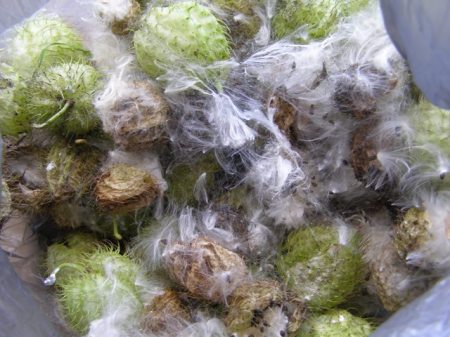
Time to gather swan plant seed

Time to gather swan plant seed

• If you had swan plants which were large enough to set seed, gather the seed and hold it over for planting in early spring. A row of plants in the vegetable garden is a satisfying summer entertainment.

• The walnuts are starting to fall. If you have trees, you need to gather the nuts frequently or you will find the wildlife beats you there at night – particularly rats. Nuts need to be dried before they can be eaten and stored. We spread them in a single layer on trays for a couple of weeks and try and fight off the vermin which will conduct raiding parties until we can get them stored away. Mark sometimes resorts to putting the dried nuts in tightly tied onion bags hanging from the shed roof.

• Pumpkins store better if they are dried out first. Eat any thin skinned varieties of pumpkin first (the green buttercup type along with squash) and keep the tough iron grey ones for last. However, if you plan on storing pumpkins, make sure that their outer casing is undamaged or they will just rot.

• Onions also store better if they are first dried in warm, light conditions.

• You are running out of time for planting vegetables to harvest during winter. Soon it will be time to plant for spring. Get in peas, brassicas and winter leafy greens (silver beet, spinach and winter lettuce) without delay.

• Sow down bare areas of the vegetable patch with green crops such as oats, lupin, vetch, phaecelia, mustard or rye grass. They will germinate and grow, reduce weed infestations and when you dig them into the ground in early spring, they will add goodness and structure to the soil. Leguminous green crops like lupin and vetch also fix nitrogen in the soil.

• You are not likely to ripen tomatoes on old vines now. Gather any perfect fruit, green or not, because they can be ripened off the vine and are less likely rot.

• If you have areas in the ornamental garden which are looking scruffy, past it and generally unappealing, lifting perennials and dividing them can make a big difference. These plants appreciate frequent handling and will respond with renewed vigour, especially if you dig over the area before replanting, water them back in and add a scattering of fertiliser. Perennial plants include all the clumping types of plants, as well as flaxes and grasses.