Tag Archives: gardening

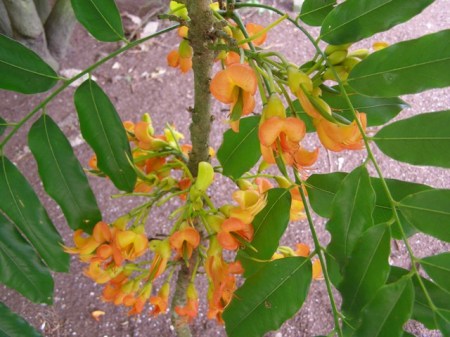
Plant Collector: Castanospermum australe

A mission requiring the tall extension ladder - gathering the Castanospermum australe flowers

A mission requiring the tall extension ladder - gathering the Castanospermum australe flowers

It was just a little difficult to photograph the orange pea flowers on the castanopsermum, owing to the fact that they are at least 10 metres up the tree and beyond the limit of my camera’s zoom. Getting this photograph entailed Mark on the end of the extension ladder cutting a branch to bring down to ground level. The tree itself is probably getting closer to 20 metres now, though it has taken several decades to get there. I was slightly alarmed to see that it has the potential to reach 40 metres high in its natural habitat of east coast Australia, particularly Queensland, but I doubt that it will reach that in our cooler climate, or indeed in my lifetime.

The common names for this plant are Black Bean Tree (on account of its large black seeds held, as legumes are, in a pod) and Moreton Bay Chestnut. Indeed castanea means chestnut in Latin and that is where it gets its name from. It has always been much on my conscience that many years ago when we sold a few of these (and painfully slow they were, to get grown to saleable size), in my ignorance I assumed that the common name of Moreton Bay Chestnut meant the seeds were edible. They can be eaten – if you are Aboriginal and understand the painstaking process of rendering toxic seeds edible (a bit like karaka berries in this country). Lacking that knowledge, poisoning is more likely. As the tree takes some time to flower, I am hoping that my incorrect plant labels will long since have faded into oblivion so nobody tries eating the seeds.

The tree is evergreen and has handsome, pale green, large pinnate leaves – pinnate meaning divided like a feather. Should it outgrow its space here, apparently the timber is attractively grained like walnut.

Learning to garden with shade – the woodland

Raised beds can be desirable, but not in tanalised timber

Raised beds can be desirable, but not in tanalised timber

When you start a new garden, especially on a blank canvas, it is hard to imagine dense shade and sheltered conditions. Fast forward some years and the picture changes dramatically. If you have planted trees and larger growing shrubs, your open, sunny conditions change gradually to the point where you realise the whole micro-climate has altered and the sun-lovers like roses and lavender are struggling. You either cut back or remove large plants to regain the earlier, open conditions or you change your style of gardening. Most larger, more mature gardens move naturally into woodland or shade gardening.

In their simplest form, woodlands are a natural occurrence – but not here. Our native forests are just that – forests. In their natural state, they can be near impenetrable and are more akin to cool climate jungles. I have seen the bluebell woods in flower in Scotland and they were enchanting. A carpet of blue, spread beneath comparatively small deciduous trees which were just breaking dormancy. I can’t recall what the trees were – chestnut, maybe, or sycamore, possibly oak – I was more charmed by the bulbs growing wild. I have only seen the flowering of the English snowdrops in photographs. A particularly memorable image showed a dense carpet of snowdrops beneath the graceful, slender trunks of the white barked birches. However, I can tell you that in general, British and European forests are quite open. You can walk through them without needing a slasher and tramping boots as you do in our forests. Robin Hood and his merry men could probably move through Sherwood Forest without having to keep to tracks. While there are conifers growing which are evergreen, the vast majority of other trees are deciduous. This means that light gets through in winter and early spring and that there is a seasonal carpet of leaf mulch below. In their predominantly dry summers, the shade inhibits the rampant growth we expect here.

But gardening is not about reproducing nature. It is about reinterpretation. Those natural woodlands, which are essentially a shade meadow garden full of wild flowers, peak for maybe two weeks of the year. We are not going to be happy with that in a home garden. England’s wonderful grand dame of gardening, Beth Chatto, has planted her woodland in a succession of spring flowering bulbs which extends the display but even so, by early summer, there was nothing left to see. I was still sufficiently inspired to return home and do the same in one small area. Here, I had to make sure there was no grass and the ground surface is bare soil and light leaf litter. And I can tell you that in a small triangular area about eight metres long and five metres at its widest, it took hundreds of bulbs – snowdrops (galanthus), Cyclamens coum and repandum, assorted dwarf narcissi, rhodohypoxis and lachenalias. The sheer volume of bulbs required rules it out for most gardeners.

The allure of the woodland garden path

The allure of the woodland garden path

Shade gardening is the option for extending display and keeping some definable form in a garden. With huge trees here, dating back to 1880, we have a lot of shade garden, usually referred to as woodland. The basic principles of gardening still apply – it is the variations in foliage, form, height and colour that give interest. Achieving it under a canopy of foliage is different to being out in the open. There are three obvious keys to remember.

Firstly, few plants are happy in dense shade. There is nothing else for it. You have to lift and limb – raise the canopy sufficiently high to allow filtered light below. The trunks of the trees are a feature in their own right and if you want to garden below, getting a four metre vertical clearance will allow space and light to give the plants a chance.

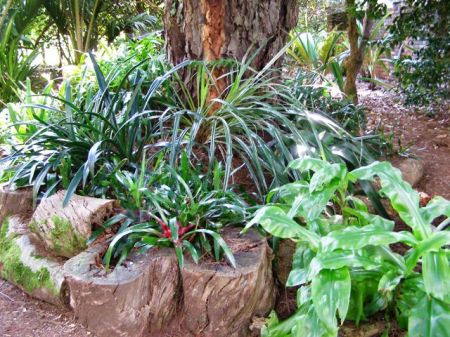
Secondly, there will be a great deal of root competition from established trees. In fact it can be damned difficult chiselling out a hole large enough to plant into and even then, there is little chance of many plants thriving when they are competing for space, nutrition and moisture. That is why many bulbs do so well – because they can cope with harsh conditions and little soil. Clivias, too, will foot it in this environment, as will some of the plectranthus, but many other shade plants such as hostas are never going to be happy and healthy. We get around this in some areas by building informal, raised beds and moving in soil and compost to get the plants established. Ponga lengths and fallen branches still look natural but spare me from the idea of tantalised timber. I don’t like the look of tantalised timber anywhere in a garden but it is even more incongruous in woodland. Casual and natural are the words to remember here.

Thirdly, woodlands are usually dry, a fact many people fail to realise. That is because when you have large trees, their massive root systems suck up the water, leaving little for smaller plants. Often the canopy of foliage and branches will deflect the rainfall away. You really do not want to be creating a garden where you have to water regularly so it is better to choose plants from the start which will take dry shade. Fortunately, the fact that they are growing in shade hugely reduces their water requirements (little evaporation from the sun) so even hostas, which are generally regarded as needing plenty of water, can thrive in dry shade once established.

You can manage flowers and colours for most of the year in a woodland garden - a tricyrtis or toad lily

You can manage flowers and colours for most of the year in a woodland garden - a tricyrtis or toad lily

I will return at a later date to plant options for shade or woodland gardening but here, we are strongly of the view that mass planting of herbaceous material in a shade garden is even duller than mass planting in a formal garden (where the structure and straight lines give form). Give us variety and mixed plantings. The aforementioned clivias are fantastic plants but you only want so much of their strappy foliage and predominantly orange flowers. Combine them with filmy ferns and the extravagance of the massive, split leaves of Monstera deliciosa (the fruit salad plant) and you have a combination with some zing.

It is possible to garden with flowers in woodland and to have colour for most of the year. And, a huge bonus for most, weed growth slows in the shade so you don’t have to be so vigilant on the weeding front. The invitation of a winding path into the woodland can be so much more mysterious and full of promise than the open, sunny section, but, like all forms of gardening, it does not just occur of its own accord.

You have to make it happen.

In the Garden: March 11, 2011

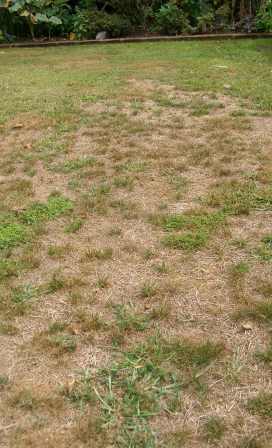
Time to think about lawn renovation

Time to think about lawn renovation

• Early autumn is a good time to do a fertilising round. Give priority to deciduous plants. Fed at this time, the plant will gain the benefit and strengthen itself before it goes dormant for winter. Certainly feed all fruit trees – when you are cropping and pruning plants, you are interfering with their usual routine of maintaining themselves so they need a bit of help. You can use cheap and cheerful, general purpose fertilisers for this task – blood and bone, Bioboost, Nitrophoska Blue and similar. Compost is a good, natural food.

• As you harvest summer vegetables, if you have areas you don’t want to use for winter cropping, sow a green crop. Lupin, oats and ryegrass are good options for this time of the year. Green crops will be dug into the ground in early spring. Their purpose is to replenish the soil. They also help to keep the place looking more cared for – without green crops, the weed invasion to bare soil will be considerably worse.

• It is really important to keep up the succession of planting winter crops – another few plants of all the brassicas, some more leafy greens of the winter lettuce, winter spinach types, even peas and more Florence fennel. It is a bit early for broad beans yet – wait until May.

• The basic rules of crop rotation are the green crop followed by the greedy feeders like potatoes, corn and cucurbits. Next come the leafy greens and brassicas and last are the root crops (carrots, parsnips etc) because they don’t like to grow in recently fertilised soils. Crop rotation is all round good practice in terms of reducing disease problems and keeping the soils in better condition – giving better harvests.

• Inland areas with chillier winters might like to do a light hedge pruning round now to keep the garden looking sharp. The trick of timing is to get it so the hedge just has a light flush of fresh growth before it stops growing for winter. In milder, coastal areas, leave the trim until later in April or you will end up needing to trim twice.

• Lawns, think lawns. Early autumn is a really good time to be over sowing existing lawns and laying new areas. The heat has gone out of the sun but there is still sufficient warmth and day length to get the seed germinating and started. Just make sure that the areas do not dry out if we get a longer spell without rain.

Tikorangi Notes: Friday March 4, 2011

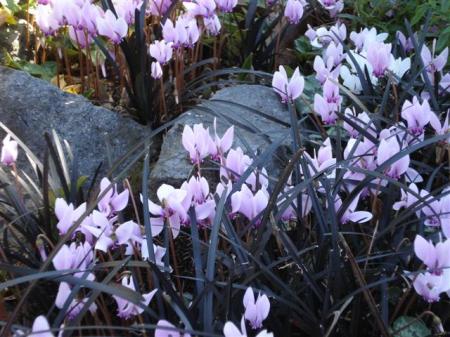
It must be autumn. The Cyclamen hederafolium are flowering again.

It must be autumn. The Cyclamen hederafolium are flowering again.

Latest Posts:

1) To say that we were simply amazed to see that Penguin is reissuing the Tui NZ Fruit Garden in May would be an understatement. Same cover, same author. This is the book they withdrew from sale extremely quickly a year ago when the massive problems of plagiarism and inaccuracy were pointed out to them. Presumably the text has been reworked because the early blurb refers to it being in conjunction with a panel of industry experts. It is to be hoped that industry experts include people with extensive personal experience in growing these plants at home throughout the country and not just the commercial producers who want to sell their plants. That aside, it is astonishing that Penguin appear to think that sticking with a discredited and blitheringly ignorant author is just fine. Are we really meant to have such short memories?

2) Alcantarea regina (or is that geniculata?) in flower this week.

3) Garden tasks for this week as autumn officially starts.

4) The third part in our series of step by step compost instructions – this time making cold compost which is the common technique for home gardeners.

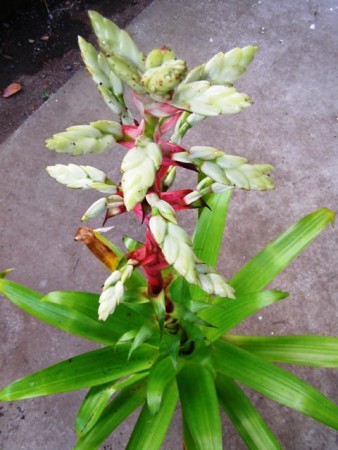
Plant Collector: Alcantarea regina

One of the most spectacular bromeliad's when in flower - Alcantarea regina

One of the most spectacular bromeliad's when in flower - Alcantarea regina

A bromeliad, or brom as they are often called, but thankfully the alcantarea family are not prickly and spiny like so many of the other species. There appears to be some debate as to whether this one is A. regina or A. geniculata – it does seem that the experts lean to the latter option but it is widely sold under the former name. Whichever, it is from eastern Brazil, as are all its alcantaera siblings. It has only been in cultivation for a little over a decade but, being easy to propagate, it is now widely grown. In leaf, it is nothing particularly spectacular – just a rosette of reasonably large green leaves. But when it shoots up a metre high, strong flower stem, it is impossible to ignore. The stem is a deep pinky red with bracts for starters, adorned by funny, waxy lemon flowers which are flat and rigid. Being a bromeliad, the flowers last a long time, after which the flowering rosette usually dies (slowly), but not before putting out pups to the side which will take over in due course.

Most bromeliads are on the tender side so we use them as woodland plants because the overhead shelter gives them protection. They have very small root systems for the size of the tops and low nutrient requirements. In other words, they need very little feeding. Most will hold water in the rosettes – which can be a breeding ground for mosquitoes as I found to my cost when working amongst ours recently. The best known bromeliad of all is the pineapple.