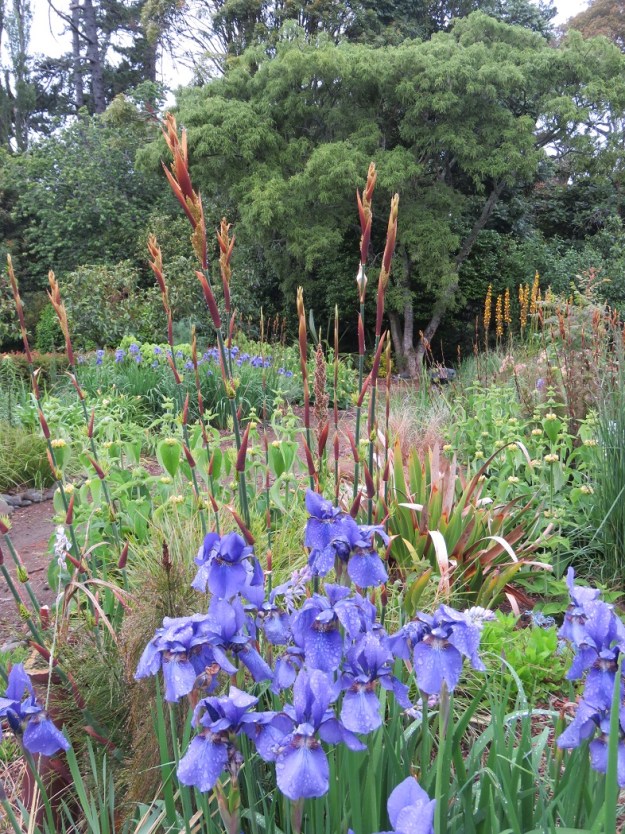
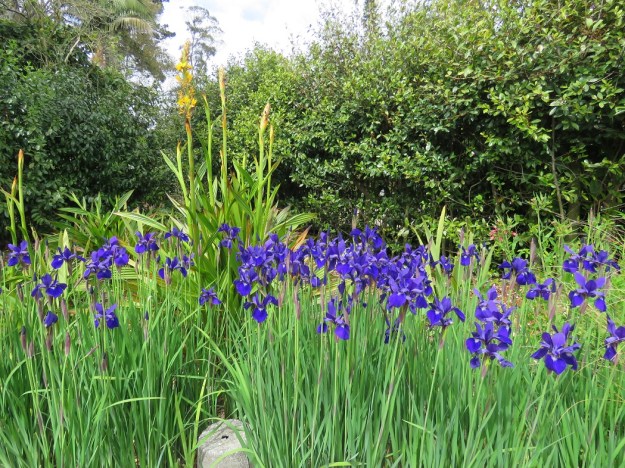
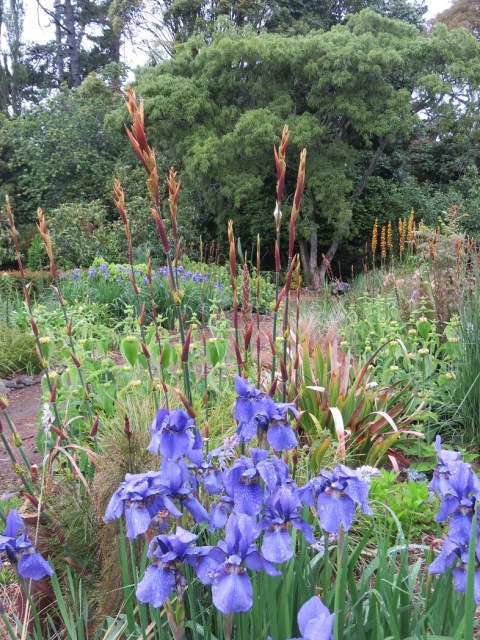
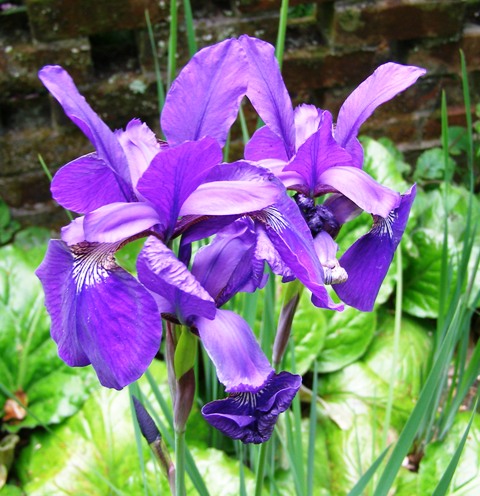
I am surprised by how strongly Iris sibirica grows in well cutivated soils and full sun. I have moved the discoloured Xeronema callistemon behind the iris to the right to a more protected position
Thugs. Not trugs.
We are cautious here. We do not want to unleash plants that threaten to become weeds and therefore become maintenance nightmares. Some plants that set seed rather too freely (like Orlaya grandiflora, Verbena bonariensis and the perennial forget-me-not, Myosotis scorpioides) fall into this category, but they are easy to pull out if they are seeding in the wrong places. Other plants are far more difficult because they wriggle their roots below ground to entwine anything in their way – not unlike couch grass but considerably more decorative. The pretty, blue Salvia uliginosa and Japanese anemones are examples. These are the plants that we are really cautious about placing and controlling.
And then there are the thugs that stand four square and strong and will swamp anything in their way. Thugs need space of their own. Preferably permanent space because some of those thugs can get too large to handle easily in a short space of time. Learning to garden with sunny perennials is teaching me quite a bit about thugs.
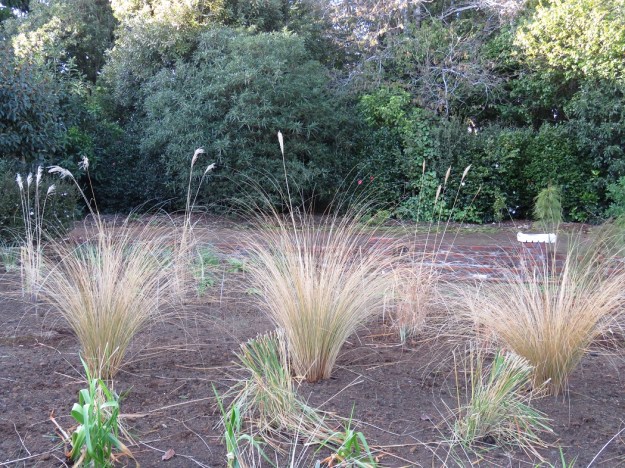
Chionochloa rubra, not a thug but seen to best advantage when allowed to stand in its own space
When I planted up the new Court Garden a few weeks ago, I removed such thugs from the herbaceous borders to relocate in the bigger space of the new garden. They are all good plants but way too strong for the congeniality of an herbaceous border. Calamagrostris ‘Karl Foerster’, Elegia capensis and the large growing salvias were the main thugs that I had used extensively. I also relocated all the Chionochloa rubra, not because it is a thug but because it needed more space to allow it to star in its graceful glory. And Stipa gigantea because it was underperforming in the herbaceous borders and I thought it might be better en masse in its own space.
Raiding the borders left some big gaps, and indeed some large holes. No problem, I thought. I had additional top soil to fill the holes and plenty of plant material to fill the spaces and it seemed a good opportunity to tweak a few areas in the borders which I felt were a bit messy – more messy-matrix than dramatic swathes of plants. I figured all I had to do was to consolidate the areas where I had tried to fill in spaces with additional material. A bit of fine-tuning.
I am sure most gardeners will understand that situation where what we think will be a relatively small project escalates into a major operation. This is one of that ilk. For I found the second tier thugs. These plants have only been in two and a half years and for the first two years, I was simply delighted at the quick result achieved in these borders started from scratch. Gardening with sunny perennials was a completely new experience and so rewarding. Yes, well….
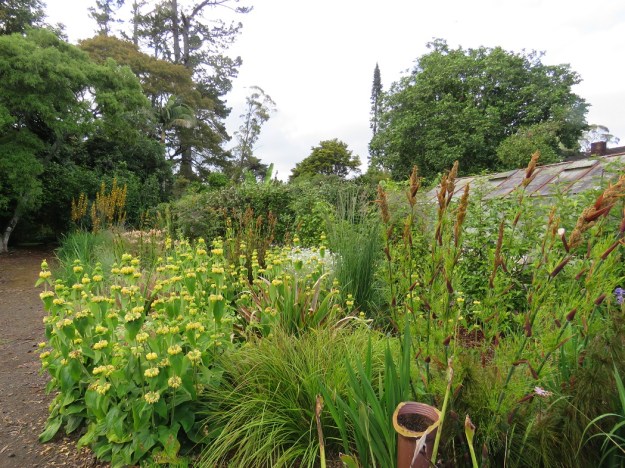
Phlomis russeliana to the left, Elegia capensis to the right with Lomandra ‘Tanika’ in the middle
I am now looking in askance at some of the plant selections. Great plants, but they are going to take a bit more work to keep them that way than I had anticipated because, boy, are they strong growers in this situation. Phlomis russeliana – Turkish sage – with its attractive, tiered yellow flower spikes, has quietly flowered away in our woodland without problems for decades. Moved into full sun and well cultivated soil, it has formed massive underground root systems and overgrown tops in a very short space of time. Iris sibirica – wow. Admittedly, I planted large chunks of it in the first place rather than separating the rhizomes and in springtime, it is simply glorious – so much so that I wanted to add new varieties and colours. Hmmm. All that foliage flops over in autumn, smothering nearby plants and it has to be cut back eventually because it doesn’t even pull off easily. I thought it would be a good time to dig and divide them. It took all my strength to get these plants out of the ground and I ended up with mountains of them. I replanted them as individual rhizomes and mulched with compost. In replanting the same area, I ended up scrapping at least two thirds of them as surplus. And each patch of maybe three or four square metres takes about a day and half to do. I have done four blocks, I have two left to do and I got rid of the seventh block entirely. That is a lot of labour input and time to just one plant type.
And the lomandras. These are tidy, Australian evergreen grasses. We only have two different ones and probably started with a single specimen of each because Mark never buys the same plant in multiples. They kicked around the old nursery area for years, unloved, uncared for, waiting for someone to find them a forever home. That should be a clue as to how tough they are.
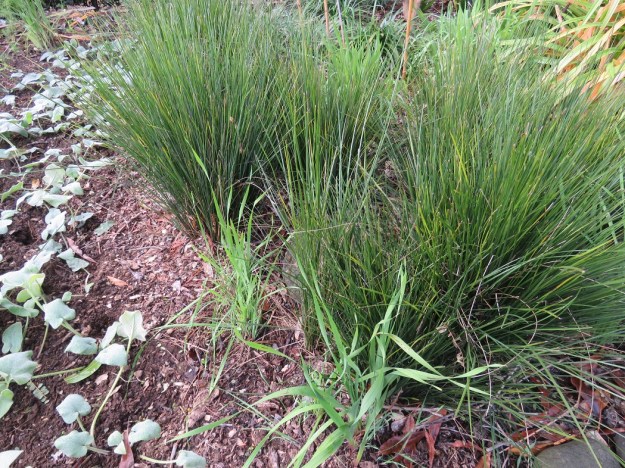
The compact dark green lomandra (with freshly divided phlomis to the left). It will be a named clone; it is just that we lost the name
The compact, forest green variety (name has been lost in the mists of time) is very good. And very well behaved. The very dark green colour contrasts well with everything, really. I wouldn’t mind it growing a little taller in this situation – it is only knee high – but it is very tidy. Not a wow sort of plant but excellent in the chorus line of back up vocals.
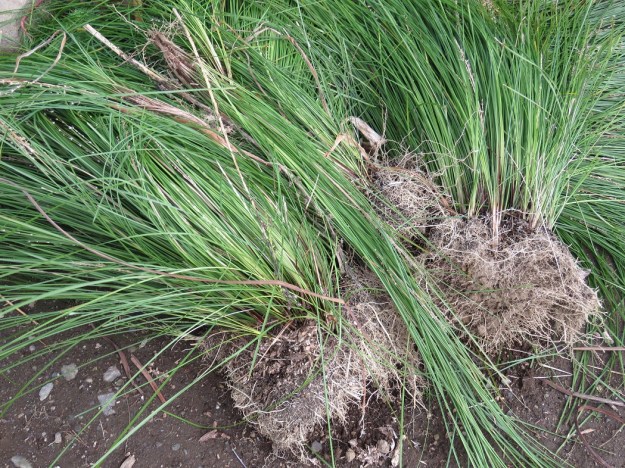
Too much Lomandra ‘Tanika’
The other one we have is Lomandra ‘Tanika’ which is widely marketed in this country. It is larger growing, sort of anonymous mid-green and what is called a reliable performer. It is one of those bullet-proof plants where you start, as we did, with one, put it in good conditions and next thing you know, you have eleventy thousand of it if you want to divide it. Enough to fill a traffic island or a motorway siding, even. It looks attractive in form for the first couple of years but if you don’t lift and divide it, it threatens to become an overgrown, overblown thug.
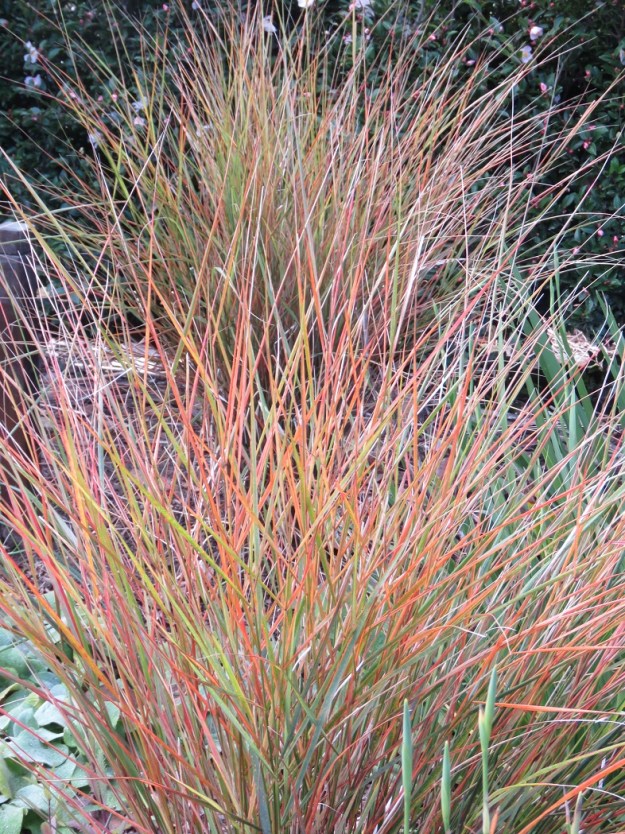
The autumn hues of our native Anemanthele lessoniana – also evergreen
I can’t get too excited about the lomandras. While they can be tidy plants, they lack the flower power of showier grasses and they are bit, well, utility. Space fillers. Evergreen and they stay looking the same all year round, which, I admit, some people see as a desirable trait. I am scaling back ‘Tanika’ – composting about 80% of it. It has another two years to win me over but at this stage, I think I would prefer to replace it with our native Anemanthele lessoniana which fills a similar niche but with more foliar interest and lower maintenance requirements.
What I thought would take maybe four or five days’ work – filling the gaps in the herbaceous borders created by my earlier raid – has turned into several weeks. I am quite happy doing this because it is an active learning exercise but I don’t think I want to be doing it as routine maintenance.
The lesson is that there is no substitute for trialling plants in situ and making some major calls when it comes to swapping some selections out for others. It is why other people’s plant lists are a guide, not a manual, especially if they are overseas recommendations. There is fine line between plants that are sufficiently strong growing to hold their own in herbaceous plantings and plants that are too strong to grow in happy congeniality.
Oh, and give plant thugs the space they need or don’t use them at all. Otherwise they will swamp out other plants of a more refined disposition.

At least the Iris sibirica star in spring, even if they are going to take ongoing work to keep them from smothering their neighbours
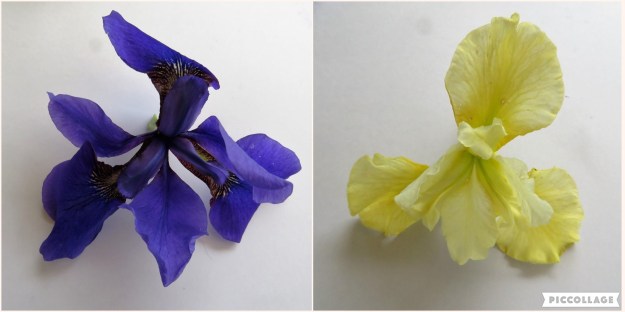
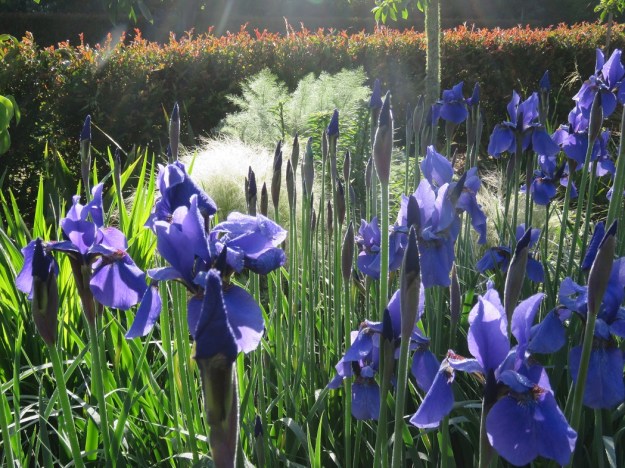
 “I think I prefer the sibiricans now to the bearded irises. Much easier care.” So spake a friend who will, for unrelated reasons, always be known as Cemetery Sue here, as we stood looking at my swathes of Iris sibirica in the new borders. In the second year since planting, their display has been fantastic.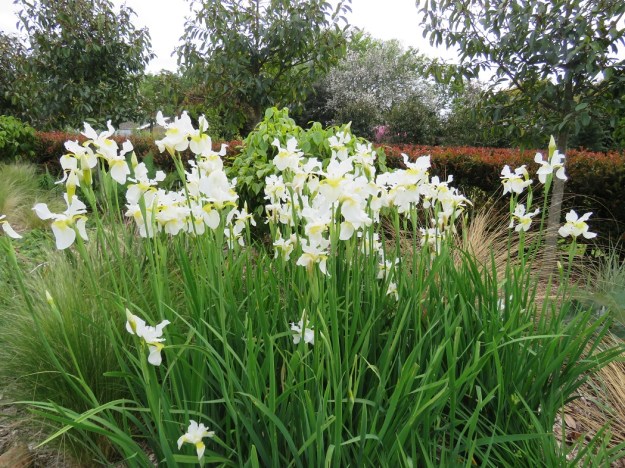
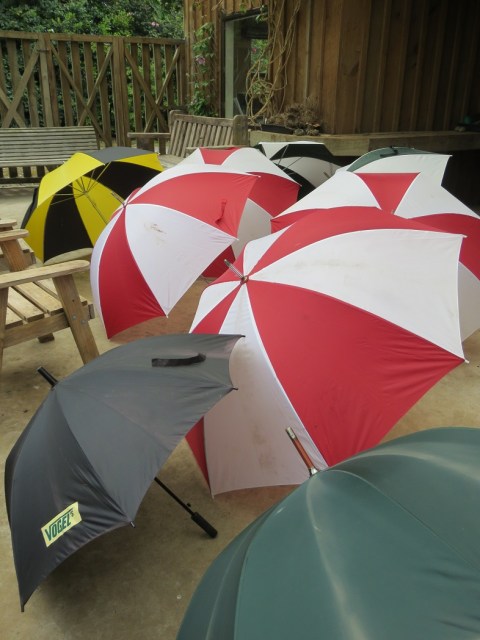 Umbrellas are a part of our lives here. We own quite a few of them and use them often to move around the property. That is because it rains quite a bit and the rain can often be torrential. We get 150cm a year (60 inches). I try and keep the respectable brollies that are in good condition tucked away for when visitors need them, confining us to the somewhat derelict ones. When I say we own quite a few, I mean getting up towards 20 of them and I don’t want to end up with 20 old, crusty brollies. Here I am, drying out some of the better ones to put away again after a garden tour last Sunday.
 The tour was a small group of British and American gardeners, led by a tour host whom we particularly like, which is why we agreed to their visit when the garden is otherwise closed. It is a very different dynamic to host tours with a knowledgeable leader and plenty of time for a leisurely walk around followed by morning tea. We really enjoy their company and that has not always been true for garden tours down the years. The more you get, the less personal the experience and, I am sure, less rewarding for the visitor too. The rain didn’t even matter much and it stopped soon after it started.
 The English visitors felt right at home as soon as we reached the park and they saw the meadow although one of them marvelled, looking back and seeing our native tree ferns growing amongst the trees – they are self-sown here but very highly valued in the UK. Though truth be told, the most common tree fern grown overseas is the Tasmanian species, Dicksoniana antarctica.

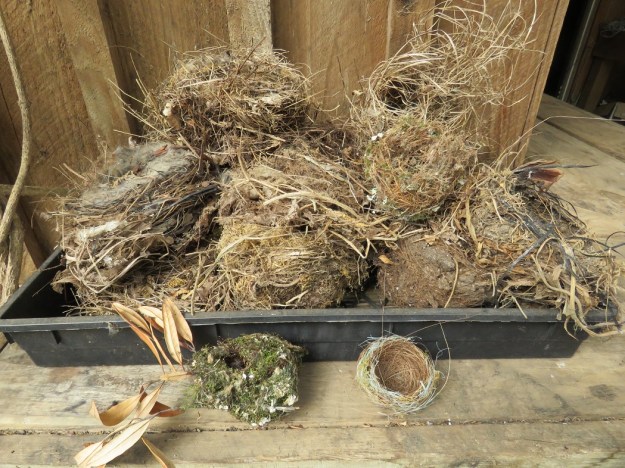 I have a collection of birds’ nests and have been wondering how to display them. I have at last found a suitable tree skeleton that I think can be severed and brought under cover so I can tie the nests to the bare branches. Whether I can do it without it looking terribly naff remains to be seen.
 Gardening is a wonderfully cyclic affair. Is there anybody as finely tuned to the seasons as the keen gardener? Yesterday was the first pick of the roses for the season. All but two of these have such scoury foliage that they have been banished to Mark’s vegetable garden (a large area that he refers to as his allotment) so the only reason they still survive is for the cutting of the blooms. Not only is gardening cyclic, it can also be distinctly ephemeral. But often those ephemeral pleasures can be the most charming on the days when they are at their best.
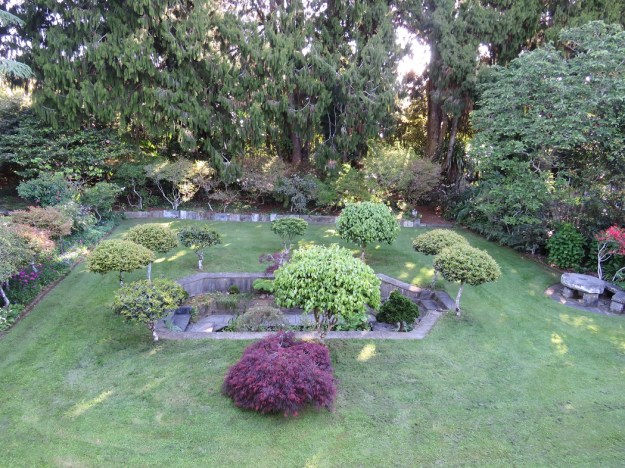
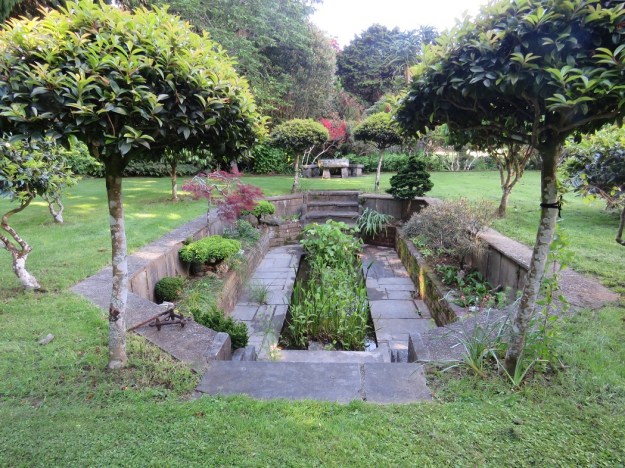

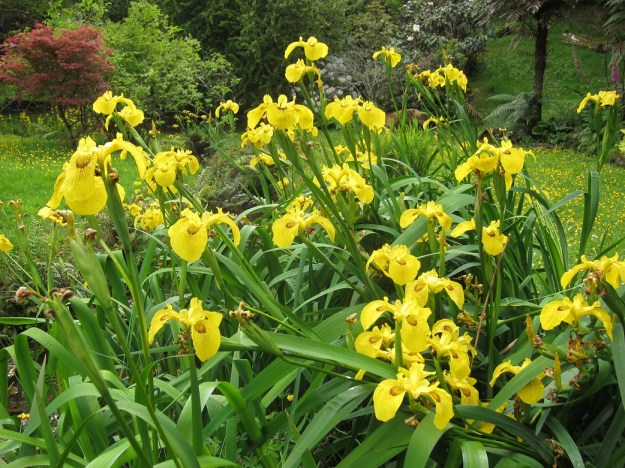


 We are enjoying the water meadow effect we are achieving in that area of the garden.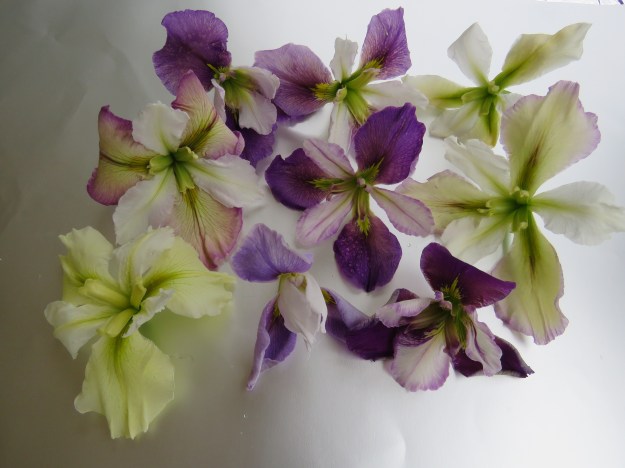
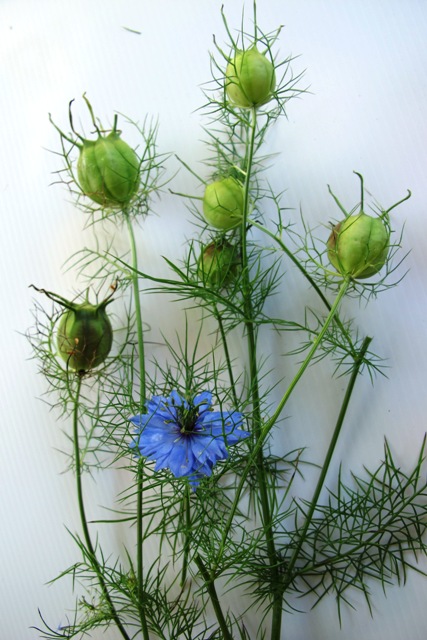
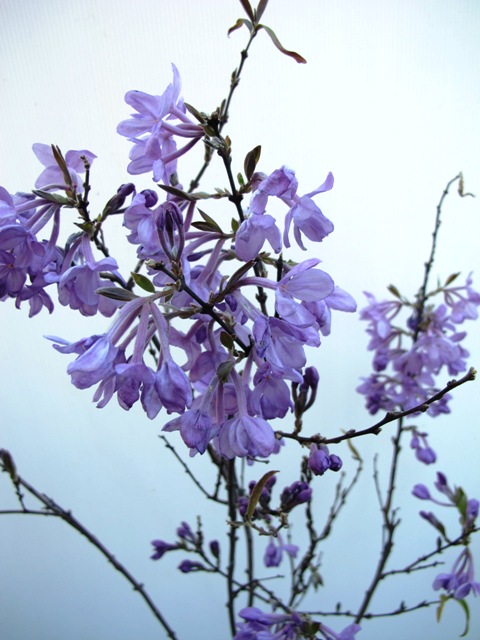
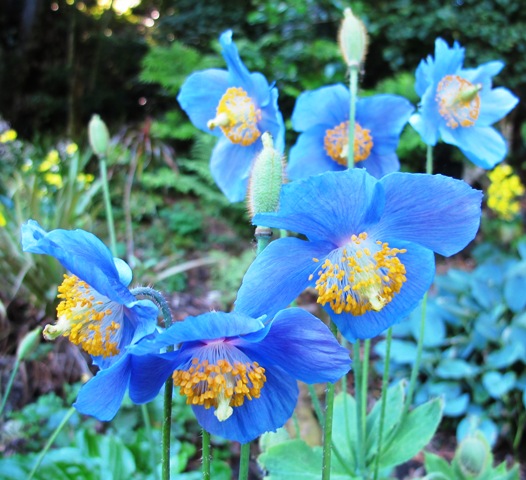
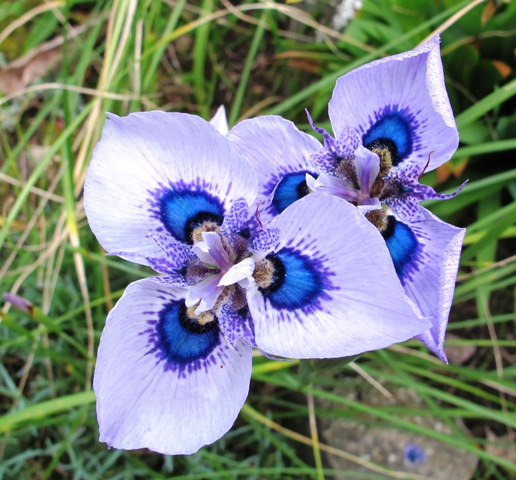
 I am firmly of the view that you can never have too much blue in the garden. While green is effectively colour neutral – every garden has green and usually in abundance – blue is the versatile colour that fits in with all others. The addition of a little blue can lift a pastel colour scheme, add complexity to a white garden, make orange zing or stand as an equal partner in a blue and yellow border. No matter what the dominant colour scheme is, blue will fit in.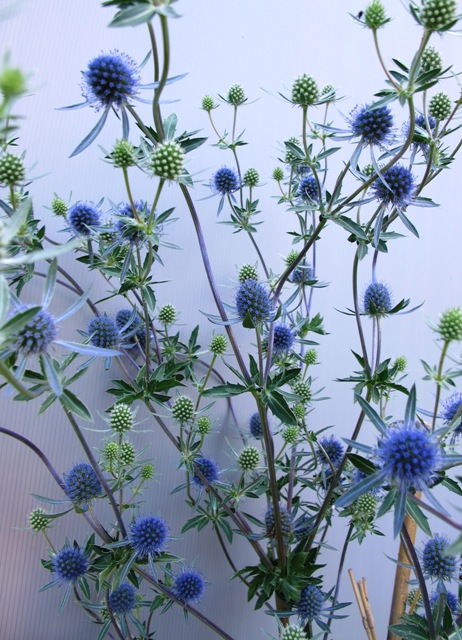



 Tikorangi The Jury Garden