Tag Archives: Magnolia Felix Jury

Tikorangi Notes – a blue sky day in Taranaki

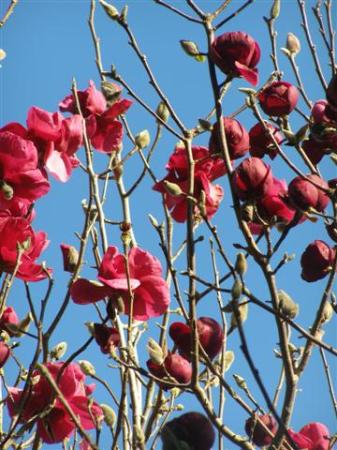
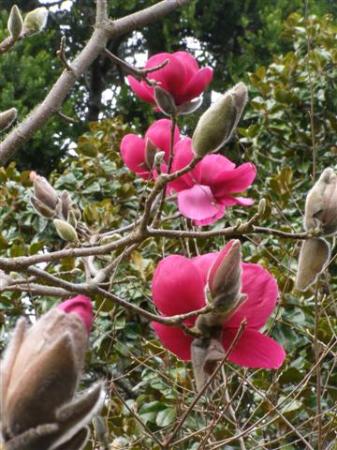
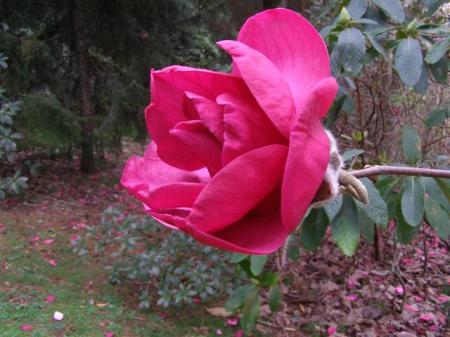
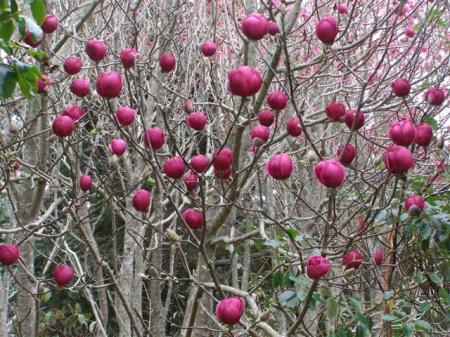
Magnolias Black Tulip and Felix Jury on a blue sky spring morning in Taranaki, Monday August 23, 2010

Magnolias Black Tulip and Felix Jury on a blue sky spring morning in Taranaki, Monday August 23, 2010

We tend to take our blue as blue skies for granted here, especially in mid winter or early spring as it is now. New Zealanders also tend to take red magnolias for granted, not realising that the sheer intensity of colour we can get here is unsurpassed elsewhere and that most of the breeding of red magnolias has taken place in this country – in fact much of the work was done in this very garden here – Jury Magnolias charts the journey.

Magnolia Diary number 7, 26 August 2009

Click to see all Magnolia diary entries

Click on the Magnolia diary logo above to see all diary entries

A short but fierce storm last night was a good reminder why we value firmer flowers and thicker petals in our magnolias. Nothing floppy and loose was ever going to survive hail, strong wind gusts and 3.2cm of torrential rain in a very short space of time. We were relieved this fine morning to discover that the main casualty was to shorten the season of plants which are past their peak already. Iolanthe came through almost unscathed, despite flowers which measure up to 25cm across.

The original Iolanthe this morning

The original Iolanthe this morning

Of all the magnolias here, the original Iolanthe remains the one with most impact at its peak. Mind you, that is a combination of size and location and a weekend visitor asked us to consider the effect Magnolia Felix Jury will have when it reaches that size. We hadn’t quite thought of that.

The original Iolanthe grows half way down our house driveway and now reaches around ten metres high and ten metres across. The leaf and petal drop is prodigious but the impact of Iolanthe in full flower is so astonishing that we do not mind the clean up. Nor has Mark complained about having to move the vegetable garden due to the increasing shade. The tree takes precedence.

Magnolia Iolanthe after the storm

Magnolia Iolanthe after the storm

Back around 1960 when Felix did his first run of magnolia hybrids, he heeled them into the vegetable garden, planning to plant them out to beautify the local town of Waitara. But Iolanthe flowered and the very first flowering was so astonishing that the plant has remained in situ ever since. Iolanthe is soulangiana Lennei x Mark Jury and here was the full sized campbellii flower on a very young plant. The colour was not quite the pink Felix wanted but it was a huge breeding step. Iolanthe also flowers down the stem so, of all the magnolias here, it has one of the longest flowering seasons stretching over many weeks. As with many of the soulangiana types, Iolanthe will put up some summer flowers as well.

For the record, as we understand it, the magnolia sold as Eleanor May is a reject Iolanthe sister seedling. It was used as root stock at Duncan and Davies because it was easy to strike, vigorous and healthy and it was referred to as Mark One. Back in those days, Duncan and Davies made an effort to select clonal root stock best suited to individual varieties but such attention to detail is a thing of the past. At some point Duncan and Davies sent out some failed grafts under the name of Iolanthe whereas they were in fact root stock. The person who named this cultivar bought it from a garden centre, noticed when it flowered that it was different to Iolanthe so took it upon himself to name it. In fact he had no right to name it. He only owned the one plant he purchased; he did not own the cultivar itself so it was not his to name. On its day it is a good performer, as many of our sister seedlings, reject cultivars and also rans are good on their day but it is inferior to Iolanthe and we do not consider it should have been named. We take particular exception to Eleanor May ever being attributed as a Jury hybrid. As far as we are concerned, it is escaped rootstock.

Magnolia Diary number 5, 19 August 2009

Click to see all Magnolia diary entries

Click on the Magnolia diary logo above to see all diary entries

Magnolia Felix Jury

Magnolia Felix Jury

When Magnolia Felix Jury first flowered, it was pretty clear that Mark had taken the step that his father, Felix, had been aiming for with his earlier breeding of Iolanthe and Vulcan. Here was the big campbellii type flower on a young plant with strong colour. Mark named it for his father, even though it may be seen as a slightly unexpected memorial for a man who was a quiet and modest person and of slight stature. The magnolia is none of these. It is large flowered, robust and simply spectacular.

What was even more gratifying for us on our recent trip to the United Kingdom was to see how very well Magnolia Felix Jury is performing there. We walked into the Garden House in Devon and there in pride of place at the entranceway was a fine specimen. It was in leaf but Mark still recognised it instantly. The head gardener confirmed that it is in such a prime position because it performs so spectacularly well and we found that in a number of other gardens around the country. To say that Mark was quietly chuffed is a bit of an understatement. There is no certainty that plants which perform well in New Zealand will be equally good overseas.

Magnolia Felix has been described as a giant pink cabbage on a stick

Magnolia Felix has been described as a giant pink cabbage on a stick

It is difficult to get full tree shots of magnolias, and especially for the original Felix which is planted in a grove of seedlings, but this plant in our park is about 12 years from cutting.

Felix Jury in our park

Felix Jury in our park

Black Tulip is also in full flower and it seems that this will be a good season all round here for deep colour. There are various theories internationally as to what affects the depth of colour but most seem to be anecdotal rather than scientific. We just feel that some years here we get better colour than other years. New Zealanders tend to take the red magnolias for granted and don’t really understand that the deep colours are unusual internationally.

Magnolia Black Tulip in full flower

Magnolia Black Tulip in full flower

Royal New Zealand Institute of Horticulture (Inc.)

Mark Jury receives the Plant Raisers Award for 2007

Mark Jury is one of this country’s foremost breeders of ornamental plants, and in recent times he has received international recognition for his achievements.

Mark was born in 1951. He graduated from Massey University in 1974 with a BA in psychology, and could well be the only person with such a qualification in the NZ nursery trade. Early plans for a career in counselling changed, and he took time out to be a rock drummer (he still has his drum kit), to teach himself to draw and paint, and to make a living as a wood turner before deciding to set up a plant nursery on his father’s property at Tikorangi.

The late Felix Jury is one of the most esteemed plant breeders and horticulturists this country has produced. Felix was a farmer who took early retirement to garden and breed plants, and the numerous outstanding hybrids he produced are now internationally acclaimed. The nursery, however, is entirely Mark’s effort, one that he ‘built up from one wheelbarrow’. Contrary to popular belief, Felix never had a nursery.

Despite having no formal training in horticulture, Mark learned enormously by working alongside his father for 17 years. He also benefited greatly from having access to Felix’s plant material, and from being able to tap into the wealth of knowledge and experience that Felix freely shared.

His uncle Les Jury was also an early mentor, particularly in the breeding of camellias.

The nursery, however, has only ever been a means to earn a living for Mark, who claims he is not a dedicated nurseryman. Rather, it is plants and the garden that matter to him, and when breeding plants his quest is invariably to produce better garden subjects.

No new plant is ever released by Mark until he has full confidence in all its attributes. Trialling is an integral part of the breeding process, and new hybrids are grown in the field or the garden, as well as the nursery, to assess their performance over a number of years before they ever get put into production.

Following is a representative selection of hybrids bred by Mark Jury:

Camellias

‘Fairy Blush’ is regarded by Mark as the best of his camellia hybrids currently on the market, followed by ‘Volunteer’. ‘Jury’s Pearl’, however, is the one which brings Mark most pleasure because it achieved what he was looking for; compact growth, abundant flowering over an extended period, healthy foliage, good flower form and an almost luminescent flower colour. He has named a number of others, including ‘Gay Buttons’, ‘Pearly Cascade’, ‘Topiary Pink’, and ‘Apple Blossom Sun’. Two promising new selections yet to be released are a compact and very free flowering red formal double, and a purple pompom flowered miniature.

Rhododendrons

‘Floral Sun’ is Mark’s pride and joy. When he told his wife Abbie that he was crossing Rhododendron sino nuttalli with R. ‘RW Rye’, she recalls quipping that he would probably get offspring which were a mass of tiny white flowers and no scent. Instead he did get the yellow colourings into the nuttalli trumpets, compact growth and nuttalli foliage. He has also named ‘Floral Gift’, ‘Meadow Lemon’ and ‘Platinum Ice’, and has various others under consideration. Mark specifically strives for healthier performance, resistance to thrips and where possible fragrance.

Magnolias

The new ‘Burgundy Star’ could prove to be the best Mark has produced. It ‘loses the purple tones’ of ‘Vulcan’ and ‘Black Tulip’ and is described as carrying a very large Magnolia liliifora type flower on a fastigiate tree. ‘Black Tulip’, however, is the cultivar that has caught the imagination of the market place, while ‘Felix Jury’ is his personal favourite. Mark thinks he may have exhausted what he can do with red flowered magnolias, but he has some pinks and whites under trial. In 2004 the International Magnolia Society conferred upon Mark the prestigious Todd Gresham Magnolia Award.

Vireya rhododendrons

‘Jaffa’ and ‘Sweet Vanilla’ are regarded by Mark as probably the best cultivars he has yet named, although he has produced quite a few others. These include ‘Sherbet Rose’, ‘Peach Puff’, ‘Jellybean’, ‘Mango Sunset’, ‘Pink Jazz’. Sadly some of the others have already been dropped from production. Despite fairly rigorous trialling, when in production some are considered to be too vulnerable to root problems. ‘Festival Ruby’ is scheduled for release later this year for the 20th anniversary of the Taranaki Rhododendron Festival. Part of the vireya rhododendron breeding programme has focussed on trying to get full trusses reminiscent of the hardy rhododendrons, whilst also aiming for compact growth, fragrance and abundant flowering.

Michelias

A range of unreleased new hybrids is currently generating great excitement and anticipation amongst those who have seen them. This series extends the colour range of the flowers, growth habits, foliage and flowering season. Mark is optimistic of a great future for these, seeing them fitting a market niche similar to camellias but without most of the problems such as camellia petal blight and yellowing of foliage. The first two cultivars from this series are scheduled for release next year.

Cordylines

‘Red Fountain’ is a hybrid produced by Felix, while Mark introduced it. The next generations of Mark’s cordylines are currently under development.

Dianella ‘Golden Chance’ (so-named because it was a chance discovery) seems to have entered the marketplace with ‘a bit of a whoosh’, somewhat to the surprise of Mark and Abbie.

Mark often ‘plays’ with other plants to produce even more high quality garden subjects. His Arisaema hybrids are regarded as particularly fetching, extending the colour range and holding their blooms above the foliage, but sadly they are unlikely to enter commerce. Unfortunately for gardeners, the same applies to a number of other plants that he ‘wields his paintbrush around’.

It is appropriate that the Institute recognises Mark Jury for his considerable contribution to amenity horticulture. He is a most worthy recipient of the Plant Raisers award.