Tag Archives: Magnolia Lanarth

Tikorangi Notes: August 21, 2010

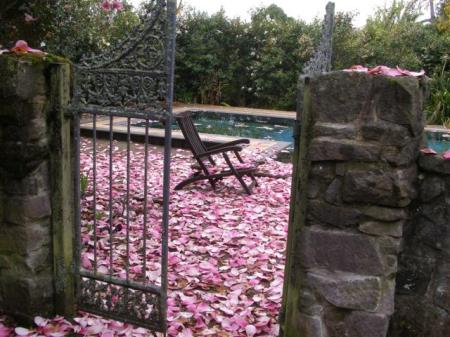
Magnolia Serene by the pool, 2009

Magnolia Serene by the pool, 2009


The photograph much admired by radio host and landscaper Tony Murrell on Radio Live this morning was the end of season snap of Serene taken last year. We might equally describe this as a fine example of why you do not plant a magnolia beside your swimming pool although in our case, it is why building the swimming pool beside the original Magnolia Serene was not such a brilliant idea of ours. The tree was there first. (Magnolia Diary 13).
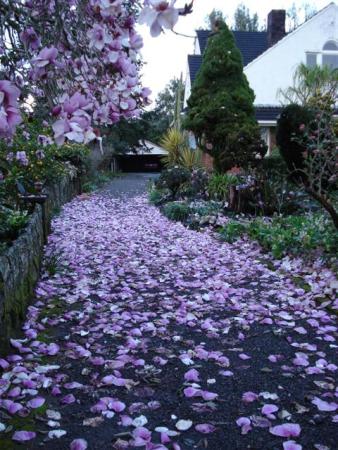
Iolanthe, after a storm

Iolanthe, after a storm

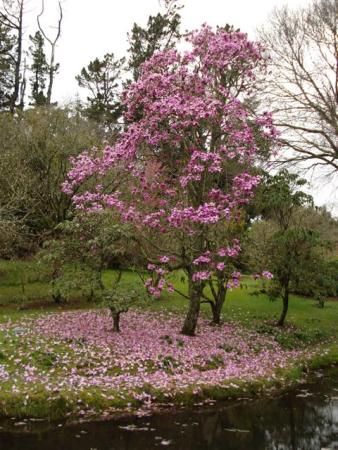
Magnolia Lanarth is the first to drop its petals

Magnolia Lanarth is the first to drop its petals

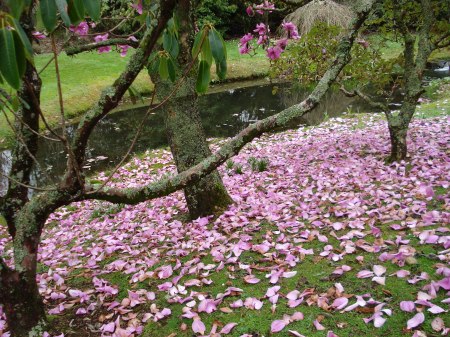
Personally, I prefer the post-storm image of the original Magnolia Iolanthe (Magnolia Diary 9), planted beside our driveway although Lanarth (Magnolia Diary 4) dropping its petals more tidily and conveniently in our park is also a favourite.
Lanarth petal drop

Lanarth petal drop


All this is a little premature this season as we are just entering the new magnolia flowering season – there should be a splendid display out by next weekend.

And as a footnote, the petal drop around our lollipop Fairy Magnolia Blush is a regular delight still in store for this season as the first buds are just opening. (Magnolia Diary 12).

Circles of Fairy Magnolia Blush petals

Circles of Fairy Magnolia Blush petals

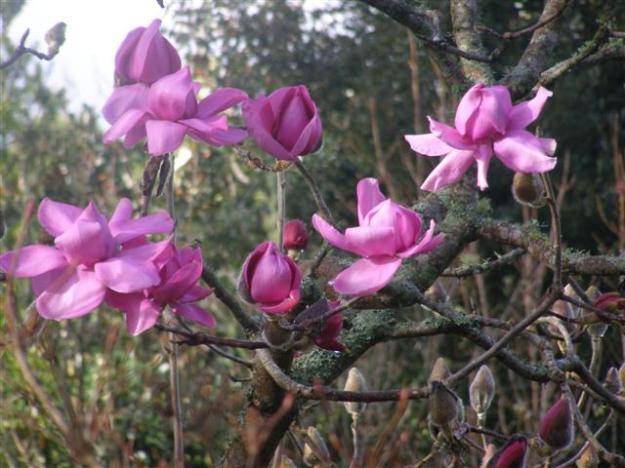
Plant Collector: Magnolia Lanarth

Magnificent in its purple splendour - Magnolia Lanarth

Magnificent in its purple splendour - Magnolia Lanarth

It is magnolia time and Lanarth is always one of the early bloomers and still sets the standard for pure stained glass purple colouring. We have yet to see a modern hybrid match the colour, flower form and size of Lanarth. So it is a bit of a shame that it is hard to propagate, so rarely offered and not that easy to establish so there can be a fall-out rate amongst those that are produced. On top of that, it takes a few years to flower (sometimes a decade or so), it makes a fairly large tree and the flowering can be short-lived. Get a storm at the wrong time and the season is pretty much over not long after it began. But in full bloom, it is a magnificent sight and that is why it is a collector’s plant.

Its full name resembles a stud animal – Magnolia campbellii var. mollicamata Lanarth – but it is usually just referred to as Lanarth, sometimes with the mollicamata in front to impress. Lanarth refers to where the seed was raised which was a garden in Cornwall. Intrepid plant collector George Forrest collected the seed in North West Yunnan in China back in 1924 where it was growing at a fair altitude of over 3000 metres. Only three seeds were grown and Lanarth was selected as the best of them. The usual pink and white campbellii magnolias come from the more westerly areas of China, Tibet and Burma whereas the mollicamata variants come from the more easterly side of that magnolia habitat.

Magnolia Diary number 4, 16 August, 2009

Click to see all Magnolia diary entries

Click on the Magnolia diary logo above to see all diary entries
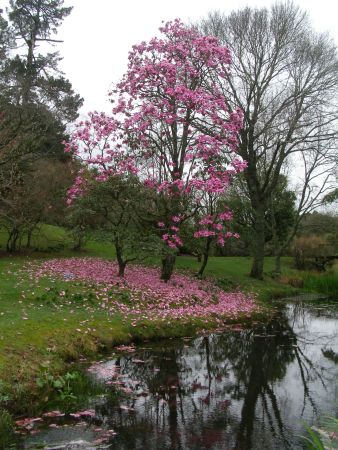
Magnolia Lanarth - now past its best

Magnolia Lanarth - now past its best

One night of rain and Magnolia Lanarth is in decline for the season. Passing over. We don’t mind that Lanarth looks a picture of perfection for such a short time but we can understand that it is a problem for people who live on small sections and who prefer prolonged flowering.
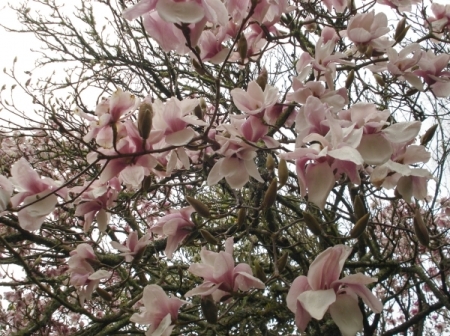
sprengeri diva - great from a distance

sprengeri diva - great from a distance

Campbellii has peaked too but in front of our campbellii tree, Sweetheart (a Caerhays Belle seedling raised from a Ron Gordon plant and named by Peter Cave) is just opening and is very much pretty in pink. Sargentiana robusta and various stellatas are also opening. Sprengeri diva is in full flower and looks great from afar, but floppy and a tad scruffy when viewed close up. We need more substance in blooms in our conditions with wind and heavy rain.

Michelia doltsopa is flowering around the district. The form in our park was named and released by Peter Cave as Rusty but we have never sold it. Quite simply, we think it is too large. Sure, our plant is only around 10 metres tall – but it is a good 20 metres wide. By my maths, that means that Rusty takes up around 300 square metres of land area. That is a large plant growing from a central trunk and not suckering.

We intercepted the neighbours out sniffing on a morning amble yesterday (and diverted them to coffee). All Mark’s doltsopa hybrids are coming into flower and indeed the fragrance is delicious from the road as well as in our garden. The neighbours were wanting the full on scented experience, having detected it even while driving home.
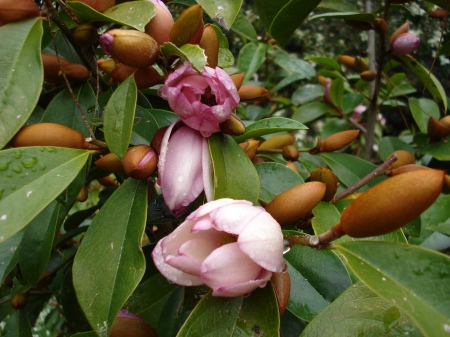
Fairy Magnolia Blush

Fairy Magnolia Blush

For the domestic garden, Mark’s first michelia hybrid to be released is opening its flowers. Fairy Magnolia Blush is reasonably compact (and clips well) with distinctive pinky purple flowers of reasonably large size. This cultivar is on the NZ market and will become available overseas in the next few years.
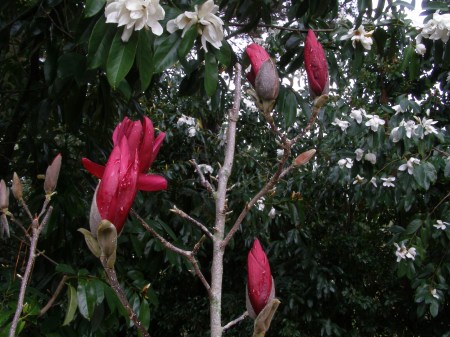
The first flowers on Burgundy Star. Doltsopa seedlings behind.

The first flowers on Burgundy Star. Doltsopa seedlings behind.

The row of stock plants of Mark’s Burgundy Star are opening their first flowers though the original plant in our carpark is hardly showing colour. In our opinion, in the proper reds Burgundy Star takes the cake so far.