Tag Archives: Mark and Abbie Jury

The magnolia and the mountain

Magnolia campbellii in our park and Mount Taranaki

Magnolia campbellii in our park and Mount Taranaki

I prefer not to leave a negative post heading my home page for long (for an update on That Matter, refer to the last paragraph here), so here instead is the magnolia and our maunga*. I am waiting for more flowers to open so I can catch the hero shot of Magnolia campbellii in full bloom against the snow. This photo was taken in the early morning light at about 8am, as the sun was rising.

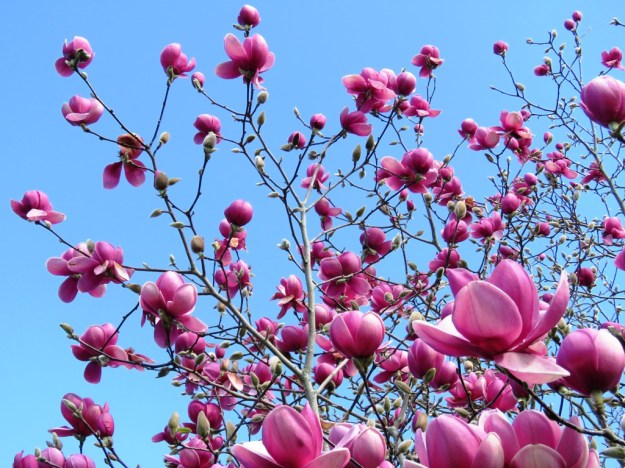
campbellii again

campbellii again

Mark is anxious that I point out I am using a zoom lens and the mountain is not 300 metres away from us. It is more like 35 kilometres distant. In this case, I feel it is appropriate to use the word iconic about our maunga. It is a beautiful volcanic cone which stands in splendid isolation on the coastal plain beside the sea and it is such a strong presence in Taranaki that it is etched into the very being of everybody who lives here. It is still active, although it is a long time since it has done much more than gently rumble to remind us not to take him for granted.

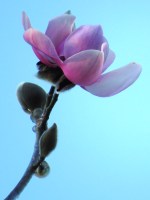
Magnolia campbellii

Magnolia campbellii

M. campbellii is always the first of the named magnolias we have here to open for the season. The tree is a fraction of its former size, having been clipped by a falling poplar tree a few years ago but it continues to grow and will regain its former glory over time.

Just an unnamed seedling

Just an unnamed seedling

For early glory, this unnamed seedling in one of our shelter belts takes the first medal. It is looking great, but it won’t be named or released. It flowers far too early for most climates and is not sufficiently distinctive. It is a good reminder that on their day, many plants look magnificent but they need to continue looking glorious in competition with many other candidates, not just on their day.

First bloom of the season on Felix Jury

First bloom of the season on Felix Jury

The first few flowers have opened on Felix Jury, which is still a source of real pride and joy to us. Felix beat Vulcan to the draw on first bloom this year, although the latter is now showing glorious colour. Felix will also outlast Vulcan when it comes to the length of the flowering season. In colder climates, these earliest bloomers open later. We are lucky where we live that we have clear, intense light – even in mid winter when these magnificent flowers start opening for us.

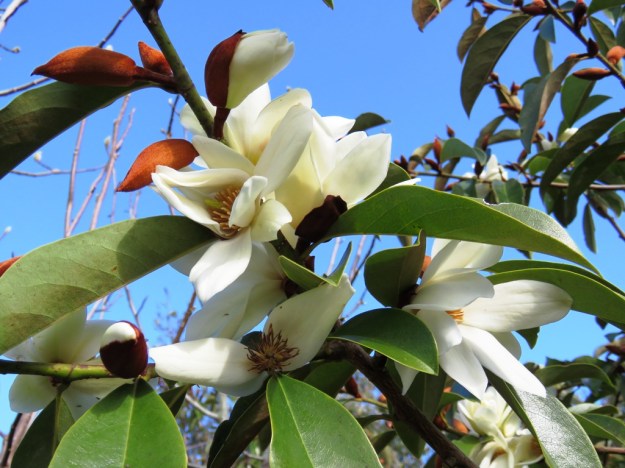
Mark's Fairy Magnolia White

Mark’s Fairy Magnolia White

Michelias have now been reclassified as magnolias and the earliest varieties are opening. This is Mark’s Fairy Magnolia White which has the bonus of a lovely perfume. Magnolia season feels like the start of a new gardening year for us and each day is filled with anticipation to see what else is opening. Many of our trees are now large, so I find I am often photographing up against the sky. Hence I often refer to this time of the year as the season of skypaper.

As far as my previous post on the magnolia and the well site goes, for those of you curious about the reaction of the company I can report that so far, the reaction has been… nothing. Nothing at all, although I know they spent a lot of time checking it on my site on Tuesday. I fully expect that situation to remain, although I will certainly be pleasantly surprised if the company responds to the challenge.

*Maunga is the Maori word for mountain and is widely used in New Zealand, especially when referring to mountains which have long held particular spiritual significance for tangata whenua – the first people of the land in this country.

The Avocado Thief

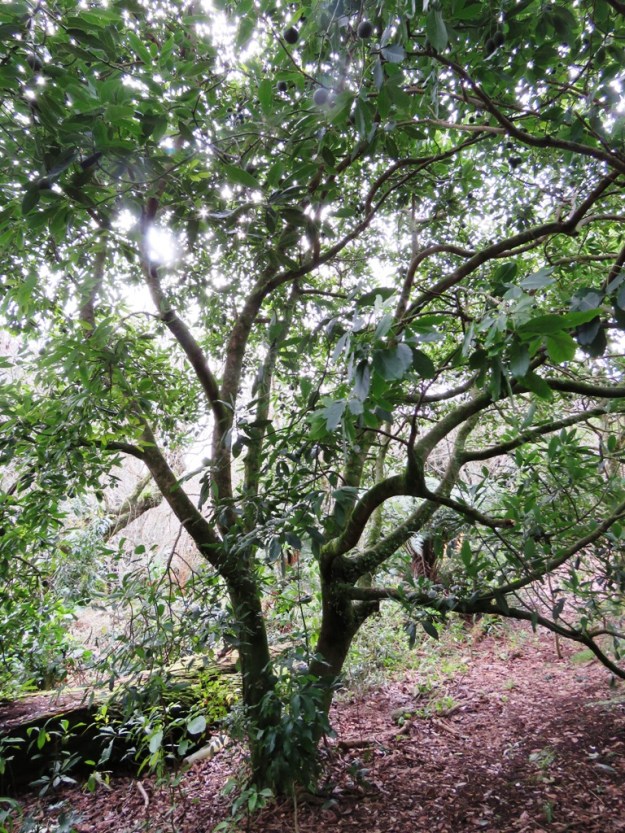
Avocado tree

Avocado tree

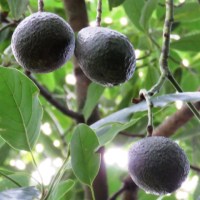
023 - CopyBehold an avocado tree. A tree, I admit, that demonstrates a case of allowing a twin trunk to develop though I am told that is permitted with avocados. It is a tree which has had the best ever crop of Hass avocados this year. It has truly been a mast year. We are a bit marginal when it comes to avocados and they tend to crop biennially. There is no crop next year so we are making hay (or guacamole, to be precise) while the winter sun shines.


Exhibit A

Exhibit A

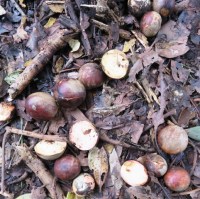
Exhibit A is the pile of avocado pits around the place. These tell us that we are not alone in harvesting the crop. In fact given the predations of waxeyes, starlings, blackbirds, rats and possums, it is a miracle that we still collect fruit by the bucket load. Possums are a major pest in this country and Mark and the dogs do a round each evening checking for them. Mark conducts an autopsy on the stomach contents of each possum he shoots – mostly to check who is eating the buds of the magnolia trees at this time of the year – and noted last week that one appeared to be full of guacamole.

Exhibit B

Exhibit B

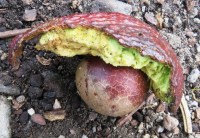
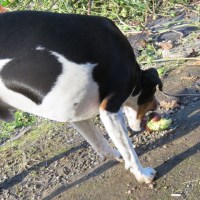
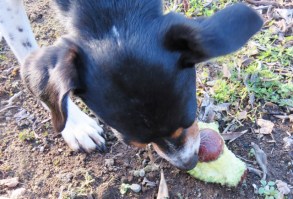
But exhibit B fingered another avocado thief. None of the aforementioned raiders stashes partially eaten fruit all round the place. We had noticed that new dog Dudley was looking particularly glossy and plump. The natural avocado oils are clearly kind to his fur. Mark has taken to doing a circuit twice a day to pick up whole fruit that has fallen in an attempt to beat Dudley to the draw but any time the dog disappears from view, it is a fair bet that he can be found near the avocado tree.

005 - Copy009 - Copy


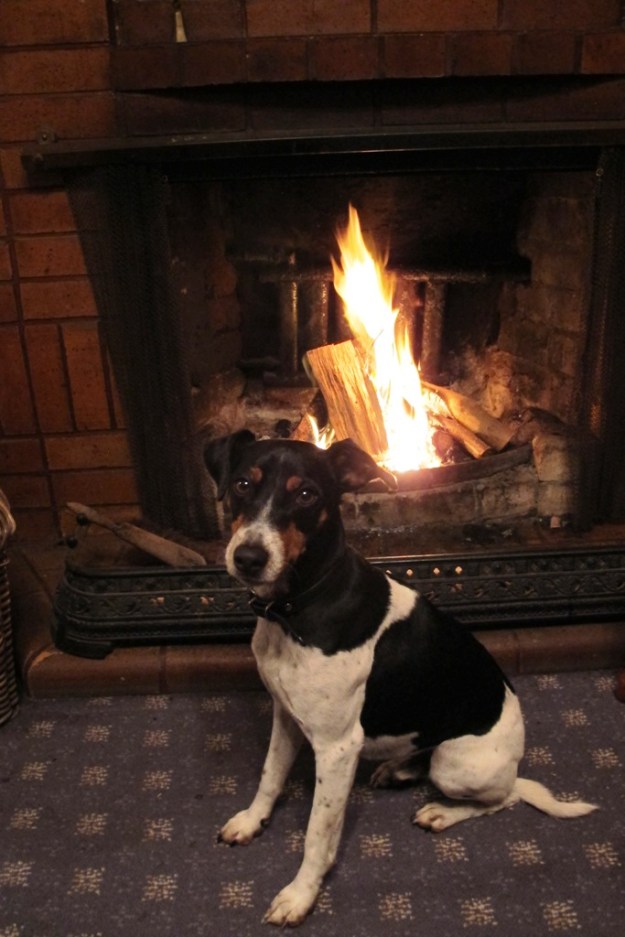
Dudley is a four year old fox terrier, surrendered by his previous owner to the SPCA for re-homing. He came to us in January – clearly a well-loved townie dog used to being fed tidbits any time his previous owner was eating, allowed on any furniture and accustomed to sleeping in his owner’s bed. He was a little timid at the space here and confused by the changes in rules. But now he has taken on the role of estate dog as though he were to the manner born. He is a whizz on rats, a keen possum dog, happy to assist with moving the four beefies that comprise Mark’s little cattle herd, patrols the boundary to ensure that Sam the neighbour’s dog does not make incursions and  he is more than happy to deal to the perceived surplus of avocados.


To the manner born

To the manner born

Plant Collector: Chamaedorea woodsoniana

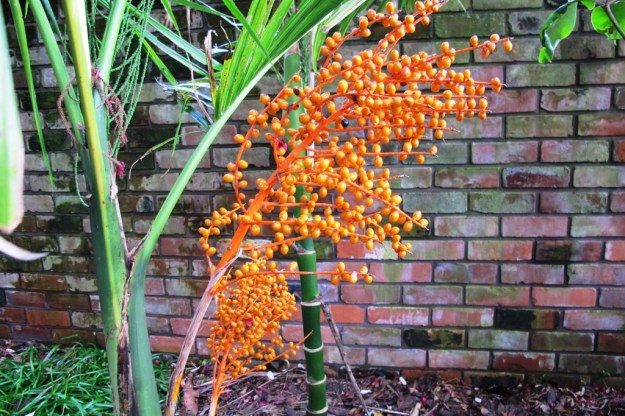
Attractive fruit but a worryingly large amount of it on the Chamaedorea woodsoniana

Attractive fruit but a worryingly large amount of it on the Chamaedorea woodsoniana

“Look at this,” said Mark putting the seed upon the table. “Off a small palm. It’s either the next invasive weed here or it has a future as a substitute in the palm oil industry.”

It took us a little while to track down the name. We knew it was a chamaedorea but there are quite a few different species so we had to go back to the original purchase to get the C. woodsoniana bit. Like most of the family, it hails from Mexico and Central America, growing in montane rainforest which is why we can grow it here. We can do the rain and the montane reference means it comes from areas with some altitude, making it a little bit hardier. However, given that its climate zone range is 10 to 11 (meaning that if the temperature plummets to around zero fahrenheit, it is not going to thrive – or even survive) and we have been moaning all week about the bitter chill of mid winter, we must be close to the limits of its tolerance. We have it planted on the margins of evergreen woodland so it will be protected from the worst of the cold. In its natural habitat, the palm encyclopaedia tells me it can reach 40 feet (about 12 metres) but we think that is extremely unlikely here. Ours is currently sitting around 2 metres and it is not growing like a rocket.

Mark tries to take the fruiting seeds off the bangalow palms here, to restrict their spread. He is now wondering if he is going to have to do it to this pretty chamaedorea too.

Chamaedorea woodsoniana growing in a protected position in our temperate climate

Chamaedorea woodsoniana growing in a protected position in our temperate climate

Garden Lore: “Touch the earth lightly”

“Touch the earth lightly, Use the earth gently
Nourish the life of the world in our care
Gift of great wonder, ours to surrender
Trust for the children tomorrow will bear.”

Verse 1 from the hymn “Touch the Earth Lightly” by Colin Gibson and Shirley Erena Murray (1991).
Photo0084 - Copy
Photo0072 - CopyReally it is the first line I like – “touch the earth lightly, use the earth gently” but I added the rest of the verse to give it context.

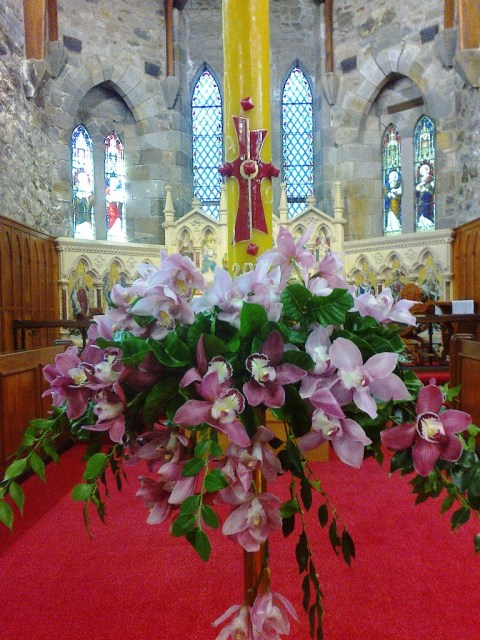
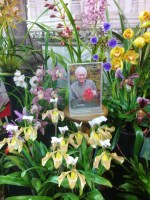
We went to a funeral this week which we do not often do, I admit. But in this case we both wanted to honour the late George Fuller. George was probably best known in this area as long standing curator of our main central city gardens, Pukekura Park, and as a defender of trees. In this role, he was more successful than we have been recently. His personal passion and his international reputation was in the field of orchids – hence the orchid display at his funeral.

To die at the age of 86, surrounded by a large, loving family and to leave behind a worthwhile legacy is to be celebrated. The selection of the hymn seemed particularly apt for such a gentle, humble man.

What a wonderful epitaph, or indeed a principle to live by – touch the earth lightly, use the earth gently.

Not quite lawn-free but leaning more to meadows

019 (3) - Copy
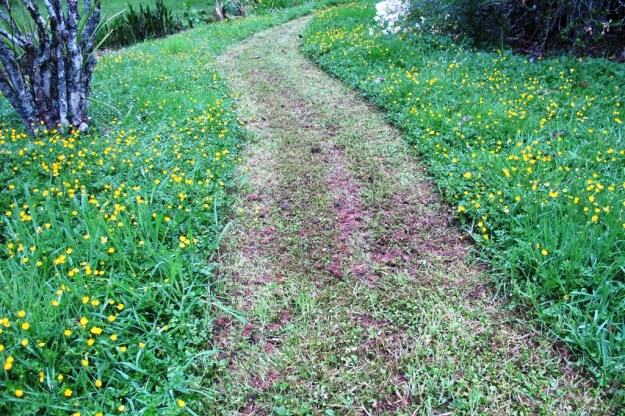
One of the advantages of having our garden closed to the public for a year or two, or maybe more, is the freedom to experiment. And experimenting we are with lawns – or mown green areas may be a more accurate description. We stopped mowing half our park at the end of last winter, choosing instead to keep to a mown track meandering through, so it is possible to walk without getting wet feet.

We have been talking about lawns and grass for years here. Lawns are arguably the most environmentally unfriendly gardening practice of all. Yet there is considerable value placed on the perfect lawn and some people take great pride in achieving this. Perfection is measured against the bowling green which has no connection whatever to the home garden, let alone to nature.

I have never forgotten taking Mark along when I was doing an interview for a commissioned garden story. The owners were very proud of their lush, green sward and claimed that garden visitors often said they wanted to take their shoes off and walk barefoot or roll on it. I saw Mark throw me a telling glance and later he expostulated: “You want to let your bare skin touch that?’ For we both knew that sort of lawn perfection is only achievable by regular spraying with a fair range of chemicals, as well as fertiliser application and the usual frequent mowing, scarifying and over sowing that is required to keep it in such an artificial state.

The perfect lawn is a triumph of man or woman over nature, a dominance achieved at considerable cost to the environment and no small financial cost. There are all sorts of concerns around the western world about run-off from domestic lawns and frankly, when your lawn clippings are too toxic to put into the compost without risking your tomatoes and other crops for the next six months, there is a problem. Some folk will even kill off the worms with a residual spray in the quest for lawn perfection.
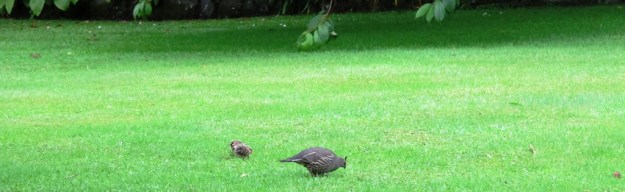
Mama Quail and two little feathered bumble bees of babies feeding on the lawn

Mama Quail and two little feathered bumble bees of babies feeding on the lawn

Mark is keen to have grass expanses with at least one flowering a year to feed the bees and other insect life. An added bonus has been unexpected. We made a decision a few years ago not to replace our cat, even though I adore fluffy felines. As a result, the Californian quail population has been steadily increasing and these lovely birds are a delight, foraging across the house lawns for seed. We might feel differently about a flowering lawn if we had small people in our lives running around bare footed, but in their absence, there is no need to worry about the bees.

We use a mulcher mower so the clippings are returned to the grass and this has eliminated any need to feed the lawn. Come early November, we let the grass grow long before cutting because then the dreaded Onehunga weed gets stretched and cut off before it can set its prickles. We do a certain amount of hand weeding to keep the flat weeds and undesirable grasses at bay in the house lawns. Beyond that, as long as it is fine or small leaved and cuts neatly, it is allowed to stay. Our lawns are more mixed colony environments than controlled grass species. We still mow regularly, but we are stretching out the intervals between mowing because we have become very aware of how dependent we now are on the motorised gardening aids and just how much fuel we have to buy to keep the mower, strimmer, chain saw and leaf blower running.

One of the delightful gardening books on my shelf is early Alan Titchmarsh, the Yorkshire gardener who is now a star TV presenter in the UK. Back in 1984, he wrote about The Lawn:
“Avant-gardeners do not have lawns; they have grass….The ‘bowling green’ lawn is a feature that belongs in front of council houses where it is surrounded by borders of lobelia, alyssum, French marigolds and salvias with standard fuchsias used as ‘dot plants’.

The avant-gardener’s grass is intermingled with daisies, plantains, buttercups… and plenty of moss (usually at least of 50% of the total coverage). This is a state of affairs to be encouraged. The grass is mown (avoiding a striped effect at all costs)…” (Avant-Gardening, a guide to one-upmanshop in the garden).
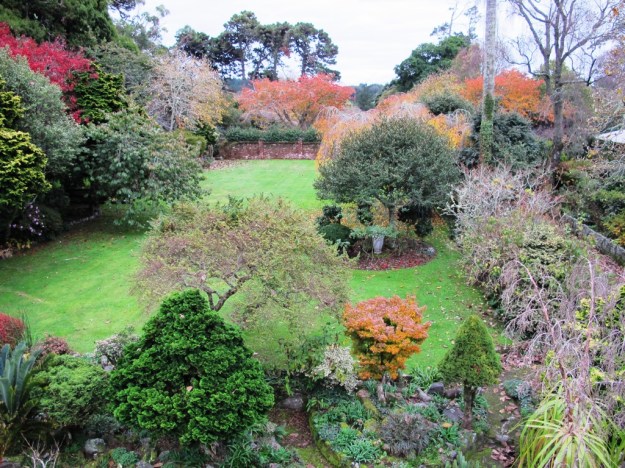
We have extensive areas of grass but have already decided that the front lawn should remain mown lawn rather than mixed meadow
We have extensive areas of grass but have already decided that the front lawn should remain mown lawn rather than mixed meadow

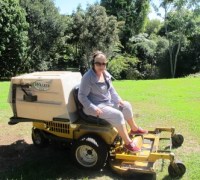
I admit we own the Rolls Royce of lawnmowers. It cost more than our car to buy

I admit we own the Rolls Royce of lawnmowers. It cost more than our car to buy

It does not appear that we have moved a long way since 1984 avant-garde thinking. If you are wondering what half our park looks like after six months without cutting the grass, I can report that the buttercup and self heal are thriving. To a critical eye it probably looks better in the shady areas than in the full sun but the mown strip is indeed like a path through a meadow and that is the effect we now want. We have worked out that we want the lawns immediately around the house more tightly maintained but, even in a large garden, we can achieve that without chemical intervention and top-up feeding. We see that as far more sustainable and environmentally friendly than the suburban value of an immaculate lawn.

First published in the June issue of the New Zealand Gardener and repinted here with their permission.