Tag Archives: Mark and Abbie Jury

New Year’s Gardening Resolutions for 2014

Plant food for the bees. Collectively, gardeners can make a difference

Plant food for the bees. Collectively, gardeners can make a difference

I failed on the Christmas-themed column. I am not big on poinsettias and I couldn’t think of anything new to say about Christmas trees. But New Year’s resolutions – these are different. If you are making garden resolutions, you may like to consider some of the following.

Lawns are a shocker when it comes to good environmental practice. There is nothing sustainable and healthy about most lawns but the vast majority of us have them for a variety of reasons. Don’t make the mistake of thinking that if you cut your lawn really short, it will mean you have to mow it less often. Not true. You stress the grass and open it up to weed invasions. Set the level on the lawnmower a little higher to keep a green sward. Good lawns invariably have longer grass.

Next time you buy a lawnmower, choose one that mulches the clippings. That way you don’t have to remove the clippings to get a tidy finish and if you are not removing the grass, then you don’t need to feed the lawn to keep it looking healthy. It reduces your inputs and therefore reduces both time and cost.
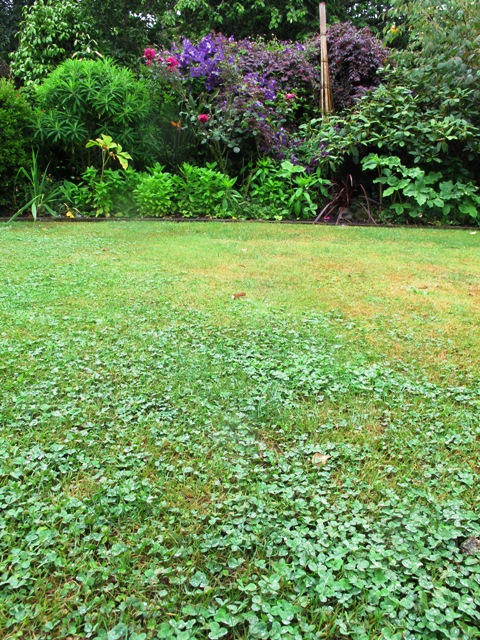
We are encouraging clover back into our lawns. It stays green, doesn't need mowing as often and feeds the bees

We are encouraging clover back into our lawns. It stays green, doesn’t need mowing as often and feeds the bees

Be cautious about lawn sprays and read the label information carefully. We are not fans of lawn sprays at all here. Year in and year out, we field enquiries about plant damage which is attributable to spray drift from lawn sprays. If you are using a spray which has a six month withholding period before it is safe to use on food crops (and that is common), you may want to think again about how environmentally sound is your gardening practice. Putting it through the compost process will not make the clippings safe for use. It might even be time to move on from the Chemical Ali generation. We are going back to encouraging the clover here. It used to be popular in days gone by and it has many merits.

Mulch. Mulch well, but only after the soil is wet through. If you lay mulch on top of dry soil, it stays drier longer. The rains this week may have been a reprieve for those who missed getting mulch laid in spring. If you lay the mulch on top of relatively weed-free soils, it will save you a lot of work later because it should suppress many of the germinating weed seeds that lurk in all our soils.

While on the subject of weeds, if they really worry you (and they do worry most of us even though, as the old saying goes, a weed is merely a plant in the wrong place), remember the old adage that one year’s seeding gives rise to seven year’s weeding. It is best to weed before the plant sets seed if you want to save yourself work down the track. If you weed with the push hoe, you need to remove seed heads that have formed already. You can leave the rest of the plant to wither in the sun but the seed heads will just continue to ripen and then germinate.
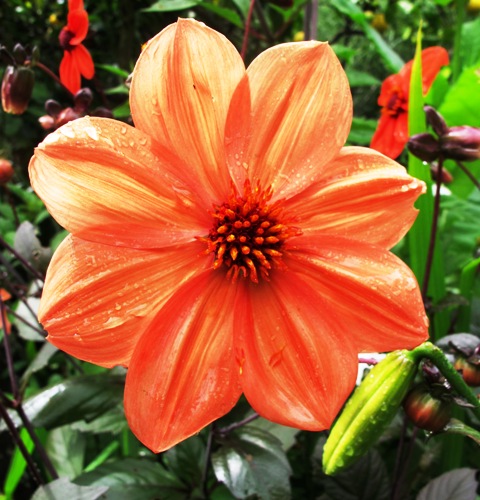
Single flowers with visible pollen and stamens feed the bees and indeed the butterflies

Single flowers with visible pollen and stamens feed the bees and indeed the butterflies

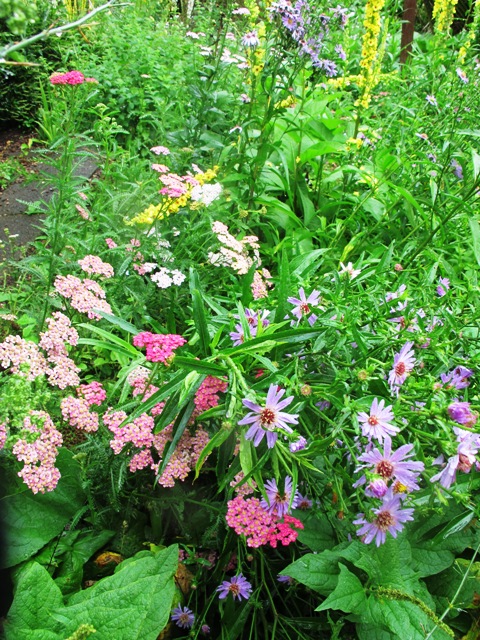
Grow plants with flowers for the bees. This means any flowers with visible stamens and pollen. We all know the bees are under deep stress, here in New Zealand as well as the rest of the world. We need the bees for pollination even more than honey. Every gardener’s contribution counts and collectively, we can make a difference to their food supplies. Fortunately, most of us have moved on from the austerity of the 1990s minimalist garden which contributed a big fat zero to the natural environment.

I am of the view that gardening should be two things above all else. It should be a pleasure. At its best, it can make your heart sing at the beauty. At a more mundane level, it can be quietly satisfying. If you get neither pleasure nor satisfaction from your garden, if it is all a great, big, tedious chore then review what you have and what you are doing.

If you really don’t enjoy gardening, then keep it very simple. It is much easier to maintain, especially if you can’t afford to pay someone to come and do it for you. If all you have to do is maintain edges, sweep paved areas, mow the lawns and do a seasonal round of tightly defined garden beds in order to keep it looking tidy, then it becomes more manageable for the reluctant gardener. Alternatively, move to an upper floor apartment.

Secondly, I think we should be gardening WITH nature, not in spite of it. Gardening shouldn’t be about imposing human will over nature, controlling and suppressing it, establishing dominance. Too much gardening practice is an imposition on the landscape, a battle with nature. Happy gardeners are often those who have managed to carve out a more constructive relationship with the natural world.

On which note, I wish readers a happy gardening year in 2014.

First published in the Waikato Times and reprinted here with their permission.
Garden Lore

“I wish the sky would rain down roses, as they rain down from the shaken bush. They would fall don light as feathers, smelling sweet, and it would be like sleeping and yet waking, all at once.”

George Eliot (1819 – 1880).

???????????????????????????????Staking trees
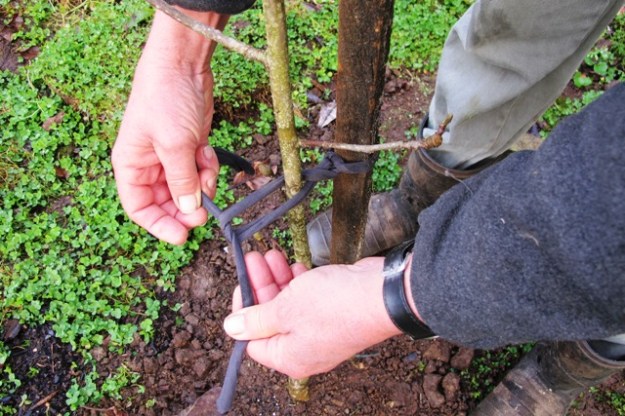
Staking trees and shrubs is often done so badly that it does more damage than good. If you have to stake a plant to keep it upright, don’t force the stake in as close to the trunk as you can get it. This sheers off all the roots in the wedge radiating out from that point. Even moving the stake out a few centimetres can make a big difference to the damage caused.
Keeping trees staked can do more harm than good. A bit of wind rock actually helps the plant to stabilise itself and to develop a tapered trunk as a result. Where you need to stake because it will fall over, keep the stakes low. They should not be more than a third of the existing height of the plant. If you still have a problem with stability, reduce the canopy bulk (called the “sail” area because this is what catches the wind). It is likely that you have a plant with too much top and not enough of a root system to sustain it.

Always use flexible ties of stockinette, old panty hose, strips of rubber from an old inner tube or similar. String and wire will cut into the trunk causing damage and potentially ringbarking it.

The bottom line remains: only stake if you really need to, not as a matter of course. It is actually better for the plant in the long term not to be staked.

First published in the Waikato Times and reprinted here with their permission.

Garden Lore

“Earthworms are used by research scientists looking to improve human medical conditions because their bodies have many similarities with our own: nervous system, blood vessels, haemoglobin, kidney-like organs prgans producing urine… But don’t get too worried about the weird relations you never knew you had because worms also have five hearts and both male and female reproduction organs, they breathe through their skins and when they want to eat they stick their throats out of their mouths to grab their food. It’s going to be a while before they start moving into houses and driving cars.”

Niall EdworthyThe Curious Gardener’s Almanac” (2006)
???????????????????????????????
Narcissus Fly

Photo credit: Sandy Rae, Wiki Commons

Photo credit: Sandy Rae, Wiki Commons

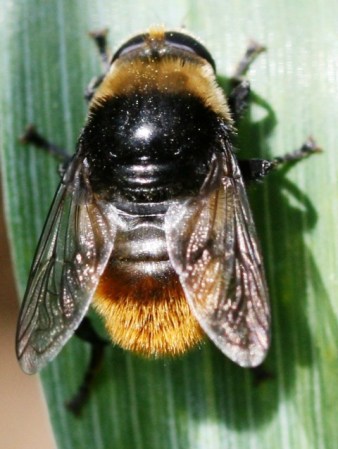
Narcissi flies are on the wing now and will be laying eggs in the withering crowns of certain bulbs. Narcissi (daffodils) are a prime target but they also attack hippeastrums, snowdrops, snowflakes, hyacinths and I have seen them attack Scadoxus katherinae. Bulbs which are close to the surface are particularly vulnerable. The fly (which looks like a cross between a very small bumblebee and a blowfly) lays its eggs on the spent foliage. When the egg hatches, the larva crawls down and burrows into the bulb, eating it from the inside out.

Mark stalks them in the rockery every fine day with his little hand sprayer of Decis (a synthetic pyrethroid,the same as is in fly spray) but if you are not inclined to spend the time on the hunt (there is an element of the thrill of the chase going on here), you can take other steps. Remove the dying foliage as soon as it starts turning brown -it has fulfilled its purpose of replenishing the bulb for next season – and lay additional mulch over the bulbs to get a greater depth. If your bulbs are in containers, remove them to a shady position immediately. These varmints prefer a sunny outlook, in our experience. Dig and divide clumps which have become so congested that they are pushing themselves out of the ground and replant them so that they are fully covered. Left unchecked, narcissi fly can multiply to the point where they can decimate a patch of bulbs to the point where you will get no flowers at all.

First published in the Waikato Times and reprinted here with their permission.

Why viburnums send a shiver down Mark’s spine

Viburnum plicatum 'Roseace' - pretty as a picture

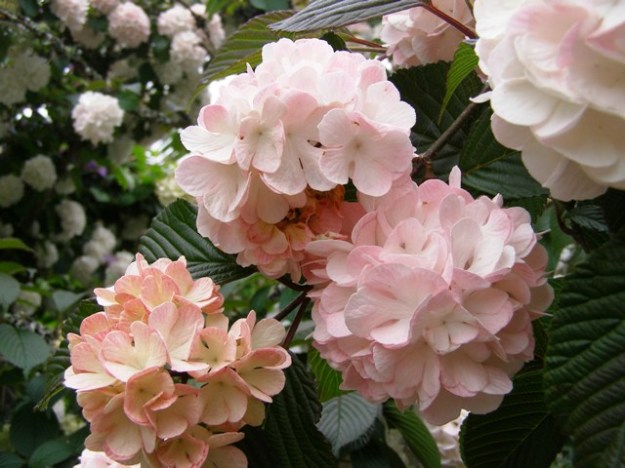
Viburnum plicatum ‘Roseace’ – pretty as a picture

In times gone by, we used to retail plants from here seven days a week for much of the year. My Mark was a reluctant retailer at best, though his plant and gardening knowledge is immense and he was perfectly capable of giving good advice if he liked the visitor. Alas, too often he would comment wryly: “That was one who put the cuss into customer”. He certainly never subscribed to the view that the customer is always right.

The mere mention of viburnums sends a shudder down his spine, even after a fair few years. A couple came in asking for Viburnum plicatum ‘Mariesii’ which they had seen growing in a prestigious garden. Mark checked that they understood this was a white lacecap variety and they assured him they knew what it was. Turned out they had no idea at all. Some time later, when the plant came in to flower and was not the common white snowball bush, the husband dug it up from the garden, put it in a supermarket bag and brought it back wanting a refund. He’d probably only paid $15 for a big plant of it. It was of course correct to its descriptive label (we take pride in such matters) and a fine specimen but it just wasn’t what he thought it would be. It is a bit like opening a packet of lollies, tasting one and then expecting to return the open packet many weeks later because you didn’t like the flavour.

I felt sure ‘Mariesii’ should be in flower for me to photograph – it is a beautiful big white lacecap flower on a large shrub with fresh green, pleated foliage and it tends to grow in layers like a cake. Mark and I agreed we must have it planted somewhere. We just can’t quite remember where. That is the problem of a big garden lacking records. It will have to wait in anonymity until we stumble over it again.

What started me thinking about viburnums were two plants which are looking particularly striking this week – ‘Roseace’ and one with the difficult name of V. sargentii ‘Onondago’. It took me a while to commit the second name to memory.

‘Roseace’ (sometimes ‘Rosacea’) is the pink form of the classic pompom viburnum, which is usually the form known as V. plicatum ‘Sterile’, or the Japanese snowball. It is a sport which was sold widely two decades ago and it forms a large, deciduous shrub to over 2 metres tall with an abundance of pretty, peachy-pink snowball flowers. That is at its best. Being a sport, it can revert to the more dominant white. We found this to our cost when we propagated a fair number from our main plant and then had to wait until they all flowered because only some of them came pink. Mark went through the original plant and pruned out all the white sections a few years ago but I see it is rather patchy pink and white again, though nevertheless very pretty and showy.

V. sargentii 'Onandago'

V. sargentii ‘Onondago’

‘Onondago’ is different, being narrow and upright. Its fresh spring foliage comes out deep maroon and lacecap flowers (like flat hydrangea blooms) have the tiny fertile flowers in deep red in the centre, surrounded by a ring of larger white sterile flowers. It is a selection out of the US National Arboretum in Washington and, being a seedling not a sport, it is very stable.

Viburnums come from a large family with over 150 different species identified. Most are from the temperate areas of the northern hemisphere so are generally hardy and are of the shrub/large shrub/small tree type. There are evergreen, semi evergreen and fully deciduous species. I am pretty sure it was the evergreen V. tinus I saw grown quite widely throughout Hamilton making a small tree that flowers in spring.

Balls of delicious fragrance from one of V. carlesii hybrids

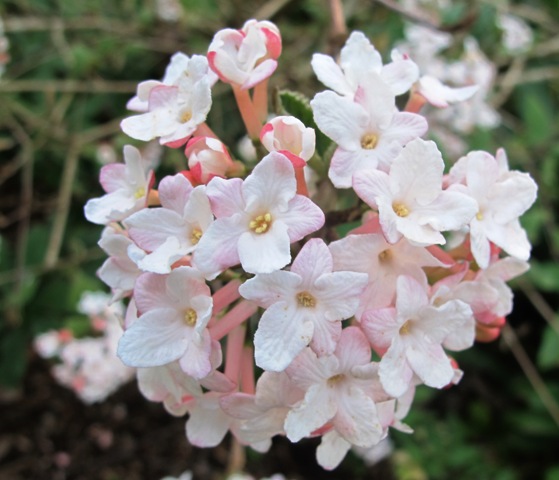
Balls of delicious fragrance from one of V. carlesii hybrids

Earlier in the season, we had the somewhat short-lived delight of the waxy, fragrant balls of a couple of different ones. I am pretty sure they were ‘Anne Russell’ and x carlcephalum – both are hybrids from the Korean species of V. carlesii. We have them planted beside the driveway and the scent is easily as strong as a good daphne with more spectacular flowers, though their season is much shorter.

Most viburnums are very easy to grow, being not at all fussy about soils and conditions. They are a bit of an unsung hero, really, making good backbone plants which star when in flower and behave themselves for the rest of the year. Some of the deciduous varieties also give good autumn colour in inland or colder climates.

Just try and find out what you are buying before you plant it and don’t expect to dig it up and return it bare rooted because you made a mistake. Mark might have been more understanding over the ‘Mariesii’ had the customers been a little less know-it-all at the time of purchase. Instead he was intensely irritated, scarred now by the memory.

First published in the Waikato Times and reprinted here with their permission.

Plant Collector: Trillium sessile

Trilliums! Not common in gardens in our area. T.sessile

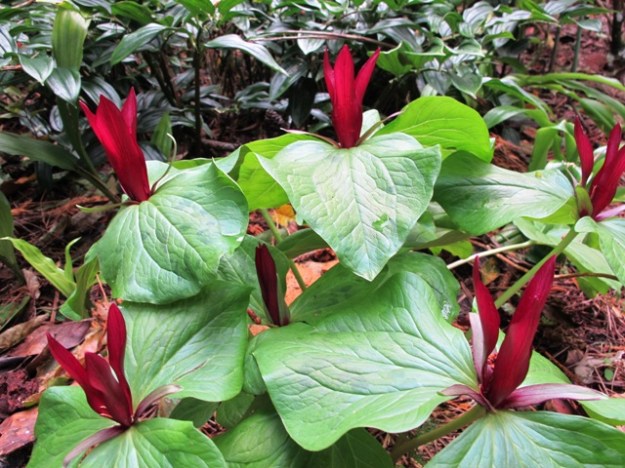
Trilliums! Not common in gardens in our area. T.sessile

In the world of status plants for the garden, trilliums are right up close to the top. I am not entirely sure why. They certainly have a quiet charm and are a delightful addition to the spring woodland garden. They are not at all easy for most people to grow and are hard to source, but even that combination of factors does not explain the reverent awe accorded to their presence in a garden.

There are a relatively large number of trillium species (somewhere over 40) and most are native to North America, with just a few from Asia. They are deciduous perennials forming rhizomes below ground. The foliage dies down each autumn, to re-emerge the following spring (one hopes – it is not guaranteed) with fresh leaves and flowers – hence their common name of ‘wakerobin’. At times they are also referred to as ‘tri flower’ on account of their wonderful symmetry of threesomeness. Three heart shaped leaves hold three narrow sepals in the centre which surrounds the three petalled flower which has six stamens. How perfect is that? The dark red trilliums (usually T. sessile or descended from that species) are usually the most highly prized as garden plants, although different species introduce white, pink and yellow to the range.

Being woodland plants, trilliums want ground rich in humus and leaf litter which never dries out. They tend to do better in inland areas with colder winters where the clumps can get more size to them than we see in our coastal conditions. They can be raised successfully from fresh seed if you find a friend with a plant.

First published in the Waikato Times and reprinted here with their permission.