Tag Archives: Mark and Abbie Jury

Grow it yourself: pumpkins

It is pumpkin harvest time, not planting time. Alas the first buttercup pumpkin here (they are the smaller, green coated ones) was a terrible disappointment – watery and lacking flavour. Mongrel seed, even though it came from a major seed company. They are not the buttercups they were meant to be. There is a surprisingly large range of different pumpkin seed you can buy, but the pumpkin grower here plans to keep to the proven heritage varieties next year – grey ironbark for keeping and classic buttercup for eating fresh.

Pumpkins take up a huge amount of room for 3 to 4 months yet are very cheap to buy, so if you only have a small garden, you can probably grow higher value crops. Timing for planting is important. They usually go in as small plants when the soil is warming up but no later than December. You can accelerate early growth by planting them in a bed of warm compost. In good conditions, they then rocket away. Keep the water up to them as the fruit develops because these are thirsty plants. The young shoots of pumpkins, chokos and the like are a taste treat for quick cooking.

Pests and diseases include white fly and mildew but these come late in the season, after the fruit has formed. They should not have much effect on the yield and are rarely treated.

We grew Austrian Oil Seed pumpkins last year because they produce hull-less seed. They took up the usual large amount of space for a small seed yield and the pumpkin flesh was only stock food. We are back to buying pumpkin seed this year.

First published in the Waikato Times and reprinted here with their permission.

Tikorangi Notes: Friday 27 April, 2011

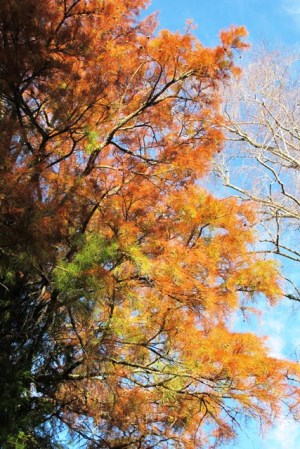
The Taxodium ascendans nutans has turned orange on one side only

The Taxodium ascendans nutans has turned orange on one side only

Latest posts:

1) Our garden diary for the fortnight (as published in the Weekend Gardener) and mostly on autumn flowers.

2) Slightly nervously, I offer up a carefully crafted opinion on the current state of garden assessments with reference to the New Zealand Gardens Trust.

3) The most lovely schefflera I know in Plant Collector this week – Schefflera septulosa. Not that I pretend for one moment to be an expert on scheffleras, but it is a beauty.

4) Feijoas feature this week in Grow It Yourself.

5) Revisiting Outdoor Classroom (in conjunction with the Weekend Gardener) – how to deal with large clumping plants. We tackled a massive Curculigo recurvata but we might equally have tackled an astelia or a flax.

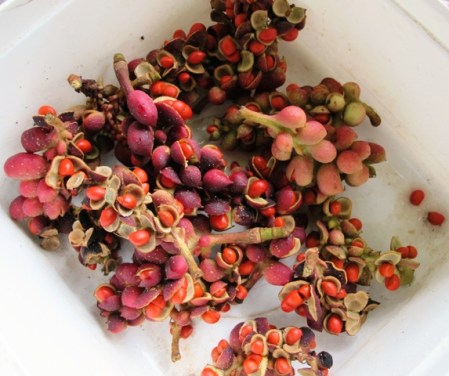
It is time to gather magnolia seed. I mentioned in an earlier Tikorangi Diary that we have been asked several times about odd growths appearing on magnolias. Each time it has been seed pods – photographed below for reference, now that they are ripe. These pods will open in due course and produce the red seeds, looking like the michelia seeds in the lower photograph. The soft red casing is then rotted off to reveal a black seed.

Michelias these days are more correctly known as magnolias – a reclassication based on scientific analysis. We persist in referring to them as michelias for clarity, while acknowledging that we are probably incorrect botanically.

Magnolia seed pods

Magnolia seed pods

Michelia seed

Michelia seed

Garden assessment and the NZGT

Mark, nose pressed to the window (or door, in this case). On the outside looking in.

Mark, nose pressed to the window (or door, in this case). On the outside looking in.

Hamilton is playing host to some good gardeners this weekend. It is the New Zealand Gardens Trust (NZGT) having its annual conference in the city. This is the parent organisation of many, but not all, open gardens in this country. We are not attending. We were enthusiastic founder members. Indeed, we even contributed $2000 to get the thing up and running. There is nothing like resigning on principle and being totally ignored to remind one not to get ideas above one’s station.

The purpose of the trust is to vet gardens, rank them and give garden visitors an accurate idea of what to expect. Along the way, it aims to provide a pleasant membership club of collegial conviviality for the garden openers and this is really the only aspect we miss.

There aren’t many circumstances where garden assessment is required. There is the occasional local competition which invariably gives lie to the idea that gardening is a non competitive activity – for some at least. There are plenty of people who would like to claim the biggest pumpkin, tallest sunflower, prettiest road frontage, or the best vegetable or flower garden. Winning can be wonderfully affirming.

Some of the garden festivals around the country insist on vetting gardens before accepting them. In this case, assessment is only setting the base line for inclusion. It can be alarmingly controversial but anybody with experience knows just how necessary the process is. Too many gardeners wear rose tinted glasses where their own patch of dirt is concerned.

Show gardens such as seen at the Ellerslie Flower Show are judged and there are some excellent international precedents for how these are assessed, emanating particularly from Britain’s Royal Horticultural Society. Interestingly, the RHS is taking a close look at its assessment processes right now.

And there is our national scheme for ranking gardens, administered by the aforementioned NZGT. Of course you can still open your garden independently, as we do these days, but from the point of view of the garden visitor, some credible outside endorsement and ranking can be helpful. Originally, this open garden scheme had three categories with the top tier being grandly named: Gardens of National Significance. We were really honoured to be named one of only six private gardens to carry this elevated status in the first year. That meant something. These days, with a huge number of gardens in the top categories, it doesn’t seem anywhere near as prestigious. Do we really have over sixty two top tier gardens, of national significance and a few even described with great puffery as being of INTERnational significance, in this country?

Equally, it seems really odd that the next tier of gardens down numbers a mere thirty six. One might expect a pyramid shape – fewer top gardens and a whole lot more in the next layer who would like to move up. Either the organisation is singularly bad at retaining membership below the top tiers, or it gives out its rankings way too cheaply.

The problem, I would suggest, is likely to stem from too heavy a dependence on a points based system. By that, I mean allocating so many points for the state of your lawns, your paved surfaces, how neatly your hedges are clipped, how you support and tie up plants, plant combinations, plant health and so on. It matters not a whit if you are scoring out of 10, 100 or 300.

In practice, slavish adherence to a points based system can mean a damned ordinary or downright awful garden lacking in any charm or originality can get through as long as it scores highly in sufficient categories. The sum of the parts is sometimes greater than the whole. We saw it happen a few years ago when someone with a good level of knowledge trotted around a number of local gardens, clipboard and marking schedule in hand. “When I got to the end,” he told us, “and added up the points, I was astonished at who came out with the highest score.” As indeed we were, too.

A marking schedule is just one tool, not an end in itself. Neither is it a shield to hide behind, to justify decisions. It needs to be used in conjunction with clear definitions, agreed frameworks, some bigger picture thinking about downstream outcomes, maybe a mediated process and preferably in the hands of a convenor. Done well, assessment can even be an empowering experience for the candidate.

I have no idea whether NZGT is now employing a wider range of strategies in assessment. They certainly didn’t in the past. From my current position out in the cold with my nose pressed up against the window pane, the current outcomes are not suggesting that there has been significant change.

Notwithstanding those reservations, one hopes that the keen and dedicated gardeners visiting Hamilton this weekend will encounter fine weather, wine and gardens to be enjoyed in convivial company.

Before becoming a garden writer, Abbie Jury spent 18 years working in education, across all sectors before specialising in adult learning. She was appointed to an advisory committee to the Minister of Education, to a standing committee of NZQA and was awarded a Commonwealth Relations Trust bursary to study alternative forms of assessment of adults in the UK.

First published in the Waikato Times and reprinted here with their permission.

Three years ago, I published the reasons for our resignation from the New Zealand Gardens Trust. Despite being widely read then and in the intervening years, those comments appear to have fallen into an abyss.

Eight years ago, I wrote in strong support of the NZGT. That does seem rather a long time ago now.

Plant Collector: Schefflera septulosa

Schefflera septulosa - frost tender and rather large

Schefflera septulosa – frost tender and rather large

Back in the 1950s, my late father in law, Felix Jury, went on a plant hunting trip in the highlands of New Guinea. In those days, one could still bring new plants into this country and one of those he brought back was this very graceful schefflera which was identified as S. septulosa. After sixty years, it seems that it is still very rare in cultivation.

Schefflera septulosa from New Guinea highlands

Schefflera septulosa from New Guinea highlands

Scheffleras are a huge family belonging to the Araliaceae group (which includes ivy). Most come from tropical and subtropical parts of Asia. Some are widely grown as house plants, while some are relatively hardy to cooler temperatures. S. septulosa is neither. The original plant here is about 5 metres tall and even young plants get large relatively quickly. The surest way to knock it back and to burn off the foliage is to let frost get at it. We grow it on the woodland margins where the canopy from higher trees shelters it. But no other schefflera I have seen is as handsome. It shoots from the base so is more shrubby than tree-like in form and the leaves are large, held in a palm shape and heavily textured, matt dark green. With its brown velvety stems, it is a striking plant.

Scheffleras flower, but I have to be honest and say they are so insignificant on S. septuolosa that I have never noticed them. Mark tells me the bees are the best indicator that there are flowers because they flock in. Generally, they are regarded as foliage plants. The chances of finding S. septulosa for sale are not good, but occasionally you may find the splendid, large leafed “Condor” on offer. It is an unidentified species from Uruguay, so some distance away from New Guinea. It was introduced by Aucklander, Dick Endt of Landsendt. Both make handsome garden additions in warm areas protected from frost.

First published in the Waikato Times and reproduced here with their permission.

Tikorangi Notes: Friday 20 April, 2012

The perfection of the fantail nest

The perfection of the fantail nest

Latest Posts:
1) Lagerfeld Rules – what the fashion maestro might say, should he ever turn his attention to gardening.
2) Despite the tendency in New Zealand to think that there is only one sasanqua camellia and that is the white Setsugekka, there are others and even some which are not white at all. Crimson King in Plant Collector this week.
3) Grow it Yourself – kumara this week. You have to get your timing right where we live because it needs maximum warmth over a relatively long period to get a good crop but it can be done.

And a second fantail nest, crafted in the fork of a magnolia stem

And a second fantail nest, crafted in the fork of a magnolia stem