Tag Archives: Mark and Abbie Jury

Grow it yourself: kumara

The world has many different types of sweet potato but the one we have made our own in New Zealand is the kumara. Had we grown them this year, we would be looking to harvest around now. But we didn’t so we will be buying them instead. Kumara are a warm climate crop so the further south and the further inland you are, the more problematic they are to get through. They need somewhere between five and six months of warm weather (preferably in the low 20s) to set plenty of tubers. You can help by planting in black plastic and using cloches early in the season. They are easier to grow well if you are right on the coast and gardening in sandy soils which heat up. However they don’t want to bake and dry out in midsummer.

Kumara will sprout like potatoes over winter so you can cover the tuber with soil or straw in early spring. That tuber will put out many shoots which can be pulled off and planted out when big enough and when roots have started to form. They don’t like any frost at all, so in inland or cooler areas, they can be started in pots for planting out in mid November. Plant them about 40cm apart in the hottest and sunniest spot in your garden and watch them r-u-n. It is easier to understand when you know they are close relatives of convolvulus. Besides keeping a little water up to them all summer, the other care they need is to have their wayward vines lifted every week or so, or trained over a wall or path. If you don’t do this, the vines start to send roots down along their length and a plant which is using its energy to create a whole lot of new roots is not developing good tubers. Harvest when the foliage turns yellow and store in dry conditions about room temperature.

First published in the Waikato Times and reprinted here with their permission.

Grow it Yourself: Broad Beans

People either love or hate broad beans but they are worth trying in the home vegetable garden where you can harvest them before they develop the tough grey outer skin which is so off-putting. Indeed, I have a friend who will only harvest them to eat when she can cook the complete young pod. We find them tasty at all stages and once the hard shell has developed, we let them mature and store them dry. The dried beans are delicious when reconstituted though I admit I peel off the outer casing of each bean after soaking them. Broad beans are often called fava beans overseas and in upmarket eateries where they have enjoyed a recent revival as a fashion ingredient.

Broad beans are one of the few crops which continue to grow through winter. Autumn planting means you will be harvesting in spring when there are not a lot of other fresh vegetables which are ready. Plant the beans directly into the ground at finished spacing. We favour a double row about 30cm apart and the plants in each row at least 15cm apart but not more than 20cm. The plants need some support as they grow, or they will fall over under their own weight. The quickest way we know is to support them either side with a long piece of horizontal bamboo suspended at about 60cm off the ground and supported at both ends of the row. You could achieve the same support by running a wire along but bamboo is good because you can easily incorporate cross pieces for added support. It saves having to stake individual plants. Once the plants have reached about a metre in height, we nip out the tops to eat as fresh greens.

If you sow in succession from autumn through to late winter, you can be harvesting from August to Christmas.

First published in the Waikato Times and reprinted here with their permission.

Tikorangi Notes: Thursday 5 April, 2012

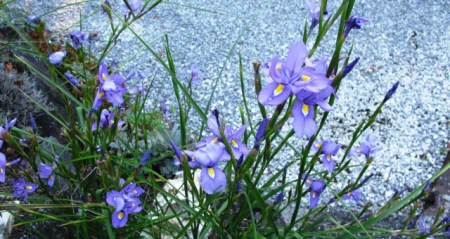
The lovely autumn peacock iris, Moraea polystachya, blooms for an exceptionally long time

The lovely autumn peacock iris, Moraea polystachya, blooms for an exceptionally long time

Latest Posts: Thursday April 5, 2012

1) The pros and cons of the decorative, formal vegetable garden – the potager which seems to have become inordinately fashionable. Personally, we lean more to the meadow style of vegetable gardening.

2) The Ornamental Edible Garden by Diana Anthony and Gil Hanly reviewed. And well done to publisher Batemans, for continuing with some practices we used to take for granted in reference books but which others have done away with in the trend to over simplify for novice gardeners who get treated like children.

3) Brugmansia Noel’s Blush – huge trumpets in peachy pink.

4) Grow it yourself – asparagus. A crop for the long haul, this one, but ranks as my all time number one favourite vegetable.

Tarting up the veggie patch

Setting the standard, really. The ultimate potager in the parterres of Villandry (Wiki Commons photo)

Setting the standard, really. The ultimate potager in the parterres of Villandry (Wiki Commons photo)

The arrival of a book on ornamental edible gardening set us thinking and talking about tarting up the veggie patch (in the vernacular), or the role of the potager (for those who aspire to a touch more class).

Keen vegetable gardeners may throw their hands up in horror. For some, there is beauty in a well presented vegetable garden with good straight rows, obedient plants in healthy condition and a succession of crops. There are sound reasons for planting vegetables in rows, including ongoing maintenance with a push hoe which is not only effective for weed control but also keeps the surface well tilled. I doubt that any other method of vegetable gardening can rival the traditional techniques for productivity. It takes ongoing work to keep it all in tiptop condition but that is to be expected. Why, some veggie gardeners may wonder, would you want to turn it into an even higher maintenance, yet lower productivity style of gardening by imposing ornamental values on what is essentially an unpretentious, utilitarian activity?

The ornamental edible garden, or potager, is almost de rigeuer today. Here is the marriage of food production with traditional garden design and practice, right? Well, yes and no. If you look at the history, it is another gardening style that has its origins with the rich and powerful of Europe, now democratised. Another example of prole drift, one could say a little unkindly. The stylised and designated herb garden, often laid out on formal principles dates back to times when herbs were more about medicine than cooking. As such, the range of plants grown was considerably more extensive and these gardens belonged in monasteries or designated apothecary gardens attached to institutions.

A word about parterres and potagers. The parterre is a highly stylised form of gardening, laid out on lines of rigid symmetry, much favoured in the sixteenth and seventeenth centuries. One of the grandest was created at Versailles for Louis XIV. The famous parterres of Villandry, also in France, are modern, dating back to the early 1900s. I liken the parterre to tapestry gardening. It is about building pleasing designs with plant blocks, originally planned for viewing by the lord from upper story windows. It doesn’t have a whole lot to do with the harvest, even when vegetables are included.

Potager is another French word, now widely applied to ornamental edible gardens. It is on a more domestic scale but its origins were also socially elevated. The peasants of yore would not have been growing in such a managed and decorative manner and the middle classes had yet to appear. So it was the upper echelons of society who could afford to indulge in creating formal gardens to grow edible crops in an ornamental style.

Rosemary Verey popularised the potager on a domestic scale (Photo:  Brian Robert Marshall)

Rosemary Verey popularised the potager on a domestic scale (Photo: Brian Robert Marshall)

The late English gardener, Rosemary Verey, is credited with popularising the potager in the last twenty years and in her hands it became a marriage of formal garden design, herbaceous traditions and food production. However, she seemed to refer to it, in the main, as simply a vegetable garden. The English show mastery of understatement. There is a pleasing symmetry in a well cared for ornamental edible garden and the formality means such gardens photograph well. It is a particularly feminine style.

It is just not a style to which we aspire personally. It is not quite one thing or the other. The principal criterion for plant inclusion is that it be edible or possibly medicinal, not that one will actually harvest it. Frankly, how many bay leaves will you ever use? One bay tree has its place, a row of topiary laurus nobilis is technically fitting the edible criterion but is primarily ornamental. And if one is going to grow ornamentals, I’d rather have topiary michelias, camellias or something more interesting than boring bay trees.

If you are gardening for looks, then the whole block of highly decorative red cabbages is going to mature at the same time so, unless you are into pickled cabbage big time, most will end up on the compost heap. Besides, you spoil the effect if you harvest one at a time, as required.

And then there are those tidy buxus hedges defining garden beds. Leaving aside the ravages of buxus blight and the fact that these tidy hedges harbour snails, buxus has an invasive root system. It sucks the goodness out of the soil and as the roots reach further afield, it becomes problematic to get crops of lush, healthy vegetables in the middle.

Often lavender is used as an edging plant but any of those big, floppy types of edgers are a problem if you have narrow paths (brick is the favoured option) and a high rainfall climate. I prefer to pop out to the garden to pick a lemon or a lettuce without getting wet lower legs.

More meadow garden than potager here

More meadow garden than potager here

We are pragmatic here. We would rather have good crops of vegetables, easily planted, tended and able to be harvested as required, with more permanent plantings of ornamentals elsewhere. That said, our vegetable gardens are by no means limited to vegetables. By this time in late summer, they are more akin to meadow gardens. Mark is fond of growing annuals for butterfly food but zinnias, marigolds and the like do not sit comfortably in our more restrained ornamental gardens so they get bedded in and allowed to seed amongst the vegetables. For us, the meadow has more romance than the potager. Besides, in this day and age when two raised beds out of tantalised timber and a citrus tree in a pot are claimed to be a potager, we would rather tread a different path.

First published in the Waikato Times and reprinted here with their permission.

Brugmansia Noel’s Blush

Brugmansia Noel's Blush

Brugmansia Noel's Blush

The late summer sight of this brugmansia in full bloom is striking and the trumpets are a pretty peachy pink in colour. Each bloom can measure 25cm long and up to 20cm across which is on the large side. I was reading a description which said strongly scented which I can’t say I have noticed so I rushed out to sniff. No scent in the morning, I am afraid. It appears they are night scented which is an indication that pollination is carried out by night flying insects, usually moths. The plant itself is a big rangy thing of no beauty – you have to work at keeping it more compact and bushy if you want a tidy plant. Otherwise it is just an overgrown solanum which wows when in flower.

This particular one was named for the late Auckland gardener and plantswoman, Noel Scotting and it came into the country about twenty years ago. Brugmansias are all South American and there seems to be quite a bit of shuffling of species, even though there are not many different species to shuffle. I lean towards the likelihood of this being B. suaveolens from south east Brazil. Or it may be a hybrid. All brugmansias are frost tender.

Brugmansias used to be called daturas, to which they are closely related. They are also very toxic. South American tribes have long used them in traditional medicine for purposes as varied as treating dermatitis, arthritis, prophecy, a ritual hallucinogen and, most scary of all, apparently to discipline naughty children by opening them up to the voices of their spirit ancestors. It sounds like scaring them witless to me. All parts of the plants are toxic and fortunately synthetic illegal drugs have replaced their occasional recreational use which was all too often fatal.

The double white brugmansia featured earlier in this series.

First published in the Waikato Times and reprinted here with their permission.