We tend to take it for granted that our gardens are green and lush all year round
As the days get shorter and the nights get colder, it is easy to lose sight of quite how benign our climate really is. There is a tendency to take our bright, clear light for granted and the fact that we can sit outside for morning coffee all year round on sunny days comes as a surprise to those from harsher climates. Of course it means we have to keep mowing the lawns, though the interval between cuts will stretch.
True, down the southern half of the South Island, it is cold enough to stop growth (and therefore stop mowing lawns in winter) but at least they keep the bright light which is a hallmark of both this country and Australia. I recall visiting London one December. Quite aside from the fact that darkness fell soon after 3.00pm, when the sun did struggle above the horizon, it was a poor watery thing. On that visit, we headed out to Leeds Castle which has a notable garden designed by famous English gardener, Russell Page. It had been put to bed for winter. Literally. There was only the formal structure to see. Beds were smothered in straw to protect the plants below. Some plants were wrapped up in their own padded sleeping bags – layers of straw, sacking and insulating material and that was just for echiums which are clearly prized a great deal more there than here. It is altogether a different way of gardening.
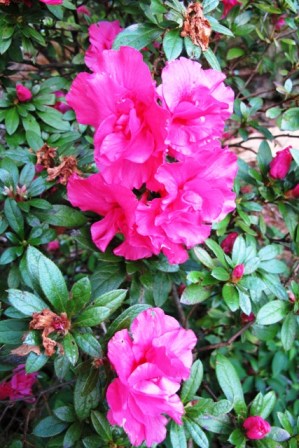
Autumn cheer in the earliest azalea flowers
Here we may moan about miserable winter days, whinge about winter wind and stress over storms (enough alliteration!), but the bottom line is that we are green and verdant with flowers all year round. For most of us, temperatures are high enough to be out in the garden in fine weather, even in June and July. Autumn is recommended as the very best planting time for trees and shrubs because it gives plants a chance to settle in over winter and start getting their roots out before the spring flush. Similarly, many perennials can be dug and divided throughout winter. In cold climates, this is a spring and summer activity only because the plants can rot out when dormant in their cold conditions. The timing of pruning is a great deal more critical in colder climates. This applies to deciduous plants like roses, hydrangeas, wisterias, as well as evergreens such as hedges. Pruning can force plants into growth and, when carried out too early, the tender new growth gets burned off by frost and cold.
In cold climates where you only get to view your garden through the window in winter, design, shape and form become all because that is all you see. Most cold climate gardens have a large quantity of deciduous plants, punctuated by a few hardy evergreens such as buxus, conifers, or laurels. Even if the design is good and strong, it can be a bit bleak.
But unless you live in a really cold winter location by our standards (National Park, Ohakune or the like), it is reasonable to expect to look around your garden and see flowers and fresh foliage for twelve months of the year. Sure you may get frosts. Anywhere more than five kilometres from the coast can expect frosts, even in Northland. But we can still grow winter flowering plants.

The gordonias are opening. This is an unidentified Vietnamese species
The sasanqua camellias are opening now and will take us into winter when the early flowering japonicas open. Early season evergreen azaleas are flowering. I see flowers on the gordonias. These look like big, white camellias on steroids but they are only very distant relatives. The first of the luculias is in flower and we always have sub tropical vireya rhododendrons blooming, no matter what the season. These last two plant types are more problematic if you have hard frosts, but in favoured positions or closer to the coast, they are a delight. In the depths of winter, the Magnolia campbellii, michelias and rhododendrons will be opening. None of these flowering trees and shrubs are particularly viable in cold climates. Even the utility camellia can be hard to grow in colder parts of Britain.
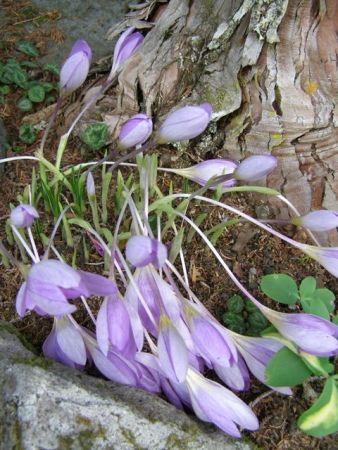
There are plenty of autumn bulbs still in flower. Hot on their heels are the winter bulbs, already rocketing through the ground and some showing the first flowers. The earliest narcissi are opening. Most of the dwarf and miniature types flower much earlier than the classic daffodils. In so doing, we find they are less susceptible to narcissi fly which lays its eggs in the crowns of bulbs later in the springtime. Narcissus bulbocodium citrinus “Pandora”, the pale lemon hooped petticoat type, has its first flowers out. The peak display of our dwarf collection is in the depths of winter. The earliest of the lachenalias will be opening soon. The first to flower here is the easy to grow red L. bulbifera which has naturalised happily around tree trunks.
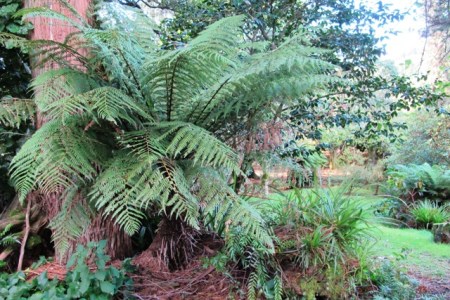
In some places, our common NZ pongas are so highly prized, they are lifted from the garden and moved under cover for winter. True. I have seen it done in the north of Italy. It really does seem churlish to complain about colder seasons here.
First published in the Waikato Times and reprinted here with their permission.
-39.042098
174.300314


 3) Strong gloves are recommended, along with sharp secateurs.
 4) This season’s new canes which will bear fruit next summer are red. The old canes, which are dying off, are brown and dry. Remove all old canes from the base of the plant. Thin out any weak new canes.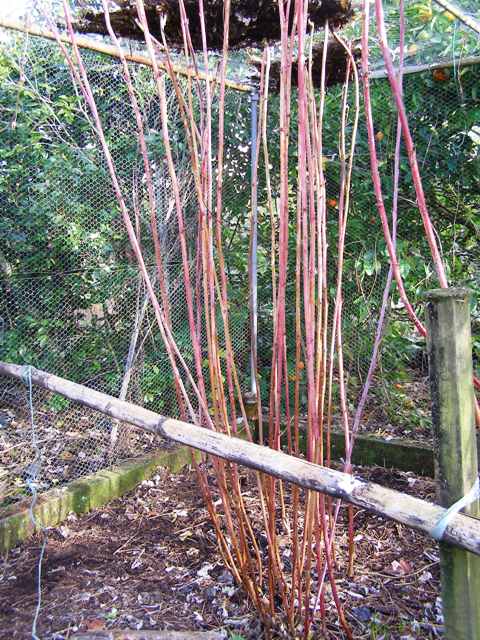
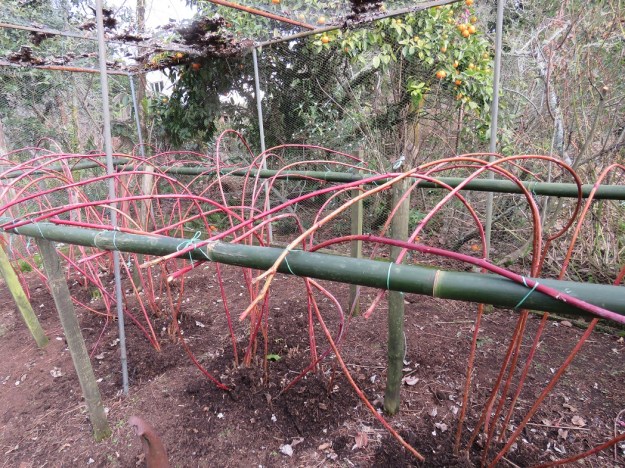 6) Alternatively, hoop the canes over and tie them to a frame as shown here. This is now my preferred approach. While it takes a little more time, it keeps the rampant canes under better control, increases the fruit set down the stem and makes picking very much easier. I then feed each clump with a generous helping of compost.
 6) The prunings need to be burned or disposed of. We clip them to manageable lengths and gather them in a wool bale for convenience. You can’t compost prickly old stems. Town dwellers may like to dry them and then burn them on a woodfire or put them out with the rubbish. Ours will go on the burning heap.