Tag Archives: Mark and Abbie Jury

Plant Collector: Crinum moorei variegated

Fragrant Crinum moorei var.

Fragrant Crinum moorei var.

Crinums are a large family, belonging to the amaryllidaceae group so having some botanical connection to the likes of belladonnas and nerines. But despite there being over 130 different crinum species, not a lot make good garden subjects in this country. Sometimes you will see different crinums being grown in the tropics but the common form in this country is C. moorei which is a South African plant. It has big strappy green leaves, largely evergreen so it can get a bit scruffy, and big, strong spikes of scented flowers in shades of pink. It is a very easy plant, tolerant of woodland shade and near total neglect.

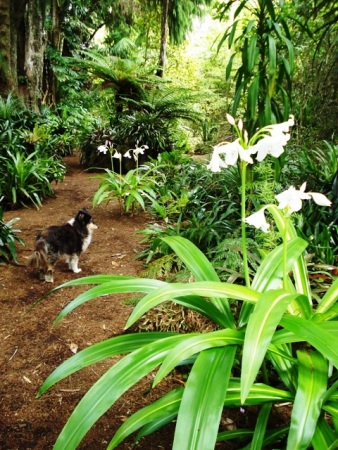
Tall, white punctuation marks in summer along a woodland walk - Crinum moorei var

Tall, white punctuation marks in summer along a woodland walk - Crinum moorei var

This is a variegated form and rather more desirable. It is deciduous which solves the scruffy problems. When the fresh growth comes in mid spring, it lights up a dark area with its bold pale gold and green striping. By mid summer, the variegation has toned down considerably to green which gives a splendid foil for the lovely tall spires of predominantly white scented blooms. These are around 150cm high but so strong, they don’t need staking. They are a wonderful late summer accent plant for shade gardens. The bulbs can reach extremely large proportions and are relatively slow to increase. As with a number of the amaryllis family, the bulbs sit half in the ground with necks exposed. We have never seen this variegated form set seed though the usual green moorei can be grown easily from fresh seed. We have to wait for our plants to form offsets on the bulbs in order to increase them, though enthusiasts could increase them by twin scaling.

First published in the Waikato Times and reproduced here with their permission.

Grow it yourself: cabbage

Cabbages are part of the brassica family, which includes broccoli, cauli and Brussels sprout. This means they are gross feeders (gross meaning greedy or hungry in a gardening context, not revolting) growing best in heavily fertilised soils, rich in nitrogen. To hold up their large heads on a single stem requires a good root system in firm soil so get the ground right from the start. You can plant for most of the year in warmer areas, though we avoid summer for the brassica family to avoid problems with white butterfly. Cabbage can be grown from seed sown directly into the ground or from small plants. Don’t get too carried away – consider how many cabbages you want to eat. They can be difficult to give away. Every plant is also going to need about half a metre clearance all round to give it space to grow. Cabbages take two to three months to mature so planted now, will be ready in winter.

However, for those of us are who are less than enthusiastic about large heads of cabbage with lots of white stalky centre bits (there is only so much cole slaw and stir fried cabbage one can eat), there is a much larger range available now for the home gardener. There used to be a choice of large red, green or crinkly savoy. Now there are a number of mini growing varieties available with heads around 1kg instead of up to 4kg for the larger types. There are also conehead types with softer leaves, assorted quick maturing Chinese cabbages and even the Italian Cavolo nero (which is more like kale). Check out the Kings Seeds catalogue for a good range which might encourage a rethink on the role of this vegetable garden standby.

For the record, we do not for one minute think there is any truth to the current theory that white butterflies are territorial so can be discouraged by eggshells on sticks. Wishful thinking.

First published in the Waikato Times and reproduced here with their permission.

Tikorangi Notes: Friday March 2, 2012

Latest posts Friday March 2, 2012
1) Space limitations in the Waikato Times this week means there is only one new post from there at this time – Gardening with grasses. Shun the contrived use of dwarf grasses forced into an unnatural role as an edger but use them instead in mixed plantings with perennials with a debt to the prairie style of gardening.

2) Judging by the visitor statistics to my website this week, it seems unlikely that anyone has missed the piece on what looks mighty like plagiarism + Penguin + Sally Cameron + Tui garden guides Round Two – More bad Penguin. It resulted in an immediate recall of a second book in the series (Tui NZ Vegetable Garden). There seems to be a bit of debate about whether it is entirely the author’s fault or whether the publisher must also bear some of the blame. Frankly, I think Penguin has to take some of responsibility – at the very least for choosing such an ill equipped author in the first place. Too many corners cut in trying to get that series of books onto the market.

3) In the absence of other original posts all I can do is to recommend a YouTube clip which was the source of great delight to me this week. A lawnmower who learns to dream big. And in case you think that was computer generated trickery, we have the rather more mundane clip which shows it is … real. Remote controlled flying lawnmower.
We are not optimistic that our Walker mower has the capacity to fly.

Nerine filifolia

Nerine filifolia

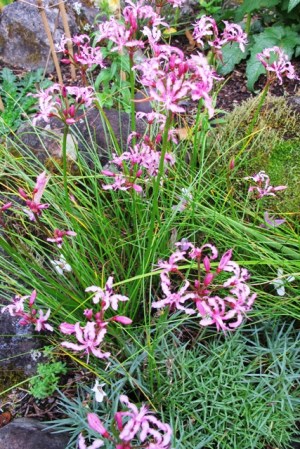
Looking out the window this morning at the swimming pool, Mark commented that clearly the swimming season was over for the summer and at least I had had a swimming season whereas he had not even been in this year! The only consolation about the most disappointing summer we can ever recall is that we were not alone. Most of the country has been similarly afflicted and indeed, our daughters in Sydney and Canberra tell us the same thing! Shared disappointments are so much easier to cope with. And gardeners move on. Autumn is here. The autumn bulbs are starting – Haemanthus coccineus with its red paintbrush blooms, the lovely blue Moraea polystachya, cyclamen, Rhodophiala bifida and the first of the nerines. Nerine filifolia is evergreen with us and is simply the daintiest, most charming little rockery nerine you are likely to see. I potted some to sell a couple of years ago and not a soul wanted to buy them so these days we just keep them to delight ourselves.

Gardening with grasses

We were entranced by the Piet Oudolf borders at Wisley

We were entranced by the Piet Oudolf borders at Wisley

Years ago I was editing garden descriptions and amongst the plethora of developing gardens or tranquil havens filled with birdsong, I came across one which claimed to have “a fascinating collection of grasses.” Fascinating seemed to be overstating the case. I think I toned down the adjective. It has taken a long time to win us over to the merits of grasses here, even though we have some lovely native varieties in New Zealand.

Big grasses need big space

Big grasses need big space

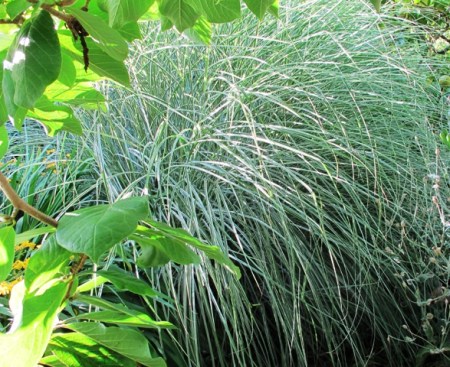
I have never actually seen grasses used in a breathtakingly beautiful way in gardens in this country though I have seen some handsome amenity planting combinations. The problem lies, I think, in how we use them. For starters we tend to limit ourselves to varieties which are knee high or lower. Even worse is the habit of forcing innocent grasses into an edging role where they are destined forever to be like an untidy fringe. And yes, mondo grass (both black and green), liriope, Carex Frosted Curls and blue fescue – I’m looking at you here. Grasses by their very form are designed to grow in the round, not to be forced into a narrow row as an edger. Nor indeed do I understand the obsession with uniform edging plants on all garden beds and borders in this country but that is another matter.

It wasn’t until we went to look at summer gardens in the UK that we were won over by grasses. We had heard slightly disparaging comments about the Piet Oudolf twin borders at Wisley (the RHS flaghip gardens) – a chevron design in grasses, I think somebody told us sniffily. It wasn’t that at all. Twin parallel borders were united by rivers of colour and texture flowing from one to the other with grasses featuring along with other plantings. Not knee high grasses, these were at least waist high and integrated with other carefully chosen perennials. It was an inspirational planting.

On the same trip, I saw the most exquisite grass I have ever seen at Beth Chatto’s garden. I don’t even know if Stipa barbata is in this country but it was light, ethereal and remarkably beautiful. Since then, we’ve seen grasses featured frequently in British TV garden programmes. One of the reasons we subscribe to Sky is to get gardening shows on the Living Channel.

Early view of the Wisley Oudolf borders before the glasshouse was built (from Penelope Hobhouse's book "In Search of Paradise" - magic

Early view of the Wisley Oudolf borders before the glasshouse was built (from Penelope Hobhouse's book "In Search of Paradise" - magic

The common threads to making these plantings work are:
1) Inspired combinations. Grasses are not planted with other grasses. They are integrated into mixed plantings which are carefully managed to look naturalistic in style. Grasses don’t generally suit formal plantings.
2) Forget grasses which are ankle high to knee high. Statement clumps are at least waist high and often considerably taller. This of course means they need quite a bit of space.
3) Big grasses plus big plantings result in a big effect. It rarely scales down effectively. Therein lies the problem – not that many of us have the space to garden on this sort of scale. Those of us who do have space (and it needs to be sunny, well drained space), have usually cluttered it up with mixed plantings including trees and shrubs. These exciting perennial plantings using grasses are usually only perennials, not mixed borders. The aforementioned Oudolf borders at Wisley are around 150 metres long by 11 metres wide – each. While that is on a grand and public scale, you really can’t expect to replicate it in miniature in a border which is only a metre wide and three metres long.
4) Many of these successful plantings have their origins in a garden interpretation of American prairies. It is a managed but not manicured style of gardening. It is some distance away from the classic herbaceous border and it is a long way away from the formal garden rooms genre we have adopted so enthusiastically in this country. It does not combine well with clipped hedges.

Set the grasses free. That is not original. I read it somewhere and it was a NZ writer though I can’t recall who. Stop trying to straitjacket them into contrived and managed combinations. If you have your grasses in a situation where they require grooming and regular combing, it is likely that you are straitjacketing them.

We were told that the Oudolf borders we so admired at Wisley required only a third of the labour input that the classic herbaceous borders needed. Partly that is because they don’t need staking or deadheading. They are cut down in late January (for us that translates to the end of July or late winter). I imagine by that stage they are quite scruffy so it is not a style that will appeal to tidy gardeners. But despite that scruffy stage, these prairie styled plantings contribute a great deal to the ecology of an area, feeding birds and wildlife. It is different to wildflower meadows in that it is managed plantings in varied combinations, often within a somewhat formal layout and with tight weed management. It is not random or self sown. This is not a style we seem to have picked up on this country. We are still mulling around as to whether we have the right position to try.

First published in the Waikato Times and reproduced here with their permission.

Tikorangi notes, Friday 24 February, 2012

Summer and Mark's vegetable garden is taking on its meadow garden alter ego as he grows food for the butterflies

Summer and Mark's vegetable garden is taking on its meadow garden alter ego as he grows food for the butterflies

Latest posts:

1) For us, the flowers of summer are lilies but you need to grow a range of different species to get them performing through the season.

2) Lepidozamia peroffskyana in Plant Collector this week – including how a Russian benefactor came to have an Australian plant named after him.

3) Grow your own garlic and keep vampires at bay. This piece also suggests that the conventional wisdom of planting on the shortest day and harvesting on the longest day may not always be the best advice.

4) Quite possibly the last in the short lived garden diary series done for the Weekend Gardener (unless a miracle happens and the magazine rises like a phoenix from the ashes of liquidation.

Tikorangi notes: Friday 24 February, 2012:

Summer came for three days this week. It was warm enough to entice me into the swimming pool where I looked up at the trees silhouetted against our blue, blue skies and reached for the camera as soon as I got out. I never tire of trees and skyscapes. The elderly pines make a pretty amazing sight even if the one leaning to the right is indeed leaning as much as it appears in the photograph below. One day it may lean beyond the point of balance.

Sadly there is no doubt that a full-on summer is simply not going to happen this year. Yesterday had the unmistakeable hint of autumn. Mark is bringing in grapes every day and muttering about how we had better eat the grapes before the melon harvest starts. Eighty something rock melons, he tells me there are ripening away out in his melon patch. He will have counted them. In the meantime we will not admit defeat and we will eat our way through the grapes. The only crop to rival them here is the green beans, which lack the romance.

The cyclamen are opening which promises an extended delight. The lilies are on their last legs – another torrential rain will spell the end of the auratums but within a few weeks, the autumn bulbs will be starting. That at least is some consolation for a truly disappointing summer.

Our old man pines, Pinus radiata, are large trees after 130 years

Our old man pines, Pinus radiata, are large trees after 130 years