Tag Archives: Mark and Abbie Jury

Plant Collector – Sprekelia formosissima

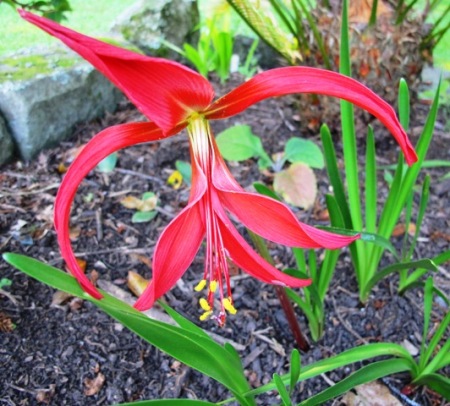
The Sprekelia formosissima or Jacobean lily

The Sprekelia formosissima or Jacobean lily

You learn something every day. This bulb is what is commonly known as the Jacobean Lily, even though it has nothing to do with the Jacobeans and it is not a lily. For years I have freely tossed the descriptor around, “it resembles a Jacobean lily”, thinking more of William Morris textile design than botany. And all the time, there is a wide level of agreement internationally that the Jacobean lily is Sprekelia formosissima. Added to that, when a species name is formasana or formasanum, it usually means that the plant comes from the former island of Formosa (now Taiwan). But the unwieldy formosissima means, loosely, beautiful. In fact it comes from Mexico.

It is indeed a beautiful flower with its rich red strappy petals and elegant form. A member of the amaryllis family, it is closely related to hippeastrums. It grows on quite a tall stem, around 30cm, with just a single flower per stem but fairly long lived. Aside from the genuine lilies, there aren’t a lot of bulbs that flower in early to mid summer. It is not particularly rare but it is one of those collectors’ items that is getting ever harder to source with the shrinking plant range offered for sale these days. If you find a plant with seed, it germinates easily when fresh.

As with all bulbs, the sprekelia likes well drained, friable soils and good light levels. It can get attacked by bulb fly (as can the hippeastrums) so we go for the woodland margins to outwit the sun-loving bulb fly. Despite its Mexican origins, sprekelia is regarded as half hardy which means that it can tolerate cool conditions and light frosts.

First published in the Waikato Times and reproduced here with their permission.

Rata and pohutukawa – the metrosideros family

Pohutakawa, maybe Scarlet Pimpernel, in Hamilton on Christmas Day (photo: Michael Jeans)

Pohutakawa, maybe Scarlet Pimpernel, in Hamilton on Christmas Day (photo: Michael Jeans)

I have to start with a touch of mea culpa. I will never misspell pohutukawa again. It had never even occurred to me that I did not know how to spell it correctly. See, I had a Dunedin childhood and in the deep south, we probably had rata on our spelling lists rather than pohutukawa. At least that is my story. My only consolation in the matter is that my misspelling of the Maori name for Metrosideros excelsa apparently escaped the notice of everyone else involved with the production of the paper I write for, so I was not alone. But I was probably alone with my embarrassment. In case you missed it last Friday (before I corrected the website post), I turned the second u into an a.

As a peace offering, I give you a photo of a lovely pohutukawa in full flower at Millenium Heights in Flagstaff, Hamilton. The owner, Bronwyn, tells me it was meant to be a dwarf but it is already three metres high and it flowers profusely every year. When she said it was meant to be a dwarf, I thought initially that it might be one of the Kermadec pohutukawa (M. kermadecensis) which is sometimes used as a smaller selection – though only relatively smaller. However, I ruled that out because the Raoul Island pohutukawa flowers intermittently all year in dribs and drabs and it does not put on a mass display as shown. Added to that, it is more frost tender so it is never going to be happy in inland Hamilton. It is more likely to be a selection of the common form, M. excelsa. In fact it may even be the one named Scarlet Pimpernel (which was selected by my late father-inlaw). There is considerable variation within this species. If you start looking at trees you see over the next couple of weeks, you will pick huge variation in colour. Some look almost rusty brown from a distance, some deep red. The ones that stand out in the landscape tend to have orange tones to the colouring which gives vibrancy. It is called seedling variation – they don’t grow identical from seed. To get an exact clone of the parent, you have to propagate by cuttings.

The yellow pohutukawa are sometimes seen as a novelty. They are pretty enough in their own way but to my eyes they are nowhere near as spectacular as a good red specimen. The yellows are just another seedling variant of the same species, most common on Motiti Island. The reason you see them in mainland gardens and public plantings is because Duncan and Davies Nursery produced them commercially some decades ago – always the quest for the different and the new. It was that quest that also saw variegated forms offered for sale. These are not my favourite. I am not a great fan of variegated plants so I am unconvinced that a variegated form of our iconic pohutukawa was ever going to be an improvement on the usual forms in the wild. But because they were seen as different and new, they sold well for a while and there are big specimens around.

M. excelsa grows naturally as far south as Poverty Bay in the east and North Taranaki in the west. The pohutukawa that grows and flowers in the top of the South Island is a different species, M. parkinsonii. It tends to be rather more scruffy in its habit of growth.

The rata does not just go up, it goes along in every which way

The rata does not just go up, it goes along in every which way

It is of course the rata that is to the South Island what the pohutakawa is to the North Island, though we do have the northern rata as well. These are all the same family (so all metrosideros) but different species. Think of them being like cousins, perhaps. So the South Island rata is M. umbellata and the North Island rata is M. robusta. It is the latter that starts life as an epiphyte, living on a host tree that will ultimately die. The rata sends down roots that eventually reach the ground and develop into a strong vine. Over time, the vinous roots fuse together to form what looks like a trunk (called a psuedotrunk) so, by the time the host tree is strangled, dies and rots away, the rata can hold itself up. We have this rata here in the garden and we find that it does not just go up the host trees, not at all. In an hospitable garden woodland situation, there is little holding it back as it attempts to take over the entire area. I have to have words with it about its smothering ways. There is a limit to how much ground cover we want. Besides it only flowers on the tops and even then is but a shadow of the magnificent display the pohutukawa put on.

The southern rata is less determinedly epiphytic and can establish itself on its own roots in conditions which vary from nearly sub alpine to wet coastal forest. I recall as a child the excitement expressed by adults at the flowering of the rata in the wild, but it tends to be more a haze of red than an in-your-eye statement of summer and Christmas as with the pohutukawa. Unfortunately rampant possums have destroyed much of the impact of the southern rata in bloom.

Of the family, it is the good red pohutukawa or M. excelsa that remains my firm favourite.

First published in the Waikato Times and reproduced here with their permission.

Tikorangi Notes: Friday 23 December, 2011

Red dahlias for Christmas (but not for Plant Collector profiling)

Red dahlias for Christmas (but not for Plant Collector profiling)

Latest posts:
1) Oh Christmas tree, oh Christmas tree (Abbie’s column) and why it may be a misnomer to brand the iconic pohutukawa as the New Zealand Christmas tree.
2) While the reasons why philadelphus is often referred to as mock orange blossom may elude me, the pure, fragrant beauty of the flowers at Christmas is above reproach.
3) Was there even life before basil?

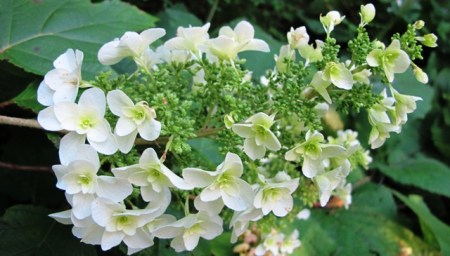
The dainty Hydrangea quercifolia "Snowflake"

The dainty Hydrangea quercifolia "Snowflake"

Tikorangi Notes: Friday December 23, 2011
Just two days before Christmas and the sun is shining brightly, temperatures are rising and there is no wind. After the torrential downpours of last week, it feels like a little Christmas blessing. In the garden we are busy with a grooming round. Well, two of us are. Mark is determinedly following his own path of draining the settling pond which stops our stream in the park from silting up and doing a weeding round. He takes the lion’s share of responsibility for weeding here. Lloyd and I are titivating in preparation for a wedding to be held here on New Year’s Eve.

Other gardens focus on the wedding venue market but not us. Mark prefers people to come because they want to see the garden rather than to see the place used as a venue. I did a handful of weddings a few years ago – singlehandedly because Mark resolutely stuck to his principles and made himself scarce. But then I met… Bridezilla. That was my last ever booking. If I had known how demanding she would be, I would have trebled the price I quoted and even then I do not think that would have compensated for treating me like the hired help in my own garden.

But, we have a wedding coming and we agreed to this one because it is our daughter’s best friend. And it is proving to be a Major Event. Pride says we have to have the top gardens in immaculate condition, even though we know that guests are here for the event and few will do anything more than cast their eyes around and say, “Oh, very nice…”. Given that the colour scheme for the wedding is the wonderfully retro orange and brown, it is perhaps just as well that the dominant garden colour at this time is lush green. We are in the gentle hiatus between late spring flowers and summer lilies, though the hydrangeas are coming into their own.

The garden remains open for visiting each day. There is an honesty box if we are not around. Best wishes for Christmas to all who read this page.

Tikorangi Notes: Friday 16 December, 2011

The DIY Christmas tree

The DIY Christmas tree

Latest posts: December 16, 2011

1) Gardening books that have stood the test of time (or are likely to). Abbie’s column giving recommendations old (some positively vintage) and new.

2) Please do not buy me garden ornaments for Christmas (what we are up to in the garden this fortnight, first published in the Weekend Gardener). Using plants as focal points.

3) The delightful small Chinese tree Tetracentron sinense in Plant Collector this week.

4) Grow it yourself – leeks this week. An easy crop for winter harvest.

5) The DIY Christmas tree for 2011 – step by step instructions. Though this is not exactly a spur of the moment creation this year.

The black sands of a North Taranaki beach

The black sands of a North Taranaki beach

With rain every day this week, there has been little gardening going on here and little of the current flush of blooms will survive. The one consolation is that it could be worse – as it is in other parts of the country. Mark has been busy in the shed sowing seed while I made the Christmas tree but we may start to suffer from cabin fever, unless we get some sunshine soon.

Rather than battling out to try and photograph some sodden plant or garden scene this week, I have turned instead to two beach scenes from last Friday (when the weather was gratifyingly good – sunny, calm and mild) and we headed to the beach at Tongaporutu to gather oysters and mussels for dinner. On the west coast we have very fine black sand beaches. It used to amuse me that despite only ever seeing black sand, the vast majority of young Taranaki children still paint beach scenes showing golden sand. In mid summer, the hot sand can get too hot to walk on with bare feet above the high tide mark, but this early in the season, it is not a problem. Tongaporutu is about 30 minutes up the coast from us and is a wide open beach, often completely empty of people and completely magical. It felt like the essence of New Zealand, captured in a few hours

Mark, gathering dinner last Friday

Mark, gathering dinner last Friday

In the Garden: Friday December 16

A fortnightly series first published in the Weekend Gardener and reproduced here with their permission.

The antique stone mill wheels are fine as garden decoration

The antique stone mill wheels are fine as garden decoration

Ours is a garden that is very light on ornamentation and we prefer it that way. The last thing I want for Christmas is a garden ornament or colourful display pot. The three stone antique millwheels are fine, but generally we like to feature glimpsed views or plants as focal points rather than statuary or any type of installation. We are lucky that we garden on a sufficiently large scale to be able to use the glimpsed view, even the odd borrowed vista. It is a bit more problematic in a tiny, town garden with a view of next door’s washing line. But using plants as a feature point is possible no matter what size the garden.

Before....

Before....

One of the delights of having a mature garden with old plants is that there is plenty of raw material for clipping and shaping. We don’t want to follow the Italian example and clip and shape everything, but the occasional large, cloud pruned specimen can be as strong as any man-made focal point. Camellias are wonderful for clipping and shaping because they will sprout again if you make a mistake and they grow densely if you clip every year. Some of the michelias also clip well when they are well established, as does loropetalum and the classic yews. The skill is in making

... and immediately after

... and immediately after

sure that not everything is turned into a lollipop (the easiest shape to clip), or a cake stand (which is just a vertical stack of lollipops). Mark favours the flatter topped mushroom shape or layers of clouds. We had four standard lollipops flanking our sunken garden but they had become too dense and rounded. Some radical cutting has seen them become much lighter mushrooms instead, giving a visual accent rather than completely dominating the area. He doesn’t rely on doing it all by eye, instead using lengths of bamboo to measure height and width. We don’t mind a bit of variation – these are living plants not artificial structures that can be like identical soldiers – but we want a sense of overall unity.

Top tasks:

1) Summer prune the wisterias. Turn your back for a moment and they can make a bid for world domination, or so it seems. I just tidy up the long, wayward tendrils at this time of the year and do a structural and shaping prune in winter.

2) Continue deadheading and light summer pruning of the roses. Because we never spray our roses here, I prune frequently to encourage fresh growth. They get a traditional winter prune so the summer effort is more like a nip and tuck. I rely on keeping the roses growing strongly and pushing out fresh leaf buds to keep enough foliage coming to replace what succumbs to black spot. I try and remove all spent blooms and damaged foliage to the wheelie bin, to avoid them harbouring pests and diseases on the ground at the base of the roses.

A large cloud pruned specimen of Camellia sasanqua Mine No Yuki

A large cloud pruned specimen of Camellia sasanqua Mine No Yuki