Tag Archives: Mark and Abbie Jury

Tikorangi Notes: Friday 23 December, 2011

Red dahlias for Christmas (but not for Plant Collector profiling)

Red dahlias for Christmas (but not for Plant Collector profiling)

Latest posts:
1) Oh Christmas tree, oh Christmas tree (Abbie’s column) and why it may be a misnomer to brand the iconic pohutukawa as the New Zealand Christmas tree.
2) While the reasons why philadelphus is often referred to as mock orange blossom may elude me, the pure, fragrant beauty of the flowers at Christmas is above reproach.
3) Was there even life before basil?
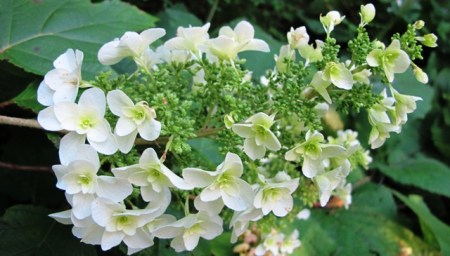
The dainty Hydrangea quercifolia "Snowflake"

The dainty Hydrangea quercifolia "Snowflake"

Tikorangi Notes: Friday December 23, 2011
Just two days before Christmas and the sun is shining brightly, temperatures are rising and there is no wind. After the torrential downpours of last week, it feels like a little Christmas blessing. In the garden we are busy with a grooming round. Well, two of us are. Mark is determinedly following his own path of draining the settling pond which stops our stream in the park from silting up and doing a weeding round. He takes the lion’s share of responsibility for weeding here. Lloyd and I are titivating in preparation for a wedding to be held here on New Year’s Eve.

Other gardens focus on the wedding venue market but not us. Mark prefers people to come because they want to see the garden rather than to see the place used as a venue. I did a handful of weddings a few years ago – singlehandedly because Mark resolutely stuck to his principles and made himself scarce. But then I met… Bridezilla. That was my last ever booking. If I had known how demanding she would be, I would have trebled the price I quoted and even then I do not think that would have compensated for treating me like the hired help in my own garden.

But, we have a wedding coming and we agreed to this one because it is our daughter’s best friend. And it is proving to be a Major Event. Pride says we have to have the top gardens in immaculate condition, even though we know that guests are here for the event and few will do anything more than cast their eyes around and say, “Oh, very nice…”. Given that the colour scheme for the wedding is the wonderfully retro orange and brown, it is perhaps just as well that the dominant garden colour at this time is lush green. We are in the gentle hiatus between late spring flowers and summer lilies, though the hydrangeas are coming into their own.

The garden remains open for visiting each day. There is an honesty box if we are not around. Best wishes for Christmas to all who read this page.


Tikorangi Notes: Friday 16 December, 2011

The DIY Christmas tree

The DIY Christmas tree

Latest posts: December 16, 2011

1) Gardening books that have stood the test of time (or are likely to). Abbie’s column giving recommendations old (some positively vintage) and new.

2) Please do not buy me garden ornaments for Christmas (what we are up to in the garden this fortnight, first published in the Weekend Gardener). Using plants as focal points.

3) The delightful small Chinese tree Tetracentron sinense in Plant Collector this week.

4) Grow it yourself – leeks this week. An easy crop for winter harvest.

5) The DIY Christmas tree for 2011 – step by step instructions. Though this is not exactly a spur of the moment creation this year.

The black sands of a North Taranaki beach

The black sands of a North Taranaki beach

With rain every day this week, there has been little gardening going on here and little of the current flush of blooms will survive. The one consolation is that it could be worse – as it is in other parts of the country. Mark has been busy in the shed sowing seed while I made the Christmas tree but we may start to suffer from cabin fever, unless we get some sunshine soon.

Rather than battling out to try and photograph some sodden plant or garden scene this week, I have turned instead to two beach scenes from last Friday (when the weather was gratifyingly good – sunny, calm and mild) and we headed to the beach at Tongaporutu to gather oysters and mussels for dinner. On the west coast we have very fine black sand beaches. It used to amuse me that despite only ever seeing black sand, the vast majority of young Taranaki children still paint beach scenes showing golden sand. In mid summer, the hot sand can get too hot to walk on with bare feet above the high tide mark, but this early in the season, it is not a problem. Tongaporutu is about 30 minutes up the coast from us and is a wide open beach, often completely empty of people and completely magical. It felt like the essence of New Zealand, captured in a few hours

Mark, gathering dinner last Friday

Mark, gathering dinner last Friday

In the Garden: Friday December 16

A fortnightly series first published in the Weekend Gardener and reproduced here with their permission.

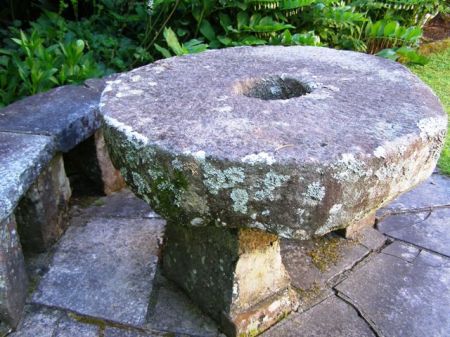
The antique stone mill wheels are fine as garden decoration

The antique stone mill wheels are fine as garden decoration

Ours is a garden that is very light on ornamentation and we prefer it that way. The last thing I want for Christmas is a garden ornament or colourful display pot. The three stone antique millwheels are fine, but generally we like to feature glimpsed views or plants as focal points rather than statuary or any type of installation. We are lucky that we garden on a sufficiently large scale to be able to use the glimpsed view, even the odd borrowed vista. It is a bit more problematic in a tiny, town garden with a view of next door’s washing line. But using plants as a feature point is possible no matter what size the garden.

Before....

Before....

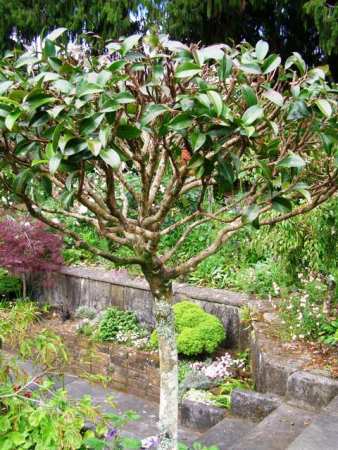
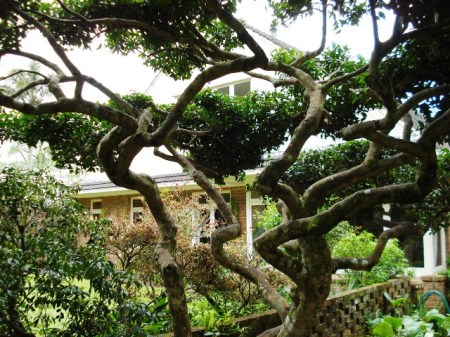
One of the delights of having a mature garden with old plants is that there is plenty of raw material for clipping and shaping. We don’t want to follow the Italian example and clip and shape everything, but the occasional large, cloud pruned specimen can be as strong as any man-made focal point. Camellias are wonderful for clipping and shaping because they will sprout again if you make a mistake and they grow densely if you clip every year. Some of the michelias also clip well when they are well established, as does loropetalum and the classic yews. The skill is in making

... and immediately after

... and immediately after

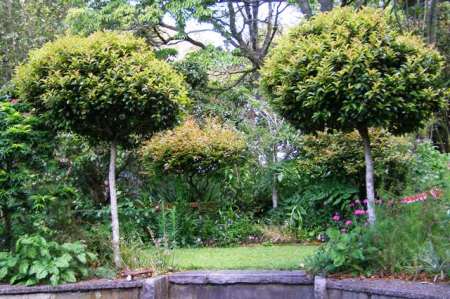
sure that not everything is turned into a lollipop (the easiest shape to clip), or a cake stand (which is just a vertical stack of lollipops). Mark favours the flatter topped mushroom shape or layers of clouds. We had four standard lollipops flanking our sunken garden but they had become too dense and rounded. Some radical cutting has seen them become much lighter mushrooms instead, giving a visual accent rather than completely dominating the area. He doesn’t rely on doing it all by eye, instead using lengths of bamboo to measure height and width. We don’t mind a bit of variation – these are living plants not artificial structures that can be like identical soldiers – but we want a sense of overall unity.

Top tasks:

1) Summer prune the wisterias. Turn your back for a moment and they can make a bid for world domination, or so it seems. I just tidy up the long, wayward tendrils at this time of the year and do a structural and shaping prune in winter.

2) Continue deadheading and light summer pruning of the roses. Because we never spray our roses here, I prune frequently to encourage fresh growth. They get a traditional winter prune so the summer effort is more like a nip and tuck. I rely on keeping the roses growing strongly and pushing out fresh leaf buds to keep enough foliage coming to replace what succumbs to black spot. I try and remove all spent blooms and damaged foliage to the wheelie bin, to avoid them harbouring pests and diseases on the ground at the base of the roses.

A large cloud pruned specimen of Camellia sasanqua Mine No Yuki

A large cloud pruned specimen of Camellia sasanqua Mine No Yuki

Plant Collector: Tetracentron sinense

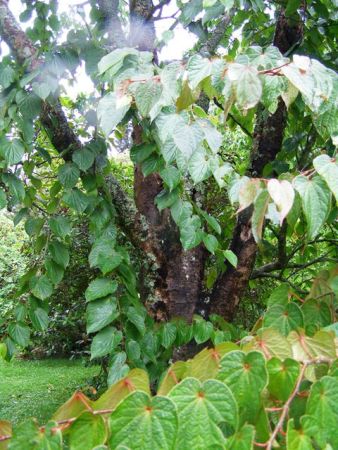
Tetracentron sinense

Tetracentron sinense

The Tetracentron sinense growing in our park is a pretty special tree for us. We rate it as a small tree – after five decades it is still only about six metres high and with a graceful, arching habit of growth. It is deciduous and the fresh spring growth emerges pink which seems appropriate for heart shaped leaves, but only briefly before it turns green, though keeping the red stems.

Sinense means it comes from China, on the western reaches where it borders with Nepal. It is a relatively late discovery, dating to 1901. As far as is known, there are no other members of the Tetracentron family (which makes it monotypic – meaning one of a kind). Our tree grew from seed collected in the 1950s. Frank Kingdon-Ward (often incorrectly referred to as Kingdom Ward) was an intrepid British plant collector and, like many of his forbears, financed some of his expeditions by selling subscriptions in return for seed. Mark’s father, Felix Jury, subscribed though we don’t know now how much he contributed. He received the tetracentron and a rhus which we could have done without.

It flowers in summer with relatively insignificant yellow catkins, though loved by bees. In our climate we don’t get autumn colour and I can’t find any mention in the literature so I would guess nobody else does either. I did find wildly varied accounts of its ultimate size – up to 40 metres in fact which is enormous. I can’t think that our specimen, rated by international experts who have seen it as a large example, is ever going to get to that stature. However it is apparently rare in the wild (sightings are recorded) so perhaps the heights are more a case of guesstimates.

First published in the Waikato Times and reproduced here with their permission.

Grow It Yourself – leeks

Dedicated leek growers (not all of Welsh descent, I am sure) know that if they want a good sized harvest, plants need to be a finger thickness by Christmas. But it is not too late to sow seed now – the plants will just be a bit smaller. Leeks have a long growing season of up to 6 months and because they are a winter plant, they can then hold in the cold ground until you are ready to pick them.

Leeks are not fussy or particular. They grow easily in most soils. Because they belong in the leafy vegetable group, they thrive on nitrogen based fertilisers. This means they are going to be quite happy growing where you have recently dug in a green crop or if you have an area where you have previously added animal manures.

If you are going to sow seed, get it in as soon as possible. As the seeds germinate, you can use the thinnings as salad veg (they are a little like chives with an oniony tang). Final spacing needs to be about 10cm to achieve full sized leeks. If you are using seedling plants, you have a few more weeks up your sleeve and you generally plant them at final spacing. They are likely to need watering for the first few weeks while they get their roots out.

With vegetable gardening, you work one to two seasons ahead. Planting for winter now means you can avoid the hefty prices of bought fresh veg and have a change from interminable frozen peas. And leeks are an easy option. You just have to plant them in good soil and keep them relatively weed free (to stop competition) and in winter they should be waiting for you.