Tag Archives: Mark and Abbie Jury

The Weird and Wonderful World of Show Vegetables

We are never going to get show vegetables out of our garden

We are never going to get show vegetables out of our garden

There is something wonderfully compelling about the bizarre, the obsessive and the freaky which may explain why even our daughter joined us on the sofa to shriek with laughter at the programme on the Living Channel last Sunday. It was all about growing and showing vegetables in the United Kingdom. Before any readers get defensive, I hasten to add that we have the utmost respect for the skills required and the proud tradition of competing for prizes in various vegetable classes. It is just a tradition which has largely bypassed us in New Zealand so we are bound to find the proud woman holder of the title of World’s Best Potato Grower faintly amusing.

Growing vegetables for show does not have a lot to do with eating them. In fact eating them was never mentioned. Growing 900 onions in the quest for the best sets of five perfectly matched specimens, each weighing 250 grams, does leave one with a rather eyewateringly large excess of produce for ahome grower. And what exactly are you going to do with the other 85 heads of celery which did not make the cut when you selected the best five to show? These are celery plants which have been grown entirely under cover, nursed, mollycoddled, blanched and fussed over until they can reach a massive 150 cm high or even more. They are hardly going to fit in the fridge. But once you have seen them being lovingly washed in a large bath of soapy water and gently groomed with a soft toothbrush, you realise this has nothing to do with home vegetable gardening. It is more akin the vegetable equivalent of the prestigious Crufts Dog Show but without the social pretensions.

There are rigid rules as to what is acceptable and what is not. Immaculate, matched onions are presented with a neat tie of raffia to hold the trimmed top tidily (which sparked a comment from the show host along the lines of: “Nothing finishes a perfect onion like a sheaf of raffia,”) but woe betide anybody who steps over the line to flamboyance. A modest knot may be required, a bow is enough to get you disqualified – or so the husband tells me from another show he watched.

Carrots and parsnips are popular crops but growing them takes special techniques and even then you may not get specimens with precision tapering, let alone perfectly matched sets of three identical specimens. Don’t be thinking that you can win with garden specimens grown in soils. These are grown in drums. First these drums are packed with coarse sand. A tube is then used to extract a perfectly straight column in the sand which is filled with the highest quality, fine garden mix. It has to be sieved garden mix because any untoward chunks could cause the plant’s roots to kink or bend. This is a serious business where timing, technique and crop management is critical. Carrots should have a nicely rounded base and are exhibited without their roots. Parsnips should be perfectly tapered and are measured and exhibited with the long tap root attached in its entirety.

We were riveted, as only holiday-makers on a bleak and windy summer Sunday afternoon can be, to learn that in order to clean and present your carrots or parsnips, you have to gently sponge them in a circular motion. If you rub them up and down, you will scratch the outer skin and cause blemishes. That is a piece of new information which just may or may not be useful at some point in my life.

Presumably it is the exhibitionists who grow the freaks. There was an earlier series on growing extreme vegetables – the parsnip, I was told, grew in a length of downpipe which ran three stories high. In this country, the giant pumpkin growing competitions are relatively common and most of us realise that said competitive pumpkins are not destined for the dining table, being of value only as stock food. Size and weight are everything in the freak classes. Beauty, uniformity and perfection count for nought.

Prize money does not count either. It is fame, glory and recognition. Most of the vegetable competitions in the UK (and there are legions of them) carry prizes of a few pounds only. The costs of competing are hugely greater than any financial reward – best grade seed only, packets of potting mix, washed sand, peat, special fertilisers and sprays and that is just for starters. Mark was a little put out to see that the competitive celery grower had a state of the art glasshouse which left anything we have here completely in the shade despite the fact that we have been professional growers of plants for the last few decades.

This is not to say that we don’t have competitions here. Mark recalls judging the vegetables at some gathering in Otorohanga where he was a guest speaker some years ago. I am sure I must have done it for the local Country Women’s Institute here at some stage. Maybe we are just of more pragmatic stock in this country. I am pretty sure that the vegetables I have seen exhibited here were actually edible and were grown in gardens. This is a very different kettle of fish to show vegetables.

First published in the Waikato Times and reproduced here with their permission.

Grow it Yourself – parsnips

Parsnips are not the most glamorous of vegetables, even less so when old and woody which is usually a sign of being dug too late. But I am very partial to a bit of roast parsnip and they add welcome variety in winter when veg can get a bit repetitive. We are doing a late sowing parsnip seed now for winter harvest. Others will have sown as early as last spring though they are not likely to harvest before winter. They will have considerably larger specimens by then, as long as they do not bolt to seed. From this you can take it that the timing is not critical. They take about four and half months to reach maturity so you can be eating them from July onwards if planting now. It is usual to leave them in the ground and dig as required. They go dormant over winter and frosts are said to enhance the flavour considerably.

The two critical issues are to use fresh seed (parsnip seed does not store well) and to avoid additional fertilisers. Nitrogenous fertilisers will encourage too much top, leafy growth and not enough root development. Fresh manures will cause forked and misshapen roots. Parsnips are a good option where you have taken out a heavily fertilised crop like leafy greens or even potatoes. Don’t add anything extra – there should be plenty of goodness left in the soil. Make sure the soil is well tilled and friable to allow the roots to grow straight. Seed is sown close to the surface and covered lightly. Once it has germinated and is growing away strongly, thin to at least 10cm apart in every direction to allow room to develop. Diseases are not usually an issue and while a few pests can attack parsnips (carrot fly, greenfly and wireworm), this is not usually a big problem.

First published in the Waikato Times and reproduced here with their permission.
Grow It Yourself: yams

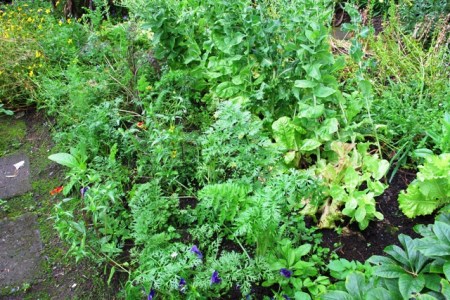
Clearly an oxalis family member - the New Zealand yam

Clearly an oxalis family member - the New Zealand yam

It is curious that what every New Zealander knows as a yam is only a yam in this country. Overseas, yams are an entirely different vegetable and our yams are called oka or oca. This does not matter unless you are using overseas growing instructions or recipes. Our yam is a member of the oxalis family – O. tuberosa – and we all know they are the reddish thumb-like, nubbly tubers that are delicious roasted but can be a pain to prepare if they are too small.

Our yams are a root vegetable from the highlands of South America. They are not difficult to grow but the yield rates can be disappointingly small. The best ever yams we saw were grown in a neighbour’s garden in Dunedin which is an indication that they are quite happy with cooler temperatures, though frost kills off the foliage. Grow them like a potato. Plant the tuber and as you see smaller nodules forming on the stems above ground, mound up the soil to encourage those nodules to develop into tubers. In warmer areas, they will grow all year and more or less naturalise if you allow them to (great if you are into one of the trendy food forests) but even so, they will appreciate a gift of compost mulch from time to time. They appear to be largely immune to pests and diseases but they do need good drainage.

Yams sweeten up if you leave them in the sun for a couple of days after harvest. Because they are thin skinned and don’t need peeling before cooking, they are vulnerable to damage during harvest and they don’t have the storage longevity of potatoes or kumaras. You can layer them in sawdust or newspaper if you want to hold them longer term.

First published in the Waikato Times and reprinted here with their permission.

Plant Collector – Sprekelia formosissima

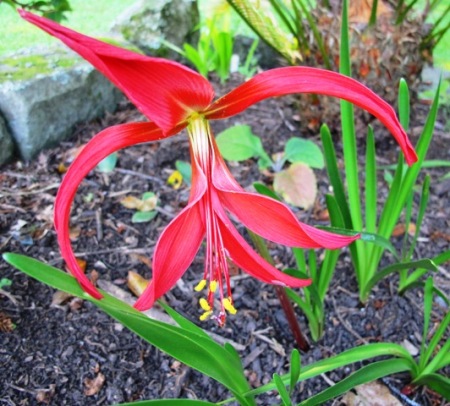
The Sprekelia formosissima or Jacobean lily

The Sprekelia formosissima or Jacobean lily

You learn something every day. This bulb is what is commonly known as the Jacobean Lily, even though it has nothing to do with the Jacobeans and it is not a lily. For years I have freely tossed the descriptor around, “it resembles a Jacobean lily”, thinking more of William Morris textile design than botany. And all the time, there is a wide level of agreement internationally that the Jacobean lily is Sprekelia formosissima. Added to that, when a species name is formasana or formasanum, it usually means that the plant comes from the former island of Formosa (now Taiwan). But the unwieldy formosissima means, loosely, beautiful. In fact it comes from Mexico.

It is indeed a beautiful flower with its rich red strappy petals and elegant form. A member of the amaryllis family, it is closely related to hippeastrums. It grows on quite a tall stem, around 30cm, with just a single flower per stem but fairly long lived. Aside from the genuine lilies, there aren’t a lot of bulbs that flower in early to mid summer. It is not particularly rare but it is one of those collectors’ items that is getting ever harder to source with the shrinking plant range offered for sale these days. If you find a plant with seed, it germinates easily when fresh.

As with all bulbs, the sprekelia likes well drained, friable soils and good light levels. It can get attacked by bulb fly (as can the hippeastrums) so we go for the woodland margins to outwit the sun-loving bulb fly. Despite its Mexican origins, sprekelia is regarded as half hardy which means that it can tolerate cool conditions and light frosts.

First published in the Waikato Times and reproduced here with their permission.

Rata and pohutukawa – the metrosideros family

Pohutakawa, maybe Scarlet Pimpernel, in Hamilton on Christmas Day (photo: Michael Jeans)

Pohutakawa, maybe Scarlet Pimpernel, in Hamilton on Christmas Day (photo: Michael Jeans)

I have to start with a touch of mea culpa. I will never misspell pohutukawa again. It had never even occurred to me that I did not know how to spell it correctly. See, I had a Dunedin childhood and in the deep south, we probably had rata on our spelling lists rather than pohutukawa. At least that is my story. My only consolation in the matter is that my misspelling of the Maori name for Metrosideros excelsa apparently escaped the notice of everyone else involved with the production of the paper I write for, so I was not alone. But I was probably alone with my embarrassment. In case you missed it last Friday (before I corrected the website post), I turned the second u into an a.

As a peace offering, I give you a photo of a lovely pohutukawa in full flower at Millenium Heights in Flagstaff, Hamilton. The owner, Bronwyn, tells me it was meant to be a dwarf but it is already three metres high and it flowers profusely every year. When she said it was meant to be a dwarf, I thought initially that it might be one of the Kermadec pohutukawa (M. kermadecensis) which is sometimes used as a smaller selection – though only relatively smaller. However, I ruled that out because the Raoul Island pohutukawa flowers intermittently all year in dribs and drabs and it does not put on a mass display as shown. Added to that, it is more frost tender so it is never going to be happy in inland Hamilton. It is more likely to be a selection of the common form, M. excelsa. In fact it may even be the one named Scarlet Pimpernel (which was selected by my late father-inlaw). There is considerable variation within this species. If you start looking at trees you see over the next couple of weeks, you will pick huge variation in colour. Some look almost rusty brown from a distance, some deep red. The ones that stand out in the landscape tend to have orange tones to the colouring which gives vibrancy. It is called seedling variation – they don’t grow identical from seed. To get an exact clone of the parent, you have to propagate by cuttings.

The yellow pohutukawa are sometimes seen as a novelty. They are pretty enough in their own way but to my eyes they are nowhere near as spectacular as a good red specimen. The yellows are just another seedling variant of the same species, most common on Motiti Island. The reason you see them in mainland gardens and public plantings is because Duncan and Davies Nursery produced them commercially some decades ago – always the quest for the different and the new. It was that quest that also saw variegated forms offered for sale. These are not my favourite. I am not a great fan of variegated plants so I am unconvinced that a variegated form of our iconic pohutukawa was ever going to be an improvement on the usual forms in the wild. But because they were seen as different and new, they sold well for a while and there are big specimens around.

M. excelsa grows naturally as far south as Poverty Bay in the east and North Taranaki in the west. The pohutukawa that grows and flowers in the top of the South Island is a different species, M. parkinsonii. It tends to be rather more scruffy in its habit of growth.

The rata does not just go up, it goes along in every which way

The rata does not just go up, it goes along in every which way

It is of course the rata that is to the South Island what the pohutakawa is to the North Island, though we do have the northern rata as well. These are all the same family (so all metrosideros) but different species. Think of them being like cousins, perhaps. So the South Island rata is M. umbellata and the North Island rata is M. robusta. It is the latter that starts life as an epiphyte, living on a host tree that will ultimately die. The rata sends down roots that eventually reach the ground and develop into a strong vine. Over time, the vinous roots fuse together to form what looks like a trunk (called a psuedotrunk) so, by the time the host tree is strangled, dies and rots away, the rata can hold itself up. We have this rata here in the garden and we find that it does not just go up the host trees, not at all. In an hospitable garden woodland situation, there is little holding it back as it attempts to take over the entire area. I have to have words with it about its smothering ways. There is a limit to how much ground cover we want. Besides it only flowers on the tops and even then is but a shadow of the magnificent display the pohutukawa put on.

The southern rata is less determinedly epiphytic and can establish itself on its own roots in conditions which vary from nearly sub alpine to wet coastal forest. I recall as a child the excitement expressed by adults at the flowering of the rata in the wild, but it tends to be more a haze of red than an in-your-eye statement of summer and Christmas as with the pohutukawa. Unfortunately rampant possums have destroyed much of the impact of the southern rata in bloom.

Of the family, it is the good red pohutukawa or M. excelsa that remains my firm favourite.

First published in the Waikato Times and reproduced here with their permission.