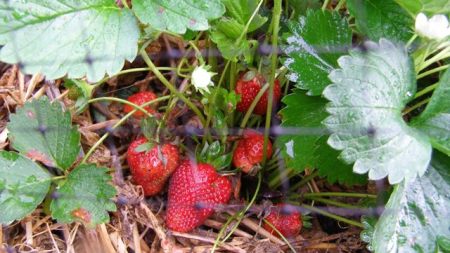
It appears to be a mast year for strawberries here. That is a term for when plants produce a significant abundance of fruit. In nature this can be important. Apparently kakapo need rimu to have a mast year in order to breed. But here it just means we are having a bumper strawberry harvest. Not wanting to overstate the case, but they are coming in by the bowl full.
This leads me to the issue of self sufficiency and the observation that if you want to be self sufficient, you have to accept that there will be mast years and there will be famine years for some crops. At least we have the supermarket option these days so the famine stakes are not as high. I have noticed that self sufficiency has become trendy again, often espoused by people who claim that it is terribly easy and achievable in very small areas, taking relatively little time. All I can say is that self sufficiency must mean different things to different people and varying levels of home provision are being hailed as self sufficiency.
We describe ourselves as relatively self sufficient in fruit and vegetables. We produce enough fruit for high individual consumption all year and only buy additional fruit for variation in the diet and seasonal treats which cannot be grown successfully in our area. We generally produce sufficient vegetables but there are times we have to supplement. The husband felt such a failure when I had to buy a bag of potatoes last week because we had run out of old ones and we had eaten the first crop of early ones already. The onion harvest was poor this year so we have had to buy. Purists would maybe go without onions for the year.
But we are nowhere near self sufficient if you take in grains and animal protein. We don’t even attempt to produce our own grains. While we raise our own beef, we haven’t done our own poultry for years. To be genuinely self sufficient, you would need to factor in sufficient grain cropping to be able to feed the poultry as well.
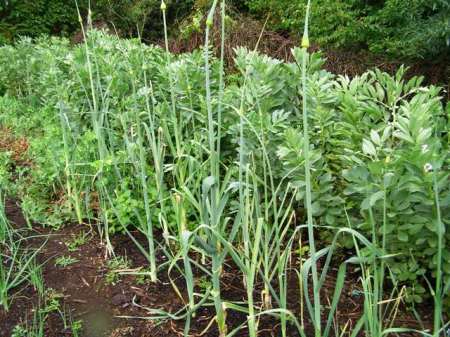
Nevertheless, it is astonishing quite how much area gets taken up in providing sufficient to keep us going at the level we like for just the two of us and how much time it takes on the part of He Who Produces it All (aka Mark). Fortunately he enjoys doing it. If it was left to me, it would be a poor harvest of basil and lettuces at best because I would rather grow flowers. Mark has long scoffed at suggestions that you can achieve self sufficiency in a tiny plot and in dinky raised beds so we returned to The Oracle to see how much land she thought was needed. The Oracle is Kay Baxter, founder of the Koanga Institute. She only preaches what she practices and she has close to 40 years of experience in food production, organics and self sufficiency. We have the utmost respect for her opinion. According to her: “To grow all your veges and grains, you will need 100 square metres per person.” Yes that does include grains, which not many of us produce, but it does not include fruit. That is a hundred square metres of healthy soils in full sun with good shelter – per person. For a family of five – five plots of 10 metres by 10 metres. There are reasons why modern society has turned to the industrialisation of food production and one is the economies of scale.
If you want to produce your food on organic principles, you may need an even greater area. Generally speaking, organic production relies on producing crops at optimum times and not pushing the boundaries either end of the season (because that is when pests and diseases will strike more readily). You also need to be meticulous on crop rotation and soil management because you don’t have the fall back position of a chemical arsenal to rectify problems.
Factor in time as well. Time every week, not just when the gardening bug strikes in spring. To get reliable production in the vegetable garden requires constant vigilance, planning and regular work. If we costed in our time, it would be cheaper for most of us to buy all our food.
For us, it is a measure of a very high standard of living that we can produce most of our fruit and vegetable requirements. It is not a point of principle so much as a measure of quality – quality of both produce and life. When our lives were more frenetic and we had the demands of running a seven day business, there was not the luxury of time to produce food which could be bought cheaper and more conveniently from the local shops. There can be luxury in simplicity. Just don’t believe the current advice that you, too, can be self sufficient in fruit and veg in next to no time with minimal area and effort and it is all wonderfully simple. Ask such proponents again in twenty years time and you may be told something very different.
First published in the Waikato Times and reproduced here with their permission.
-39.042098
174.300314

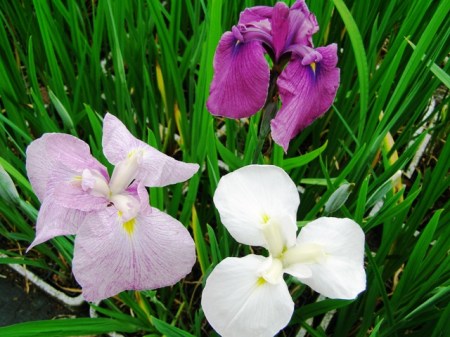
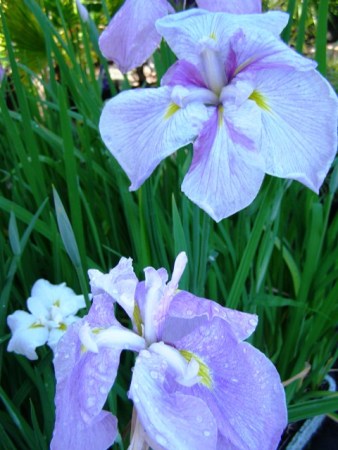
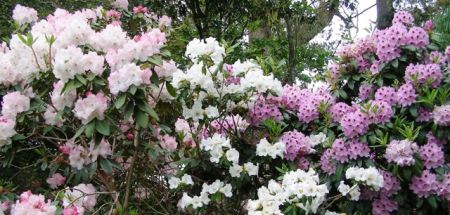 Rhododendron Elizabeth Titcomb to the left, Blue Pacific to the right and R. lindleyi (Ludlow and Sherriff form) caught in their cleavage, as Mark describes it – though nearly strangled might be a better description.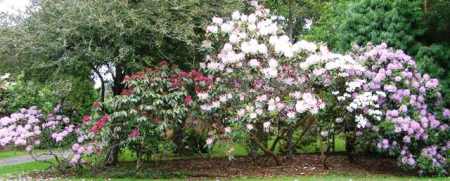
 Tikorangi The Jury Garden