Tag Archives: Mark and Abbie Jury

Rhododendon johnstoneaum “Ken Burns”

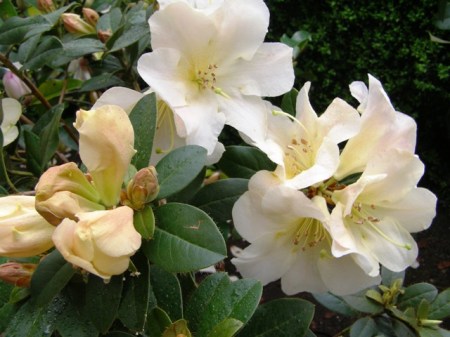
Rhododendron johnstoneanum "Ken Burns"

Rhododendron johnstoneanum "Ken Burns"

October is the peak time for rhododendrons and while this group of plants has seen a considerable slide in popularity in recent years, there is delicious anticipation in watching buds fatten, show colour and then gradually open. We would not want to be without plenty of them in our garden and this week it is “Ken Burns” that is looking delightful. It is hard to describe the colour. I would call it honey buff, others describe it as champagne. The buds are buffy yellow with a pink flush and the fully open flowers fade out to a cream with a yellow throat. It is even lightly scented. The leaves are quite small and slightly hairy and the plant stays well furnished and compact to about 1.2 metres high and a similar width. But for those of us living in warmer parts of the country, one of the real stand-out features of “Ken Burns” is that it stays healthy and rarely gets affected by nasty thrips (which turn the leaves silver and weaken the plant) or by sun scorch.

I had always thought that this is just a superior selection of the species R. johnstoneanum (which is as it occurs in the wild – raising species from seed gives variation within the seedlings), but it appears that there is a school of thought that it may be a natural hybrid (in other words, R. johnstoneaum crossed with something else unknown). The story goes that the original plant was growing in the garden of Mr Ken Burns who lived near Timaru and it was nearly lost when a bullock leaned too heavily on the fence and inflicted major damage on it. Somebody salvaged the plant and named it for Mr Burns. It is not at all the done thing to name plants after oneself. Since then, all plants bearing this name have been propagated by cutting which keeps the plant true to name. To raise it from seed would be to give rise to more seedling variation so it would no longer be “Ken Burns”.

Grow it Yourself – beetroot

Beetroot is enjoying something of a renaissance these days. It has gone beyond the large tinned slices which made sandwiches and hamburgers soggy, as it has progressed past being grated and set in vinegar flavoured jelly. These days you are more likely to find baby beet, golf ball sized, served with fresh curd cheese and toasted fresh walnuts in upmarket lunch dishes or flavoured with balsamic vinegar and roasted. The good news is that it is a root crop which is dead easy to grow at home and fresh young beet will always taste sweeter and more delicious than woody old things you may have tried in the past.

Being a root crop, it likes well drained, friable soils which are not too rich in nitrogen. Usual practice is to sow it in a spot where you previously grew a green, leafy crop. The seed is usually sown directly into the ground. Cover them with about 2cm of soil. As they germinates, go through and thin the crop – these thinnings are delicious and often found in salad mixes. Essentially you want to reduce the crop to allow about 10cm spacings between each plant to give them room to develop the tubers. Do not expect good crops if you miss the thinning process. They take about two to three months to mature. This is not a time specific crop. You can sow any time between early spring to mid autumn (about September to April), though you may find the summer crops bolt to seed too readily, especially if the soils are dry. Chief Veg Grower here advises that he prefers to keep to spring and autumn sowing because there are plenty of other more time sensitive crops to fill the garden in summer. Root crops appreciate plenty of moisture to develop juicy roots. Left too long in the ground, they will become large, old and woody. It is better to harvest them, remove the leaves and store in cool conditions – this will probably have to be the fridge in summer. With the rise in popularity, there is now a whole range of different varieties available with variation in both shape and colour, even a cerise and white candy ringed version.

Tikorangi Diary Thursday 13 October, 2011

Mark's meconopsis available again

Mark's meconopsis available again

As we hurtle into spring, the pressure is on to get the garden all groomed up and ready for our annual garden festival at the end of the month. This means we are around most of the time so plant sales are not restricted to just Fridays and Saturdays. If you come in and can’t find anyone, please sound your car horn. We have Eftpos available (but not credit cards).

Half price on most magnolias (while stocks last). This includes Vulcan, Burgundy Star and Black Tulip but not Felix Jury (which is in short supply). It is nearing the end of the season – the plants would be happier in your garden than in our nursery. There are about a dozen Magnolia grandiflora “Little Gem” left at the bargain basement price of $12 (but the Camellia Jury’s Yellow have gone). Magnolias are listed under Plant Sales on our website but not with sale prices – halve them. This offer includes good plants of Fairy Magnolia Blush – if you have been planning a hedge of them, now is your chance to do it at a very reasonable price.

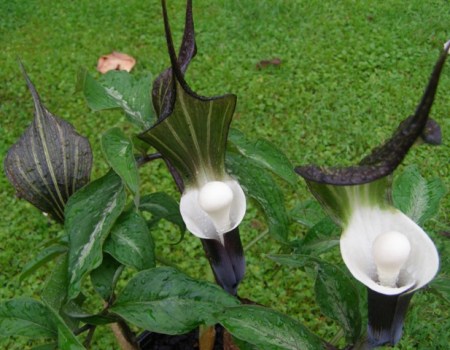
The very curious Arisaema sikkokianum

The very curious Arisaema sikkokianum

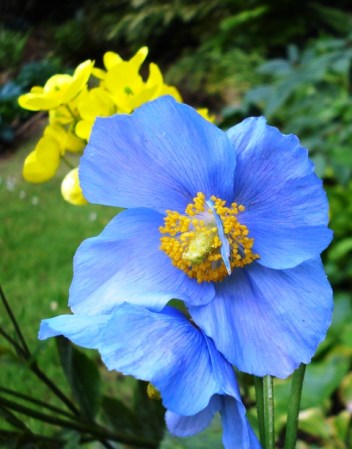
In the treasures line, we have some of Mark’s meconopis for sale – blue Himalayan poppies. These plants are already in their second year and show more perennial tendencies than usual in our climate (though not guaranteed perennial – it would pay to gather the seed this year as well). And we have good plants of Arisaema speciosum (great for woodland carpets) and the curious, showy but more difficult Arisaema sikkokianum.

No mail order, sorry. Personal customers only.

Tikorangi Notes: Tuesday 11 October, 2011

Notable, perhaps, for a total absence of any PC thinking here!

Notable, perhaps, for a total absence of any PC thinking here!

Tikorangi Notes: Tuesday 11 October, 2011

I am a little late with the links to latest posts this week. They were available on Friday as usual but I was in Hamilton speaking at the Waikato Home and Garden Show – where I found a wonderful example of absolute lack of any hint of political correctness. Golliwog scarecrows – gollycrows, perhaps. I am guessing that the creator had simply no concept whatever of the debate two decades ago about Little Black Sambo, the Black and White Minstrels and golliwogs which forever labelled these as monuments to racial stereotyping.

Latest posts:

1) Cyrtanthus falcatus – a first flowering for us of this interesting large bulb and member of the amaryllis family. We must have waited well over a decade for this event.
2) Kicking off the debate here on the difference between maintenance and sustainability in the garden – Abbie’s column.
3) Grow it Yourself looks at potatoes this week.

Rhododenrons Floral Sun and Rubicon

Rhododenrons Floral Sun and Rubicon

Tikorangi Notes: Tuesday 11 October, 2011

Arisaema sikkokianum

Arisaema sikkokianum

As the magnolias pass over, it is the time for rhododendrons and the mid season bulbs to come into their own. While the soft golden tones of Rhododendron Floral Sun and the pure red of Rubicon side by side may lack subtlety, they present an eye catching combination in our carpark. Rhododendrons often have a relatively short time in full bloom but the anticipation of fat buds showing colour and starting to open extends the flowering season substantially. It is also arisaema time for us. A. sikkokianum is not the easiest variety to keep going as a garden subject and it needs to be increased by seed as a rule, but it is one of showiest species in flower with its pure white spadix and its bloom held above the foliage. A. speciosum is not as showy but is trouble-free to grow and settles in most comfortably for the long haul. It has very curious burgundy snake’s head flowers held just below the tall, open foliage.

With our annual garden festival now just two and a half weeks away, the pressure is on the groom the garden to pristine standard for the 10 days which is our peak time for garden visitors. Formerly referred to Rhodo Festival, this year its full name is the Powerco Taranaki Garden Spectacular (!). More details at www. gardenfestnz.co.nz.

Cyrtanthus falcatus

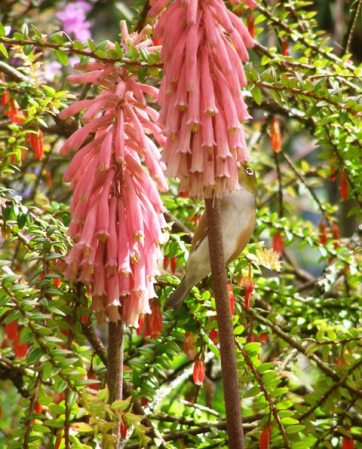
Cyrtanthus falcatus - more a curiosity than a beauty

Cyrtanthus falcatus - more a curiosity than a beauty

We are rather delighted with our Cyrtanthus falcatus this week. It is not that it is a flower of great beauty in its own right, more that it is a plant of great curiosity and a bit of triumph to grow in the garden.

The cyrtanthus family come from South Africa. By far the most common form is the one widely known as the red vallota (Vallota speciosa, often called the Scarborough lily though it is a member of the amaryllis family and not a lily at all). We also use the dainty but sweetly scented evergreen Cyrtanthus mackenii in the rockery. It will not stop you in your tracks. But C. falcatus will attract anybody who is interested in plants.

We first saw it flowering in the UK in a glasshouse at Wisley back in the mid nineties and have never seen it flower in this country. That is not to say that it hasn’t ever flowered here, just that we haven’t seen or heard of it flowering. Auckland plantsman, Terry Hatch, listed it many years ago and Mark bought several bulbs. Only one survived. He had been trying to grow them in containers but in desperation planted the last remaining specimen into the garden where it has thrived and multiplied. The original bulb is now about the size of a belladonna bulb, so large, and has at least three visible offsets. But this is its first flowering. We have only waited well over a decade, maybe even fifteen years for this event. The mottled stem is about 30cm, strong and curved at the top like an upside down umbrella handle so the reddish pendant flowers face downwards. Who knows, given another decade or two, we may have a whole drift of them and they will undoubtedly be more spectacular when there is more than one. Good things take time.