
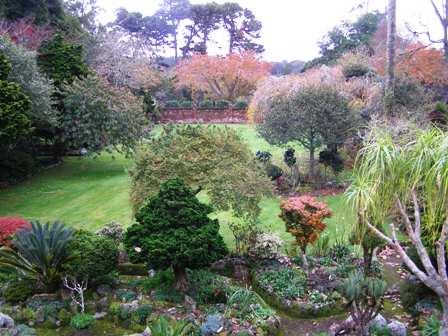
The front lawn - a support player, not the star
A gardening newsletter arrived this morning and it contained a quote: “Lawns, hedges and edges… these are what make a good garden.” No. I do not agree. Lawns, hedges and edges are what make a tidy garden and that is something entirely different.
The person being quoted was Sue Macfarlane of Winterhome Garden near Kaikoura. I have been to Winterhome and I really liked it. This was surprising because it is a garden which makes heavy use of low buxus hedges and I am not the world’s greatest fan of the use of this device to define spaces. But what I remember of Winterhome is the use of long vistas and enticing avenues which draw you down to explore with a sense of anticipation, which was well rewarded in this garden. There was a confident use of space and distinct changes of mood and style. It was carried off with panache.
But I don’t remember anything about the lawns at Winterhome and as far as I am concerned, that is entirely as it should be.
I do not understand the obsession with lawns in New Zealand. To me, it smacks of a suburban obsession which has nothing to do with gardening. When you visit a garden, if you remember the lawn it is for one of two reasons.
Either it is a rank and unkempt assemblage of ill cared for low growing green plants, probably infested with flat weeds and onehunga weed, desperately in need of some mowing, edging and a little weeding.
Alternatively, it is a pristine velvet sward of such immaculate perfection that it is a feature in itself. And to Mark and me, that is as bad as the unloved lawn. Perfection shouts: unsustainable garden practices! Heavy use of selective sprays! Unacceptable use of synthetic fertilisers! Summer watering which washes the chemicals even further afield! Removal of all clippings! Dethatching every year!
I remember interviewing for a commissioned piece, profiling a garden for a national publication. The owners were terribly proud of their lawn and claimed that garden visitors often said they wanted to take their shoes off and luxuriate in bare feet on the grass. I caught Mark’s sideways glance to me and later he expostulated: “You want to take your shoes off and expose your bare skin to the chemical cocktail on those lawns????”
In a good garden, as far as I am concerned, you should not notice the lawn. Grass is a bit player, the chorus line playing a support role. It is there to fill in spaces and to make the surroundings shine. Tiny town gardens may do away with lawns. My mother always dispensed with all grass but that was because she would rather garden than mow lawns and she never, ever, ever managed to get a rotary lawnmower started (not even a brand new one) so the only choices were a handmower or no lawns. She chose the latter. But in bigger gardens, grass gives a breathing space, a sense of open-ness and simplicity which is a sharp contrast to intensively planted areas. In a family garden, it is the place for the trampoline and the cricket or badminton set, or for the dogs to run.
According to “The Curious Gardener’s Almanac”, over three-quarters of the garden chemicals sold in Britain are for the improvement of lawns. That was in a 2006 publication. And the British are nowhere near as obsessed with lawn perfection as we are in NZ and also in USA so our percentage may even be higher. How can that be justified?
We have lawns here. In fact we have quite extensive lawns. The one in front of the house is substantially larger than a tennis court. We mow them religiously every week on the Rolls Royce of lawnmowers which cost more than our car (it is a Walker Mower from the US). But we use a mulcher deck on the mower. We do not remove the clippings so we do not need to pour fertilisers on to replace the goodness from the clippings stripped off. Mark will spray occasionally (very occasionally) and we try and keep the flat weeds and onehunga weed out, often by handweeding. Beyond that, as long as it stays green and cuts well, we can live with a bio-diverse green sward. And should we chose to gather our clippings, we could spread them in the vegetable garden without causing problems to tomatoes and capsicums (there is a good test for the toxicity of your lawn clippings).
We also have grass, as in our park. It has a major colonisation of daisies which look particularly pretty in flower in spring. And we have moss in shady areas. But all these grassy areas gives the framework and breathing space in the garden, obligingly filling their support role without wanting to be the main act.
The final words on lawns and grass belong to vintage Alan Titchmarsh – a doyen of English gardening. He published a seriously funny book in 1984, called “Avant –Gardening, A Guide to One-Upmanship in the Garden”. I inherited a copy from my late mother. I found a second copy for a friend, believe it or not, in a second hand bookshop on the Greek island of Patmos so clearly there are other copies kicking around in odd places. I am not sure aforementioned friend appreciated what a gem this book is but never mind. Of lawns, Titchmarsh wrote: “ Avant-gardeners do not have lawns; they have grass…. Gardeners with large plots should devote a good sized area to unmown grass where wild flowers and bulbs can be allowed to flourish. The more this site is criticised by tidy gardeners the better. A bit of name-dropping will get you out of tight corners. Try: “Christopher Lloyd does it at Dixter, you know.”
The trouble is that in this county, it is just as likely that your critic will never heard of Christopher Lloyd, let alone Alan Titchmarsh. But maybe we will come of age and review the elevated status we place on the unsustainable ideal of the perfect lawn.

 Tikorangi The Jury Garden