Tag Archives: Mark and Abbie Jury

Tikorangi Notes: Sunday 12 June, 2011

Latest posts:

1) Introducing Roma Red, our first new camellia release for a decade.

2) Tikorangi Garden Diary – what we have been up to in the last week (including a few hints on timing for pruning of rhododendrons and camellias and why you should never try mulching your hydrangea prunings).

The first blooms on Magnolia campbellii - a new season starts

The first blooms on Magnolia campbellii - a new season starts

A little battered by the rains, but the first of the michelias has opened

A little battered by the rains, but the first of the michelias has opened

Tikorangi Notes: Sunday 12 June, 2011
We measure our years by the start of magnolia flowering heralding a new season. This week, just the second week of June and winter chill yet to bite, Magnolia campbellii has opened its first two flowers. The leaves are still falling but the promise of a new season is already upon us. So too with the earliest michelia – the first of the fragrant maudiae hybrid series has quite a few blooms open already. The heavy rains of the past week have not been great for the flowers but we know they will just go from strength to strength over the next months.

The rains hit (again) this week – already over 120mm since last weekend. As our rain falls in torrents over a short space of time rather than in prolonged showers, that adds up to some very heavy downpours. It is all right outside – we are well used to rain and have free draining soils. But Mark has to patrol the roof and ceiling when the rains get too heavy. We once went to a slide lecture by the current owner of Villandry in France. The style of gardening bears no resemblance at all to what we do here but we were particularly amused by the charming Frenchman who is the current owner saying that whenever it rains heavily, he has to frequent the attics in search of leaks. Admittedly, he has a chateau on a grand scale whereas we merely have a house with ageing concrete tiles but there is some remote bonding in a shared task.

Introducing Roma Red – our latest camellia

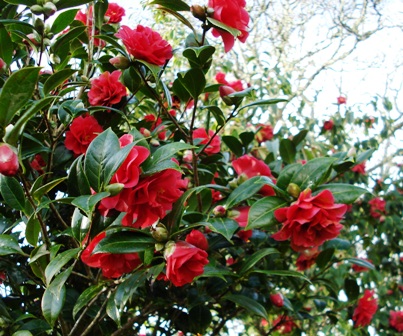
Roma Red - our first new camellia release for a decade

Roma Red - our first new camellia release for a decade

Camellia Roma Red in full bloom

Camellia Roma Red in full bloom

The first new camellia we have released for a number of years – in fact the first since Camellia Volunteer in 2001. Nobody could accuse us of naming and releasing new cultivars willy nilly. Roma Red has been a long time in the trialling process. The original plant is clipped as a lollipop standard and we have admired its good, red formal blooms for many years. Trials showed that it sets excellent flower buds on young plants and has pleasing compact growth. The flowers are formal and red – very red on the parent plant, tomato red even. In container grown plants, the red can take on a slightly coral tone but perfection is hard to find and we remain confident than when planted out, that true red will reign supreme.

Roma Red is available from selected independent garden centres this season or we have a few plants available here.

Tikorangi Garden Diary: Sunday 12 June, 2011

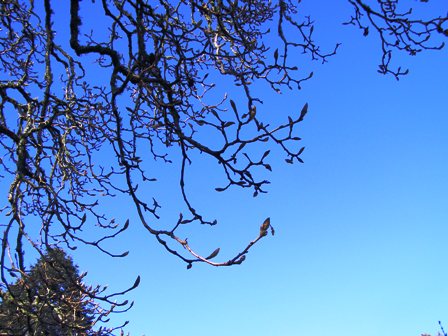
Fattening magnolia buds signal the need for a nightly possum patrol

Fattening magnolia buds signal the need for a nightly possum patrol

Despite the torrential rains this week attempting to undermine our gardening efforts, we are nearly at the end of the renovation of the Avenue Gardens. Now it is just a case of getting the mulch on to suppress the legions of weed seeds which will be triggered to germinate by digging and cultivating the soil. We have done a lot of lifting and limbing, reclaiming vistas that had gradually disappeared over the years. It always feels rather brutal cutting off branches laden in flower buds (both rhododendrons and camellias in this case) but it is best to carry out hard pruning in winter.

It may be fine in a small garden to plan hard pruning for the exact time as flowering passes its peak, just before the plant puts on its new growth. The timing is different for every plant and maybe in a small garden, one is out and about every day, ready with the loppers, saw and secateurs to seize the moment. But in a big garden, it is far more likely that we working somewhere else entirely and the opportunity passes without notice for another year. So we are hard pruning right now. Overcrowding had forced many plants to grow out at an angle so some of the pruning has been an attempt to counter that inclination.

The mulcher is working overtime (with Lloyd on the end of it). Small mulchers tend to be so slow and limited that they are more trouble than they are worth, but ours is a reasonably grunty machine capable of most of what we require. If the wood is too large for the mulcher, then it is big enough to warrant cutting up for firewood. We do not, however, mulch hydrangea prunings. Not after Lloyd told us he tried mulching his at home one year and discovered micro-propagation. The carpet of mulch became a carpet of hydrangea buds which all took root and grew.

Hydrangea and rose pruning has also started. While gardeners in colder climates may prefer to leave this until after the worst of winter (pruning can trigger fresh new growth which then gets frosted), our winter temperatures are not low enough to cause problems.

Mark thinks he is getting on top of the rat population but is now starting possum patrol. The magnolia buds are swelling and while they are not a favoured food for the pesky possums as the oranges are, every year at least one develops a taste for them. As they gnaw in and eat out just the tasty centre of the bud, it is not clear that anything has happened until the flowers open in a sad and deformed manner. Year in and year out we receive phone calls from concerned magnolia owners wondering what is wrong with their tree at flowering time. Nothing that high velocity lead earlier in the season can’t cure. Often the gaudy rosella parrots are blamed but in our experience, it is the other pesky Australian import – the possum.

Tikorangi Notes: Monday 6 June, 2011

Latest Posts:
1) What does your lawn say about you? (Subtitled: a plea for sustainability in lawn management). Abbie’s column.

2) Plants that Delight – a reprint of an article featuring my seven favourite plants in the latest Weekend Gardener – although a cynic might suggest that this is in part the seven plants for which I had good photos. When Mark is asked what is his favourite plant/magnolia/michelia/camellia/rhododendron, he is inclined to reply: “Whichever is in flower this week.”

3) Tikorangi Diary No. 2. What we have been doing in the garden last week, including praise for our big walnut, Freshford Gem, and a lament for what has happened to the garden pages in our local paper. My ruggedly independent advice for garden tasks for the week has been replaced by garden tasks as recommended by a local garden centre: you need three different fertilisers when planting your roses. I have not heard of chitting garlic prior to planting before and you are meant to get out and spray all your deciduous plants with copper now to hasten leaf drop. We blenched at the prospect in a garden our size. Besides, I rather thought deciduous plants dropped their leaves when they were ready to. My beloved Plant Collector has been replaced by a shopping reporter. My columns and Outdoor Classroom have been replaced by low grade stories about people who have gardens of some description but no particular skills and no interesting insights. Sigh. Serves me right for having an argument with the deputy editor.

Luculia pinceana Fragrant Cloud

Luculia pinceana Fragrant Cloud

Tikorangi Notes: Sunday 5 June, 2011

How lovely is the luculia? Well relatively lovely if it is the garish little, candy pink Luculia gratissima Early Dawn and particularly lovely if it is the wonderful Luculia pinceana Early Dawn or Fragrant Pearl.  These somewhat tender Asian shrubs are a feature of our early winter garden.

Alas Mark found the first instance of camellia petal blight today – in a japonica. It seems to appear earlier every year. We have never seen it in sasanquas and I was a little surprised this week to hear of claims that in warmer climates, sasanqua camellias are susceptible. We would really like to hear confirmation from anybody who has actually seen it in sasanquas (as opposed to having heard reports of it). We had thought that these Japanese camellias were resistant. Blight has certainly never shown in ours and we are reasonably eagle-eyed on the matter.

What does your lawn say about you?

The front lawn - a support player, not the star

The front lawn - a support player, not the star

A gardening newsletter arrived this morning and it contained a quote: “Lawns, hedges and edges… these are what make a good garden.” No. I do not agree. Lawns, hedges and edges are what make a tidy garden and that is something entirely different.

The person being quoted was Sue Macfarlane of Winterhome Garden near Kaikoura. I have been to Winterhome and I really liked it. This was surprising because it is a garden which makes heavy use of low buxus hedges and I am not the world’s greatest fan of the use of this device to define spaces. But what I remember of Winterhome is the use of long vistas and enticing avenues which draw you down to explore with a sense of anticipation, which was well rewarded in this garden. There was a confident use of space and distinct changes of mood and style. It was carried off with panache.

But I don’t remember anything about the lawns at Winterhome and as far as I am concerned, that is entirely as it should be.

I do not understand the obsession with lawns in New Zealand. To me, it smacks of a suburban obsession which has nothing to do with gardening. When you visit a garden, if you remember the lawn it is for one of two reasons.

Either it is a rank and unkempt assemblage of ill cared for low growing green plants, probably infested with flat weeds and onehunga weed, desperately in need of some mowing, edging and a little weeding.

Alternatively, it is a pristine velvet sward of such immaculate perfection that it is a feature in itself. And to Mark and me, that is as bad as the unloved lawn. Perfection shouts: unsustainable garden practices! Heavy use of selective sprays! Unacceptable use of synthetic fertilisers! Summer watering which washes the chemicals even further afield! Removal of all clippings! Dethatching every year!

I remember interviewing for a commissioned piece, profiling a garden for a national publication. The owners were terribly proud of their lawn and claimed that garden visitors often said they wanted to take their shoes off and luxuriate in bare feet on the grass. I caught Mark’s sideways glance to me and later he expostulated: “You want to take your shoes off and expose your bare skin to the chemical cocktail on those lawns????”

In a good garden, as far as I am concerned, you should not notice the lawn. Grass is a bit player, the chorus line playing a support role. It is there to fill in spaces and to make the surroundings shine. Tiny town gardens may do away with lawns. My mother always dispensed with all grass but that was because she would rather garden than mow lawns and she never, ever, ever managed to get a rotary lawnmower started (not even a brand new one) so the only choices were a handmower or no lawns. She chose the latter. But in bigger gardens, grass gives a breathing space, a sense of open-ness and simplicity which is a sharp contrast to intensively planted areas. In a family garden, it is the place for the trampoline and the cricket or badminton set, or for the dogs to run.

According to “The Curious Gardener’s Almanac”, over three-quarters of the garden chemicals sold in Britain are for the improvement of lawns. That was in a 2006 publication. And the British are nowhere near as obsessed with lawn perfection as we are in NZ and also in USA so our percentage may even be higher. How can that be justified?

We have lawns here. In fact we have quite extensive lawns. The one in front of the house is substantially larger than a tennis court. We mow them religiously every week on the Rolls Royce of lawnmowers which cost more than our car (it is a Walker Mower from the US). But we use a mulcher deck on the mower. We do not remove the clippings so we do not need to pour fertilisers on to replace the goodness from the clippings stripped off. Mark will spray occasionally (very occasionally) and we try and keep the flat weeds and onehunga weed out, often by handweeding. Beyond that, as long as it stays green and cuts well, we can live with a bio-diverse green sward. And should we chose to gather our clippings, we could spread them in the vegetable garden without causing problems to tomatoes and capsicums (there is a good test for the toxicity of your lawn clippings).

We also have grass, as in our park. It has a major colonisation of daisies which look particularly pretty in flower in spring. And we have moss in shady areas. But all these grassy areas gives the framework and breathing space in the garden, obligingly filling their support role without wanting to be the main act.

The final words on lawns and grass belong to vintage Alan Titchmarsh – a doyen of English gardening. He published a seriously funny book in 1984, called “Avant –Gardening, A Guide to One-Upmanship in the Garden”. I inherited a copy from my late mother. I found a second copy for a friend, believe it or not, in a second hand bookshop on the Greek island of Patmos so clearly there are other copies kicking around in odd places. I am not sure aforementioned friend appreciated what a gem this book is but never mind. Of lawns, Titchmarsh wrote: “ Avant-gardeners do not have lawns; they have grass…. Gardeners with large plots should devote a good sized area to unmown grass where wild flowers and bulbs can be allowed to flourish. The more this site is criticised by tidy gardeners the better. A bit of name-dropping will get you out of tight corners. Try: “Christopher Lloyd does it at Dixter, you know.”

The trouble is that in this county, it is just as likely that your critic will never heard of Christopher Lloyd, let alone Alan Titchmarsh. But maybe we will come of age and review the elevated status we place on the unsustainable ideal of the perfect lawn.