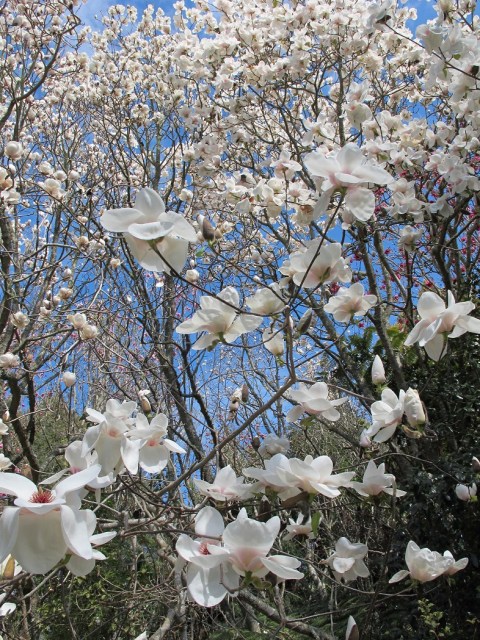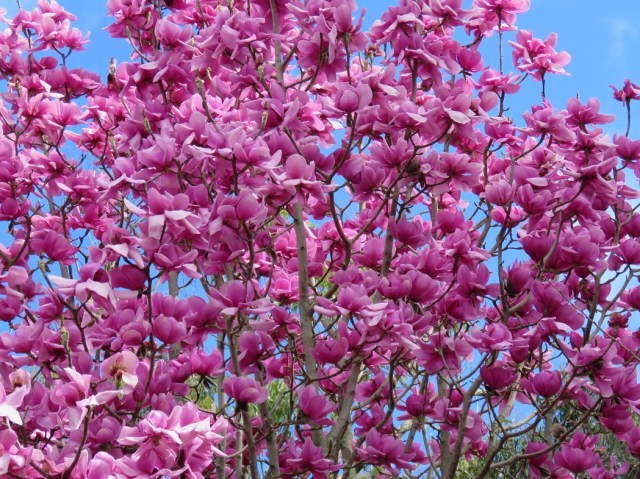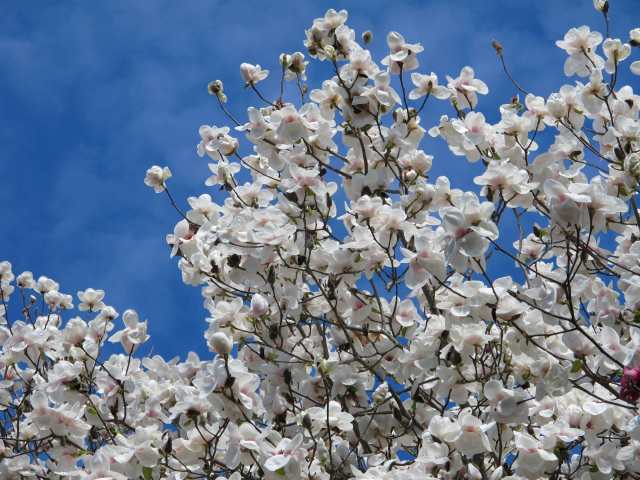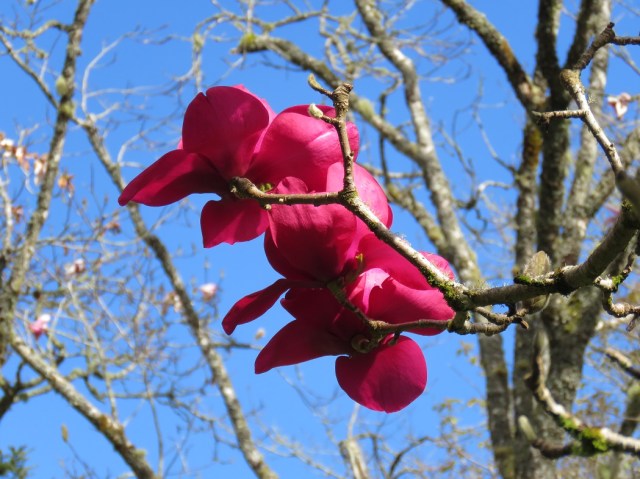
Tag Archives: Mark Jury

The Jury Magnolias. A retrospective view.

Written for and first published in the International Magnolia Society journal. In the time since writing the text and publication, we are now able to release details of the three new deciduous magnolia hybrids being released internationally.

The Jury magnolia reputation rests on just twelve deciduous magnolias so far. Soon there will be fifteen and it may end up at seventeen in total. Despite originating on a farm in far-flung New Zealand, some of those plants have had a significant impact in the international magnolia world. 
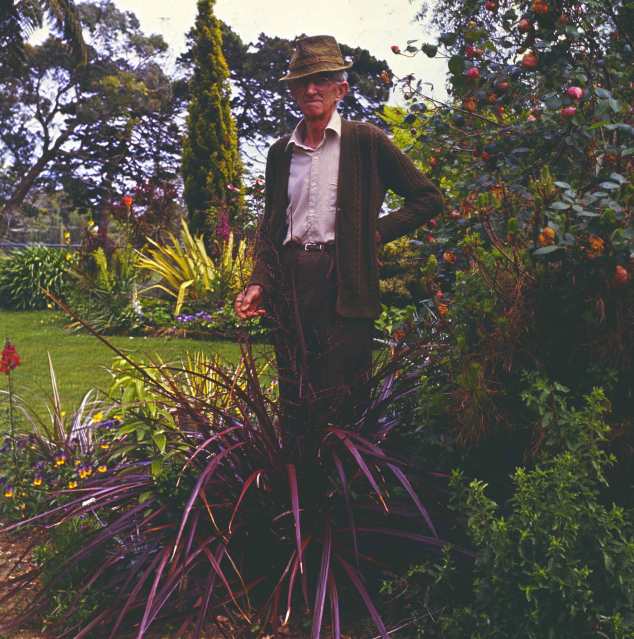
Felix in his garden, 1985. Photo credit: Fiona Clark

Felix Jury was a farmer who decided he would rather garden. He handed over the family farm to his second son as soon as he could and devoted his time and energy to building a large garden. He started by buying plants, importing new material from around the world. It was the failure of many of these to thrive in our warm temperate conditions that started him on the hybridising path. He was a self-taught amateur; like many of his contemporaries of the day, he became proficient at raising seed, striking cuttings, budding and grafting across a wide range of genus but it was always on a small scale, hobby basis. For an amateur, some of his plants have stood the test of time across the world. Phormium ‘Yellow Wave’ is still being produced internationally in surprisingly large numbers and Camellias ‘Dreamboat’ and ‘Waterlily’ have remained household names in the camellia world. He never received a cent in payment for any of these plants. Over time, it is his magnolias that have firmly cemented his name in international gardening.

Mark Jury was Felix’s youngest son. By the time Mark and I returned to the family property in 1980 with Mark planning to set up a plant nursery, his father had scaled down his adventures with plants and quietly retired to the garden. It was a privilege for both father and son to have seventeen years working closely together in remarkable harmony. Felix was able to transfer all his knowledge and experience to Mark who was keen to continue the garden development and to take the plant breeding to the next level. Unlike his father, Mark needed to generate an income. Also self-taught, Mark started the nursery, literally building up from one wheelbarrow to a successful boutique business doing mail-order, wholesale and on-site retail.

Felix didn’t raise large numbers of magnolias from his controlled crosses. They would probably number no more than fifty and over a few years only in the 1960s. Of these, eight ended up being named and released commercially. Technically, there were nine but we will return to the irritating matter of the ninth later.  He would have named more but Mark vetoed that. From an early stage, Mark took the view that fewer and more stringent selections were better than more when it comes to a genus with the potential to be long-term trees in the landscape.
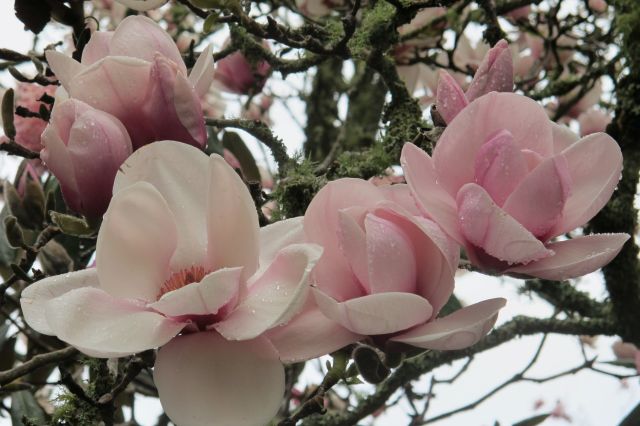
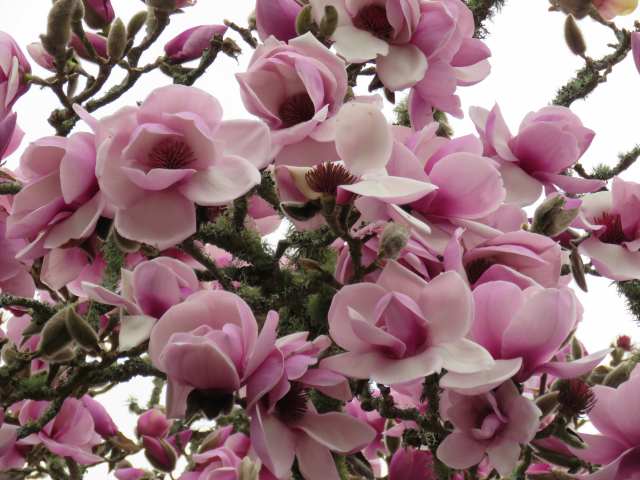
Magnolia ‘Atlas’
Magnolia ‘Iolanthe’

Of those eight, Mark has felt that probably only six should have been named. He singles out sister seedlings ‘Milky Way’ and ‘Athene’ as two that could have been narrowed down to one. For a long time, he said the same thing of ‘Iolanthe’ and ‘Atlas’ but has had to change his tune. While we regard ‘Iolanthe’ as a flagship magnolia, arguably one of the best two Felix bred in New Zealand conditions, it has never performed as well overseas and is certainly not rated as highly elsewhere. ‘Atlas’ has a larger bloom and is a prettier pink but its flowering season is short – by our standards – and we don’t often see it in its full glory because the petals are too soft and get badly weather-marked. But ‘Atlas’ appears to be hardier in overseas climates and a better performer elsewhere than it is here.
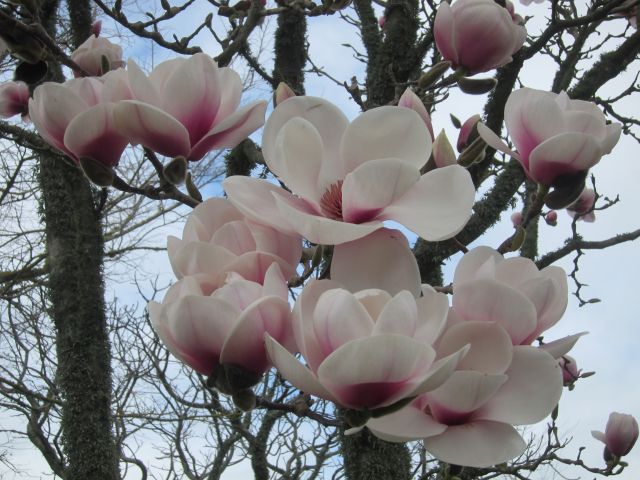
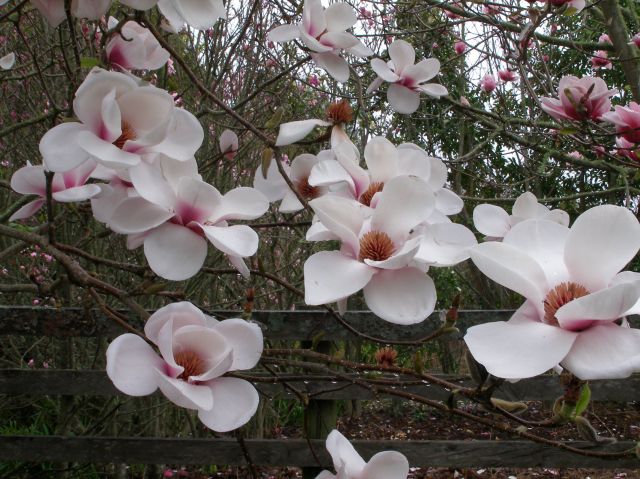
Magnolia ‘Milky Way’
and ‘Athene’. Even we have trouble telling them apart at times, particularly in photo close-ups. We can usually tell by looking at the tree and time of flowering or side by side comparisons, but we have to think about it every time.

In those days, the range of magnolias available commercially was small. Felix’s initial goal was to see if he could create hybrids that would flower on young plants and stay a garden-friendly size. It was generally accepted that when a magnolia was planted, it was realistic to expect a delay of between about seven and fifteen years to get the first blooms. He also liked the cup and saucer flower form and he wanted more colour. Of his named hybrids, six of the eight had a chance hybrid in their parentage. It was the cross he received from Hillier’s Nursery as a seedling of M. campbellii var mollicomata ‘Lanarth’. Mark has always referred to it as his father’s secret weapon. When it flowered, it was clear it was not ‘Lanarth’ but a hybrid, presumed to be with M. sargentiana robusta. He duly named it for his favourite son so it is known as Magnolia ‘Mark Jury’.
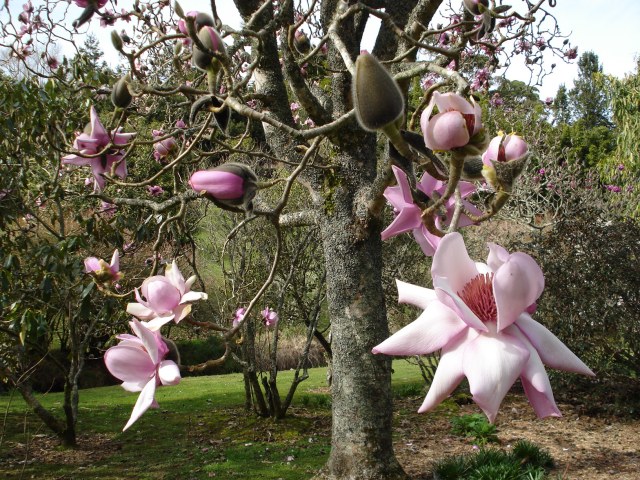
Felix’s breeder parent – M. ‘Mark Jury’ – is always distinctive with its very large blooms and pronounced recurved petals

Felix’s two greatest achievements were in creating large-flowered hybrids that bloomed on young plants and in introducing the breakthrough to red shades with his cultivar ‘Vulcan’.

Possibly under-appreciated are the additional factors of heavy textured petals, solid flower form and the setting of flower buds down the stems so blooms open in sequence, rather than just tip buds that all open at once for a mass display that may only last a fortnight. Our springtime is characterised by unsettled weather; Mark refers to the magnolia storms. One overnight storm can destroy the display of softer booms like M. sprengeri var. ‘Diva’ or wipe out the tip bud display of ‘Sweetheart’ (a ‘Caerhays Belle’ seedling).
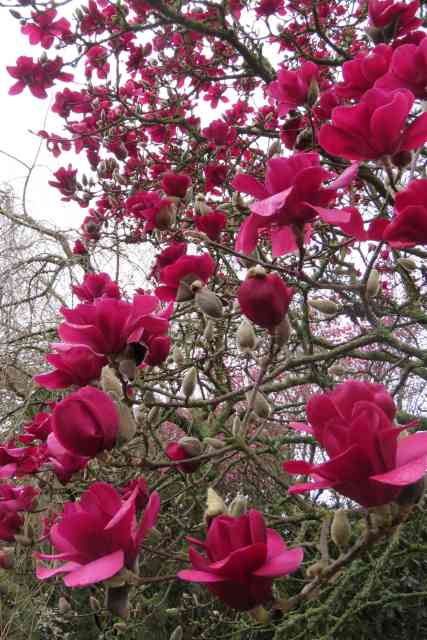
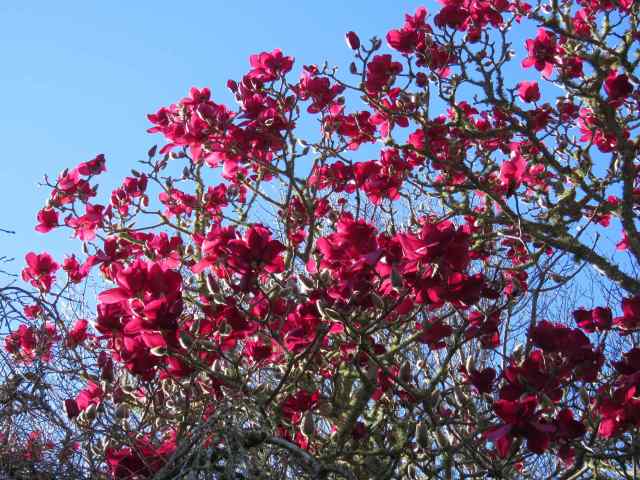
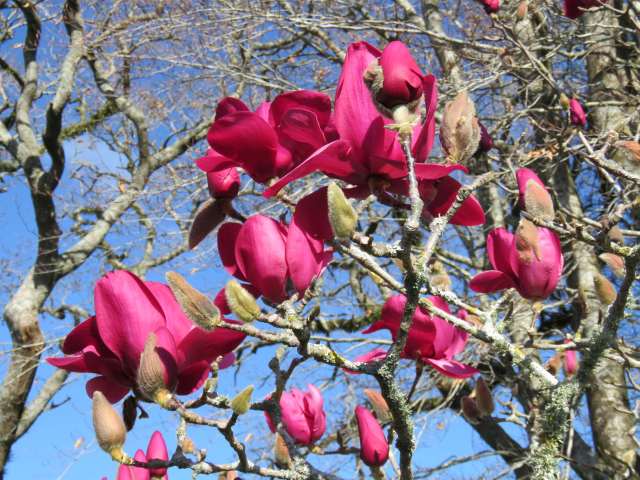
Magnolia ‘Vulcan’ at its early season best

The performance of ‘Vulcan’ around the world has been well documented and ranges from brilliant to undeniably disappointing.

I will say that ‘Vulcan’ was the only plant we have ever put on the market which we could track its flowering by the phone calls we received year on year. Being a long, thin country in the southern latitudes, magnolias open first in the warmer north and then in sequence heading down the country. The phone would start ringing in early June from the north and continue through August from more southern areas. That is a stand-out plant.

Whatever its flaws, ‘Vulcan’ opened the door to the plethora of red hybrids now available internationally and it remains a key foundation plant in the development of new hybrids.
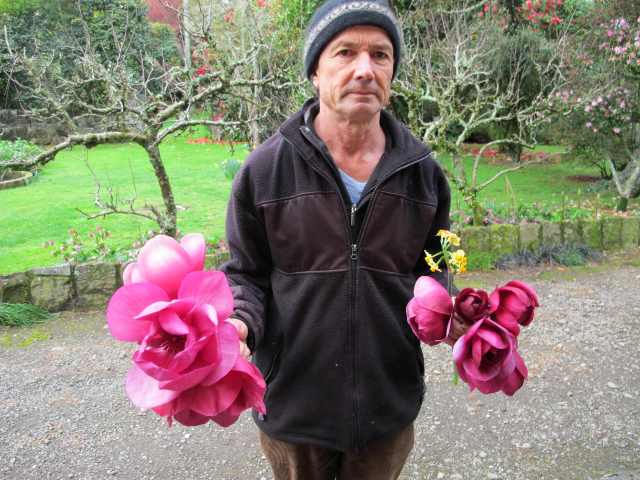
Mark, picking seedling blooms to compare back in 2013
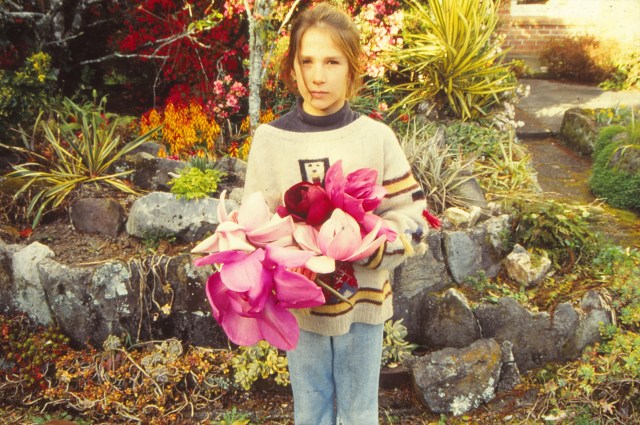
Like father, like daughter. I recently found this photo of our second child holding her father’s blooms from twenty years earlier – likely the first blooms from some of Mark’s earliest crosses

Mark started hybridising magnolias in the 1980s, picking up where his father had left off and using the same genetic base. He has raised many more controlled crosses than his father ever did. We have never counted how many but it will be well into the thousands. Of those, only four have been named and released and there is another tranche of three which are being built up for release internationally. That makes seven Mark Jury magnolias and all are distinctly different.

Ill health has cut short Mark’s breeding programme and we are now assessing the final batches of his breeding efforts. He has already decided that he has done as much as he can with the reds so he has ruled out the next generations of those and we are now looking at his yellows. We are hopeful that we will get maybe two final selections so he may end up with nine named magnolias in total.
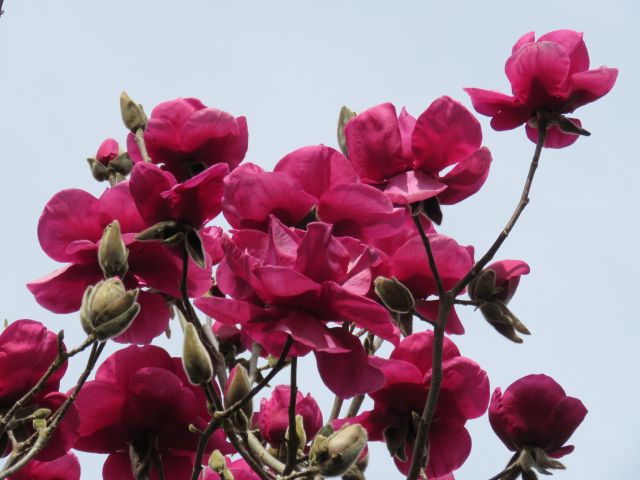
Magnolia ‘Felix Jury

He has always been particularly proud of the cultivar he named for his father, Magnolia ‘Felix Jury’. He reached the goal Felix had set – a tree that will not get excessively large but with very large, colourful blooms from an early age. It has always delighted us that Felix was still alive to see it bloom. In our climate, the colour can vary from rich pink through to deep red, at its best. Over the years, we have learned that the colour in magnolias can bleach out, particularly in colder climates, and we get exceptionally rich colour in New Zealand. Presumably this is related to the very clear light that we have, along with the soils and mild climate (never very hot and never particularly cold). ‘Felix Jury’ keeps its size and form in different climates and even when the colour is lighter in shade, it is an acceptable pink, albeit not the stronger shades we see here.
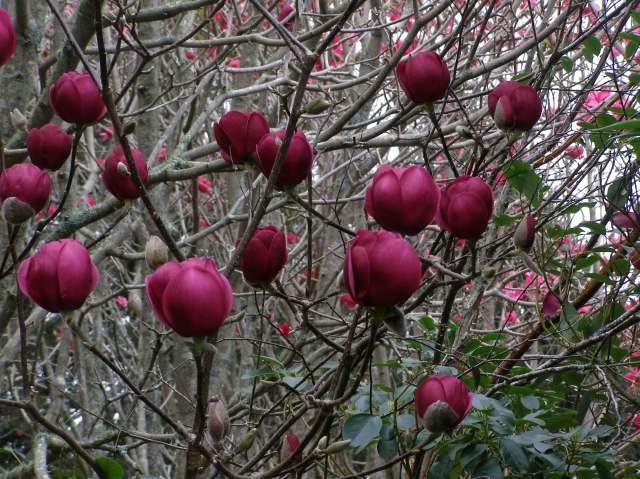
Magnolia ‘Black Tulip’

Both Mark’s ‘Black Tulip’ and ‘Felix Jury’ are showing up in the breeding of countless cultivars across the magnolia world and are clearly having long-term influence. ‘Black Tulip’ sets seed readily and it seems every man, woman and their dog have raised seedlings, judging by the photos we have seen.  None appear to be an improvement on the parent to our eyes and not many have taken it in a different direction. But its impact on the development of new hybrids is clear to see. Mark has raised hundreds of his own ‘Black Tulip’ hybrids so we see many, many lookalikes but few stand-outs.
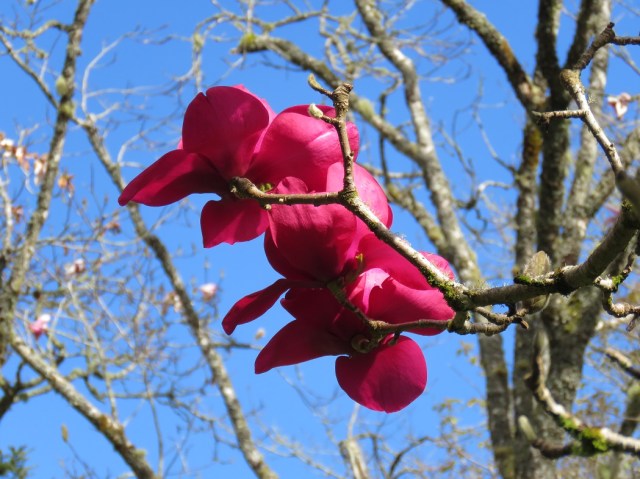
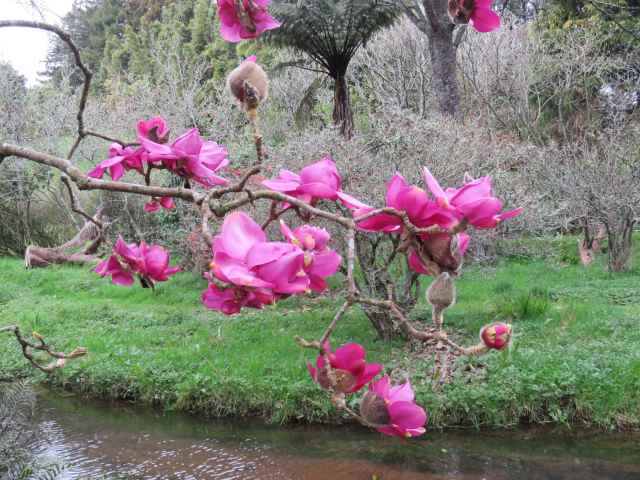
Mark’s best red, ‘Ruby Tuesday’

We have high hopes of the last red he has selected which is one of the three new ones to be released. He bypassed ‘Black Tulip’ and went back to his father’s ‘Vulcan’ as one of the parents. We don’t rush selections based on flower alone; this one goes back 20 years but its shade of red stood out from the start and the original plant has never had an off-season. It has lost the muddy purple undertones of ‘Vulcan’ and keeps its rich shade of red right through the exceptionally long flowering season. It starts a little later than ‘Vulcan’ so is less vulnerable to late frosts and the late season blooms are as good as the first ones. We describe it as a ‘Vulcan’ upgrade. It has kept the best features but eliminated the undesirable characteristics. Only time will tell if this is true in other climates but keep an eye out for this ruby red selection in the coming years.

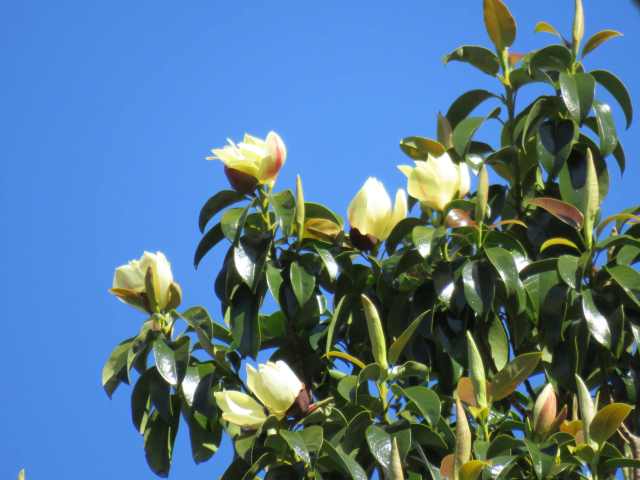
Mark turned his attention to the yellows. The magnolia world is awash with yellow hybrids, so many that it is hard to pick out the ones that are superior. Mark’s dream was of a big, pure yellow flower in the cup and saucer form of M.campbellii but on a tree that opens its flowers before its foliage appears, and in a garden-friendly size. A yellow ‘Iolanthe’ or ‘Felix Jury’, so to speak.
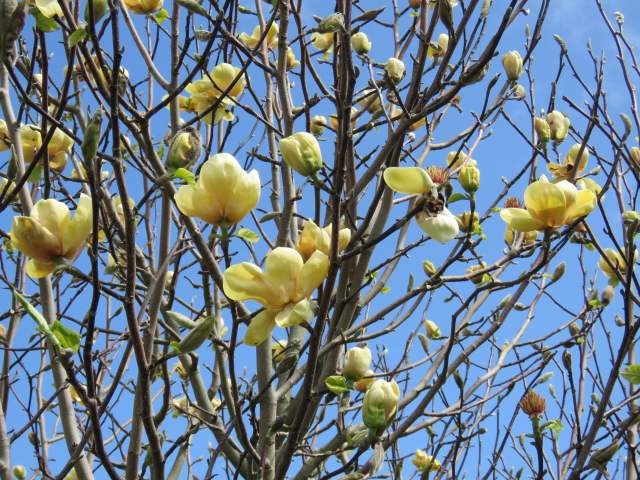
Magnolia ‘Honey Tulip’ – the only yellow Mark has named so far

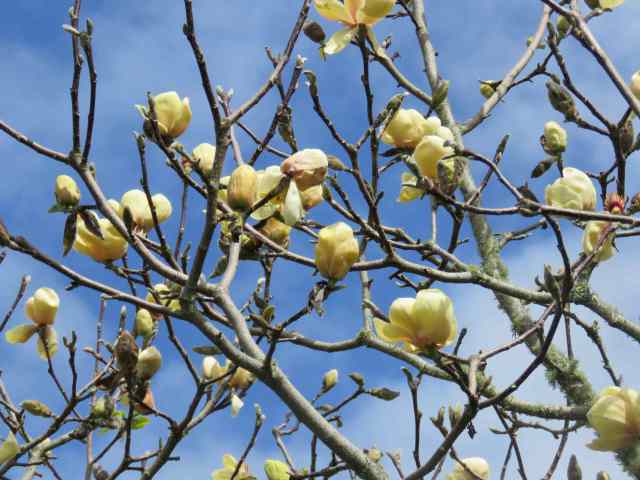
His ‘Honey Tulip’ was a step on the way. It was a break away from the pointed buds, narrow petals and small flowers that come from the dominant M.acuminata parentage. It isn’t the butter yellow he wanted but it met the brief of solid flower structure and thick texture, flowered before leaf-break and stayed small enough for most gardens. Importantly, the colour does not fade out as the season progresses.

The next generations have taken it further. He has the strong, clear yellow he wanted, the large flower size, the flower form, the slightly earlier blooming season to beat leaf-break and the garden friendly habit of growth. He just doesn’t have them all on the same plant.
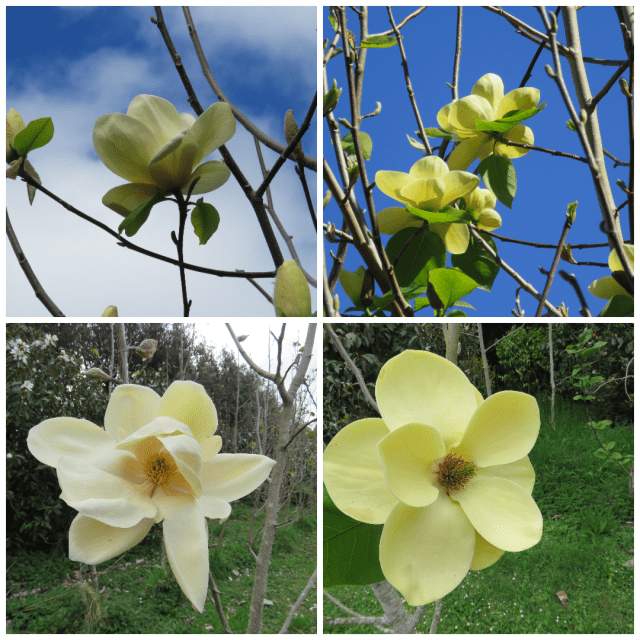
If we could just take the best aspect of each of the seedlings and get them all onto one plant, that would be good.

The goal of a big, pure yellow, cup and saucer magnolia is achievable but Mark has run out of time and energy. It will take another generation of plant breeder to reach it. That said, there are probably a couple of good yellows that are significant steps along the way that we should get out of the last batch of seedlings. One, in particular, is a very pretty lemon-yellow (so not the strong colour he wanted but still yellow) with the desired flower size and form and it is blooming from an early age although the flowers coincide with leaf-break. It is hard to reach perfection.
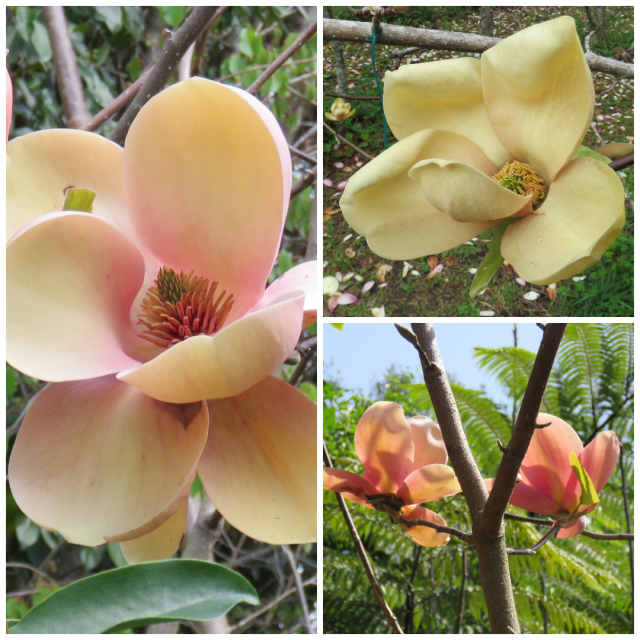
Sunset shades and caramel shades but none good enough to select yet

There are a few striking sunset mixes of strong colour on goblet shaped blooms but none of them look good enough to select. Plant selection is always made on a variety of criteria but Mark’s personal preference for solid colour is strong. Every magnolia he has named is one colour inside and out because that is what he likes. I had to twist his arm to even look at the sunset mixes; he does not think pink and yellow is a pleasing combination. He is also dismissive of what he calls ‘novelty blooms’. I marked one seedling that had distinctive, caramel-coloured blooms. Viewed close-up, they are interesting but I had to concede he was right. On the tree, they will just look like they have been hit by frost.

Always, we are selecting for plants that will look good over time in the landscape. Looking interesting as a cut flower in a vase is not enough, given the magnolia is a landscape tree with long term potential.

I mentioned the irritating ninth Felix Jury hybrid at the start. It is Magnolia ‘Eleanor May’ and I wouldn’t even reference it except I saw a photo lauding its merits in the UK this year. I don’t have a photo of it in my files which indicates the low esteem we hold it in. While it is a seedling from Felix’s breeding programme, we don’t claim it as a Jury hybrid. It is a full sister to ‘Iolanthe’ and a rejected seedling. Felix provided material of it to the nursery Duncan and Davies to use as a good root stock. From there, the nursery sent out a few failed grafts of ‘Iolanthe’ to garden centres by mistake. One plant was purchased by a customer who was observant enough to pick the difference when it flowered. He then took it upon himself to name it for his wife which may have been legal but was certainly lacking in courtesy. As far as we are concerned, it is inferior to ‘Iolanthe’, had already been rejected in selection and was an escapee by mistake. Besides, when we question releasing two of the same cross – ‘Iolanthe’ and ‘Atlas’ – why would we want to claim a third of the same cross? We have a property filled with sister seedlings which we would hate to see unleashed onto an over-crowded magnolia market.
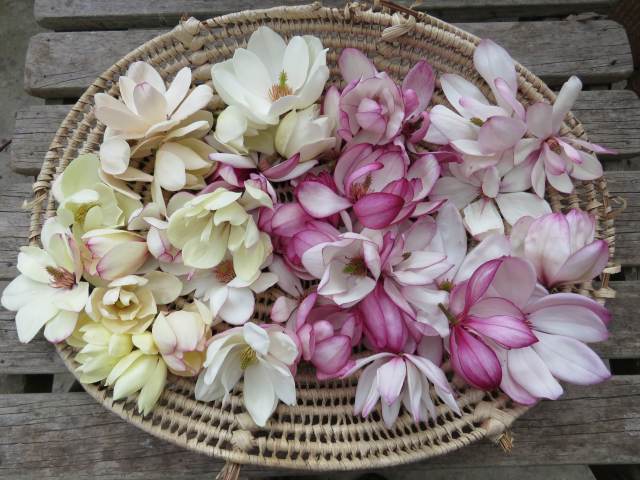
Starting with predominantly white genus, Mark has reached into the pinks, purples, peach tones and lemon as well as bicolours.

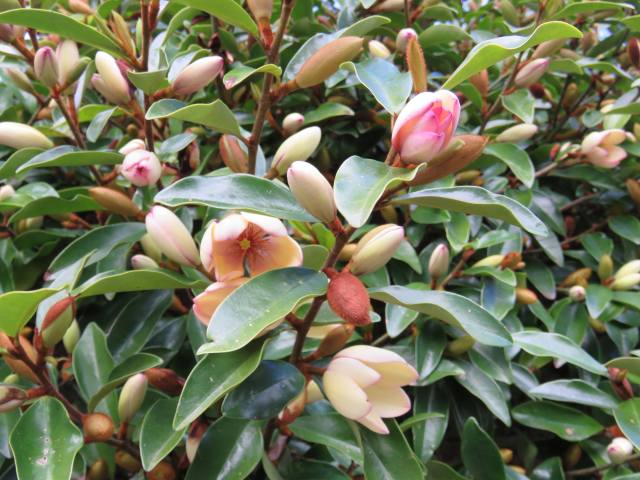
Mark’s more recent work with hardier members of the michelia group is another story. The first three selections are on the international market under the Fairy Magnolia® branding. They are in white, cream and soft pink and the next two on the way are in shades of peach and blackberry ripple. We are now onto the final round of selections which are into the bicolours and purple.
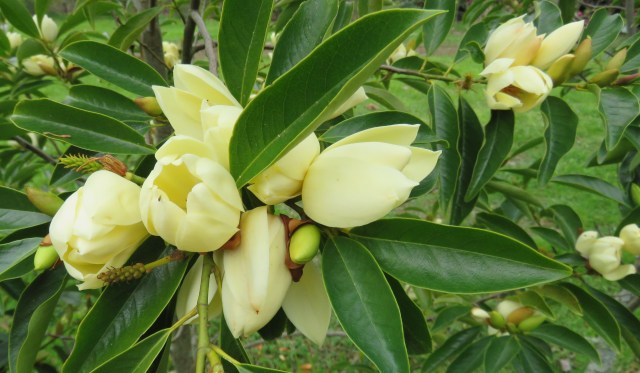
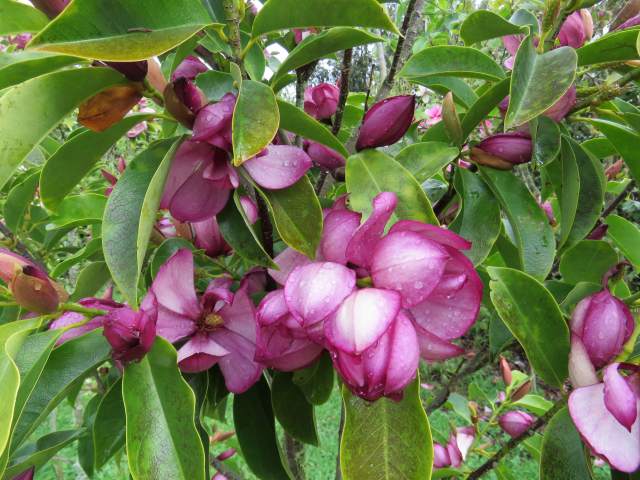
Getting there – definitely lemon but not yellow enough
The dark pinks and purples have been more rewarding than the yellows

Again, he has come up short on a strong yellow that is good enough to select and, regretfully, the really pretty apricot ones have not made the grade. But we know that those colours are within reach without sacrificing hardiness. Mark wryly describes his work on michelias as ‘RFI’. That is Room for Improvement. It will take another breeder to get there but there is plenty of promise and scope to take them further.
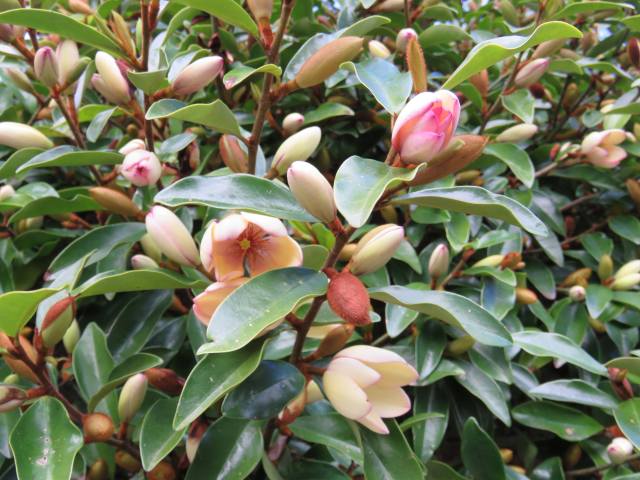
Labelled ‘FM Baby’ in my files, this new selection is being released as Fairy Magnolia® ‘Petite Peach’

Felix Jury magnolias

Apollo (probably liliiflora nigra hybrid x campbellii var mollicomata ‘Lanarth’)

Athene (‘Lennei Alba’ x ‘Mark Jury’) 

Atlas (‘Lennei’ x ‘Mark Jury’)

Iolanthe (‘Lennei’ x ‘Mark Jury’)

Lotus (‘Lennei Alba’ x ‘Mark Jury’) 

Milky Way (‘Lennei Alba’ x ‘Mark Jury’) 

Serene (liliflora x ‘Mark Jury’)

Vulcan (liliiflora hybrid x ‘Lanarth’)

Mark Jury magnolias

Black Tulip (‘Vulcan’ x)

Burgundy Star™ (liliiflora nigra x ‘Vulcan’)

Felix Jury (‘Atlas’ x ‘Vulcan’)

Honey Tulip (‘Yellow Bird’ x ‘Iolanthe’)

 Plus Ruby Tuesday, Dawn Light and Ab Fab
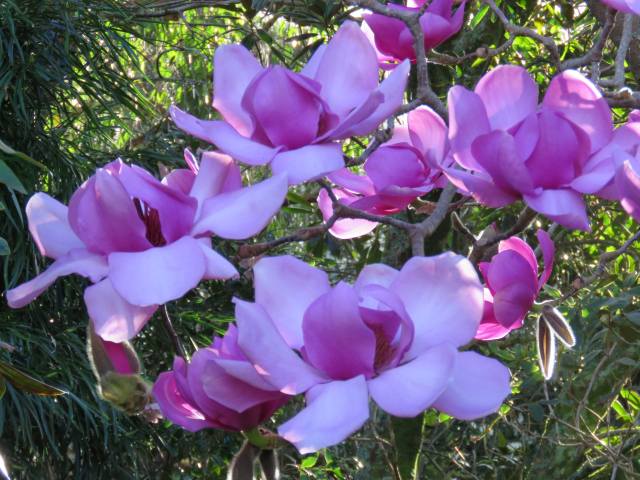
Magnolia ‘Dawn Light’
Magnolia ‘Ab Fab’

Fairy Magnolia® Blush (M. laevifolia x foggii hybrid)

Fairy Magnolia® Cream (M. laevifolia x foggii hybrid)

Fairy Magnolia® White (M. laevifolia x doltsopa)

Fairy Magnolia® Lime (on very limited release in Europe only)

Plus Fairy Magnolia® Petite Peach
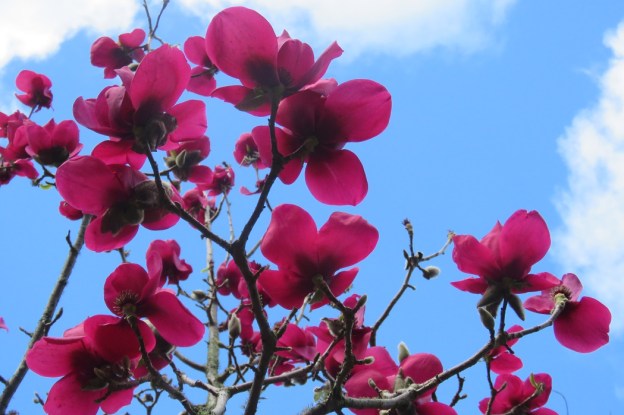
New Jury Magnolias

Lead photo: Magnolia ‘Ruby Tuesday’™

It can take a long time for a new plant from Mark’s breeding programme to reach the point of sale on the market. We have long since moved on to looking at more recent plants but it is a thrill when the time comes to seeing the plants finally released commercially into the wider world.

Magnolia ‘Dawn Light’™

It was different when we had the nursery and we would release new plants onto the domestic market. There could be a quick turnaround on those. Nowadays, we focus internationally and that is a very different ball game. It has become increasingly difficult and eyewateringly expensive to get new plants into other countries, through quarantine, trialled and then built up commercially for release. Aside from controlling the initial selection and supply of plant material for propagation, everything is done by our Australian-based agents these days – Anthony Tesselaar Plants – and for this we are truly grateful because it is a plant mission.

Magnolia ‘Ab Fab’™

This year heralds the start of a new round of plant releases – three new deciduous magnolias and the next evergreen in the Fairy Magnolia® series – but not simultaneously.

First up, there will be a limited release this year in Aotearoa New Zealand of the three deciduous magnolias, 2026 for Australia and then or soon after for Europe. Don’t even ask about USA – a work in progress there but likely to be longer.

Magnolia ‘Ruby Tuesday’™

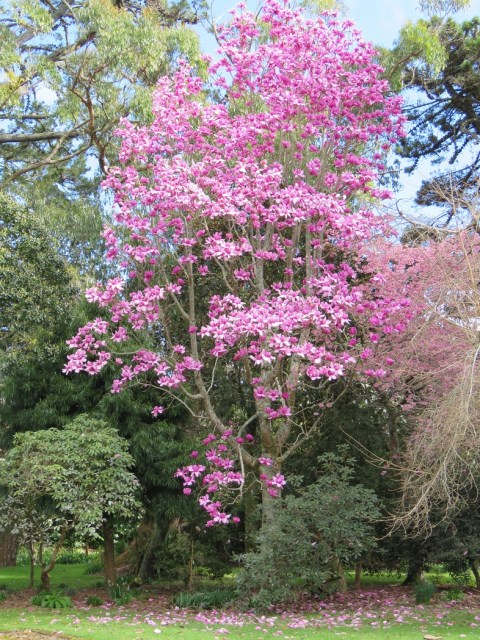
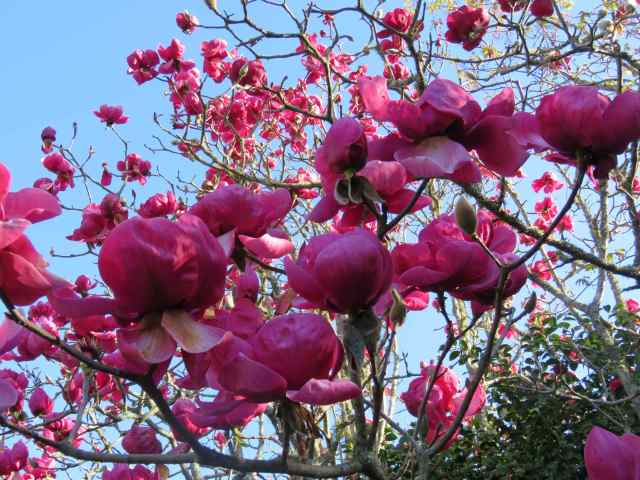
Magnolia ‘Ruby Tuesday’™ will the last of the Jury red magnolias to be named and released. It all started with Felix’s ‘Vulcan’, a breakthrough that has well and truly stood the test of time. Mark followed up with ‘Black Tulip’, ‘Burgundy Star’ and ‘Felix Jury’ – the latter varying in colour from deep red to rosy pink, depending on growing conditions. ‘Black Tulip’ and ‘Felix Jury’ in particular have become influential in international magnolia breeding. I see many photos of plants that have one or other of them in their parentage. I may be biased but I don’t see many that are an improvement on their parent.

Magnolia ‘Ruby Tuesday’™ – the original plant is a stand out in our park but small enough to fit in most domestic gardens.

It seems fitting that we end the Jury reds with Magnolia ‘Ruby Tuesday’™ because we regard it as a significant upgrade on ‘Vulcan’. It has all the desirable characteristics of ‘Vulcan’ – rich colour, smaller tree, flowering from a young age and very floriferous. But better. It loses the less desirable aspects of ‘Vulcan’. It blooms a little later in the season which is better for colder climates; it has a long flowering season and the later season flowers are as good as the earlier ones (which is not always the case with magnolias). But best of all, it has lost the purple undertones that were the main problem with ‘Vulcan’ – especially as the season progressed when the brilliant early blooms could give way to smaller flowers which tended to be rather murky and paler in colour. ‘Ruby Tuesday’ stays the same clear red from start to finish. We describe it as ‘garden friendly’ which means it is a suitable size for smaller, domestic gardens – still a tree but a smaller specimen. We are very proud of it.

Magnolia ‘Ab Fab’™
Magnolia ‘Ab Fab’™ and yes, I do think it is pretty fabulous

Second up is Magnolia ‘Ab Fab’™, the only white magnolia Mark has named. His initial code name has stuck – it is named primarily for me with a nod to Jennifer Saunders and Joanna Lumley and I feel in excellent company there. It has a huge white bloom with just a touch of pink at the petal base and we do like big flowers on our magnolias here. So, in flower size, it sits alongside Felix’s ‘Atlas’ and Mark’s ‘Felix Jury’. I was amused to be sent a photograph of it flowering in a European nursery – in Germany, from memory – of a bare stick about 1.5 metres high adorned with several excessively large white blooms. It looked impressive but is even more impressive on the original plant. It is a larger growing tree and we worried for a while that it may be too large but growth rates and size are heavily determined by climate and most magnolias around the world are grown in harder conditions than we ever get here so it is unlikely to reach the same stature that we see.

Magnolia ‘Dawn Light’™
The habit of growth on Magnolia ‘Dawn Light’™ is tall but slender

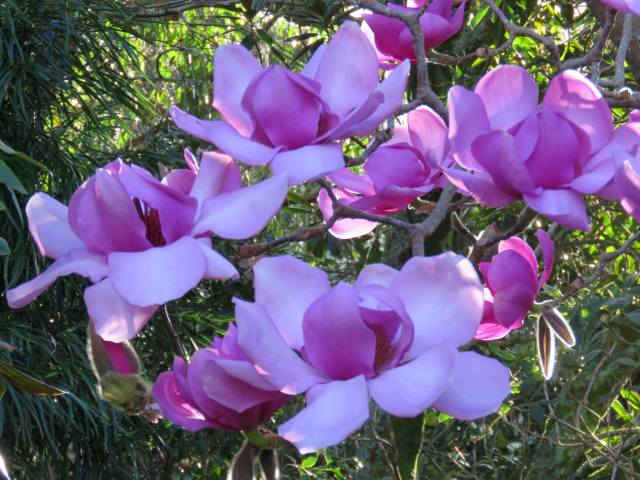
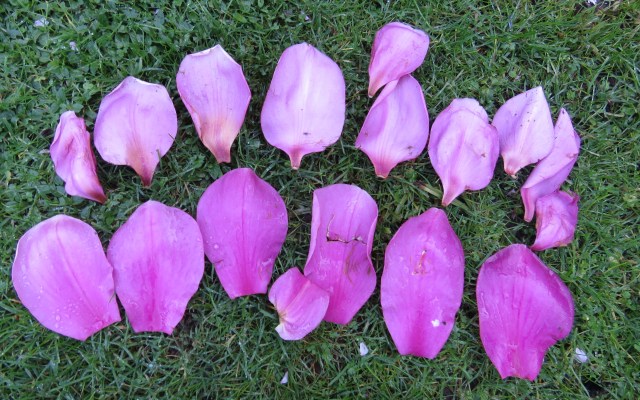
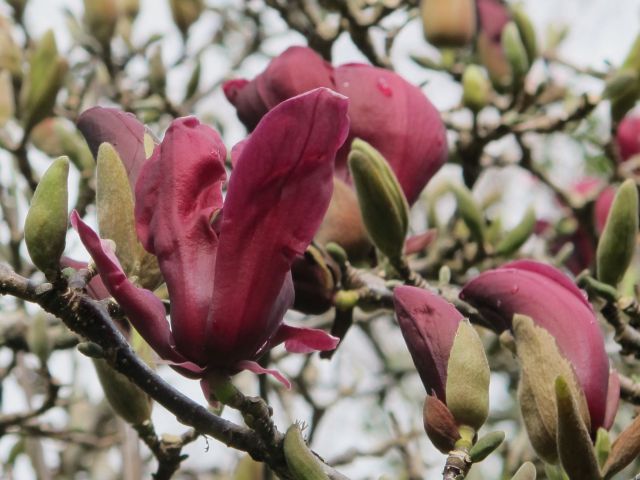
We have really struggled with naming the third one. In the end, I crowd-sourced a name on the social media platform, Bluesky. Out of hundreds of suggestions, we came up with a short list of of nine good names and I think we have settled on Magnolia ‘Dawn Light’™. Our problem came with trying to nail down the colour. Depending on light conditions, it is somewhere between rich pink and purple. I lined up petals alongside Magnolia campbellii var mollicomata ‘Lanarth’, one of the purplest of the species and the petals of the hybrid were darker but it doesn’t always look that way on the tree. It is not blue enough to be able to say it is purple, lilac or lavender, not brown enough to be puce, but possibly too many blue hues to be rich pink. Hence ‘Dawn Light’™. Whatever the colour, it is lovely and has been a consistent performer in a prominent position here year on year.  It is another taller, upright grower – rather than spreading – but is not likely to be as tall in different climates.
This is why we had such trouble naming Magnolia ‘Dawn Light’™ – it can look purple or pink, depending on the light
I once lined up petals to try and determine the colour. That is Magnolia ‘Lanarth’ at the top, ‘Dawn Light’ below but it can still look too pink on the tree. Mark quipped that he wanted to call it Purple Haze – to go with Ruby Tuesday, you understand. Showing our era, I wondered whether ‘Ab Fab’ should therefore be named A Whiter Shade of Pale.

These three cultivars have been under our watchful eye for years and we are confident on their merits. Magnolias are a long term plant. You don’t want to be casting a plant out after 5 or 10 years because something better comes along. We think these three will stand the test of time.

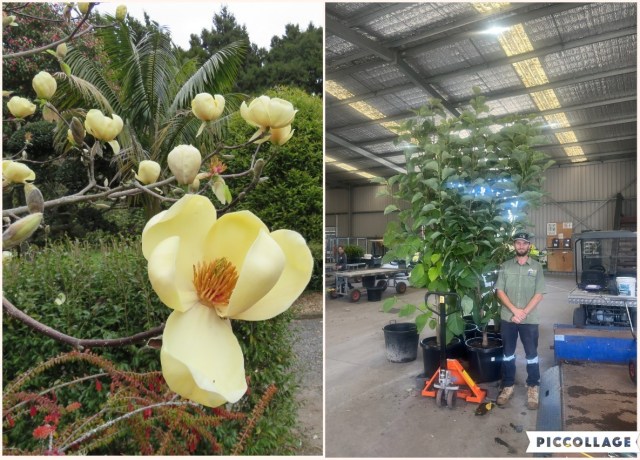
Magnolia ‘Honey Tulip’ and some very fine plants about to go on sale from Warners Nurseries in Victoria, Australia

Australia is as difficult to get through border control as Aotearoa NZ is so it has taken a long time for Mark’s Magnolia ‘Honey Tulip’ to be released there, even though it has been sold in this country, in Europe and the UK for some time. But at last it is ready for release in Australia this year.

Fairy Magnolia ‘Petite Peach’™

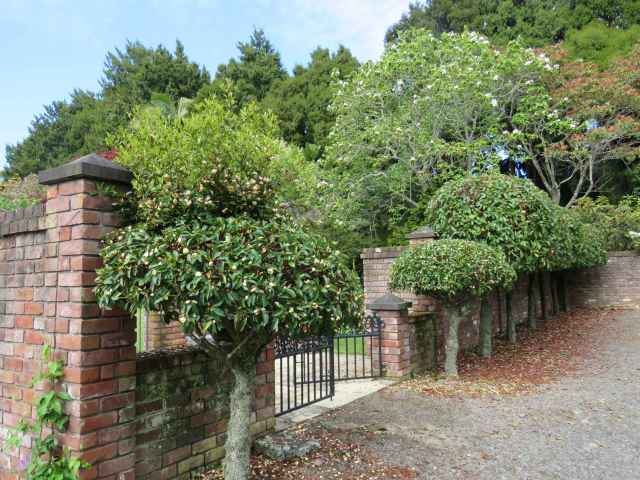
However, Australia gets the first chance at Fairy Magnolia ‘Petite Peach’™ which will be released this year (2026 in NZ and 2026/27 in Europe).  Sharp-eyed garden visitors may have spotted the two clipped, smaller pompoms at our gate. ‘Petite Peach’ has been well trialled down the years here. It is much more compact than the three Fairy Magnolias® already released, with smaller foliage and a mass of smaller blooms in peach shades. It is what we would describe as a ‘good garden plant’ – reliable, consistent, extremely healthy, able to fit into gardens of any size and pretty, rather than spectacular.

The two plants in the foreground are Petite Peach, over 20 years old now and clipped once a year. The front plant hadn’t been fully clipped on account of Mama Blackbird and her babies in the middle of the top knot.

Meantime, we are into the final year or maybe two of assessing what is likely to be the last tranche of Jury hybrids from this generation of the Jury family. It is likely there will be a couple more deciduous magnolias but yellow this time, and maybe another three or four different colours in the ‘Fairy Magnolia’® series. But don’t hold your breath. These will be years off being released internationally. Plant breeding with the magnolia genus is definitely a long term project.

Magnolia ‘Ab Fab’™ resembling fluffy meringue, maybe

Postscript: For the magnolia aficionados who are going to ask about the breeding, these are largely from crossing hybrids but if you take it back to the originating species it works out to the following:

Magnolia ‘Ruby Tuesday’M.soulangeana x ‘Lennei’ – so some liliiflora – x {M.campbellii mollicomata ‘Lanarth’ x M. sargentiana robusta} x {M. liliiflora hybrid x ‘Lanarth’}. Which translates to 3/8 ‘Lanarth’, around 3/8 different forms of liliiflora with some sargentiana robusta and a few unknown genes to make the full quota.

Magnolia ‘Ab Fab’™ (M. soulangeana x ‘Lennei’ – so some liliiflora – x {M.campbellii mollicomata ‘Lanarth’ x M. sargentiana robusta}) x M. x ‘Lennei alba’ (liliiflora genes again with some denudata) x {M.campbellii var mollicomata ‘Lanarth’ x M. sargentiana robusta}. Which makes the dominant genes liliiflora followed by ‘Lanarth’ and sargentiana robusta.

Magnolia ‘Dawn Light’™ (M. soulangeana X ‘Lennei’ – so some liliiflora –  x {M.campbellii var mollicomata ‘Lanarth’ x M.sargentiana robusta} x ‘Lanarth. So the dominant genes in this one are ‘Lanarth’ with lesser amounts of M. sargentiana robusta and M. liliiflora.

In layperson’s terms, Mark has continued using his father’s lucky break with the hybrid seedling he was sent which he named Magnolia ‘Mark Jury’ (back in the 1950s), crossing with the downstream Jury hybrids both he and Felix created, plus ‘Lanarth’.

The legacy of Magnolia ‘Lanarth’ and modest Magnolia liliiflora ‘Nigra’

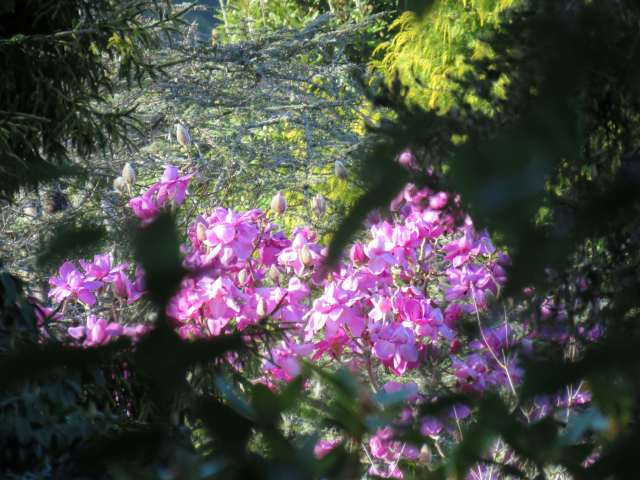
Not the best photo but I can assure you it was the best sight on its day – looking through trees to ‘Lanarth’ in the distance

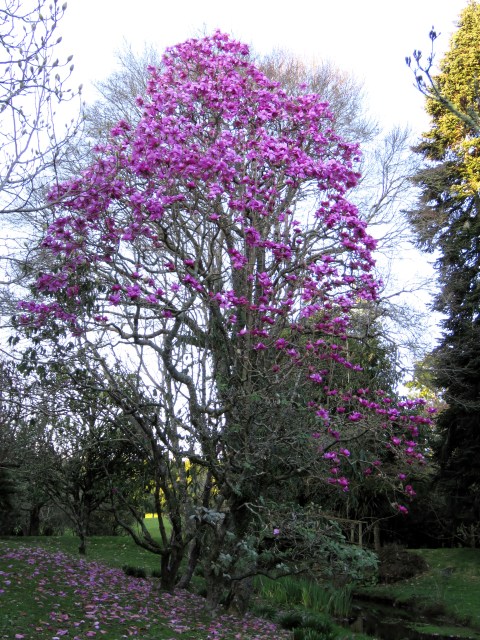
As I paused to admire the glorious purple of Magnolia ‘Lanarth’ through the trees, the thought occurred to me that the vast majority of the red magnolias raised and released around the world since the mid 1980s have descended from this particular tree down by the stream in our park. Some are several generations down the line but they trace their genes back to our tree.

Our plant of Magnolia campbelllii var mollicomata ‘Lanarth’

Botanically, our Magnolia ‘Lanarth’ is the form distributed by leading UK nursery, Hilliers, back in the 1960s, Magnolia campbellii var. mollicomata ‘Lanarth’. Felix Jury imported it at considerable expense and thank goodness he did.

Magnolia liliiflora Nigra – red but otherwise unremarkable
and the shrubby tree of M liliiflora Nigra at about 60 years of age. It flowers later in the season so we think must have been the mother of the red hybrids, not the pollen donor.

To be fair, it wasn’t just ‘Lanarth’ that launched the platform for new generations of red magnolias. The plant of Magnolia liliiflora ‘Nigra’ in the garden border behind our house was the other parent, almost certainly the seed-setter. In the heady world of magnolias, liliiflora is not a showstopper. Our plant is more sturdy shrub than tree, the blooms are not large, typical liliiflora form which is not showy and the flower colour has none of the rich glow that magnolias can have. But it is red both inside and outside on the petals. Mark tells me we are reputed to have a particularly good form of liliiflora ‘Nigra’ in this country in terms of its solid red bloom without the inner petal being white.

Breeders and enthusiasts around the world had been trying to create good red magnolias before, like the optimistically named ‘Chyverton Red’,  ‘Pickard’s Ruby’ and ‘Pickard’s Garnet’. We have one example here but I only have one tiny photo of it and I have just found out that the name we have on it is wrong. I will have to take more notice of it when it flowers this year and try and work out what it is, only out of curiosity because it is not remarkable.  

Felix looked at his plant of ‘Lanarth’ and wondered if he could get a good-sized, red campbellii-type flower. He had already done his other breeding to reach ‘Iolanthe’, ‘Milky Way’, ‘Athene’ and the other four Felix Jury cultivars. And so he created ‘Vulcan’, a breakthrough in its day. ‘Lanarth’ contributed the flower size and form, solid colour inside and out but also the translucence, tree form and scent. M. liliiflora ‘Nigra’ contributed solid colour, smaller tree stature and, importantly, red.

Magnolia ‘Vulcan’ this morning

We first released ‘Vulcan’ in 1989, in that wonderfully under-stated way of that era. I don’t think we sent any plant material overseas at the time but bits of it soon winged their way around the world and the rest, as they say, is history. ‘Vulcan’ is not without its flaws. It flowers too early for frosty areas (as does ‘Lanarth’); it only achieves its density and purity of colour in warmer climates and even then tends to fade out to murky purple as the season progresses. But for its time, it was a breakthrough. It was the only plant we ever released that we could track its flowering from north to south of the country by the telephone calls we received. Even today, 35 years on, it is a showstopper at its best. I had two young tradeswomen painters in a couple of weeks ago and one of them asked me about the ‘black magnolia’ as she spotted the first buds opening, declaring she had never seen anything like it before.

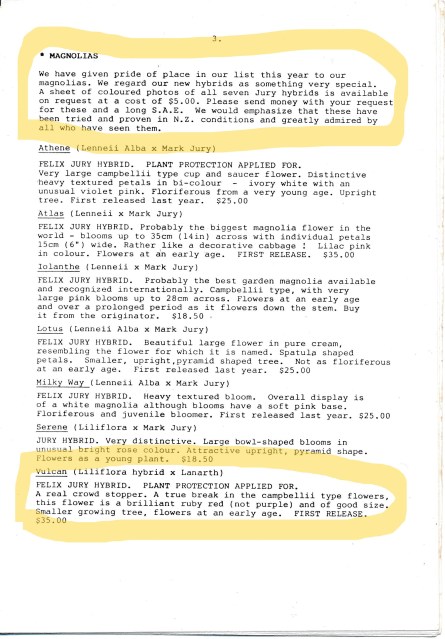
Our mailorder catalogue from 1989

Felix didn’t go any further with breeding magnolias after ‘Vulcan’ but encouraged Mark in turn. And it was Mark who created the next generation which included ‘Black Tulip’ and ‘Felix Jury’.  Other NZ breeders followed suit – notably Vance Hooper and Ian Baldick.

It seems that ‘Black Tulip’ and Felix Jury’ have become two of the more significant breeder parents around the world. I see many, many red seedlings on international magnolia pages and they are clearly descended from those early red hybrids here.

Magnolia ‘Vulcan’

Felix named one red magnolia, Mark has named and released three but there is a fourth in the pipeline. We are hoping it will be ready for release internationally next year or maybe 2026. We describe it as a ‘Vulcan’ upgrade. It flowers a little later and has an exceptionally long blooming season and is a different hue of red, without a tendency to the purple undertones inherited from ‘Lanarth’. Solid colour and cup and saucer form which is our preference – it stands out here as good and we have high hopes for it across a range of climates. I won’t share photos until we have a release date.

Magnolia campbelli var mollicomata ‘Lanarth’

The new selection also traces its origin to the lovely ‘Lanarth’ in our park. That ‘Lanarth’ originated from a seed collection by plant hunter, George Forrest, in 1924 in southeastern China, near the Burmese border. Only three seed germinated back in the UK and this one was the best, named for the garden where it was raised in Cornwall. Those are quite long odds for what turned out to be such a significant plant.

While we may only have named and released four red magnolias from the Garden of Jury, with one more to come, we have many, many magnolias on the property that come from the same breeding lines. This lovely one that won’t be selected for release is another seedling from the batch that gave both ‘Black Tulip’ and ‘Felix Jury’.

Of rhododendrons and the roof

Mark’s ‘Floral Sun’

As the deciduous magnolia season draws to a close, it is time for the rhododendrons to star. And Mark’s rhododendron hybrids ‘Floral Sun’ and ‘Floral Gift’ have indeed been starring this week. Not only are they gorgeous, they are also scented, Gift even more so than Sun.

On Friday next week, we have the New Zealand Rhododendron Association conference attendees coming here. This was originally scheduled for 2021 but cancelled at the last minute as large parts of the country went into the second Covid lockdown. We agreed to them coming this year even though we no longer open the garden.

We are not the rhododendron garden we once were. They were a key plant when Felix and Mimosa started the garden here and Mark started the nursery on rhododendrons. We produced a huge range, including many of the showy American rhododendrons that were all the rage back then. Some readers will remember the days when everybody wanted ‘Lems Cameo’, ‘Lems Monarch’, ‘Puget Sound’ and the likes.

Mark’s ‘Floral Gift’ has been a bit of a sleeper star. We worried that it was a bit sparse on foliage at the start but it has gone from strength to strength as a garden plant. This plant was moved a few months ago from an area where it had become too shaded and it has not worried at all about that relocation.

In the time since, we have lost many plants which either faded away or up and died on us, as Mark describes it. This includes a lot of the species, the dwarf varieties which are largely bred from alpine species and the showy hybrids from places with colder climates. Rhododendrons are reasonably adaptable plants as long as they get a winter chill (which they don’t here), a situation which is not hot and dry in summer or too wet at any time. I console myself with the knowledge that the British Royal Horticultural Society’s flagship garden, Wisley, has recently felt the need to relocate a lot of their rhododendron collection to more northerly RHS gardens in order to save it. Wisley has a low rainfall and the combination of increasingly dry conditions combined with milder winters meant that many varieties were endangered.

Public gardens play a major role in preserving species and collections but that is not a responsibility we take on as a private garden. We just go with the flow and adapt. One of those adaptations has been to largely eliminate the use of sprays. Some of our rhododendrons required spraying every year to keep them healthy but there is nothing sustainable in that. So it comes down to accepting that we will lose ‘Rubicon’, ‘College Pink’, the Loderi hybrids and some others.

At least the nuttalliis still thrive here

What we do know is what will thrive and look good without spraying. We have always been fond of the maddenii group and particularly the nuttalliiis. None of them have the big, round, ball trusses commonly associated with rhododendrons but most are scented, keep good foliage, do not get infested with thrips (which is what gives white leaves and weakens the plant), suffer from leaf burn on the edges of the leaves and they are far happier in our mild conditions without a winter chill. I much prefer them to the classic ball trusses now but I spent countless hours trying to persuade customers and retailers of their merits when we were producing them commercially. Too many just wanted rhododendrons with big red trusses.

One of Mark’s unnamed hybrids. Please notice the foliage.

Mark set out to see if he could breed healthy plants with ball trusses and clean foliage in order to meet the market demand. But it takes a long time to breed and assess new woody plants (except for roses which have a super-quick turnaround) and, in the meantime, rhododendrons fell from favour for all the reasons mentioned above, meaning demand dropped away and we retired from the nursery and plant production. So even though some of them are pleasing, they just sit in a long row in a paddock and we look at them from time to time.

It is more about the foliage than the flowers on these unnamed seedlings. Of course they need to put up plenty of good blooms but plants that stay looking good and lush all year round with no spraying, feeding or mollycoddling was the important factor in breeding.

I may pick blooms of those that are looking good to show the conference attendees when they visit. It is not that the flowers are exciting breakthroughs; it is that they have good foliage and a healthy habit as well as mass flowering, even when grown in full sun without ever being fed or sprayed. That is an achievement. One day, rhododendrons may come back into fashion and there is a little resource sitting here for a future generation to capitalise on.

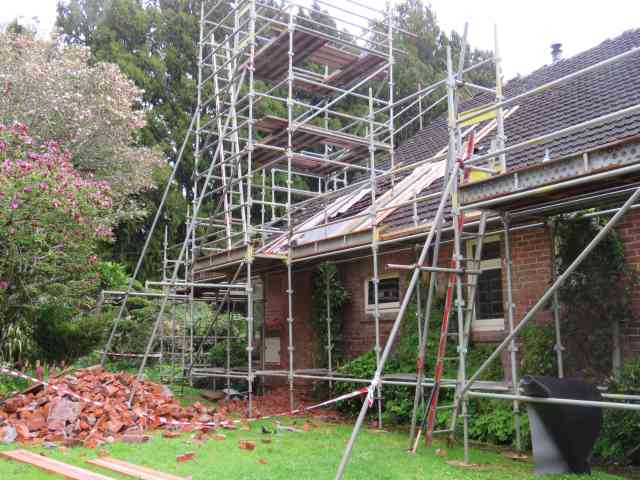
Besides preparing the garden for the conference and an overseas tour due soon after, our roof has been dominating our lives here for the past few weeks. Like other houses from the same era of the early 1950s, we have – or had – a concrete tile roof and those tiles are now so fragile that they break if you so much as look at them. We bit the bullet and decided we could no longer delay replacing the roof. It is not an easy roof and therefore eye-wateringly expensive. The lead scaffolder commented that it is one of the most difficult scaffolding jobs on a domestic house that he has done because of the different roof levels. So we are surrounded in scaffolding, piles of tiles, bricks, new roofing and a whole lot more. And a partially reroofed house with stop-gap weather proofing in a Taranaki spring is high stress. Yesterday’s rain had Mark and me crawling around in ceiling cavities patching remaining cracked tiles from inside and strategically placing buckets. I don’t often concede to age but I came to the conclusion that we really are getting too old to be crawling around in ceiling cavities. If it is fine tomorrow, we should see the main body of the roof finished with only ridge cappings, flashings, spouting and downpipes to go. I am looking forward to the day when we no longer have to worry about leaks and occasional internal floods (two so far this year).

A work in progress

The new roof is an anachronism in materials – long run roofing iron – but not in colour. The old tiles had weathered to grey-brown but we can see that they started off in a shade that was more orange than red and I can remember those startling orange tile roofs from my childhood. The new roof is dark brick-red-brown and that will be fine, probably an improvement on the earlier orange-red. I did not want a grey roof. There is enough greyness in the world without voluntarily adding more.

The chimney was a cause of nagging anxiety

Dropping the back chimney to below roof level was a major job that took three men with a jackhammer and a sledge hammer all day on Friday. We didn’t use that fireplace – we have three others – and we have long worried that the massive brick tower was an earthquake hazard that had the potential to demolish part of the house and take lives if it ever snapped off. We have to take earthquake risks seriously in our shakey, quakey isles. Architecturally, I am sad to see it gone but it will be a relief not to worry about earthquakes or leaks.

Going, going…
… gone.

Whether all this will be completed, cleared and the outside areas reinstated before the conference people arrive at the end of next week remains to be seen but they are coming to see the garden, not the house. At least we are not open for the garden festival because that would have been a problem.

Magnolia time

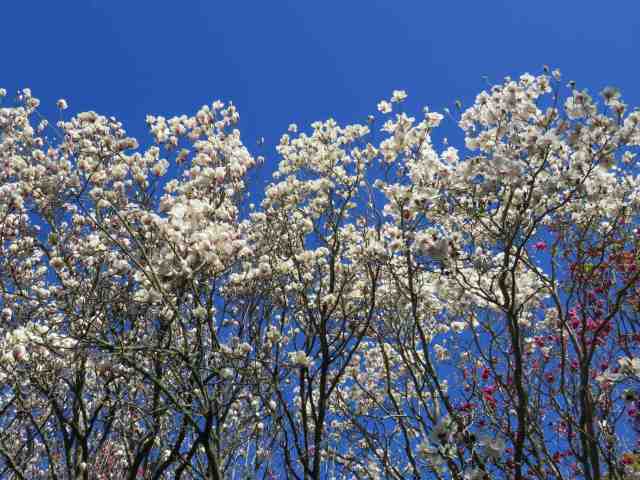
Blue skies and space to let magnolias grow to their potential certainly helps the display

We are currently at peak magnolia and this year has been a relief. Flowering in the past two years has been – dare I say it – pretty damn disappointing. Very wet springs saw blooms weather-mark badly, infected by some form of blight, and turn to droopy brown slush. They were not inspiring at all and I was beginning to wonder if one effect of climate change might be to take out the impressive splendour of our flagship plant family. This year they are magnificent after a bit of a stuttering start. Mind you, we have been blessed with perfect conditions – clear, calm and dry with only the occasional storm or downpour.

June 13, which is very early for us. The display this year never actually improved on this although more snow fell.

The season started unusually early. The first flowers on M. campbellii var campbellii opened at the end of May before the leaves had even fallen and winter was upon us. Every year I like to get out and photograph our tree against the maunga, Mount Taranaki, and the first photo of that was on July 6, before the mountain even had its full cover of snow. Similarly, ‘Vulcan’, ‘Burgundy Star’ and M. campbellii var mollicomata ‘Lanarth’ all opened their first blooms in early June and early July which is mid-winter here. Interestingly, that early start proved to be a false start on all four of them. They never really recovered from it to give us their usual mass display of splendour. Some are limping on, still with flowers, but the overall display from them has not had the usual breathtaking oomph. There are always some disappointments and this is the first year I can remember when those varieties have been rather ho-hum. We are concluding that an early start can in fact be a problem more than a promise.

Magnolia ‘Felix Jury’ on the left with white ‘Manchu Fan’
Magnolia ‘Felix Jury’.

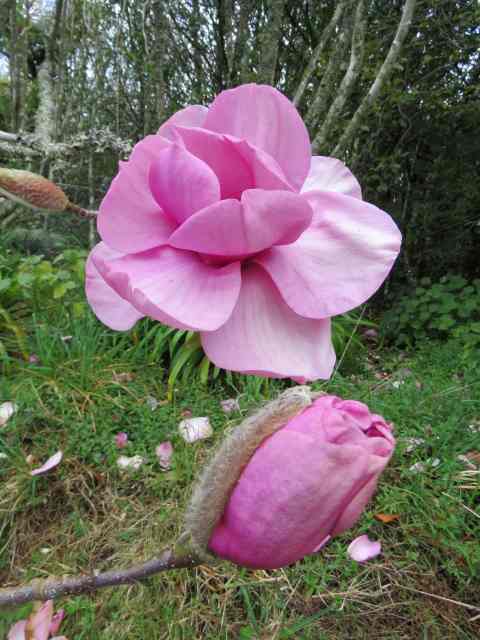
The main flowering on  the rest has more than made up for the disappointing. Day after day of blue skies have delivered us perfect blooms with none of the previous problems of blight turning petals to mush. We know it is a good season because Felix’s Magnolia ‘Atlas’ is looking splendid. When we first released it, Mark described it as being like a giant pink cabbage and one of the largest magnolia flowers in the world at the time. It is the only one of ours that seems to perform better overseas than here. Year after year, I have struggled to get good photos of unblemished blooms because it does not like our spring storms but this year, this year it is perfect.

Magnolia ‘Atlas’
Magnolia nitida, for those of you who like to see something different

We have many magnolias. I have no idea how many. We also have space so we can allow trees to grow to the size they wish. Some of our magnolias are species and some are named cultivars from other breeders but the vast majority of our plants are seedlings from the breeding programme and there are literally hundreds of those. While we have only ever named twelve Jury magnolias (eight from Felix, four from Mark and another four of Mark’s are in the pipeline for release), they are the pick from several thousand seedlings. The majority end up getting chainsawed out as being of insufficient merit to retain but some are very good. They don’t meet our stringent criteria for releasing a new plant but they are good enough to keep across the property.

Just an unnamed seedling but looking very pretty this week

Finally, I saw a death notice recently for writer, gardener and magnolia lover, the inimitable Biddy Barrett. We have always referred to this pretty pink seedling as ‘Biddy’s Pink’ as she was adamant it should be selected for release. Mark didn’t agree so it remains a one-off plant but R.I.P Biddy. Your pink lives on.

Biddy’s Pink – a reference name only. This one has never been named and released.
Biddy’s Pink – pinker than Iolanthe but otherwise very similar
Mark’s Magnolia ‘Honey Tulip’
Felix’s ‘Milky Way’
And a purple seedling to cover the current range of colours in deciduous magnolias