
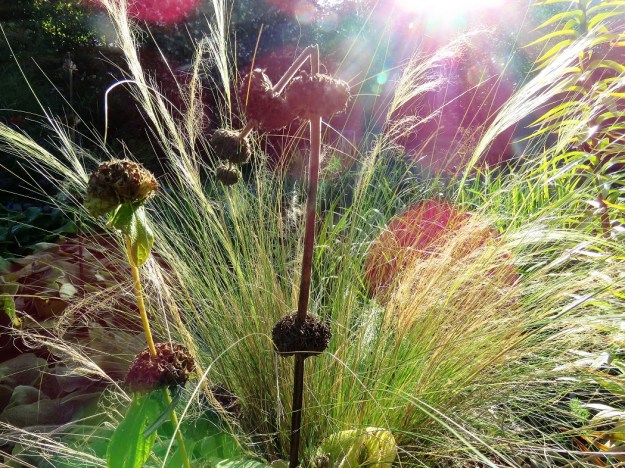
Phlomis and Stipa tenuissima in the morning light of autumn
I have never done so much dead heading in my life before. Not that I mind it, you understand, more that I am surprised to find it becoming part of my routine. The need was not anticipated. But neither have we ever had extensive areas of summer perennials before. This week, I achieved what was a milestone for me – the completion of the revamped Iolanthe Garden as a perennial meadow (I use the word ‘meadow’ loosely, here.) That gives us close to an acre (0.4 hectare) of new summer gardens finished.
It has been heavily influenced by the New Perennials movement, led by its uncrowned monarch, Dutch designer, plantsman and gardener, Piet Oudolf. Anything and everything you read about this modern approach to perennial gardening will refer to its lower maintenance requirements and leaving the plants and all the seed heads to stand well into winter, that there is beauty in that black and brown decay of autumn and winter until everything is cut down to the ground – usually in February, so very late northern winter. Besides, all those seed heads feed the birds and save them from starving when food supplies are desperately short. Oudolf has coined the term ‘fifth season’ to describe that period in late autumn when low light levels, frost, dew and sometimes snow light the blackened tips of plants to make them sparkle. There are many beautiful photographs on line capturing this phenomenon.
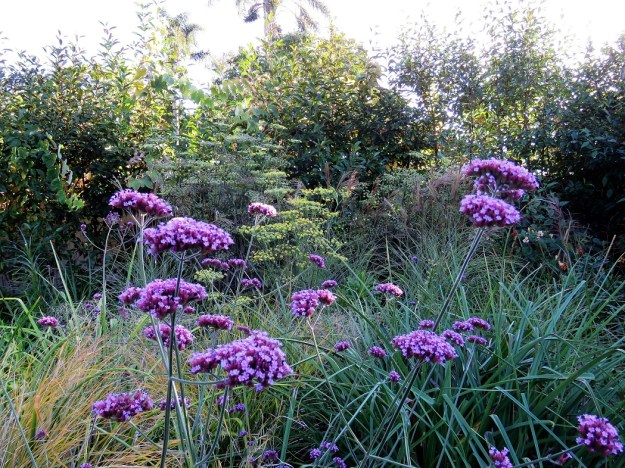
You can have too much of a good thing – Verbena bonariensis and fennel
It is different in New Zealand. Boy is it different. Only the coldest parts of the country have that winter hiatus. Most of us have flowers and seasonal interest all year round. A large proportion of the plants we use are evergreen so never die down to ground level. There is food for the birds all year round and they are not in danger of starving. Besides, most of those seed and grain eating birds are the introduced ones (sparrows!). Our native birds tend to favour fruit or partaking of nectar. Our light levels don’t drop in winter. A midwinter’s day can be as clear and bright as midsummer.
And we have a problem with garden escapes becoming weeds. That is the big issue that has me out there dead heading. Much and all as I love Verbena bonariensis, I don’t want mountains of it everywhere. The same goes for crocosmia be it yellow, orange or red, kniphofia (red hot pokers), some of the asters, tigridia (jockey caps), eryngium, dietes, fennel, nicotiana, verbascums and quite a few other plants we are growing. Even Gloriosa superba sets so much seed it is threatening to become a weed. There is nothing for it but to get out there with my snips and bucket to reduce the seed heads.
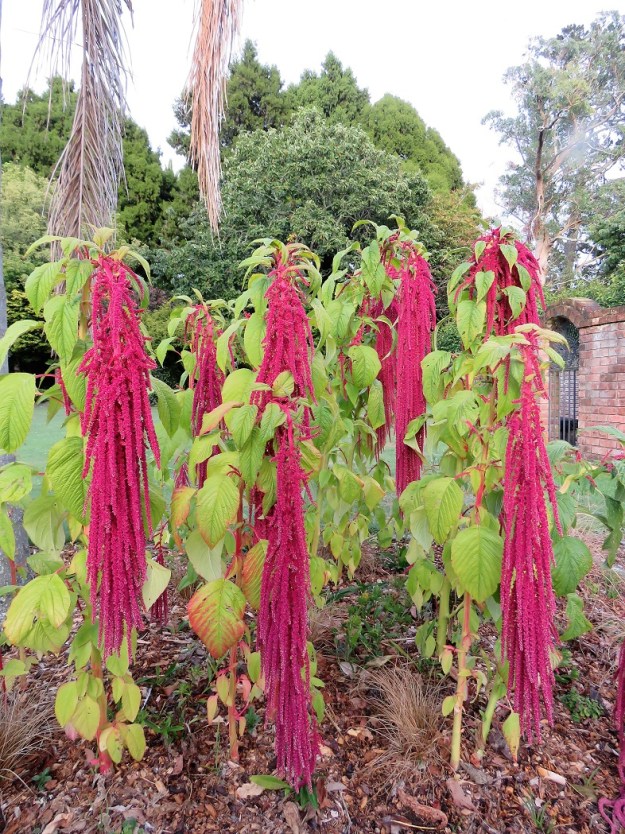
Amaranthus caudatus – not unwelcome in this situation but a surprise arrival in the compost
There is a slight problem with disposing of the seed heads. Even though we make hot compost, too many seeds come out the other end of the process and live to germinate and grow another day in another place around the garden. This unexpected display of amaranthus arrived in the compost I spread in this area. I have learned my lesson. Now I stow the seed heads in deep shade on the wilder margins of the property where few will germinate because they don’t see the sun.
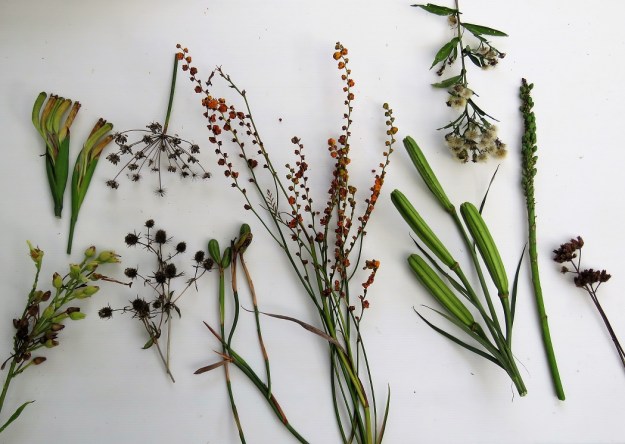
A sampling of seeds that need removing. I contemplating setting it up as one of those quizzes for bored readers to identify but I would rather be out gardening. Top left tigridia and fennel, bottom left nicotiana, eryngium and dietes, centre crocosmia, top left aster, bottom right Lilium formasanu,. kniphofia and Verbena bonariensis.
The skills come in knowing which plants need total removal of seed heads (kniphofia and tigridias, for example), which plants need the removal of most seed heads to restrict their self-seeding (such as eryngiums, fennel, crocosmia, verbascums and Verbena bonariensis) and which plants don’t need to be dead headed because they are either welcome to seed down (I am not sure than I will ever have too many echinaceas) or because they don’t seem to cause a seeding problem (phlomis and the grasses). Then there are a few plants that I will dead head because that encourages them to flower again (roses, though I don’t grow many of those these days, and some of the daisies).
There is no substitution for observation and experience. We can not just take gardening practices from other climates and assume it will be the same here. If I have another 20 years, I may be able to come up with plant lists that are specifically designed for our conditions. For anyone thinking that maybe it would be better to concentrate on using our native plants, consider the fact that most of our sunny perennials are alpine. In our lowland conditions, native perennials are shade loving foliage plants with a heavy emphasis on ferns.
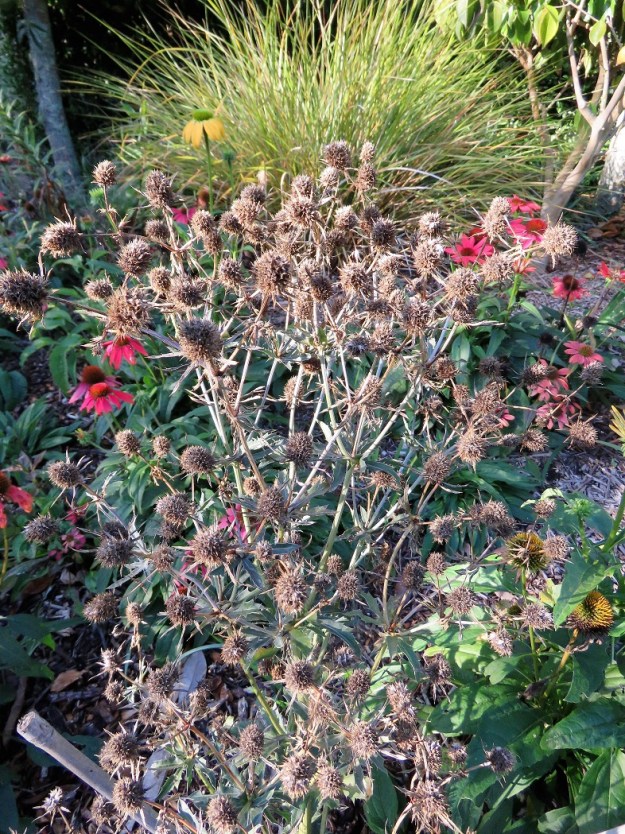
I want some eryngiums to self seed but not all of them
Two footnotes: the acclaimed film about Piet Oudolf, called ‘Five Seasons: The Gardens of Piet Oudolf’ is available free to stream this weekend only. We plan on watching it this evening, as long as I can work out again how to get Chromecast working. Where is a teenager or young person when you need one? It is being streamed from https://www.hauserwirth.com/?fbclid=IwAR2YXqr5-VDT2TwThnzWxVF2lzS4HXMVCV-l9166HQsVlTqqktF-QYsMTm4
And we are opening the garden and unveiling the new summer gardens for ten days this spring during the annual Taranaki Garden Festival, October 30 to November 8. As part of that, I am considering offering workshops on new directions with sunny perennials and managing meadows in our climate. Numbers will be strictly limited so look for details when the programme comes out.
May your lockdowns go well, or at least harmoniously. The end is in sight for us in NZ, with the strong possibility that we can eliminate the virus and return to some sort of Covid-free normality – as long as our border stays closed. Just don’t try injecting, drinking or otherwise consuming disinfectant – you may then be Covid-free but actual scientists tell us you will also be dead.

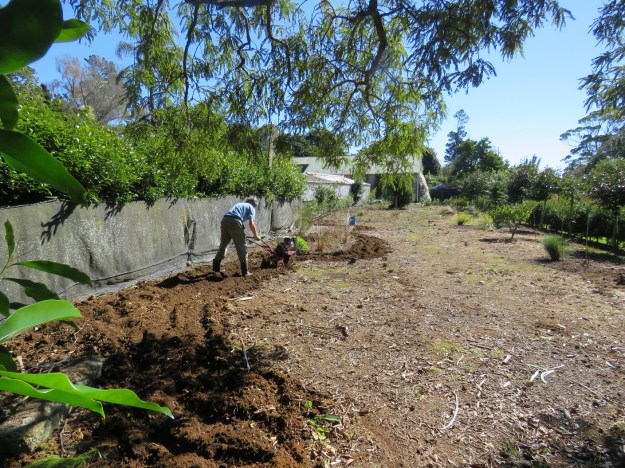
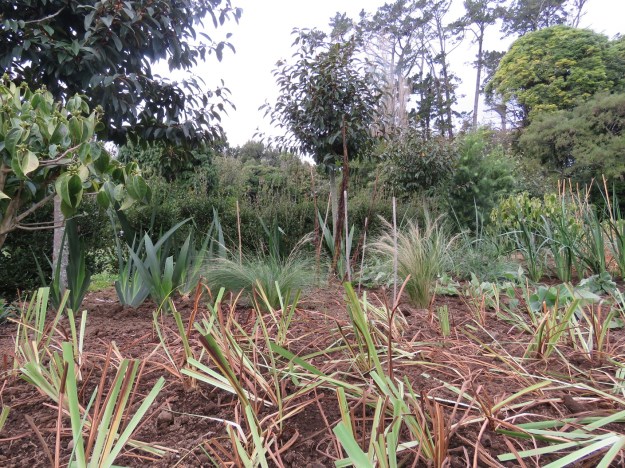
 My patch is like passage-way to the side of all this, albeit a passage-way in full sun that is about 10 metres wide by 30 metres long; at around 300sqm it is larger than some urban dwellers get in life. The idea of a “grass garden” has somewhat morphed into “grasses and other plants with long, narrow foliage and spear-shaped foliage”. The plant palette is broadening substantially as I go but still restrained overall, by our standards. “You are not copying the Bury Court garden, are you?” asked friend and colleague, designer Tony Murrell. Well, no.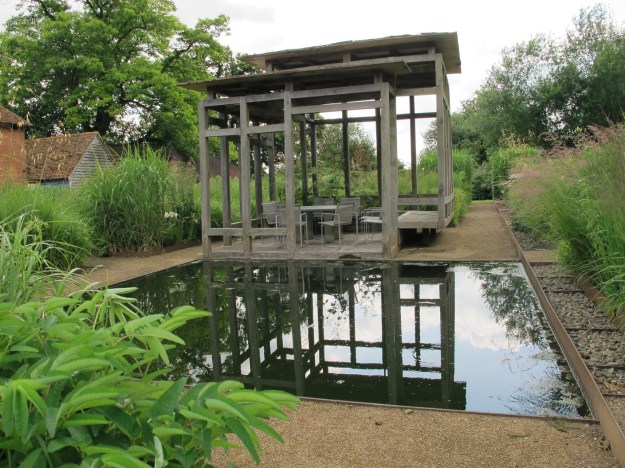
 First published in the February issue of New Zealand Gardener and reprinted here with their permission.
 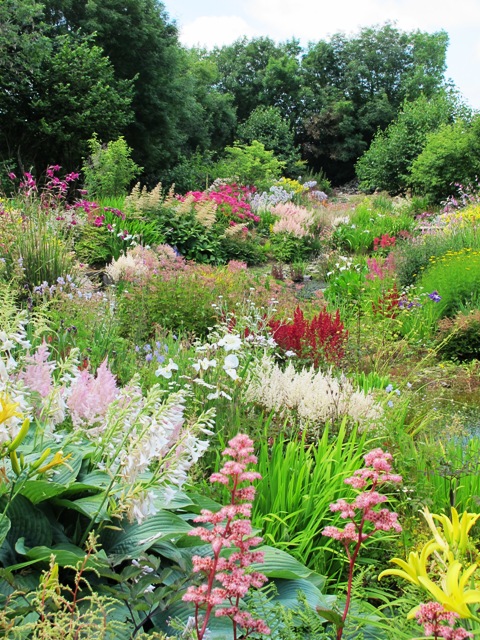 1) I want to try and capture the magic of a particular garden in a few words and photos. This is Wildside in North Devon and was quite simply one of the most exciting modern gardens we have seen. It is not that we will try and re-create it at home, but we found it interesting, stimulating and inspirational in many ways. It has been about 10 years in the making to this point.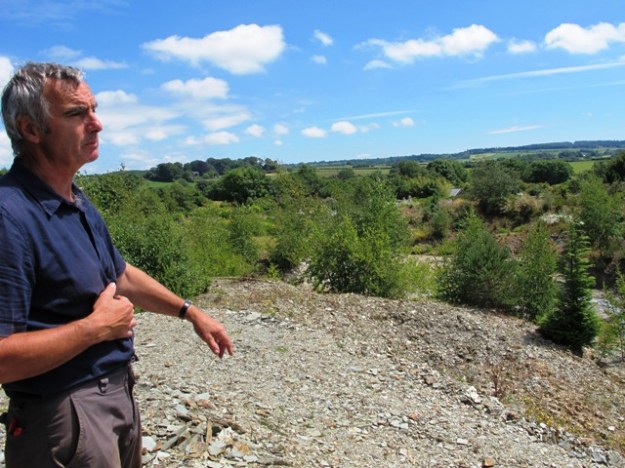
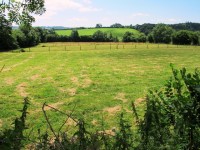 2) The creator, Keith Wiley (and let us acknowledge the active assistance from his partner, Ros) has taken a 4 acre (1.6ha) flat field and created a landscape. When he started, it looked identical to this neighbouring field. All the top soil was removed and substrata redistributed to create ponds, canyons, shallow valleys and hills. At this stage, it is still possible to see this process in the upper garden which has yet to be planted. Once shaped, Keith returned the top soil in varying depths, depending on what plants he planned to grow in each area.
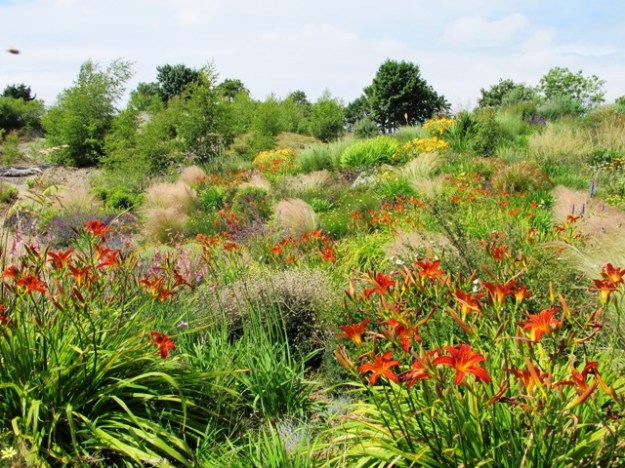 3) The interaction between the created landforms and the plants are the key components of this garden. When we visited, the upper garden was dominated by oranges, golds, yellows and whites. We would love to have been able to return a few weeks later because we could see that the dominant colour was going to change to blue and it would have looked very different. It takes exceptional plant skill to be able to get that transition and successional planting across seasons, let alone within the same season.
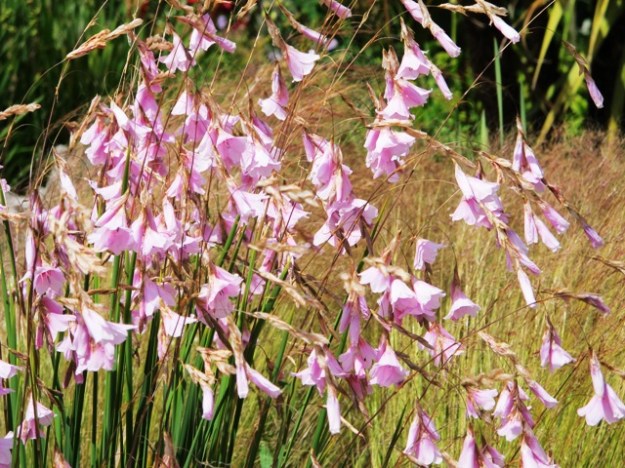 4) These are dierama, commonly called Angel’s fishing rods, one of the few corms and bulbs that were in flower in midsummer but this was a garden which was rich in drifts of bulbs – another layer of plant interest and a means of ensuring colour and detail when most perennials are either dormant or resting. In keeping with the modern perennials movement, there were grasses used but in moderation. Plants were in good sized clumps and often in drifts, but always in combinations, not chunky blocks standing in their own right as seen in many modern gardens.
 5) There is very little hard landscaping and very little ornamentation. There may have been one small lawn, from memory, but this is a garden of plants and flowers. Some may consider the lack of formality and structure to be a shortcoming, certainly in a country with a long history of landscaped gardens full of permanent features. We saw a garden that pushed the boundaries of the prairie style and New Perennials movement, combined with the creation of sustainable ecosystems, underpinned by exceptional plantsmanship.
 6) We travelled a long way to visit Wildside which is on the edge of Dartmoor, near Yelverton, and we would gladly travel a long way to see it again. However, it is currently closed to the public and it is uncertain when it will reopen. The owner told us that he needed to get the house built. After a decade of living in temporary quarters while giving priority to the garden, they had reached the point where the house had become a priority.
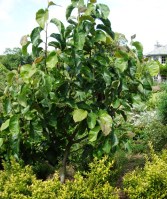 Yes, a prologue. We first became aware of Keith Wiley’s style when we visited The Garden House in 2009 – the garden of the late Lionel Fortescue which Keith managed for many years. True, he had no hand in the first sight to gladden our eyes. As we went to enter the garden, lo and behold there was Mark’s very own Magnolia Felix Jury in prime position. To say we felt proud would be an understatement.


 Tikorangi The Jury Garden