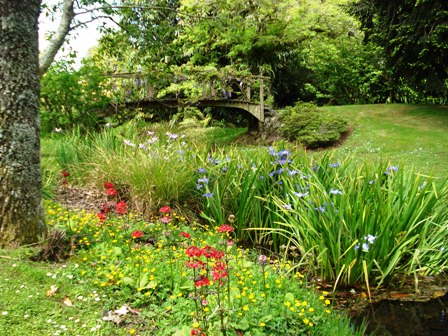
The wisteria festooned bridge in spring
I am also pruning the roses and my relationship with these leans more to hate than love. Yes they have beautiful flowers and fresh foliage in spring. Because we don’t spray, come summer they have some beautiful flowers but cruddy foliage. In winter, all they do is try and ensnare me as I work around the areas where they are planted. I do not feel the need to plant more roses until breeders start to offer us more options in beautifully full, fragrant blooms (of the David Austen type) on bushes that repeat flower and don’t get diseased, preferably without thorns. By far and away, the best performers here are Rose Flower Carpet white and coral, the rugosas and one called, I think, Golden Celebration which has fearsome thorns but very good habits otherwise. But none of these give me the soft and subtle flowers of the lovely Austens.
I had a matched pair of standard Mary Roses of which I was very fond. Note the past tense. Today I dug out the one that is all but dead and which has for a long time persisted in putting out strong shoots from the root stock. And therein lies a demonstration of the problem of matched, formal plantings. What do you do when one dies or ails badly? It is much easier to get the formal look with inanimate objects. I could probably source a replacement standard but I am not going to. I do not think anyone but me will notice that there is one half of a pair missing. It is a garden which, at its best, is full of froth and flower within a formal setting. I think the setting is enough – I will not worry about trying to repeat the formality in framework planting.
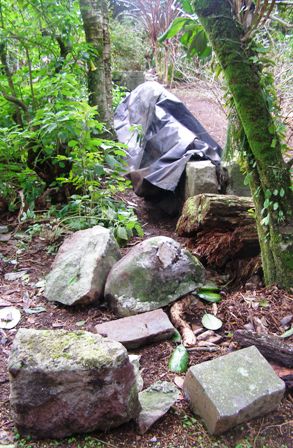
Repairing the stone wall (a pine tree fell on this section some years ago)
When not fluffing around with his vegetable garden, Mark has been giving his attention to his michelia propagation trials. With the flowering season just starting, the hybridist’s hat is back on his head and we face many months where the first call on his time will be his plant breeding. It is easy to underestimate just how much time and energy goes into a controlled plant breeding programme as opposed to people who just pick out chance seedlings (or worse: copy what other breeders have already done successfully. Expect to hear more on this topic, which is a sore point here).
Lloyd is continuing with repairs to our stone wall. I did say last week that these activities are best measured in terms of results, not costs….
And while the winter/early spring bulb season is just starting (Narcissus bulbocodium, galanthus, leucojums and the early lachenalias), it is the bromeliads which are the unsung hero for winter colour this week. If you can grow broms, they sure are eye-catching in bloom.
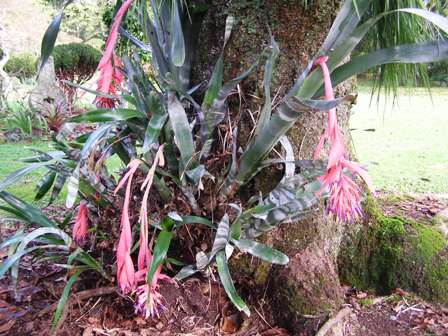
Bromeliads for winter colour. This one is a Bilbergia.
 Tikorangi The Jury Garden