Tag Archives: rhodohypoxis

The bulbs of November

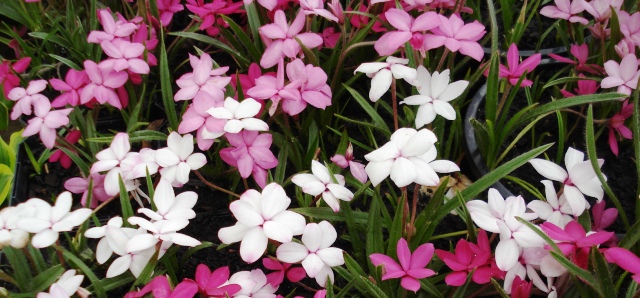
Arguably, rhodohypoxis could be the provincial flower of Taranaki. Like clockwork, they bloom on cue for the garden festivals which take place here at the start of November and there wouldn’t be too many gardens that don’t have rhodohypoxis growing either in garden soil or, more commonly, in shallow pots. They may hail from southern Africa, but we have made them our own.
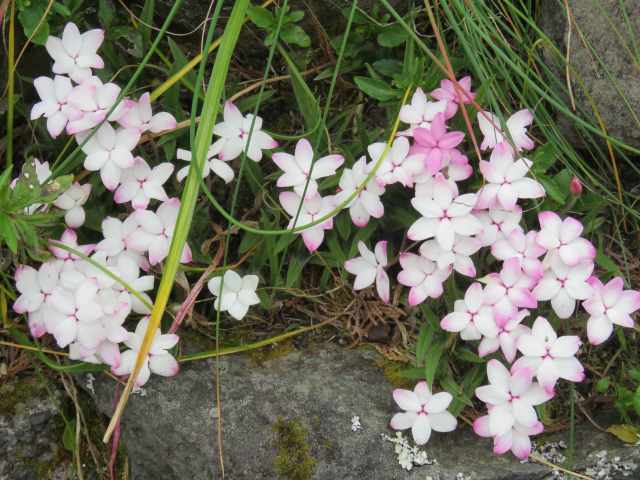
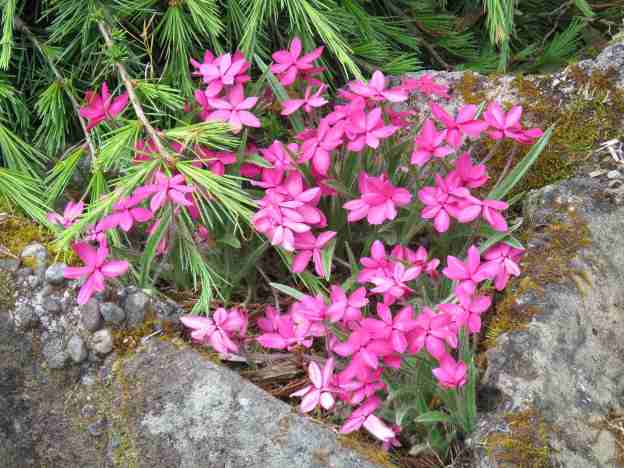
Rhodohypoxis baurii ‘Ruth’

For all our years opening the garden and when we had the nursery, we would pot up what seemed like an inordinately large number of these little rhizomes in shades of pink, white and deep carmine. I wondered if we would reach saturation point when every local gardener and any return gardeners from out of the region already had them, but we never did. It seems the market for these charmers – referred to as ‘roxypoxies’ by more than one customer – is endless in the month of November.
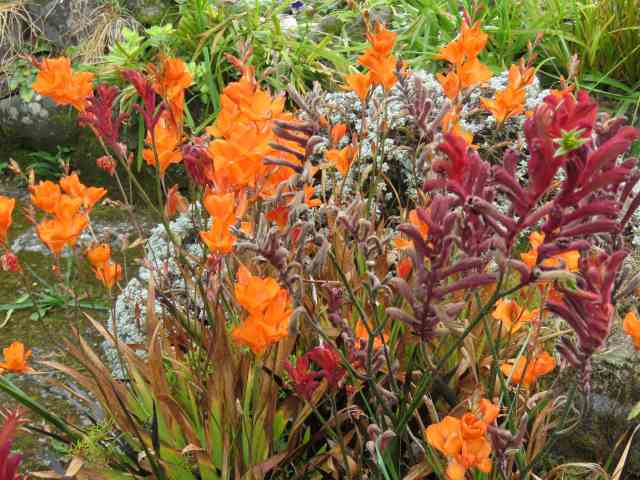
Orange tritonias

Also standing out are the orange tritonias. There is nothing subtle about these easy bulbs, also from South Africa. They need to be managed and used thoughtfully or they just look a bit… vulgar really. They pull their weight in vibrant meadows, set against deep blue flowers or in predominantly green situations.

I am pretty sure those are pastel tritonias at the front of the borders at Riverlea Garden

I am pretty sure the muted pink clumps repeated down the front of the borders at Riverlea Garden are also tritonias, or a close relative. They were very pretty and maybe easier to place in the garden than the orange.
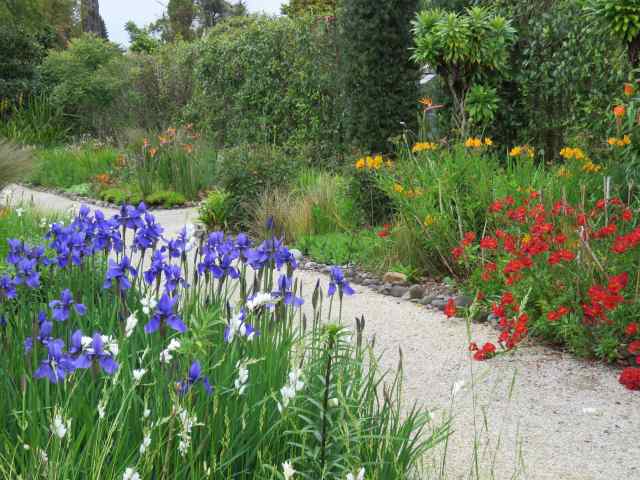
White ixias in the front left. And of course those red and yellow alstromerias on the other side are also rated as bulbs. And I would assume that the Iris sibirica ‘Blue Moon’ can be included in the bulb fraternity with its underground rhizomes.

Also in the ‘easy’ bulbs class are ixias – African corn lilies. Not that all ixias are equal. I had a brief look at the ixia family and it seems there are somewhere around 100 different species and there seems to be quite a strong correlation between different colours and different species. Our form of Ixia viridiflora – the best known and unusual coloured one in strong blue-green – is a poor form. Despite my best efforts, it never flowers well and I have seen photos of way better performing selections. It is the pure white ixia that delights me this week, both in the Wild North meadow and in conjunction with the blue Iris sibirica in the borders. We also have ixias in various shades of pink from pastel to cyclamen pink, in lilac and in yellow.
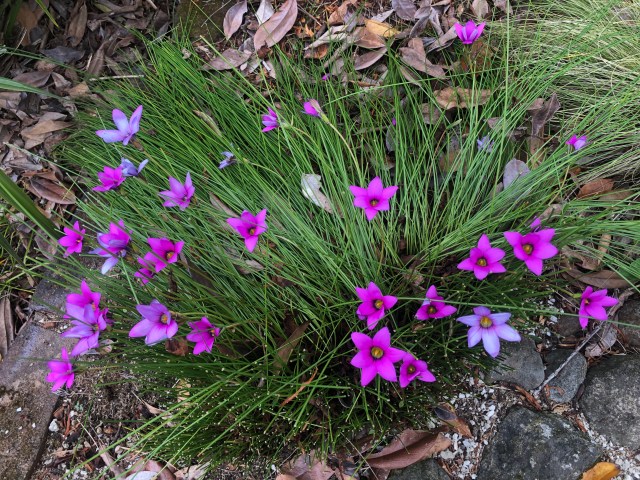
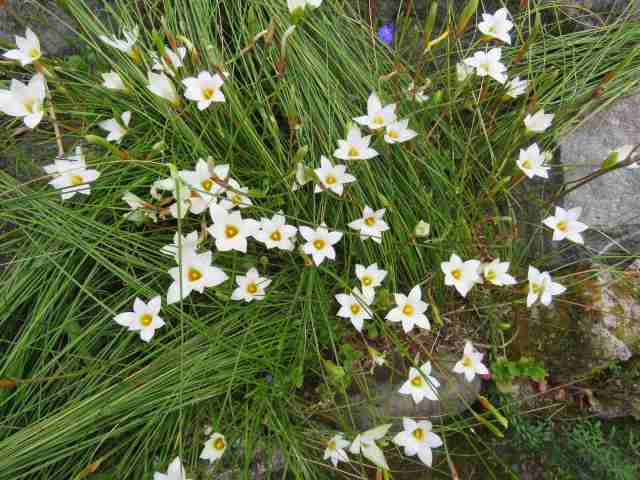
Romulea rosea
Romulea candidissima

Romuleas can be a bit too enthusiastic on the reproduction stakes but both R. rosea (in brightest pink) and R. candidissima (in pure white) are earning their keep this week. Mark tells me that the best romulea is R. sabulosa but it is also the most difficult to grow and we lost it.
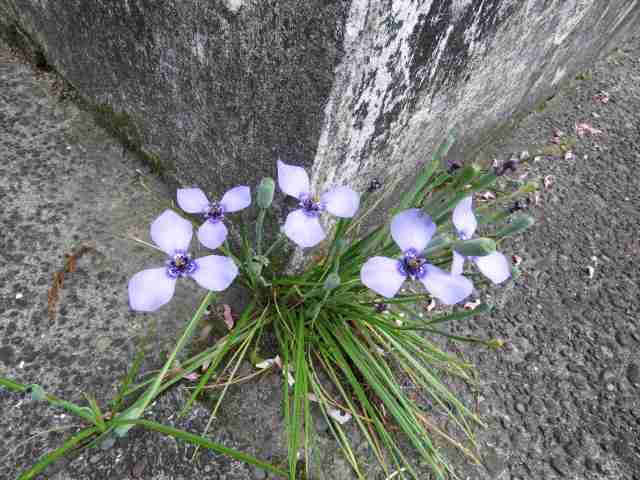
It has taken us a long time to get to the name of this – Herbertia lahue or prairie nymph

Crossing the ocean to the central and southern Americas, we get Herbertia lahue with the charming common name of Prairie Nymph. Neither Mark nor I have known what this was until now, although Mark gave his assessment that it ‘looks dangerous’. He is right that the visible evidence of seed development is scary, but in all the years we have had it, it has not become an invasive problem.
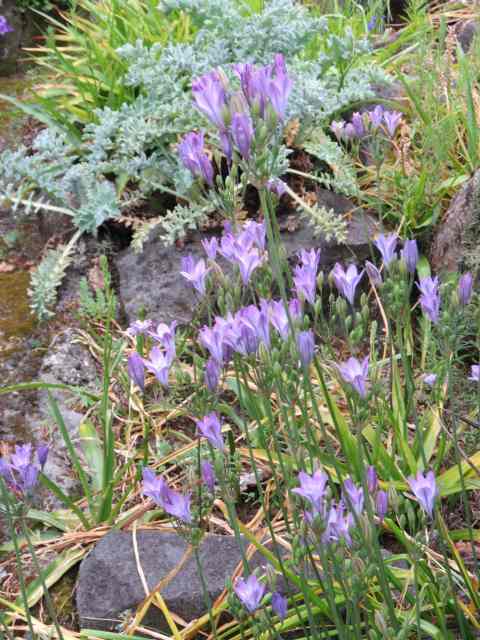
I have brodiaea firmly embedded in my brain so I may struggle if in fact it is now a tritelia

Then there are the multitudinous but welcome plants of Brodiaea laxa ‘Queen Fabiola’. Or is it definitively reclassified as a tritelia these days? This I do not know. It has built up most satisfyingly here without becoming a problem. In a climate where the giant blue alliums are not a starter for us – or indeed for many people in this land, given the whopping price per bulb let alone sparse availability – I see my brodiaeas as the poor man’s alternative to swathes of late spring blue. True, it falls over in the rain but it stands up again when the rains stop.
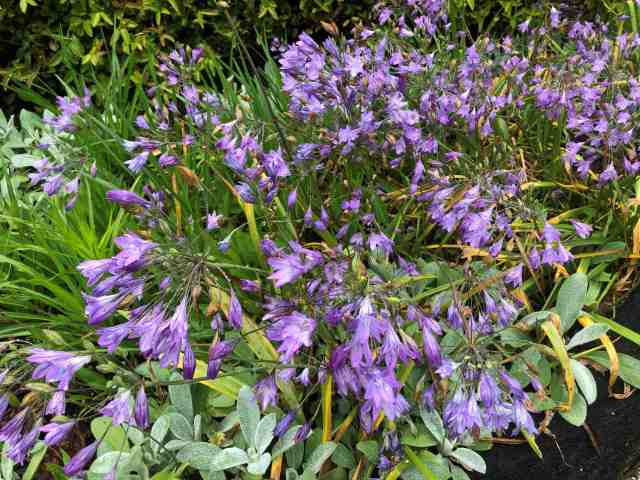
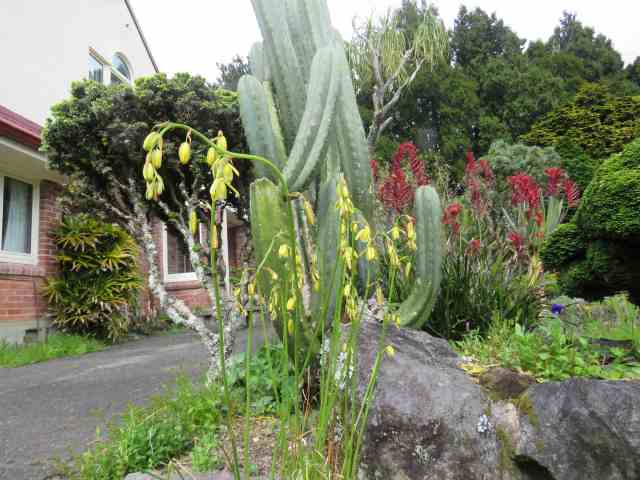
Flattened by the rain this week but what I think of it as the poor man (or woman)’s blue allium replacement
Albuca flaccida (not canadensis!)

It has taken a few years (read: quite a few, possibly many years) to build up Albuca flaccida  (incorrectly named and sold in this country as A. canadensis, including by us) in sufficient numbers to put on a show but we are finally there. In the class of graceful, hooded, hanging bells in yellow with green stripes, this South African bulb is a winner and even more charming when in a clump of many. The bigger growing white and green albucas are only just opening and we will get to them next month.
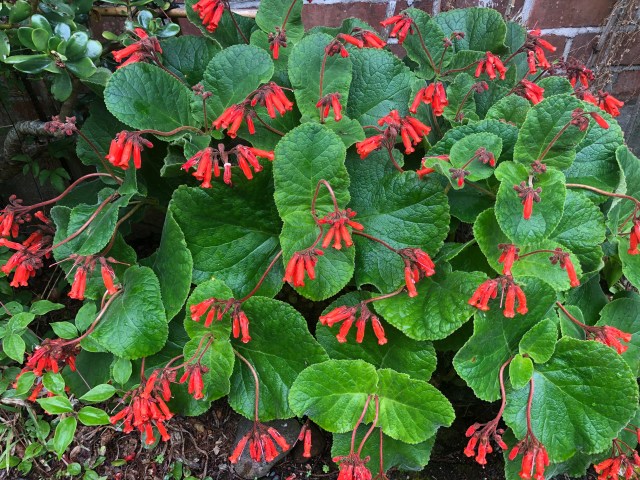
I will struggle with remembering Sinningia instead of gesneria but the cardinalis remains the same

Sinningia cardinalis (alternatively known as Gesneria cardinalis) is one of our curiosities here, built up over decades to be standout clumps of foliage and flowers that attract attention. I am not aware that it has a common name but it belongs to the same family as African violets, streptocarpus and some gloxinias. You don’t see it around much because it doesn’t appear to reproduce easily from seed and its large tuber doesn’t set offshoots so propagating it requires a bit more skill than most bulbs.
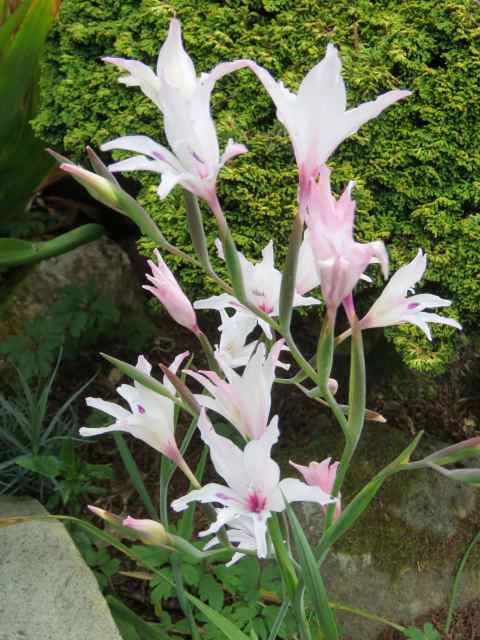
Pretty sure it is one of the gladiolus species but we don’t know which one. These often seemed to be loosely grouped into G. carneus but that may not be right

Our interest in bulbs largely begins and ends with what we can grow as garden plants. We have enough garden without having to faff around with pots. Some bulbs are easier to manage in pots, particularly those that are being grown outside their climatic and geographic areas. It is easier to manage water and growing medium requirements in pots, as well as controlling temperature and day length. It is also easy to take your eye off pots and find the contents withered away to nothing in high summer, eaten out by hungry mice in winter, or sprouting with unwelcome seed from invasive neighbours. Ideally, potted bulbs should be replanted in fresh mix every year. We prefer to keep them to the garden once we have enough to plant out.
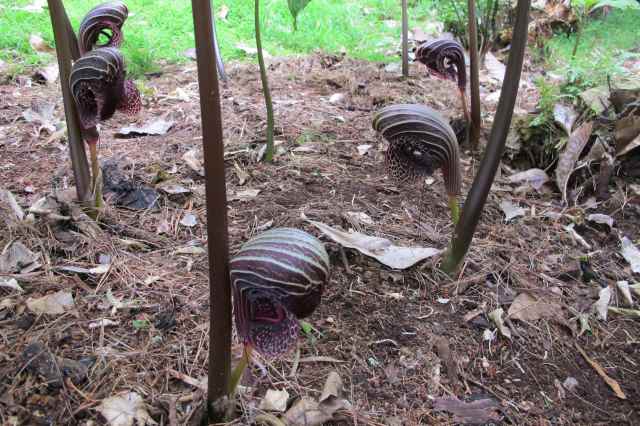
But wait there is more! I had forgotten entirely about the arisaemas, which is quite a big oversight on my part. This oddity is A, dahaiense.

The folly of the quest for garden perfection

Rhodohypoxis are to be in drifts, not clumps, thank you.

Rhodohypoxis are to be in drifts, not clumps, thank you.

I commented to a photographer once about the immaculate interiors featured in glossy magazines and how our home could never look like that. She laughed and said she once went back to get some extra photos for a feature and the place did not look the same at all. Oh, so this is how they usually live, she thought.

It is an illusion made possible by the fact that photographs capture a single moment in time and it applies equally to gardens as to house interiors. I do it when I take photos. I look at the first image and then I will rearrange or remove something to get a clearer, more pleasing shot. The folly is when we think we can achieve and maintain that in real life. It is a trap to which many of us fall victim.

This train of thought came about recently as I spent a day redoing a garden bed. In my mind, I know exactly what I want and yet again, I am on a quest to make it happen. In this case, it is a bed with five clipped and shaped small camellias in it, backed by a clipped hedge. How much can you do with about 12 square metres of garden? A lot, it turns out.

This bed, in full sun, started as a cottage garden themed on red and yellow, full of roses, perennials and annuals. It looked lovely for 3 weeks of the year and messy for the remaining 49 weeks. It then went formal(ish) and I wrestled with finding the perfect ground cover. Rubus pentalobus (‘the orangeberry plant’) was too invasive. Violets were too vigorous. Cyclamen hederafolium were lovely for about 8 months of the year but were dying off during our peak visitor season. We changed the hedge last year from clipped buxus to clipped Camellia transnokoensis (tiny white flowers and small leaves). I reduced the number topiaried camellias which give the structure. I started inter-planting the cyclamen with rhodohypoxis for spring colour and a little ground hugging perennial called scutellaria with white flowers for summer cover.

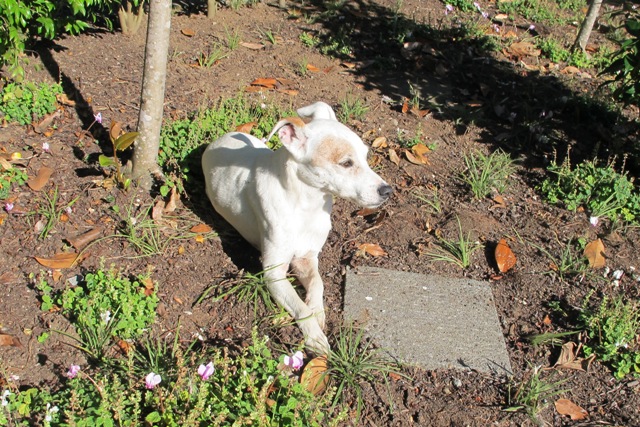
How ironic that I still went searching for a photograph to show the garden bed looking good - but had to settle for Spike the dog creating a dust bath in the reworked ground covers. This is a long way from the mental image I have of what it is to look like.

How ironic that I still went searching for a photograph to show the garden bed looking good – but had to settle for Spike the dog creating a dust bath in the reworked ground covers. This is a long way from the mental image I have of what it is to look like.

My most recent effort was because the rhodohypoxis were looking too clumpy and I wanted them drifty, not clumpy so I spread them out, while trying to make sure that the cyclamen were sufficient in number to make an uninterrupted winter carpet. It is still looking dry and dusty at the moment but will it work?

Yes and no. It will, I hope, closely match my mental image at some points in the next year or two – but it won’t stay that way. Gardens have plants and plants are not static. The mistake is thinking that we can create constant pictures in our gardens and that when it most closely matches the mental image we have, that we can then keep it that way.

It is possible to achieve something nearing perfection in a garden. For a couple of weeks. For 52 weeks? Without an army of able staff and a stand out area of replacement plants “out the back” somewhere, I doubt it. None of us own Versailles where, reportedly, the entire colour scheme of the extensive parterre gardens could be changed overnight. Even Sissinghurst today has a large nursery out of sight, full of plants to bring in as required to spruce up the displays in the garden.

Does the answer lie in a very formal garden? Not unless you are going to use artificial plants. I have seen formal gardens where the hedges and shapes have lost their sharp edge because the wretched plants will insist on putting out fresh growth. When you lose the sharp edges in a formal garden, there’s not much of interest left.

It would be much better, surely, to rid ourselves of this idea that we can achieve photographic perfection in real life gardens. But that is easier said than done, as evidenced by my repeated efforts in the garden border mentioned above. When all is said and done, I am still worried about the scutellaria which may be better in partial shade than full sun.

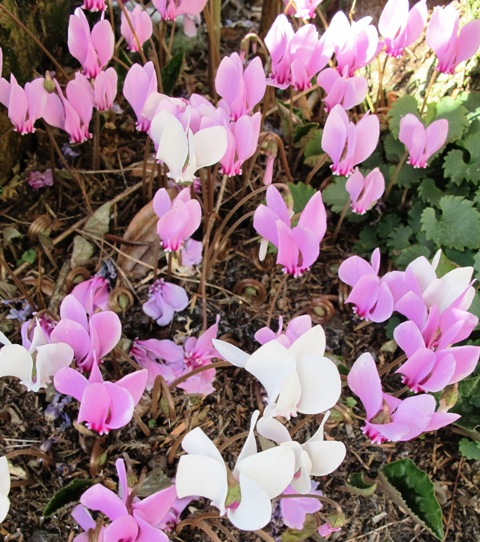
Cyclamen hederfolium give pretty flowers from summer through autumn and carpet of attractive foliage until mid spring

Cyclamen hederfolium give pretty flowers from summer through autumn and carpet of attractive foliage until mid spring

First published in the Waikato Times and reprinted here with their permission.

Plant Collector: Rhodohypoxis

Pretty little rhodohypoxis - Ruth (white), Susan (pink), Albrighton (dark)

Pretty little rhodohypoxis – Ruth (white), Susan (pink), Albrighton (dark)

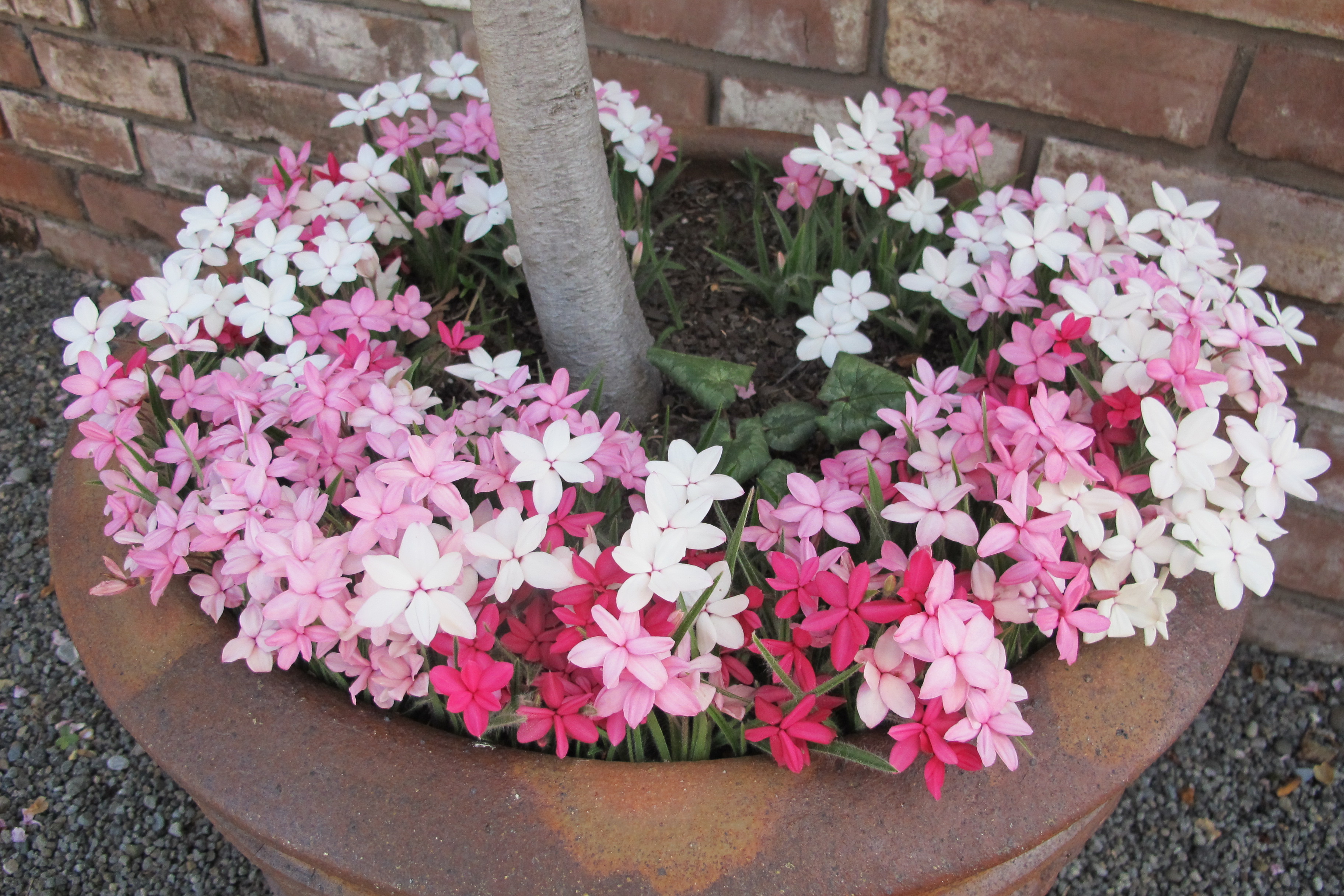
As the peak time for spring bulbs passes over, the South African rhodohypoxis come into their own. These are cracker little plants, forming a colourful carpet in well drained, sunny conditions. They are also great in wide, shallow bowls or underplanting shrubs in containers, as illustrated. Their fresh growth is triggered by autumn rains and they have a long flowering season from mid spring into early summer, as long as they don’t dry out. The foliage is short and grassy and hangs around unobtrusively until autumn when the plant goes dormant for a brief time.

There are a mass of different named rhodohypoxis, though most are just selections of R. baurii. Essentially they come in sugar pink, deep pink to red, white, bicoloured variations and occasional double forms. They are really easy to grow and multiply up most satisfyingly, with one proviso. The rhizomes are tiny and dark brown – sometimes not unlike the clawed ranunculus and other times just small, brown lumps. This means they are alarming anonymous when dormant and I am sure that is when most people forget where they are and either flay them round when weeding or plant something on top of them. If in doubt, plant them in a pot and sink the whole pot in the garden while you build up numbers.

With a rhodohypoxis expert staying here this week, we had a discussion on whether these bulbs are technically tubers, corms or rhizomes. The internet uses all terms interchangeably. The decision came down fair and square on rhizome status.

First published in the Waikato Times and reprinted here with their permission.