Tag Archives: sasanqua camellias

Garden lore

“Now us the time to thin out the carrots…” (is) an observation which always makes me come out in a cold sweat, when I read it in a London paper. As though the earth were hardening, minute by minute, so that one must rush up to the country and do things before it is too late.”

Down the Garden Path by Beverley Nichols, (1932).
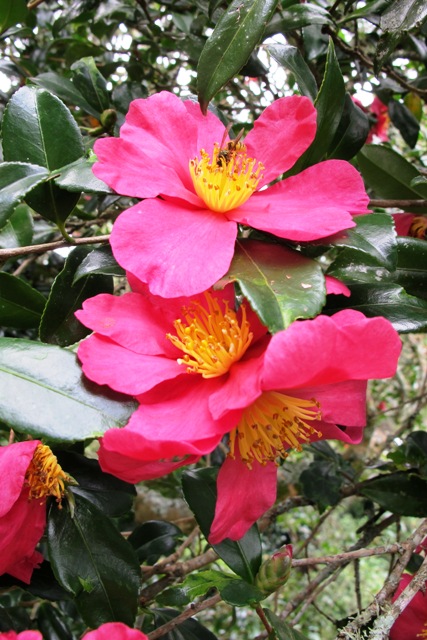
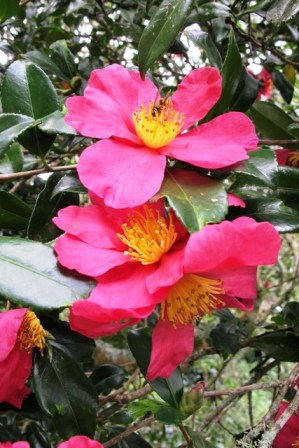
Camellia sasanqua Crimson King

Camellia sasanqua Crimson King

Autumn flowering sasanqua camellias
Most of the early camellias just coming into bloom now are sasanquas. Not snackwas, sankwas or other variants. Nor are they all white and called Setsugekka, as rather a lot of novice gardeners used to think.

Sasanquas come from Japan (most of the other types of camellias are Chinese) and are small woodland trees in their native habitat. They generally have smaller, darker leaves which is why they clip so well to hedges as well as being tolerant of full sun and wind. Being somewhat slower to get away as nursery plants, you may find plants for sale are a little smaller and more spindly than their stronger growing japonica cousins but they make up for it when planted out. While often described as scented, it is a mossy sort of scent rather than sweet perfume.

The big plus for sasanquas now is that they are generally free from petal blight which is decimating the flowering displays of many other camellias. Petal blight is what turns lovely camellia blooms splotchy and brown almost overnight. I hedge my bets.

We have never seen it on a sasanqua camellia here and we have been looking since seeing reports on the internet that it can attack them. As far as we are concerned they don’t get it in our conditions so we enjoy the full floral display through autumn into winter. If you don’t want a clipped hedge or a topiary shape, sasanquas can make graceful, light airy trees to about 3 metres over time.

First published in the Waikato Times and reprinted here with their permission.
Plant Collector: Sasanqua camellia Crimson King

Crimson King - harbinger of autumn

Crimson King - harbinger of autumn


Crimson King forms a graceful, open shrub when mature

Crimson King forms a graceful, open shrub when mature

Crimson King heralds the arrival of autumn. It is a sasanqua, one of the autumn flowering camellia family from Japan. Too many people seem to think that sasanqua is synonymous with Setsugekka (how clichéd is the Setsugekka screen planting?) and only comes in white. In fact there are a relatively large number of family members, including Crimson King. It has the usual sasanqua attributes of finer foliage and a graceful, open habit of growth as it matures. In addition to that, the exceptionally long flowering season means it will last well in winter.

Single flowers have just one row of petals and exposed yellow stamens in the centre. The birds and the bees, and indeed the butterflies, need these stamens exposed to be able to feed from the flower. Big full forms or sterile formal flowers are not a source of pollen and nectar. Most sasanquas lack the highly refined flower forms so prized in japonica camellias but single flowers like this shatter and dissipate without ever leaving a sludgy mess below. There is also a simple charm in such a simple flower.

Sasanquas are renowned for being one of the most sun and wind tolerant types of camellias. They also flower early enough in the season to avoid the dreaded camellia petal blight. Overseas reports say that they can suffer from this dreaded fungal ailment but we have never seen it in our sasanquas here. Crimson King has a pleasant scent if you stick your nose right in the flower but I think that the faint waft of fragrance in camellias is rather over-hyped.

First published in the Waikato Times and reproduced here with their permission.

Tried and True – sasanqua camellias

The cheerful face of Camellia sasanqua Gay Border

• Autumn flowering.
• Excellent hedging and good wind tolerance.
• Generally happy in full sun or partial shade.
• Widely available in a range of colours.
• Hardy in all Taranaki conditions.
• Not affected by camellia petal blight.

The first camellias of the season to flower each year are the sasanqua group from Japan. The white sasanqua hedge, Setsugekka in particular, has become a garden cliché in New Zealand but that should not detract from the garden value of this useful and hardy group of evergreen shrubs. When the deciduous trees are changing colour and dropping their foliage, the mass flowering of sasanquas is a cheerful sight. With smaller leaves in a good deep green and a growth habit that is a little lighter and airier than the rather solid japonica camellias which flower later in winter, sasanquas are less chunky as garden plants.

As well as the whites (Early Pearly, Silver Dollar, Mine No Yuki and the like), there is a whole range of pinks from pale to deep shades, a few reds and some attractive bi-colours such as the deep pink and white Gay Border. The flowers are softer and less formal than the japonicas. If you want to clip your sasanqua camellia, the rule of thumb is to do it as flowering ends with a follow-up on wayward growths in spring. It will then hold its tidy form for the rest of the year.

Camellia Diary – the second entry. May 13, 2010

Click to see all Camellia diary entries

Click on the Camellia diary logo above to see all diary entries

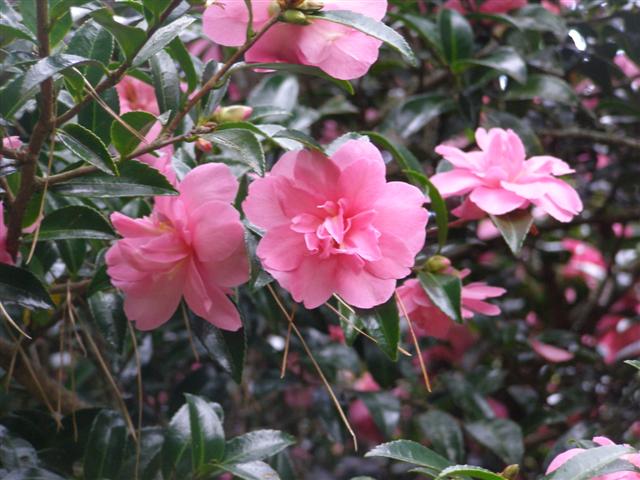
Camellia sasanqua Elfin Rose - a personal favourite

Camellia sasanqua Elfin Rose - a personal favourite

Now that we are well and truly into autumn, it is the sasanquas which are the dominant flowering shrub in the garden. What they sometimes lack in flower substance and form, they more than make up in mass display. And in a country where camellias are used extensively as garden plants and shelter, we have been hit hard by the advent of the dreaded camellia petal blight from mid season onwards. The sasanquas flower early enough to miss the onset of that scourge.

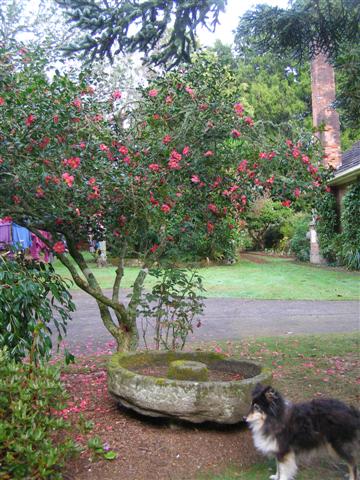
Crimson King - a graceful plant with a light canopy

My personal picks are Elfin Rose and Crimson King which just keep on flowering but there are a host of others which are very charming in their own right – Bettie Patricia, Gay Border, Mine No Yuki, Yoimachi (a sasanqua hybrid), Bonanza and Silver Dollar to name but a few.

Many of our plants are decades old, three to four metres high and just as wide. Of all the different groups of camellias, sasanquas particularly lend themselves to clipping and shaping, turning into either layered forms or light canopies often growing from multiple trunks. There is a grace to be found in their natural growth habit and form which is not always present in the more sturdy japonicas.

In the species, we couldn’t help but notice that brevistyla was brief indeed in flower. While individual blooms continue to open, the mass flowering can only have lasted ten days. The closely related microphylla, however, has continued to put on a really good show for nigh on a month now. I was writing a piece on the earliest flowering camellias for a national gardening magazine and friend and president of the NZ Camellia Society, Tony Barnes, mentioned C.granthamiana as one of the earliest to open.

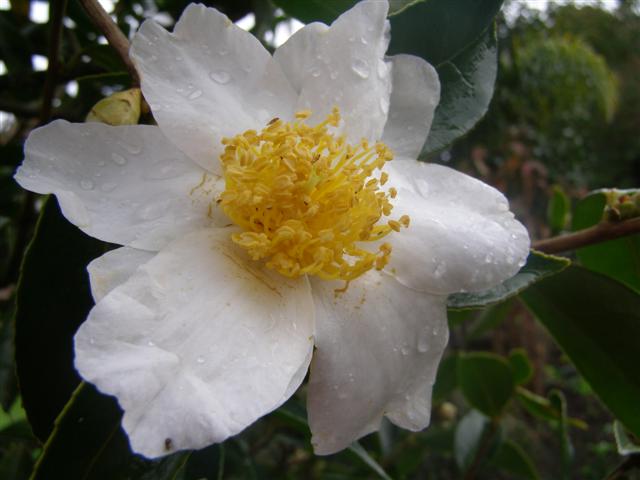
We are pretty sure it is C. gauchowensis

We have it somewhere in the garden but we appear to have mislaid it – which is to say that Mark can’t remember where he planted it and neither of us have come across it yet. We have what we think is C.gauchowensis in flower. It is another pristine white single bloom as many of the species are , on a narrow, columnar bush. Unfortunately it does get easily weather-marked. Few of the species are inherently spectacular when compared to the modern cultivars on offer but they have a quiet charm which we enjoy.