Tag Archives: summer bulbs

Plant Collector: Crocosmia “Lucifer”

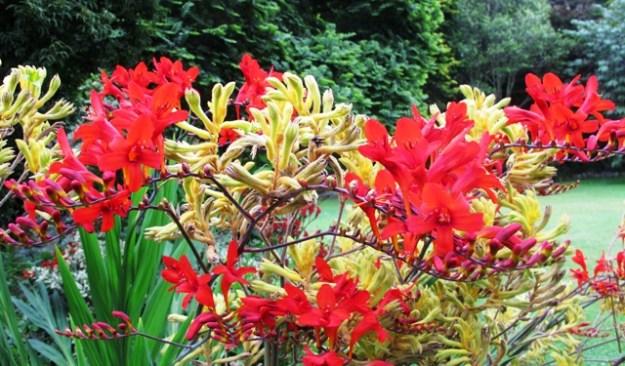
Red Crocosmia 'Lucifer' with yellow anigozanthus

Red Crocosmia ‘Lucifer’ with yellow anigozanthus

When they are roadside weeds, these bulbs are often referred to as montbretia. Treading on thin ice, I admit that we have orange-red ones growing amongst agapanthus on our roadside. At least it is better than the dreaded bristle grass that is the scourge in our area. “Lucifer” is a superior form, a hybrid with bigger flowers and stronger colour, making it popular as a garden plant. It is strong growing and both the pleated leaves and the flower spikes can get above waist height and it is almost indestructible. I like to keep it confined but it makes an attractive display beneath the apple trees and also alongside an equally strong growing yellow anigozanthus (kangaroo paw) which we have at the front of the rockery.

The bulbs are not unlike gladiolus corms and form chains below ground. It is the ability to grow when the chains are separated that makes these both easy and verging on weedy in some situations. We have a much larger flowered golden orange form which may be “Star of the East”. I say we have it, but we are waiting to see if indeed it is still here because it has been nowhere near as vigorous as “Lucifer” and each year we worry we have lost it.

Crocosmias are a small group of South African bulbs belonging to the iridaceae family. They are winter dormant, but their one drawback as a garden plant is that it takes a long time for the foliage to die down and they can be unattractive in autumn. That said, they are such toughies that I often trim the foliage off early to tidy them up.

First published in the Waikato Times and reprinted here with their permission.
Plant Collector: blandfordia (February bells here)

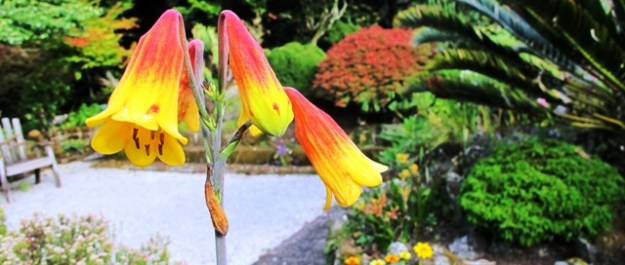
Blandfordia - Australia's Christmas bells

Blandfordia – Australia’s Christmas bells

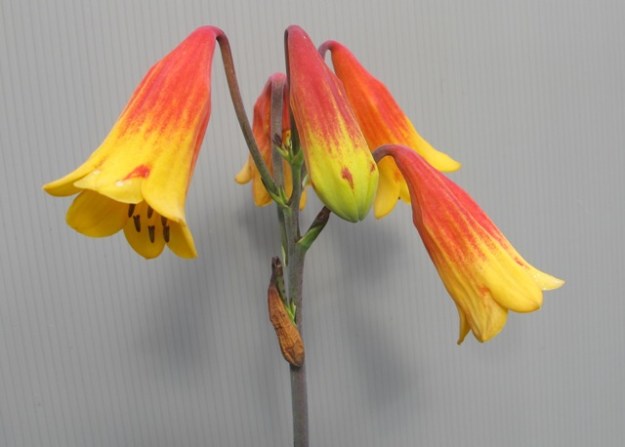
Christmas bells is the common name. Apparently in their homelands of Australia, these bulbs flower around Christmas. They are somewhat later here but the flowering lasts many weeks. It is not that there are large quantities of blooms, just that they come in succession and each trumpet lasts for a long time. These ones are on stems about 30cm high. The foliage is small, anonymous and grass-like at the base.

There are four different species of blandfordia and they have been given a family all of their own. They are hugely variable in colour and flower size, ranging from all red to all yellow, which makes identification difficult. We think this one is most likely to be Blandfordia grandiflora (so-named because it has the largest flowers) which is native to New South Wales and Queensland. There is a slight hesitation, however, between that and the Tasmanian form B. punicea. Unless an Australian botanist arrives at the right time, we may not get a definitive identification.

You don’t see blandfordias around often, or used in cut flower production, because they are slow to establish. Really slow, in fact. The references say up to 7 years to get to flowering size. In our case, maybe add another 7 before we started getting consistent flowering. Ours appears to be largely evergreen, keeping some foliage year round. Blandfordias need excellent drainage but not dry and baked in arid conditions.

blandfordia (2) - Copy

First published in the Waikato Times and reprinted here with their permission.
Plant Collector: Crinum moorei variegated

Fragrant Crinum moorei var.

Fragrant Crinum moorei var.

Crinums are a large family, belonging to the amaryllidaceae group so having some botanical connection to the likes of belladonnas and nerines. But despite there being over 130 different crinum species, not a lot make good garden subjects in this country. Sometimes you will see different crinums being grown in the tropics but the common form in this country is C. moorei which is a South African plant. It has big strappy green leaves, largely evergreen so it can get a bit scruffy, and big, strong spikes of scented flowers in shades of pink. It is a very easy plant, tolerant of woodland shade and near total neglect.

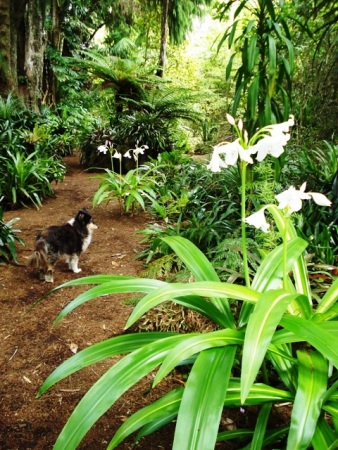
Tall, white punctuation marks in summer along a woodland walk - Crinum moorei var

Tall, white punctuation marks in summer along a woodland walk - Crinum moorei var

This is a variegated form and rather more desirable. It is deciduous which solves the scruffy problems. When the fresh growth comes in mid spring, it lights up a dark area with its bold pale gold and green striping. By mid summer, the variegation has toned down considerably to green which gives a splendid foil for the lovely tall spires of predominantly white scented blooms. These are around 150cm high but so strong, they don’t need staking. They are a wonderful late summer accent plant for shade gardens. The bulbs can reach extremely large proportions and are relatively slow to increase. As with a number of the amaryllis family, the bulbs sit half in the ground with necks exposed. We have never seen this variegated form set seed though the usual green moorei can be grown easily from fresh seed. We have to wait for our plants to form offsets on the bulbs in order to increase them, though enthusiasts could increase them by twin scaling.

First published in the Waikato Times and reproduced here with their permission.

Tikorangi Notes; Friday 27 January, 2012

Crocosmia hybrids

Crocosmia hybrids

Latest posts: Friday 27 January, 2012
1) No amount of wishful thinking can alter the fact that we do not in fact have a Mediterranean climate here and romantic recreations of the glam of Med holidays are likely doomed to disaster. Abbie’s column.
2) A big, beautiful, fragrant rhododendron flowering in mid to late January? R. diaprepes in Plant Collector this week (but don’t expect to find this one offered for sale at your local plant store).
3) Grow it Yourself – broccoli. Personally I prefer not to. I have tried repeatedly over many years to learn to love broccoli and have met with dismal failure but others are more enthusiastic and it is fearfully good for you.
4) The latest instalment of our fortnightly garden diary as published first in the Weekend Gardener – dealing with prickly onehunga weed without resorting to lawn sprays and other garden matters.

The sad state of Camellia chyrsantha

The sad state of Camellia chyrsantha

Tikorangi Notes; Friday 27 January, 2012

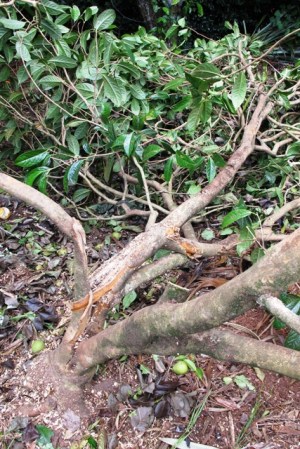
It was only last year that I featured one of the best flowerings we have had on Camellia chyrsantha (it of the butter yellow flowers – bright New Zealand butter at that). It only took a decade or two to start performing well. Alas, it came off second best to the rapid descent of a massive old pear tree last week. The trouble is that it is a grafted plant and the trunk has been split. We are hoping it may still recover and live to bloom again. We can take the long view and wait another decade, if need be.

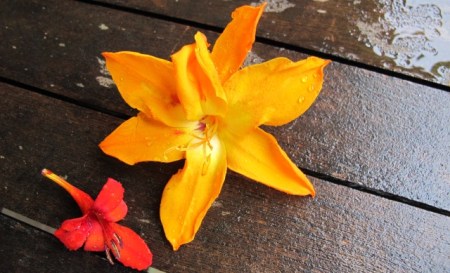
I have been photographing the different bulbs flowering this month. We were worried we had lost the yellow-orange form of crocosmia but it has leapt into flower and is remarkably showy with very large blooms. The red form (the one above is a hybrid called Lucifer) is such a strong grower that the chances of losing it are negligible, which means we take it completely for granted. Indeed, red crocosmia is a widespread roadside flower regarded as an invasive weed and known as montbretia in our area. The pink vallota is also looking particularly fetching. I would describe it more as peach than pink. There appears to be some debate about whether it is a vallota or a cyrtanthus so the pink vallota may in fact be the peach cyrtanthus. The auratum lilies are still fattening buds and not yet in full stride – just some tasters open so far.

The pink vallota. Or should that be the peach cyrtanthus?

The pink vallota. Or should that be the peach cyrtanthus?

Plant Collector – Sprekelia formosissima

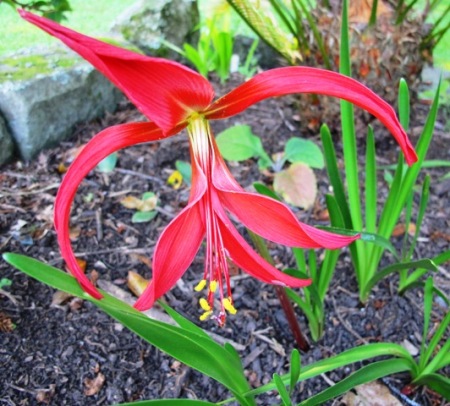
The Sprekelia formosissima or Jacobean lily

The Sprekelia formosissima or Jacobean lily

You learn something every day. This bulb is what is commonly known as the Jacobean Lily, even though it has nothing to do with the Jacobeans and it is not a lily. For years I have freely tossed the descriptor around, “it resembles a Jacobean lily”, thinking more of William Morris textile design than botany. And all the time, there is a wide level of agreement internationally that the Jacobean lily is Sprekelia formosissima. Added to that, when a species name is formasana or formasanum, it usually means that the plant comes from the former island of Formosa (now Taiwan). But the unwieldy formosissima means, loosely, beautiful. In fact it comes from Mexico.

It is indeed a beautiful flower with its rich red strappy petals and elegant form. A member of the amaryllis family, it is closely related to hippeastrums. It grows on quite a tall stem, around 30cm, with just a single flower per stem but fairly long lived. Aside from the genuine lilies, there aren’t a lot of bulbs that flower in early to mid summer. It is not particularly rare but it is one of those collectors’ items that is getting ever harder to source with the shrinking plant range offered for sale these days. If you find a plant with seed, it germinates easily when fresh.

As with all bulbs, the sprekelia likes well drained, friable soils and good light levels. It can get attacked by bulb fly (as can the hippeastrums) so we go for the woodland margins to outwit the sun-loving bulb fly. Despite its Mexican origins, sprekelia is regarded as half hardy which means that it can tolerate cool conditions and light frosts.

First published in the Waikato Times and reproduced here with their permission.