
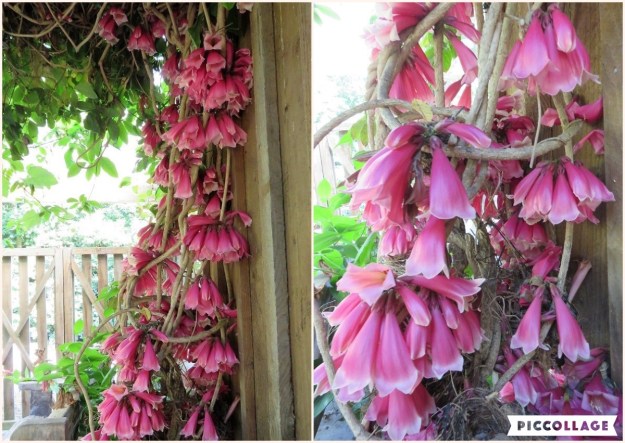
Tecomanthe venusta at its best
I have been busy gardening all week so all I have to give you this weekend are summer flowers. The New Guinea Tecomanthe venusta has never bloomed better than this week. The vines are simply smothered with its pink trumpets and I had trouble getting a photo that does it justice. True, it is not the prettiest pink to my eyes, but with all its blooms sprouting out from bare wood, it is spectacular. We have it growing under the verandah on our shed because it is a tropical climber and we are warm temperate, not tropical. For much of the year, it serves as the repository for the birds’ nests I pick up around the place.

Mummified rat in a nest
If you can get over the somewhat grotesque aspect, the mummified rat found in a blackbird nest is a little haunting. I found it like that.
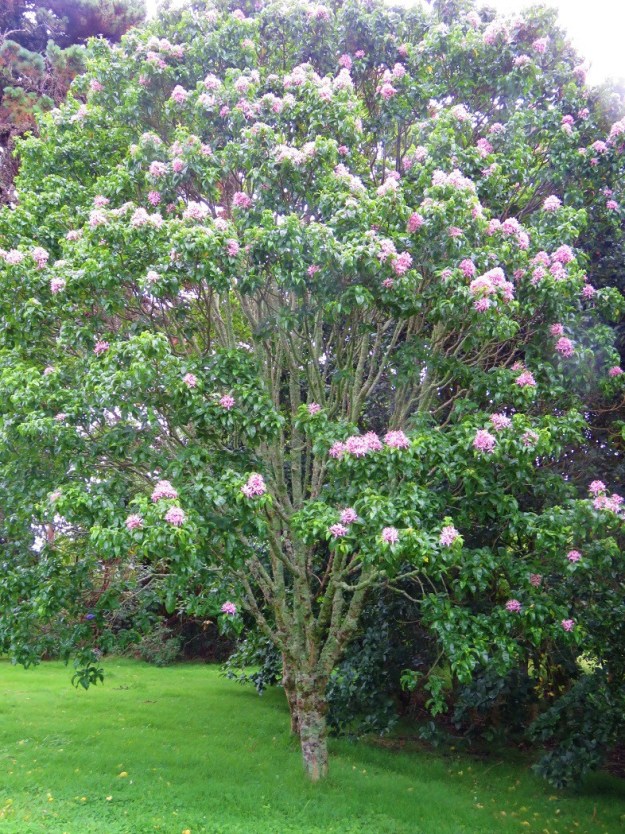
Calodendron capense
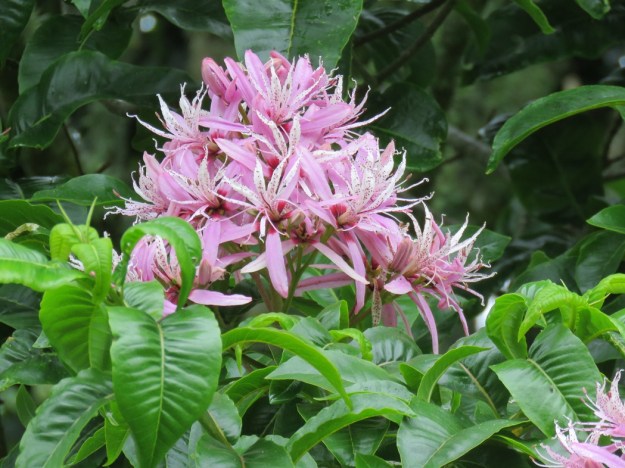
Not an aesculus, a calodendron
Across the southern hemisphere, it is the south east of Africa that gave us the cape chestnut or Calodendron capense. This is another plant that probably prefers a drier climate and few more degrees of heat than we can give it but some years, it pleases us with a really good season in bloom. Even before I found its common name of cape chestnut, I noticed the similarity of the blooms to the aesculus, or horse chestnut. The edible sweet chestnut, by they way, is a different plant altogether, being Castanea sativa. It is not even a distant relative though there is some botanical heritage shared between aesculus and calodendron so the latter should really be the Cape horse chestnut. I haven’t found any advice that it is any more edible to humans than the common horse chestnut.
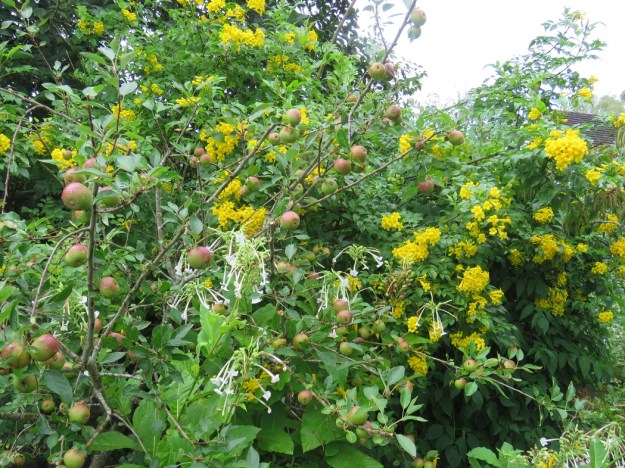
Tecoma stans – with apple tree and nicotiana in the Iolanthe garden
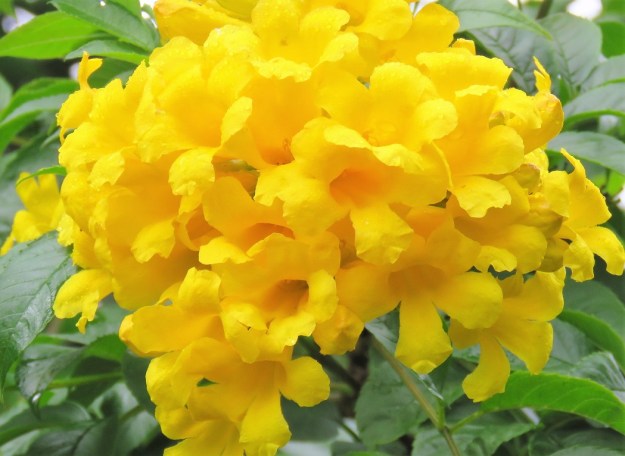
Tecoma stans – it is very yellow.
Tecoma stans is also from southern and central Africa and it is coming into its own now it is well established and has some size. It is growing in the Iolanthe garden where I have been working and because I have spent most of my time on my knees in that garden, eyes faced downwards, it was the bright yellow fallen blooms that first caught my eye. I had meant to photograph the falling blue of the jacaranda flower carpet but I left it a bit late so this is the best I can offer.

Jacaranda to the left, tecoma to the right – fallen flowers
The echinaceas have been slow to come into their own this summer. Some were set back when I did a certain amount of digging and dividing of large clumps over autumn and winter but the main problem has been the rabbits. They never touched them in the previous two years but developed a taste for them in spring when they started coming into growth and it took me a while to notice. 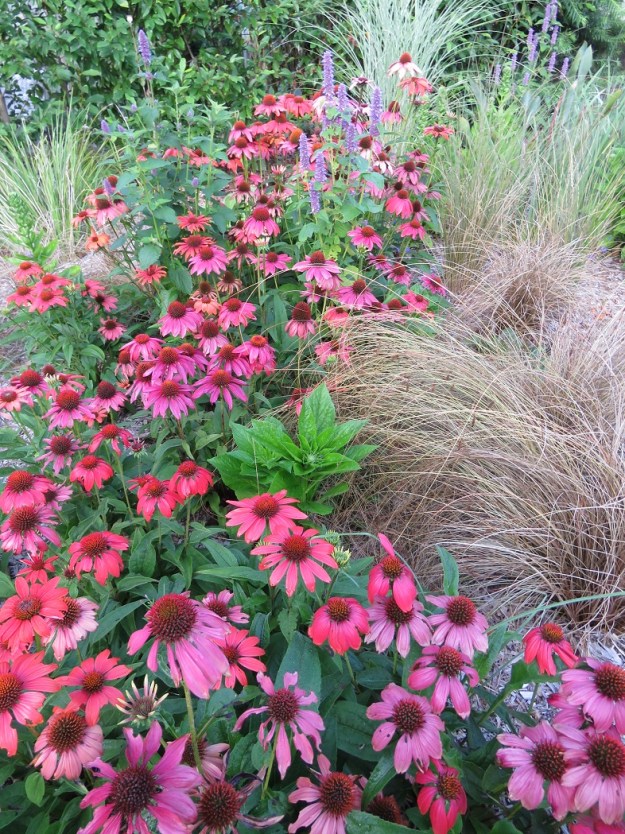
Mark has been waging war on the rabbits this summer. Every evening he heads out with our useless fox terriers – one too old and deaf to be any good on rabbits and who just likes to feel a part of things these days and the other who has never really caught on to how to hunt. Dudley hangs around waiting for Mark to shoot them. “Come on Dad, hurry up.” He appears to think he is a retriever, not a terrier. Mark is simply gobsmacked at how many he has shot in recent weeks – around 23 in just one area of the garden that is probably only an acre or two in total. They are spread over the rest of the property – in fact, right across Tikorangi we are told by others – but they aren’t wreaking havoc there on the same scale as in the house gardens.

Mark is on a mission, the fairly useless dogs don’t want to miss out on potential excitement but fail to honour their terrier heritage
Next spring, I will be out with the blood and bone in early spring at the first hint of growth on the echinaceas. We beat the bunnies on the lilies though I admitted defeat and moved the campanula that they took down despite my best efforts. I will win on the echinaceas.

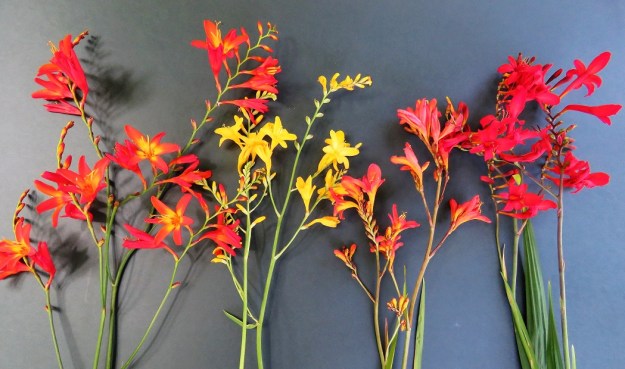
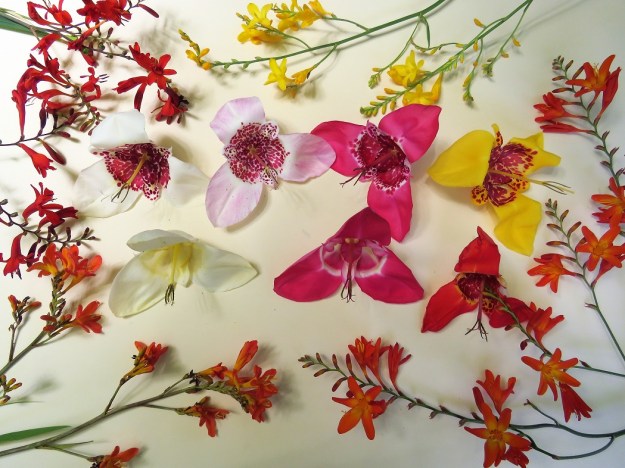 I started by thinking I would do a comparison of tigridias. And then crocosmias. It was too hot to be out in the garden and I couldn’t go down to the shaded areas of the stream in the park to clear weeds on the banks and free up the water from some of the choking weeds on account of having stuffed my dodgy wrist doing this heavy work the day before.
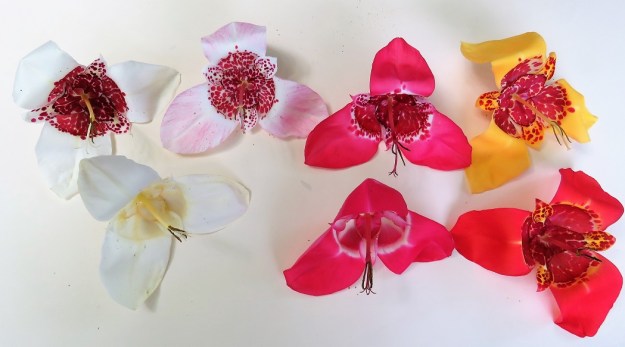 I have spent some time separating the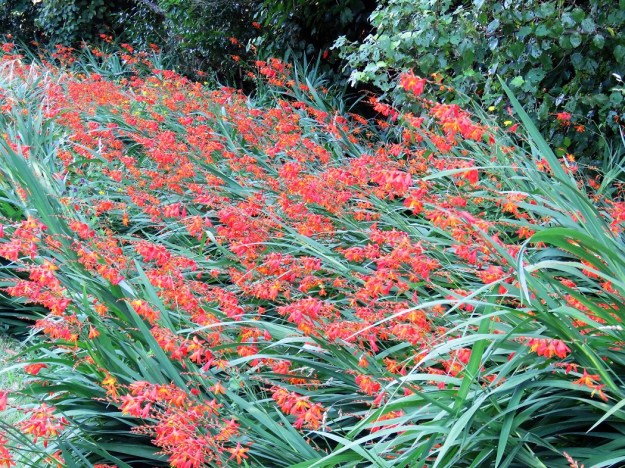

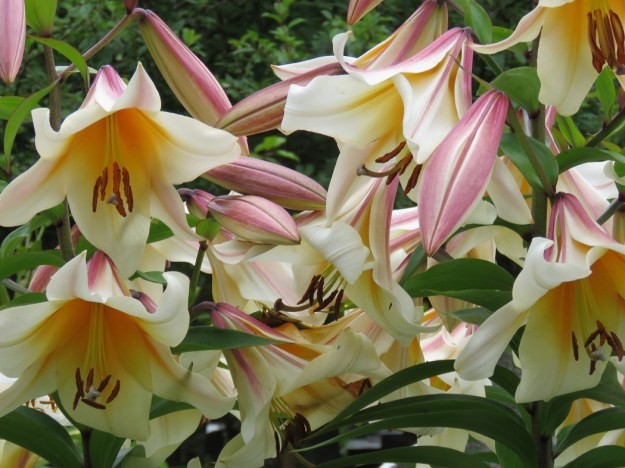
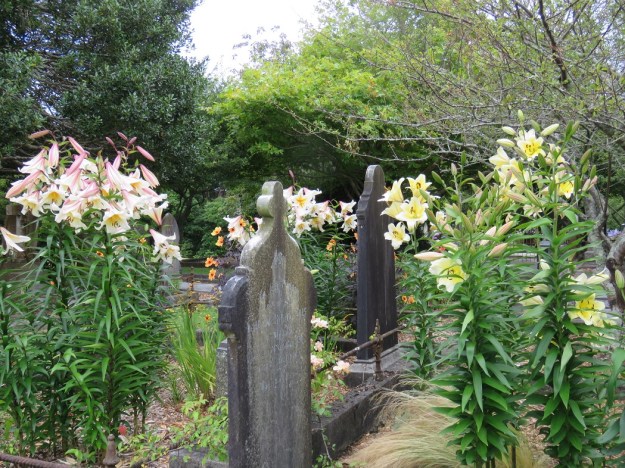
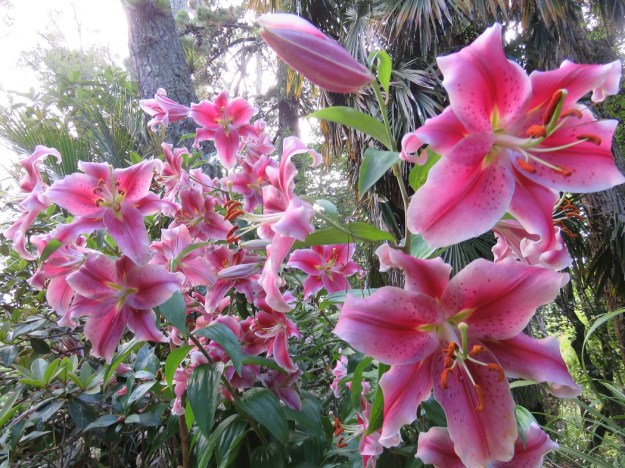 Auratum lily time is a delight, a joy even. Showy, over the top, flamboyant but glorious. And we are just entering these weeks of glory.
 We grow lilies in the better lit areas of woodland. They can get somewhat stretched reaching for the light so need more staking when not in full sun. I am rounding them up to limit the areas where we have them growing in order to make that seasonal staking task easier. But they certainly light up the woodland margins.
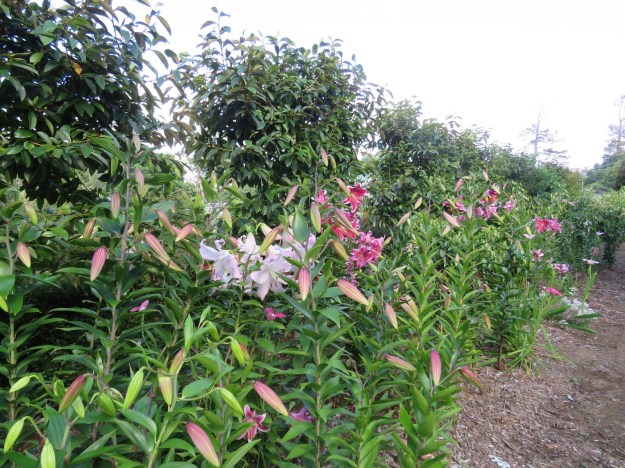 The new lily border has just opened its earliest flowers. These are the result of a determined and sustained effort to
  Almost all of ours are unnamed hybrids raised by father and son – first Felix and now Mark. Felix named a few that we used to sell but they are pretty mixed in the garden now. All are outward facing, not upward facing. That was one of the breeding aims. Upward facing lilies act as leaf and debris catchers and weather-mark badly.
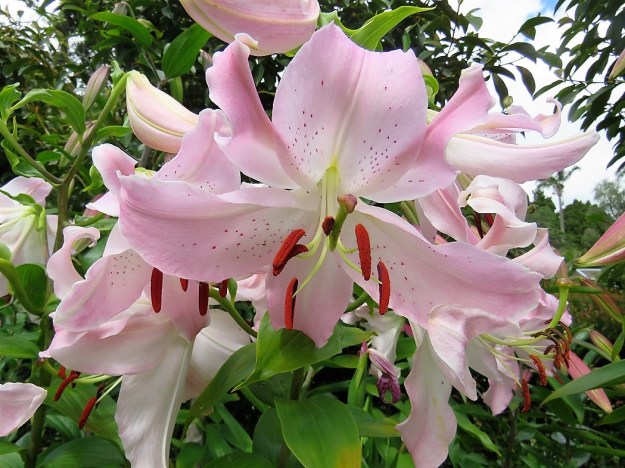 Of them all, I think these soft, marshmallow pink ones of Mark’s raising may be my favourite. Or it could be another one in a few days’ time.
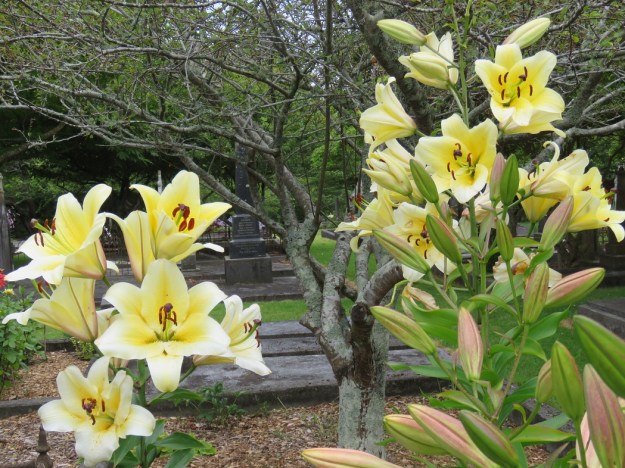
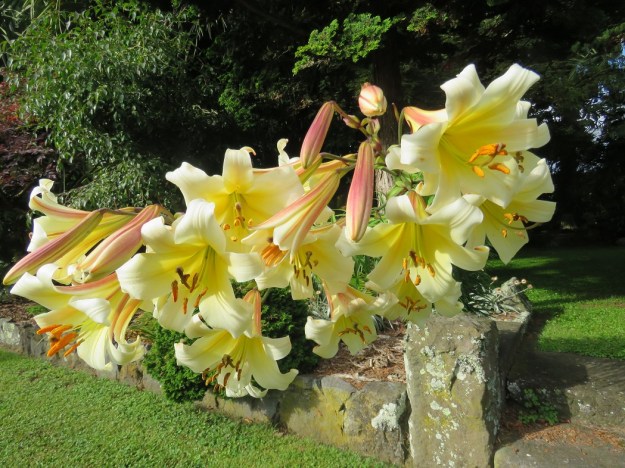 Finally, just in case there are any lily experts reading this: I assumed these trumpet lilies elsewhere in the garden are an unusual, honey-coloured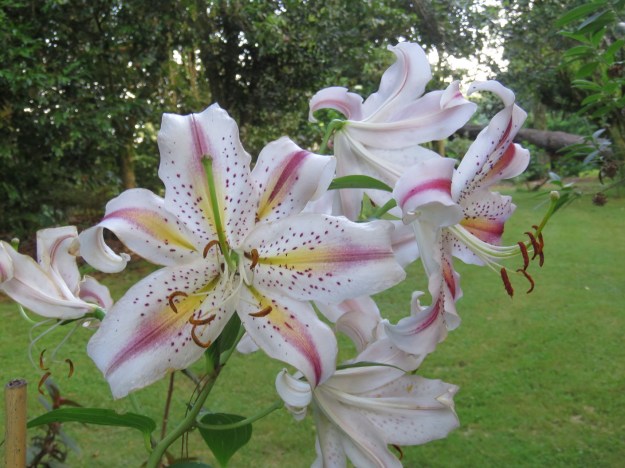
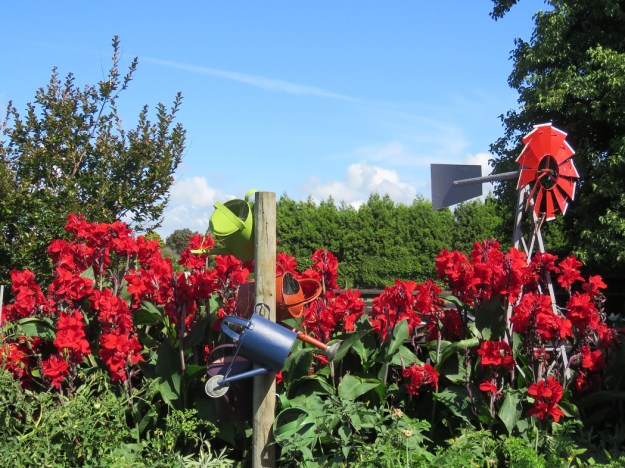 But the fact that I don’t want to grow them myself does not stop me from seeing their merits elsewhere. Down the road, so to speak – as in maybe 5km and a couple of road changes down the road – is a fine patch of red cannas that I admired all last summer each time I passed. They are very… bold. And undeniably cheerful. When passing in a car, they are bright enough to catch my eye every time and they do appear to have a long season in flower. Pat, who owns these, offered me some when I stopped to photograph them yesterday, but I declined. I get my pleasure from looking at them in her garden.
 If you are going to grow them, my advice would be to plant them in blocks of a single colour for maximum effect. I did not realise until I looked them up to get their species name that they are edible. My cursory study of them indicated that it is the tubers you eat, not the flowers. They are Canna indica, not lilies at all, but that is probably no surprise. Their widespread natural habitat takes in large parts of South and Central America, stretching up into the southern states of USA.
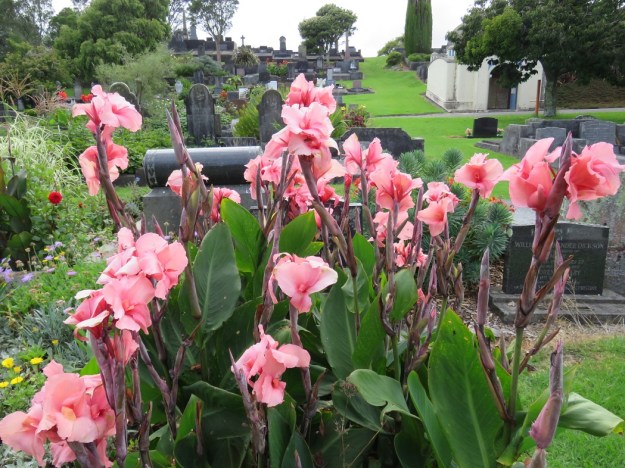 Cannas are a mainstay of the summer plantings at the Te Henui cemetery. Mercifully, Cemetery Sue who leads the team of volunteers who tend those gardens, has kept the colours separate.
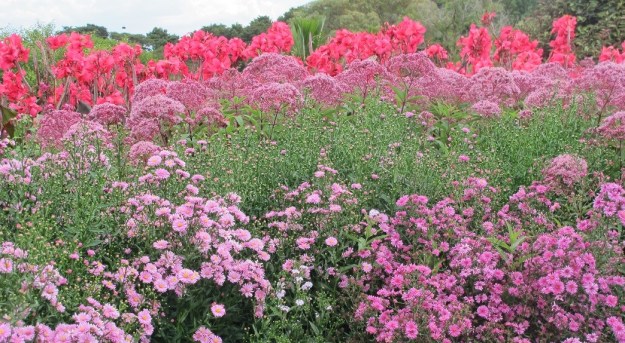 Auckland Regional Botanic Gardens also uses big plantings of cannas in their summer herbaceous displays. Some of these are better than others. The symphony in pink was, I thought, charming on the day. The garish stripes in primary colours, not so much.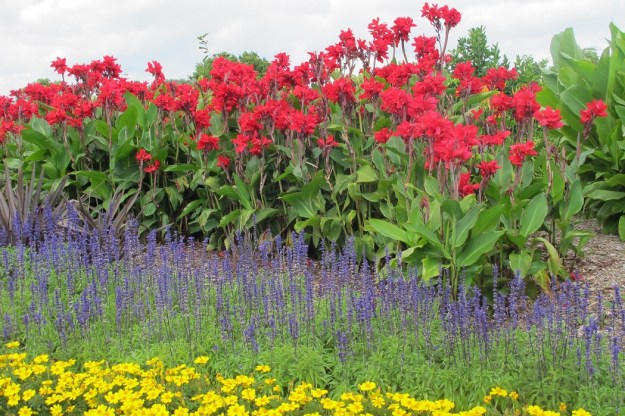
 Tikorangi The Jury Garden