Tag Archives: Taranaki gardens

More mid winter delight than harbinger of spring – galanthus (snowdrops)

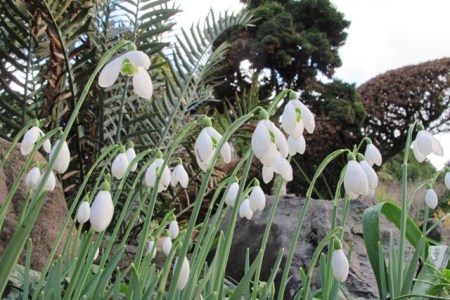
Galanthus S Arnott is a wonderful performer here

Galanthus S Arnott is a wonderful performer here

It’s snowdrop time. Proper snowdrops which are galanthus. These are widely referred to as English snowdrops, though they are not. In fact they occur naturally throughout Europe and down through the Mediterranean. It is just that the English have made them their own and who can blame them? Snowdrops rank right up there beside daffodils for that feeling of seasonal wonder.

We lack the snow of course, so we don’t get the simple picture of the flowers appearing through melting snow. I assume this is why they are called snowdrops in common parlance.

We will never be galanthophiles here, though that has more to do with climate than anything else. We have a number of different types of snowdrops but most are very marginal in our mild conditions and we struggle to keep them going here so there is no point whatever in collecting as many different ones as we can and keeping them separate, as galanthophiles will. While there are only about twenty species, there are hundreds of named varieties. Most of these are species selections. In other words, while snowdrops will seed down in the wild, particular variations have been selected out and then propagated from that original bulb (as opposed to raised from seed which won’t keep the variation stable – most will revert immediately to the usual form). We could only look in awe at the fabulous prices paid for a very good new white and yellow snowdrop in the UK last year. It was knocking on the door of past times when the wealthy paid vast amounts for a new tulip bulb. While we have the old double variety, G. nivalis Flore Pleno, we have not sought the many variants on doubles. Flore Pleno is not flowering yet so I can’t photograph it but it looks a bit of a mutant and lacks the charm of the simpler, more natural forms in my eyes.

In this country, if you want to see snowdrops in all their glory, the place to go to is Maple Glen where Muriel Davison has built up extensive plantings in her large garden. Unfortunately for northerners, it is sited at Wyndham between Gore and Invercargill so few of us are likely to make it at the right time. Or time a late winter trip to the UK. For years I had a photo a reader sent me of a carpet of snowdrops (and we are talking bulbs in the magnitude of five to six figures all in bloom at the same time) beneath white barked birches somewhere in England.

So I know that our snowdrop efforts here are modest by those standards. But we have snowdrops, and quite a few of them now. The one variety that performs consistently well in our conditions, flowering reliably every year and building up readily, is Galanthus S. Arnott. Apparently it is equally good in the UK because it has been given an Award of Garden Merit from the Royal Horticultural Society.

The peak flowering season is not a long one. It is just enchanting while it lasts and snowdrops lend themselves to drifts in garden borders, on woodland margins, in our growing bulb hillside (coming through the grass) as well as being featured in rockery pockets. They flower at a time when there is not a lot else out. While typically regarded as harbingers of spring, they are more mid winter. We keep gently spreading them further afield in the garden. Many British gardens open in February for what is often called a snowdrop weekend. That is the aim here. It may take us another decade to get sufficient carpets of snowdrops to warrant declaring snowdrop weekend, but we could never be accused of taking the short term view of gardening. And we are well on the way.

Curiously with snowdrops, the practice is to lift, divide and replant soon after flowering. There aren’t many bulbs where you are advised to move them in full growth. In England they are often sold as “green bundles” when still in growth. I have taken from this that they are not fussy so I move them any time now – whether dormant or at any stage of growth. Typical of all bulbs, they need good drainage and reasonable light levels. Woodlands overseas are largely deciduous which means they have more light. Our dominance of evergreens in this country leans us more towards forest than woodland. That is why we go for planting the margins rather than the depths.

Finally, just for clarification, what is often referred to as a snowdrop in New Zealand is an entirely different family. The leucojum is much stronger growing, often found in old homestead paddocks, associating with daffodils. It has the little cup without the surrounding skirt of petals and is less refined than a proper snowdrop. Notwithstanding that, it is an under-rated garden plant with a very long flowering season. But it is a snowflake not a snowdrop.

Snowflake (leucojum) to the left and snowdrop (galanthus) to the right

Snowflake (leucojum) to the left and snowdrop (galanthus) to the right

First published in the Waikato Times and reprinted here with their permission.
Tikorangi Notes: Friday 22 June, 2012

Latest posts: June 22, 2012
1) The garden identity crisis (or why you need to do quite big things around about year 15). My column from the Waikato Times this morning.
2) The sugar candy pink of Luculia gratissima Early Dawn on a winter’s day. Not my favourite luculia, perhaps. Plant Collector from the Waikato Times this morning.
3) The strawberry bed should be planted this weekend. Time is running out. From the Waikato Times this morning.
4) Much of what you may want to know about the early flowering camellias (plus more). From the latest edition of Weekend Gardener.
5) In the garden this fortnight. On actually getting around to digging and dividing instead of merely advising others to do it and getting rid of excess mondo grass – my garden diary from Weekend Gardener.
6) For absolute beginners – how to plant a tree. Outdoor Classroom has a second coming with our step by step guides.
7) Latest cookbook reviews – and why it may be better to keep local. In fact our NZ cookbooks are particularly good so it is a mystery to me as to why a NZ publishing house would want to import and release this utility series from Kyle Books in the UK.

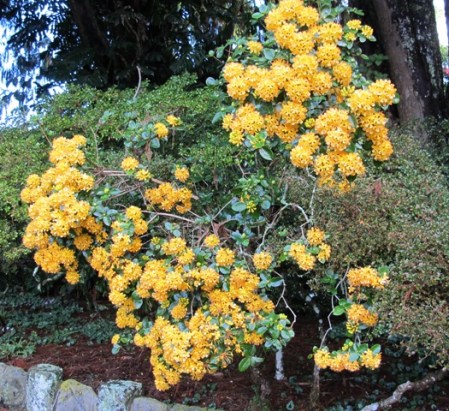
A reasonably remarkable mid winter sight - the original R. macgregoriae aged 55 years!

A reasonably remarkable mid winter sight – the original R. macgregoriae aged 55 years!

A week of typical winter weather – random rain, torrential at times with thunder storms and just enough sun to remind us that our weather isn’t too bad, temperatures swinging from cold (like 10 degrees during the day) to a balmy 16 or 17. A typical mid winter’s week, really. I have at least started my major renovation of the rose garden. It is fun and not all gardening is fun. Wait for more – it is all part of learning to garden with perennials and finding a level we are happy with in terms of a modern look without resorting to mass planting and utilitiarian ground cover.

The snowdrops are opening here and that is a simple delight. But the flowering star this week is the vireya rhododendron, R. macgregoriae. This is the original plant that Felix Jury collected in what was just New Guinea in 1957. It is a particularly good form and gave the basis of a breeding programme here. But the astonishing thing, for anyone who knows vireyas, is that it is still thriving after 55 years. This is not a plant genus that is known for its longevity.

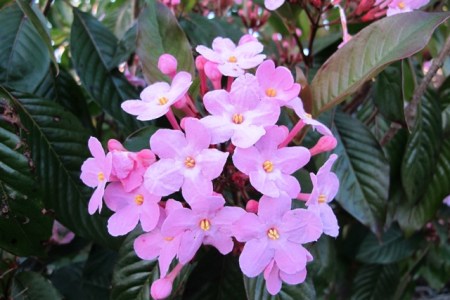
Plant Collector : Luculia gratissima “Early Dawn”

Luculia gratissima 'Early Dawn'

Luculia gratissima ‘Early Dawn’

To be honest, this is not my favourite luculia but it is the one that you are most likely to find offered for sale and it stays somewhat smaller than the other types we grow.

Do not let the fact that this winter flowering shrub hails from the Himalayas lull you into thinking it is hardy. It does not like frost at all and much more than a few degrees will cause short term damage to the foliage and possibly take out the winter blooms for the year. A heavy frost may kill it. However, you can learn a lesson from the fact that it is a forest tree in the Himalayas. If you have areas of the garden with good overhead cover from larger, evergreen trees, you may succeed with this plant, even in frosty inland areas. And it looks a great deal more attractive, in my opinion, when grown as a woodland plant.

The common practice in this country is to plant Early Dawn in full sun in the open and to keep it hard pruned and therefore more compact. It then covers itself in its rather harsh candy pink flowers (which are at least sweetly scented), shouting “Look at me! Look at me!” Its foliage develops a red tinge in cold temperatures and if an untimely frost catches it, you then have this rather unsightly, little shrub with shrivelled leaves. The plant we have in our woodland, however, is tall (2.5m), willowy, graceful and the sugar pink flower heads contrast well with all the greenery. It is a very different picture to the one we have in the open. Get it into woodland, is my advice, into ground rich in litter and humus. Then it may cheer up a bleak winter’s day.

First published in the Waikato Times and reproduced here with their permission.

For my preferred luculias, check out the white Fragrant Pearl and the pretty almond pink Fragrant Cloud (scroll down to the photo).

In the garden this fortnight: June 7, 2012

A fortnightly series first published in the Weekend Gardener and reproduced here with their permission.

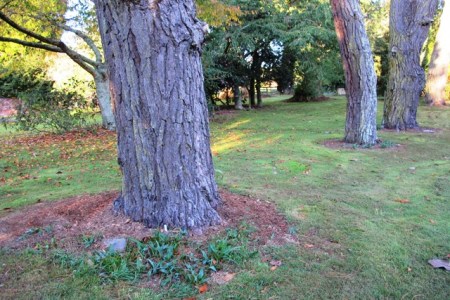
Naturalising bulbs in conditions of rampant grass growth

Naturalising bulbs in conditions of rampant grass growth

Meadows of naturalised bulbs are a complete delight and a contrast to the highly cultivated type of garden most of us have. But they are best suited to places where there isn’t vigorous grass growth and regular rain. This means that good dairy country like Taranaki is by definition not suitable for bulb meadows. All that grass overpowers and hides them. But we are undeterred. Mark has been working on a bulb hillside in recent years where we have a native microlaena grass (probably M. stipoides) which is much finer and less vigorous than introduced pasture and lawn grasses. He likes the bulbs on a hill because it is possible to get closer and to look up at the flowers from a pathway. He is very pleased with how the dwarf narcissi, species cyclamen, colchicums, snowdrops (mostly Galanthus S. Arnott) and pleione orchids have settled in over the last three years and started multiplying. The bluebells (hyacinthoides) are more robust and build up well in open areas under the trees where we can control the grass with a weed-eater. The exercise is getting the last grass trimming round done before the bulb foliage is too far through the ground with flower spikes formed.

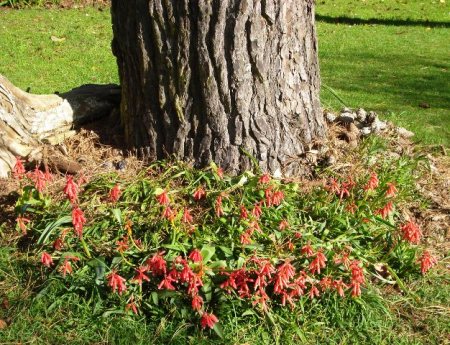
Lachenalia bulbifera

Lachenalia bulbifera

In a different area of the garden, in recent years I have been planting surplus bulbs around the trunks of large trees where the grass won’t grow because the ground is too dry and poor. These are ideal conditions for some bulbs and the lachenalias from South Africa, stronger growing dwarf narcissi like the bulbocodiums and peacock iris (Moraea villosa) don’t mind at all. There is plenty of light because these trees have dropped all their lower limbs over time. It is not quite the meadow we would like with big drifts, but it is what we can manage in our climate.

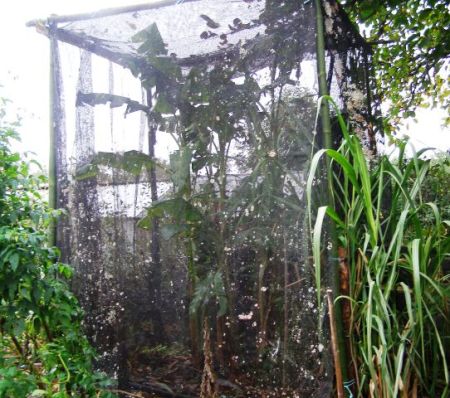
The Theatre of the Banana

The Theatre of the Banana

Top tasks:

1) Get the winter cage erected around the bananas. They are the only plants we wrap up for winter but we are very marginal banana growing territory and we are willing to work at trying to get a home grown banana crop. I refer to the construction as the Theatre of the Banana.

2) Sort out the compost heaps. We make quite large quantities of compost but at the moment, the waste is accumulating faster than we are layering it into compost piles. We work a three heap system – the heap we are currently using, the heap that is curing and the one we are building. At the moment there seems to be enough for two new compost heaps.

Tikorangi Notes: Friday June 1, 2012

A true blue verbascum - Blue Lagoon (Photo: Thompson and Morgan)

A true blue verbascum – Blue Lagoon (Photo: Thompson and Morgan)

Latest posts: June 1, 2012
1) Astoundingly, a blue as blue verbascum. Currently only available in the UK, as far as I know, but we seriously covet it for our garden. Abbie’s column.
2) The last nerine for the season, N. bowdenii, standing up to late autumn with brazen pinkness.
3) Grow it yourself – a bay tree. It is easy.
4) And, nothing to do with gardening, but a slew of new reviews on http://runningfurs.com – children’s books this time (mostly picture books) with three really good ones amongst them.

After last week’s column about reviewing our mixed borders, I have been having such fun reworking some of the borders. But I think my concept (and practice) of unifying the underplantings is on a somewhat different page to that of the author, Anne Wareham, who motivated me in this direction. True, in one border, I drifted the blue corydalis, yellow polyanthus and blue lobelia, but also retained the Rodgersia aesculifolia and Mark’s showy arisaemea hybrids. I cast out the dreadful mondo grass which seems to inveigling its way in everywhere (compost heaps are so useful) and figured that the interesting Manfreda maculosa would be better being interesting somewhere else. Same with the burgundy eucomis and a few other plants. But I was always bound to fall off the simplifying wagon. It being the coldest border we have in the upper gardens, I simply could not resist trying some meconopsis (blue Himalayan poppies) to see if they would like the spot. Ditto, some Higo iris, because we are looking for the right conditions for these.

The proof of the pudding is in the eating. We will see how my border looks in the spring and then for the next two or three years. There is little dross left but I realise it is just not in my nature (nor, indeed, in Mark’s) to switch to simple, unified plantings. We just have to work harder at getting the combinations better and establishing different looks so they don’t all start to meld and look the same.