Tag Archives: Taranaki gardens

In the garden this fortnight: Thursday 23 February, 2012

The natural look can take a surprising amount of effort and intervention

The natural look can take a surprising amount of effort and intervention

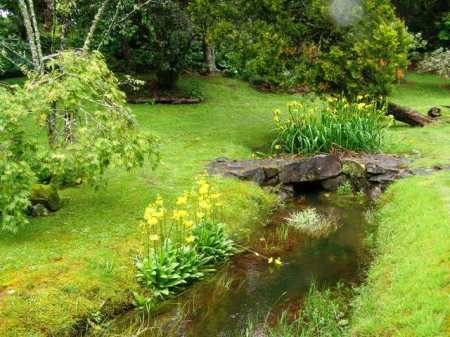
We have been making a major, combined effort to return our natural stream closer to something resembling pristine condition. I say natural stream because it is entirely natural where it enters and leaves our property but in between we manipulate it quite a bit. We have ponds, we play with the levels to create little rapids so we have the sound of water running and we have total control over what happens with flood water when we get torrential rain – achieved by a simple weir, flood channel and stopbanks. What we don’t have control of is the build up of silt and invasive water weeds.

What started as a pleasant summer activity reducing the water weeds (Cape Pondweed, oxygen weed and blanket weed are the worst), has grown to be something more major. We have hand pulled and raked most of the weed out. The clumps of streamside planting (mostly irises but also bog primulas, pontederia and a few others) are all in the process of being dramatically reduced in size. We hadn’t noticed quite how large they had grown in the years since they were first planted. The build up of silt in the water channel – up to my knees in places – is being stirred up and then flushed through to settle in the ponds. To flush it through requires holding the water back and then releasing it in one swoosh. To do it properly requires the building of a second, simple weir. Once all the silt is in the ponds, we will hire a sludge pump to clear it. Trying to stay on top of water weeds (none of which we introduced ourselves) is an ongoing task. We are thinking a bit more regular maintenance may keep the silt under control. Our access makes getting a digger in very difficult and the mess afterwards is such that we prefer to do things by hand.

The end result is that we will have a natural looking stream again. Sometimes it takes a lot of work to achieve and maintain a natural look in a garden.
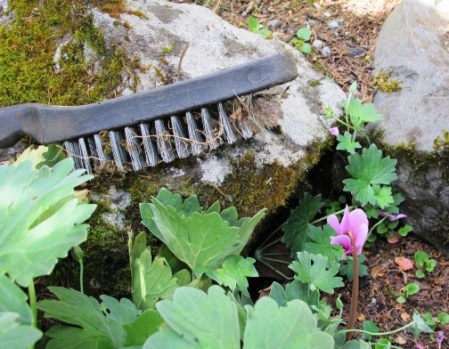
Top tasks:

1) Continue reducing mossy cover and lichen on rocks and paths in the rockery. In our humid climate, we have continual moss growth and while some of it softens hard lines and adds a certain look, too much of it obliterates lines altogether and makes the place look unloved. I use a wire brush and I know I will probably have to continue doing it for the rest of my gardening life here.

2) And on the theme of having too much of something, no matter how good, I need to finish my radical thinning of the black mondo grass (ophiopogon) and the cyclamen hederafolium which seem determined to try to choke each other out. The mondo grass goes on the compost heap. The large cyclamen corms I am laying as ground cover in an area where I have given up on both Rubus pentalobus (orangeberry) and violets which both proved to be too strong growing.

A fortnightly series first written for the Weekend Gardener and reproduced here with their permission.

Tikorangi Notes: Friday 3 February, 2012

Our pregnant gecko, Glenys, is back in view

Our pregnant gecko, Glenys, is back in view

Latest posts: Friday 3 February, 2012

1) The battle with the water weeds in Abbie’s column this week.

2) One for the dendrologists in Plant Collector this week – Pinus montezumae. It takes a bit to convince most New Zealanders that any pine tree is capable of being special but garden visitors do single our specimen of P.montezumae as being a tree out of the ordinary realm of the common pine.

3) Grow it yourself – silver beet. Some people are even alleged to enjoy eating this iron-rich but utility vegetable.

4) Welcome back Glenys, our highly prized but rather shy resident gecko. We are terribly excited by the evidence that we have a population of gecko in our garden, though that excitement does not appear to have been widely shared by others! But in this country, the small skinks are a common sight whereas our native gecko is nocturnal, elusive and rarely seen.

5) Check out the lily photo album I am building on our Facebook garden page. If you feel inclined to “like” the whole Facebook page, it would be most gratifying. Our popularity on Facebook lags behind the visitor numbers to our websites, and even the subscribers. This may of course just indicate that gardeners are less inclined to use social networks.

The auratum lily season is late this year, but no less spectacular for its delay

The auratum lily season is late this year, but no less spectacular for its delay

Tikorangi Notes: Friday 3 February, 2012

Oh summer, where art thou? Even the auratum lilies seem to be waiting for some real summer heat before opening fully in all their glory. This may go down in history as one of the coolest summers in recent history. On the bright side, the garden is very lush and green and working conditions are not unpleasantly hot. In fact, for Lloyd and I cleaning out the ponds and stream in our park, working conditions have been very pleasant. I just like a little searing heat to justify the fact we have a swimming pool. It has had precious little use so far this year.

Mark is very excited to see the blandfordia coming into flower. I have tried to photograph it but even by our standards, it is still looking a little too modest to boast about. It may look more notable when additional buds open. The reason for our excitement is that it was planted in the rockery by Felix Jury and as Felix died in 1997, it means it has been there for quite a long time and not doing very much. In fact, in all those years, it has only flowered twice before. Its third flowering is cause to celebrate.

Our Lloyd makes a prettier sight than I do when it comes to weeding the pond

Our Lloyd makes a prettier sight than I do when it comes to weeding the pond

In the Garden: January 5, 2012

A fortnightly series first published in the Weekend Gardener and reproduced here with their permission.
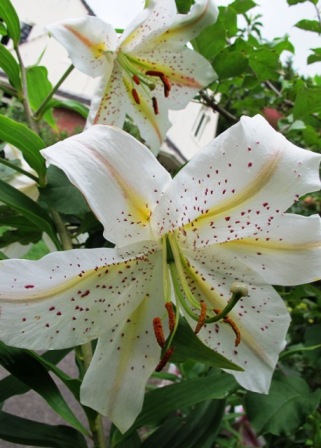
I am very selective about container plants these days

I am very selective about container plants these days

As summer takes hold, I am grateful that I have dramatically reduced the number of plants I grow in containers. I am not particularly reliable at hand watering and there is nothing worse than feature plants in pots, troughs or containers that stand out because they are gasping for water, drooping and defoliating badly. It is also very difficult to get water into potting mixes which have dried out completely because the water just flows straight through. A squirt of detergent can act as a surfactant and help water absorption. Because I only grow bulbs, the odd large bonsai or choice shrubs in pots, I never add water retention crystals. With our high rainfall, these products keep the potting mix too wet, rotting out the roots and the bulbs. This is particularly so in winter when plants don’t want to live with their roots sogging in cold, wet conditions. The only time I have used water retention crystals was in my hanging basket phase (it passed quickly) and when I tried seasonal pots of annuals – which also passed quickly. We went on holiday leaving lovely big pots of blooming pink petunias and blue ageratum and came back to pots of withered, dead plants. The water retention crystals were not enough. I decided then and there that I preferred a more permanent and sustainable style of gardening.

In issue 323 of the Weekend Gardener, I wrote about plunging pots to reduce watering requirements while still keeping individual plants featured. It only works if the pots are porous (I keep to terracotta) and they still need the occasional water but they are much easier to maintain over summer. I have found I need to keep an eye out for slug infestations around the plunged pots. They like the damp, dark conditions and can take up residence on the outside surfaces of the pots. I found an entire slug convention on one pot recently but at least it encourages them into one area for easy eradication.

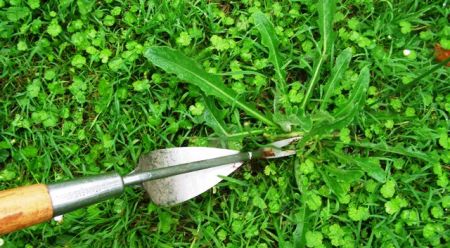
The peaceful, neverending task of hoicking out flat weeds

The peaceful, neverending task of hoicking out flat weeds

Top tasks:
1) Weeding is never ending. At this time of year, some of it can be done quickly by push hoe. If any weeds get away on us and set seed heads, we try and remove them from the area but the aim is always to get them before that stage so they can be left to wither and die in the summer sun.
2) The autumn bulbs will be starting to move very soon, putting out fresh roots. I need to thin the Cyclamen hederafolium, Colchicum autumnale (the autumn crocus) and check over the clumps of nerines (mostly sarniensis hybrids) before they are growing.
3) When I feel the need to do something quiet and mindless, I head out with the lawn tool to dig out flat weeds in the grassy areas of our park. It is a bit like King Canute holding back the sea but it makes me feel more virtuous than spraying and it is a soothing summer occupation.

Tikorangi Notes: Friday 23 December, 2011

Red dahlias for Christmas (but not for Plant Collector profiling)

Red dahlias for Christmas (but not for Plant Collector profiling)

Latest posts:
1) Oh Christmas tree, oh Christmas tree (Abbie’s column) and why it may be a misnomer to brand the iconic pohutukawa as the New Zealand Christmas tree.
2) While the reasons why philadelphus is often referred to as mock orange blossom may elude me, the pure, fragrant beauty of the flowers at Christmas is above reproach.
3) Was there even life before basil?

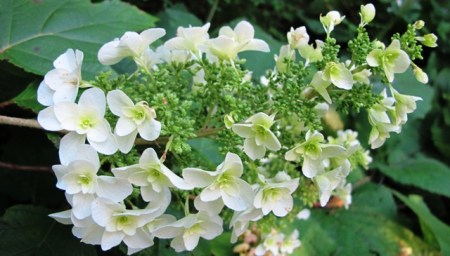
The dainty Hydrangea quercifolia "Snowflake"

The dainty Hydrangea quercifolia "Snowflake"

Tikorangi Notes: Friday December 23, 2011
Just two days before Christmas and the sun is shining brightly, temperatures are rising and there is no wind. After the torrential downpours of last week, it feels like a little Christmas blessing. In the garden we are busy with a grooming round. Well, two of us are. Mark is determinedly following his own path of draining the settling pond which stops our stream in the park from silting up and doing a weeding round. He takes the lion’s share of responsibility for weeding here. Lloyd and I are titivating in preparation for a wedding to be held here on New Year’s Eve.

Other gardens focus on the wedding venue market but not us. Mark prefers people to come because they want to see the garden rather than to see the place used as a venue. I did a handful of weddings a few years ago – singlehandedly because Mark resolutely stuck to his principles and made himself scarce. But then I met… Bridezilla. That was my last ever booking. If I had known how demanding she would be, I would have trebled the price I quoted and even then I do not think that would have compensated for treating me like the hired help in my own garden.

But, we have a wedding coming and we agreed to this one because it is our daughter’s best friend. And it is proving to be a Major Event. Pride says we have to have the top gardens in immaculate condition, even though we know that guests are here for the event and few will do anything more than cast their eyes around and say, “Oh, very nice…”. Given that the colour scheme for the wedding is the wonderfully retro orange and brown, it is perhaps just as well that the dominant garden colour at this time is lush green. We are in the gentle hiatus between late spring flowers and summer lilies, though the hydrangeas are coming into their own.

The garden remains open for visiting each day. There is an honesty box if we are not around. Best wishes for Christmas to all who read this page.

In the Garden: Friday December 16

A fortnightly series first published in the Weekend Gardener and reproduced here with their permission.

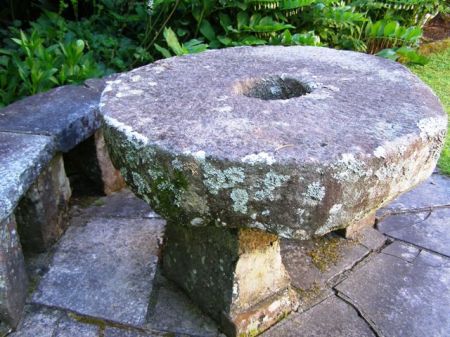
The antique stone mill wheels are fine as garden decoration

The antique stone mill wheels are fine as garden decoration

Ours is a garden that is very light on ornamentation and we prefer it that way. The last thing I want for Christmas is a garden ornament or colourful display pot. The three stone antique millwheels are fine, but generally we like to feature glimpsed views or plants as focal points rather than statuary or any type of installation. We are lucky that we garden on a sufficiently large scale to be able to use the glimpsed view, even the odd borrowed vista. It is a bit more problematic in a tiny, town garden with a view of next door’s washing line. But using plants as a feature point is possible no matter what size the garden.

Before....

Before....

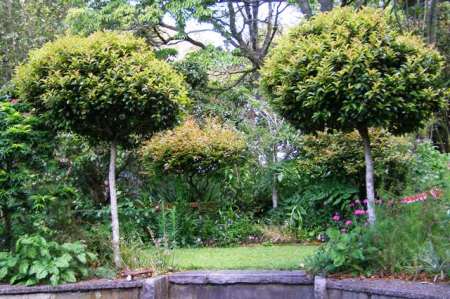
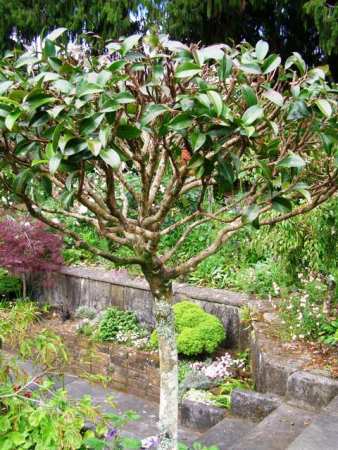
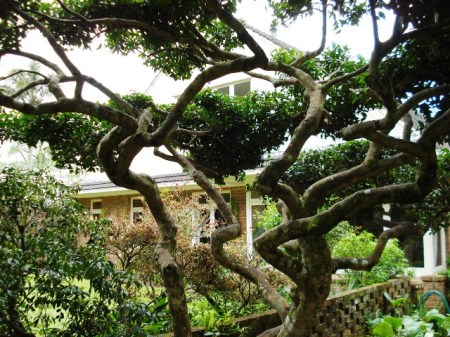
One of the delights of having a mature garden with old plants is that there is plenty of raw material for clipping and shaping. We don’t want to follow the Italian example and clip and shape everything, but the occasional large, cloud pruned specimen can be as strong as any man-made focal point. Camellias are wonderful for clipping and shaping because they will sprout again if you make a mistake and they grow densely if you clip every year. Some of the michelias also clip well when they are well established, as does loropetalum and the classic yews. The skill is in making

... and immediately after

... and immediately after

sure that not everything is turned into a lollipop (the easiest shape to clip), or a cake stand (which is just a vertical stack of lollipops). Mark favours the flatter topped mushroom shape or layers of clouds. We had four standard lollipops flanking our sunken garden but they had become too dense and rounded. Some radical cutting has seen them become much lighter mushrooms instead, giving a visual accent rather than completely dominating the area. He doesn’t rely on doing it all by eye, instead using lengths of bamboo to measure height and width. We don’t mind a bit of variation – these are living plants not artificial structures that can be like identical soldiers – but we want a sense of overall unity.

Top tasks:

1) Summer prune the wisterias. Turn your back for a moment and they can make a bid for world domination, or so it seems. I just tidy up the long, wayward tendrils at this time of the year and do a structural and shaping prune in winter.

2) Continue deadheading and light summer pruning of the roses. Because we never spray our roses here, I prune frequently to encourage fresh growth. They get a traditional winter prune so the summer effort is more like a nip and tuck. I rely on keeping the roses growing strongly and pushing out fresh leaf buds to keep enough foliage coming to replace what succumbs to black spot. I try and remove all spent blooms and damaged foliage to the wheelie bin, to avoid them harbouring pests and diseases on the ground at the base of the roses.

A large cloud pruned specimen of Camellia sasanqua Mine No Yuki

A large cloud pruned specimen of Camellia sasanqua Mine No Yuki