Tag Archives: Taranaki gardens

Tikorangi Notes: Sunday 10 July, 2011

Latest posts: Sunday 10 July, 2011

1) Prole drift (further comment on trends in NZ gardening)

2) Tikorangi Diary Friday July 8 (subtitled: what we have been up to with a smattering of garden hints which may be useful)

3) Growing garlic based on Mark’s experience. I was going to say our experience but that would be the royal we. Growing garlic and indeed all fruit and veg is entirely Mark’s domain, as writing is mine.

It is persimmons set against the winter sky this week, instead of Magnolia Vulcan

It is persimmons set against the winter sky this week, instead of Magnolia Vulcan


Tikorangi Notes: Sunday 10 July, 2011

Winter in our neck of the woods tends to be wet but comparatively mild. This year has been particularly mild with the warmest May on record and a warm June to follow. But wet. We can continue to garden in all the fine spells and because we have such free draining soils, the ground rarely gets too sodden to work. And light is our other defining feature – we keep the same astonishing clarity of light all year here. Most New Zealanders take our blue as blue skies and bright sunlight for granted and it is not until you visit countries with very low winter light levels that you realise our winter light is quite extraordinary. It is what makes the magnolias so wonderful here and despite July being our coldest month, more magnolias and michelias are opening blooms. We usually have a wonderful display of the early red magnolias towards the end of July and then flower through to mid September (longer for the michelias).

In the rainy, sodden times, I have been getting to grips with social media – as in Twitter and Facebook. This is a challenge for me (and one which entirely bypasses Mark who does not even know where the on switch to the computer is located). I enjoy the brevity and simplicity of Twitter but Facebook has been a bigger challenge. However, we reached our magic number of 30 “likes”, as one says in Facebook parlance, so we now have our own designated url: facebook.com/thejurygarden It takes a certain amount of mental energy and time to manage all these on line connections but it does appear to be the way of the present and maybe the future. Facebook seems to offer a good platform for current pretty pictures. If you feel inclined to visit our new facebook page and tick the like box, it apparently helps in establishing a profile beyond just our standard webpages.

Tikorangi Diary: Friday 8 July, 2011

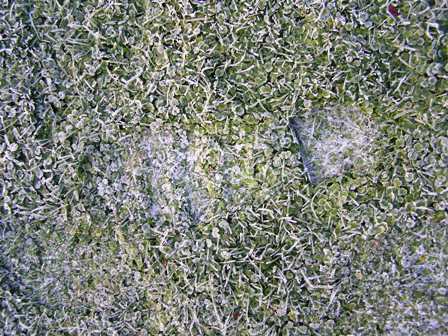
Footprint in the frost

Footprint in the frost

Today feels like the first blast of real winter. As it is now the second week of July, I guess we can hardly complain. Spring starts here in August. A visible frost earlier in the week had me out with the camera which is an indicator that they are not common events here. As Lloyd and I tramped across the lawn and I photographed the footprints, I did briefly ponder the advice not to walk on frosted grass. Sure enough, the footprints had turned black the next day.

The bananas are partially tucked up for winter, just in time

The bananas are partially tucked up for winter, just in time

Fortunately, Mark had covered his bananas a few days earlier. This is one fruit which we have to nurse through the winter, though we did scoff a little at the advice in the local paper last week to cover your citrus in frost cloth. We have never worried about the citrus and it has never been a problem.
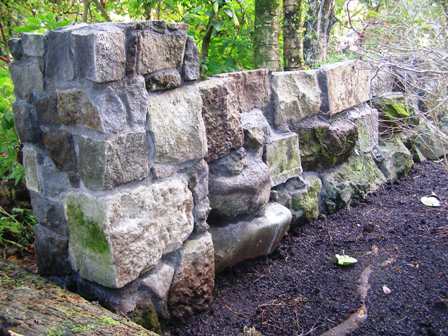
Lloyd does build a nice stone pillar when required

Lloyd does build a nice stone pillar when required

Lloyd finally finished the repairs to one of the stone walls – he does build a nice stone pillar when needed, does our Lloyd. This one was started from scratch. Since then, poor man, he has been out lifting the last of the open ground magnolia crops. We still have to sell some plants here to pay for the garden so the call of the nursery has taken him away from the garden. So too for Mark, who has been spent most of his time putting in cuttings (mostly michelias from his breeding programme as he conducts propagation trials). It is getting close to the end of the cuttings season now, though we only put in a shadow of what we used to when the nursery was in full production.

Mark is out and about most evenings after dark with the dogs in search of troublesome possums who may be developing a taste for magnolia buds. Every year without fail, we get asked about magnolia trees which are opening badly deformed flowers. In our experience, the culprit is always a possum, and usually only one. Magnolias are not possum magnets as the oranges or fresh growth on roses are, but one single minded critter can take out most of the buds on a single tree over a matter of nights. Because they chew down into the centre of the bud, the damage is not obvious until the tree tries to open the flower. Mark usually does autopsies on the possums he shoots (which is to say, he analyses the contents of their stomachs to see what they have been feeding on) and upon occasion he will find one chock-a-block with magnolia buds.

Besides doing a little fiddly-faddly potting of plants to sell during our annual garden festival at the end of October (a very important time for us), I have abandoned my efforts on the rose garden (I just don’t enjoy working in that area and I have not worked out yet what is wrong with it). I will have to return to it to finish, but it has been much more fun to work in an under-used area of the woodland. I have been planting drifts of bulbs – big bulbs like Scadoxus puniceus (given that we can sell each big bulb for about $25 because it is rare here, it felt wonderfully indulgent to plant a drift of about 30 of them), Scadoxus katherinae, Haemanthus albifloss and Haemanthus conccineus. I find bulbs much more rewarding than those wretched roses and I can live with their scruffy foliage when they start to go dormant – though H. albifloss is evergreen and the others have quite short dormancy periods. I am only just getting to grips with the fact that large clumps of bulbs need more regular lifting and dividing to stop them from falling apart when in full growth. We did the auratum lilies this time last year and most of them held themselves up in summer, without needing staking. Every three to four years seems to be about right for these types of large bulbs.

For a change from grubbing in the dirt, I have been pruning rhododendrons. These are a backbone plant in our garden and winter is the ideal time for hard pruning. They do look better when dead wood and wayward branches have been removed. A few get subjected to a really hard prune back to bare stems though this sacrifices this year’s floral display for a better long term outcome.

I was going to dig some of the huge clumps of yellow clivias today, replant the largest sections and pot some of the smaller divisions for sale but it was too cold for me to want to garden. It can wait. Clivias are tough, forgiving plants and the timing of lifting and dividing is not critical at all. In fact, they won’t turn a hair, as long as they are treated properly, no matter when it is done. It shouldn’t stay this cold for long. I even caught myself with the camera, starting a photo shoot on how to divide clivias for an Outdoor Classroom – old habits die hard.

The magnolias are coming into flower. At this stage, just M. campbelli and Vulcan but the buds are swelling fast and starting to show glimpses of colour on many others. It makes this time of year one of the most exciting for us.
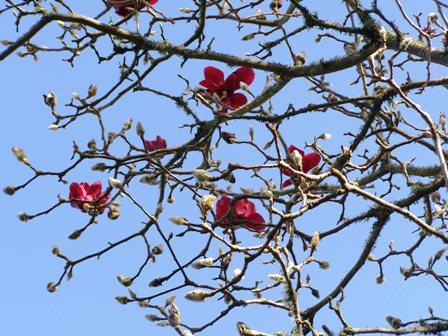
Magnolia Vulcan is coming in to flower

Magnolia Vulcan is coming in to flower

Growing garlic

Sown in late autumn, the garlic is well into growth here - seen with an unusually heavy frost which had me out with the camera this morning

Sown in late autumn, the garlic is well into growth here - seen with an unusually heavy frost which had me out with the camera this morning

We have been talking about garlic.This is because of the repeated advice from a local garden centre that it is not too late to plant garlic but you must start it off in trays and transplant in several weeks time when the bulbs have made good growth. It is an approach that will work (though individual pots cause less root disturbance at the time of transplant rather than trays) but it is a lot of work that we are not convinced is necessary.

Garlic can be planted directly into the ground. It is not difficult to get it growing. Within a few days of planting, it should be showing fresh root. But it is getting late in the planting season and should be done immediately. Increasingly, we are of the opinion that it is an unhelpful old wives’ tale that it should be planted on the shortest day and harvested on the longest day. These days, Mark plants it in autumn, a practice which is becoming increasingly common in this country. Autumn planting means the cloves are already growing well before the ground becomes cold and sodden.

The single biggest issue with garlic is that you need to know where they come from because you want NZ garlic. Cheap imported garlic may look fine and clean but it is usually from China, so from the wrong hemisphere and therefore on an opposite seasonal sequence. Added to that, imported garlic is reputed to be troubled by garlic virus which you do not need to unleash.

Other growing tips:

• Break the garlic bulb into single cloves and only plant the big ones. It is a waste of time planting small cloves.

• Plant at about 10cm spacings into ground which has been dug over well and is friable and fluffy.

• Put the cloves in so they are about 2cm deep to the top of the clove. Press them down firmly because they can push themselves out of the ground as they start to grow.

• Pile on the compost on top of the soil. Garlic is a hungry plant. Real enthusiasts will liquid feed regularly and keep the fertiliser up to them and it is likely to result in a bigger and better harvest. We are busy here with a big garden so Mark just plants well, keeps the area weedfree and that is pretty much it until harvest time.

• If we get a very dry spell in spring, that can be a problem. Check the crop. You may have to water them if we get several weeks without rain.

• Harvest around mid summer when the bulbs have reached maturity. You do not have to wait for the tops to die off. Dry the garlic before storing (plaited is the traditional approach) – hanging in an airy situation helps it to last longer.

And, basically, that is about it. Keep the vampires at bay.

Ornithological bickering and squabbling

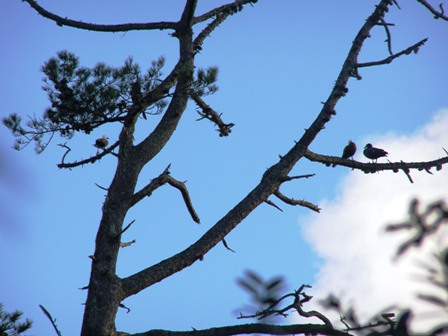
Three paradise ducks but spot the shag

Three paradise ducks but spot the shag


The paradise ducks were not at all thrilled by the shag in their old pine tree (you can just see the silhouette of the shag amongst the pine needles but it is about 20 metres up the tree) and were attempting to move it on by verbal abuse. The bellbirds don’t like the tui (one tui, two tui – we have many tui but they don’t have an s to make them plural). Everybody hates poor old Hedwhig the Morepork and the tui will persist in lording it over pretty much every other feathered inhabitant of the garden, including each other. Clearly these birds do not believe in peaceful co-existence.

Tikorangi Notes: Sunday 26 June, 2011

Latest Posts:

1) Growing citrus in the Taranaki garden – the first part of a random series drawing on our experience of growing fruit trees in the home garden here. With the abundance of tui in our garden, I did briefly ponder calling it the Tui Tikorangi Fruit Garden as a nod and a wink to the somewhat infamous publication from Penguin. Given that we also have a surprising and gratifying number of bellbirds or korimako in residence at the moment, Mark was of the opinion that I could instead draw on the common name for these songbirds – mockers. So, perhaps, The Mockers Tikorangi Fruit Garden. At least our advice is based on practical experience underpinned by some horticultural experience….

2) Meet Hedwhig the Morepork (our native owl, also called a ruru).

3) Tikorangi Diary – aka what we have been up to in the garden this week from pruning roses and wisteria to planting broad beans and peas with a bit more inbetween.

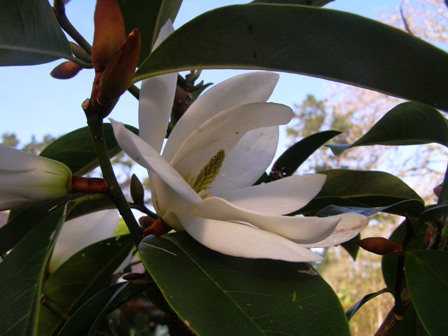
The lovely flowers of the early season michelias

The lovely flowers of the early season michelias

Tikorangi Diary: June 26, 2011

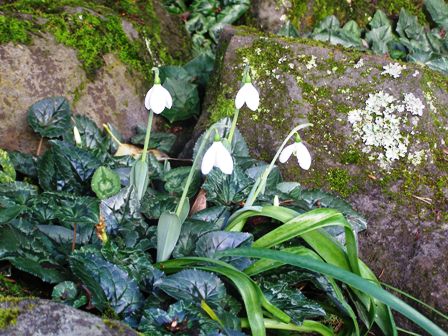
We New Zealanders have a love affair with white flowers. I was told that Rose Flower Carpet White is easily the biggest selling colour in this country but not internationally. My informant put this down to the fact that snow never settles here for long (except in alpine ski villages) and, indeed, most of the country never even sees snow. Winter white is a colour from a clothing catalogue, not the view from our windows. Which is by way of introducing two very different white flowered plants in bloom this week – the charming snowdrops (no snow, but growing here happily with cyclamen and lachenalias) and the white perfection of one of our early flowering michelias. One of the attributes of gardening in a soft climate such as ours is that we can have flowers for twelve months of the year in the garden. We tend to take it for granted until we see people gardening in much harsher climates. The corollary is that weeds and grass also keep growing all the time, but that is a small price to pay when mid-winter can still be brightened by the loveliest of blooms.

No snow, but we have plenty of snowdrops coming in to flower

No snow, but we have plenty of snowdrops coming in to flower