Tag Archives: Taranaki gardens

Summer meadow gardens (and why they don't work here)

Enchanted by the native orchids growing wild at The Garden House in Devon

Enchanted by the native orchids growing wild at The Garden House in Devon

Surely the two most romantic sounding gardening styles are meadow gardens and woodland gardening. Woodlands will have to wait because summer is for meadow gardens, though not without difficulty in our climate.

Meadow gardens are based on the attempt to re-create and manage the wildflower meadows and we don’t have these in abundance in this country. Generally, one seems to go to Western Australia to catch the blooming of the wildflowers and that, I am told, can be a hit and miss affair. Timing is critical and some seasons are much better than others. In New Zealand we have natural alpine meadows (the Mount Cook lily, gentians and the like) but in such difficult, inaccessible and vulnerable environments that they do not lend themselves to garden tourism. Countries with naturally occurring wildflower meadows share several things in common – a much harsher, drier climate, and a lack of intensive, pastoral farming. Intensive dairying and wildflower meadows are an oxymoron. And most such areas will have an abundance of annual native flowers which leap into growth en masse, usually triggered by seasonal rains. Our native flora is unique and fascinating but not rich in pretty flowers of the field. So, by definition, wildflowers in this country tend to be invasive weeds. The lupins of Central Otago and the perennial sweet peas of Marlborough are a case in point. As indeed are gorse, broom, Kelly thistles and ragwort, all of which can have a blooming season which is showy. Not for us, thank you, and more than one New Zealander has been shocked to see gorse used as a garden plant in the UK.
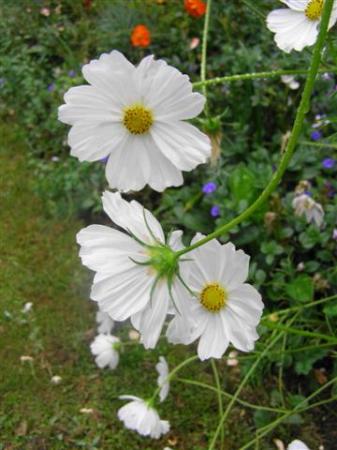
Simple flowers like this white cosmos look best in meadow-style gardening

Simple flowers like this white cosmos look best in meadow-style gardening

All our garden plants, of course, originated somewhere so plants such as the species cyclamen, the deciduous ground orchids like dactylorhiza and anacamptis, even the Black-eyed Susans, echinacea and cosmos are native wildflowers somewhere. Just not here. I have never seen the North American prairie gardens, nor the wildflowers of South Africa but it was exciting (believe it or not) to see the ground orchids that we treasure as choice garden plants growing wild in England and in Italy.

Having decided that naturalised wildflowers in this country are more often noxious weeds, how about the controlled alternative of the managed meadow garden? Bad news. All the characteristics which make Taranaki prime dairy country mitigate against meadow gardens. Our grasses grow too well, our soils are too fertile, on top of that we fertilise too heavily, our rains come too readily all year round and our temperatures are too even. The grasses will swamp out all but the most aggressive of the wildflowers. Gardeners right on the coast in the north and in the drier south in the Hawera to Waverley stretch may have more success because their conditions are a little harsher. But it is not just conditions that one needs to get right. Meadow gardens require a bit of an attitude shift, we now realise, and it is a theme that we keep returning to in discussions here. Weeds. Meadow gardens require a high tolerance level for weeds and that is a problem for most New Zealanders. We have an ingrained antipathy to them. The worst crime an open garden can commit is to have weeds. Whether this is a reflection of our farming background, of the DOC position (our weeds are all introduced plants) backed up by our local councils, our high tolerance level for the use of chemicals in gardening and agriculture (and indeed in conservation), or an innate value placed on tidy suburbia, we do not like weeds. Because meadow gardens rely on letting plants grow naturally, you can’t control weeds. Once you start intensive control and management, your meadow garden becomes a cottage garden, and that is a different kettle of fish altogether.

We may need to reconsider our antipathy to weeds. Mark recalls the late Peter Winter, one of our leading environmentalists locally, commenting that the riparian plantings being fostered so actively by our regional council and indeed by Fonterra, are a positive move but that we will have to accept that a certain amount of weed growth is inevitable. The riparian plantings are the ribbons of mixed plants being established along all waterways, fenced off from stock. Done properly, they will filter run-off from farm land and reduce the amount of nutrient being washed into waterways. But they are not going to be a healthy environment if farmers expect to keep them weed free which, for the vast majority, will mean the repeated use of chemical weed killers.

A field of flowers in its first season

A field of flowers in its first season

But back to meadow gardens. It is the very simplicity of the meadow garden that lends it so much charm but it takes a little more skill than just standing and broadcasting a meadow mix of seeds in early spring. Amongst other things, the birds will pick off a fair portion of the seed and the germinating plants unless you take precautions. Then there are strategies for managing a succession of flowers through the seasons from spring to autumn and to ensuring that the garden lasts for more than one year. If you are willing to kill out all the grasses and competing plants before you sow a very generous amount of seed, you can manage a field of flowers in the first year. By the second year, the grasses will have crept back and the weeds will also be germinating and seeding. Weaker performers in the mix will have been beaten out by the competition. It will be more akin to the wildflower environment and it will have rank and unkempt times of the year.

If you want to try a meadow, pick an area which is in full sun and with poor soil. Don’t feed it at all. You want the plants to flower and seed, not to make a lot of leafy growth so they need to be on the stressed side. At the end of the season, you mow the meadow (one man went to mow, went to mow the meadow…) and leave it all lying on the ground for two weeks to allow the seed to fall out. Then you rake it all up because you don’t want to fertilise the ground by letting the clippings rot down. And you live with the weeds which will also be colonizing the area. The meadow should come back into growth when triggered by seasonal change. That is the theory of it, more or less.

We would love to grow a meadow garden but each time we look at it again, we figure the climate and conditions which make it possible for us to grow lush and verdant gardens mitigate against the meadow concept. It is why we continue to work on naturalising selected plants in designated areas instead. It is not at all the same thing, but it is what we can manage here.
In the Garden: February 18, 2010

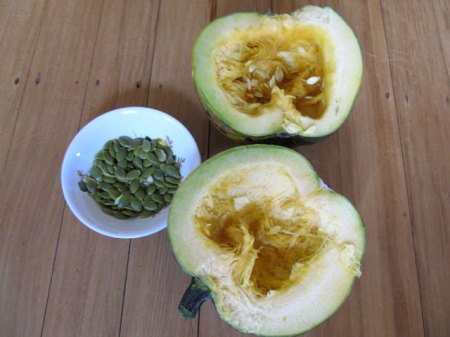
Rather too high a ratio of barely edible pumpkin to seed yield

Rather too high a ratio of barely edible pumpkin to seed yield


· Do not delay on summer pruning cherry trees as time is running out.

· Get on to planting the winter vegetables too. They need the rest of summer and all of autumn to grow because once the winter cold comes, they stop growing though they will hold in the garden so you can harvest fresh each day. Fresh veg are usually much more expensive to buy in winter and spring rather than the bountiful summer and autumn so it makes economic sense to grow your own, even aside from the pleasure and satisfaction of gathering your own produce. So get the parsnips, carrots, peas, Florence fennel, beetroot and brassicas in. The turnip family too, if you regard them as suitable food for humans.

· We have been trying out growing pumpkin for seed this year – a variety that has no hulls so needs no separation. It is an oil-seed variety. Certainly the fresh pumpkin seed is delicious but based on the first gathering, it appears that you would need a very large area to attain self sufficiency in pumpkin seeds. And alas, the pumpkin flesh itself is of no merit. If you were starving, it might be okay to eat but it is nearly as bland as marrow.

· We have been a little slow on the uptake revisiting beetroot here but, as many others have discovered, when picked young and tender (about golf ball size), they are delicious cooked in a variety of ways but especially roasted. Beetroot can be sown from seed pretty much all year.

· Rocket and mesclun bolt to seed in summer but with cooler weather just around the corner, it is fine to return to sowing these crops from seed.

· If you have been intending to spray your rhododendrons for thrips (the cause of irrevocably silver leaves and a weaker plant), now is the time. You need to use a systemic insecticide so the plant sucks it into its system. Contact insecticide only kills where it touches and as the offenders are on the undersides of the leaf, you can’t get total coverage. The alternative is bands of old carpet or similar soaked in neem oil and secured around the main trunk. This approach seems to be getting good reports though we have yet to get around to trying it ourselves. Soaking a band in Confidor or similar insecticide will also work but wear gloves when handling it.

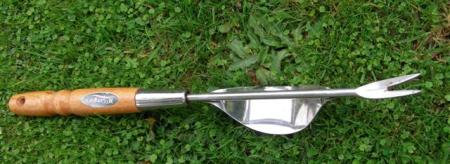
A handy implement for dealing to lawn weeds

A handy implement for dealing to lawn weeds

· Autumn is an optimum time for sowing or over sowing grass so if your lawn is looking very sad, you can start preparing it now for resowing in a few weeks time. Getting out the flat weeds is a good start. You can either dig them out (I have a very handy tool for this), sprinkle them with sulphate of ammonia or use a designated lawn spray. Don’t feed your lawn at this time. We are too dry and it is more likely to kill the remaining grass instead.

Tikorangi Notes: Friday 11 February, 2011

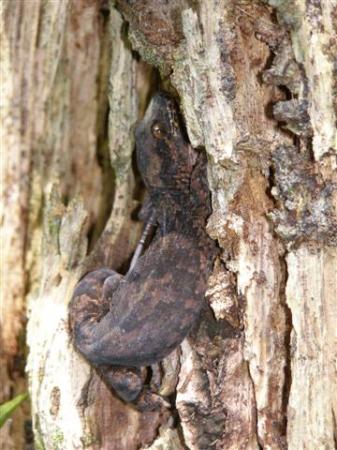
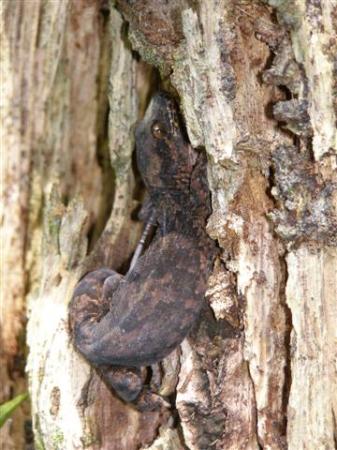
The gecko - a first for us to find a live one in our garden

The gecko - a first for us to find a live one in our garden

LATEST POSTS: Friday 11 February, 2011

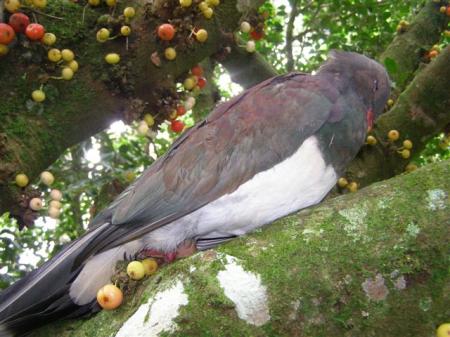
1) Gecko (singular but rare), many kereru and a mass of monarch butterflies in Abbie’s column this week. I admit that the photograph of the kereru was staged. It is not easy to get close enough to them and I had lost my one good image. In desperation we got one out of the freezer where Mark stores dead native birds he finds (all from natural causes) to pass on to a local kuia to pluck for use in making korowai or Maori feather cloaks. We had to partially defrost it to mould it, hold it in position and then hastily refreeze it as it was starting to smell rather high.

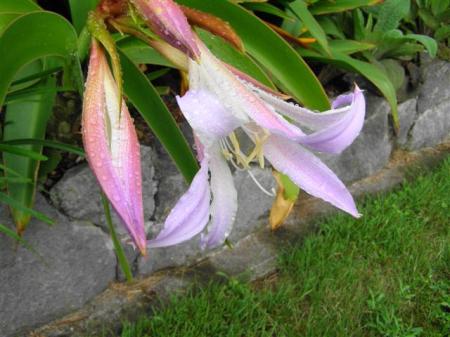
2) Amaryllis belladonna – often seen as rather coarse and common roadside flowers in this country but worth a second look. Plant Collector.

3) Garden tasks for this week though there is not a whole lot one can do at this time of the year beyond dividing bearded irises, daffodils and bluebells.

4) Not your ordinary everlasting flower – Helichrysum Silver Cushion in Plant Collector last week.

5) A little after the event now – garden tasks for the first week of February in an antipodean summer.

6) The second in our Outdoor Classroom series on making compost – step by step hot compost mixes with an impressive shot of our compost heap resembling an attraction at a thermal reserve.


Worsleya rayneri in the garden, just starting to open its blooms

Worsleya rayneri in the garden, just starting to open its blooms

TIKORANGI NOTES: Friday 11 February, 2011There weren’t any Tikorangi Notes last week. I think I was feeling uninspired and having a great deal of trouble focussing my eyes on the computer screen – the result of not seeking help earlier for what turned out to be part of a seed head embedded in one eye. Such are the dangers of gardening. But this week was marked by two events – finding that we have a resident gecko in the garden (the gecko being a rarely sighted native lizard) – written about in Latest Posts 1, and the opening of not one but two Worsleya rayneri blooms in different locations in the garden. The worsleya flowering is not quite as rare as the sighting of a live gecko – it has happened twice before – but to manage this feat with bulbs planted out in the garden rather than kept in controlled conditions in a container is a reasonably significant triumph.

Wildlife in the garden – New Zealand style

Spot the gecko - a rare sight in New Zealand

Spot the gecko - a rare sight in New Zealand

As we sat outside having our morning coffee last Sunday, Mark commented that he had counted five native wood pigeons in the gum tree. Now there is nothing unusual about one or two kereru around here but five is close to a crowd for these birds who do not make a practice of hanging out together. As we watched, another two or three flew in to join them, followed by more, and then some. And but wait there were still more. We ended up with fifteen of these large and cumbersome but beautiful birds in our gum tree. A convention, we decided. They must be having a convention of local kereru. These are not birds renowned for having great brains and clearly their concentration spans are of short duration because they soon decided that it was time to break for morning tea. They flew over, more or less as a flock, to sample the offerings on the karaka tree. A quick snack and it was time for a field trip to a nearby pine tree from where they gradually dispersed. It made for a memorable coffee break.

Our native wood pigeon or kereru in the Ficus antiarus

Our native wood pigeon or kereru in the Ficus antiarus

As far as we know, our kereru stick around the area all year. Give them enough to eat and there is not a lot of point in them moving on. If you do a search for plants to grow for kereru, most sites list native plants including puriri and miro and only give exotic or introduced plants as an afterthought. But, like most of our native birds, kereru are untroubled by political correctness and they browse widely. They are gloriously untroubled by whether the food is nasty privet berries or nikau seeds. All that matters is that they are herbivores so they eat berries, seeds, fruit, flowers and leaves. In late autumn they come in close to eat the apple leaves just before leaf drop at a time when the sugars are concentrated. They are very partial to guavas and, apparently, to plums. Mark has watched them eating the kawakawa (pepper tree) berries, they raid the karaka tree, the flowering cherries, kowhai blossom and a host of other food sources. Being large birds which tend to crash land rather than being light of wing and foot, they feed from trees and shrubs which can hold their weight. You don’t see these birds on the ground, so they are not going to feed from annuals or perennials.

The delight for Mark this week was to find his first ever live gecko in the garden. In fact he has only ever seen one dead one before and that was in his glasshouse. In the lizard family, New Zealand only has skinks and geckos – the former are relatively common but the latter are rarely sighted. This particular gecko was presumably trying to warm itself on the trunk of a very old pine tree. Now that we have our eye in for this extraordinarily well camouflaged creature, we have found it out sunbathing in the same spot each day since so it is presumably resident. It now has to get accustomed to Mark bringing every visitor to stare at this rare sight and to make admiring noises even if they can’t tell it apart from the pine bark.

We did a bit of a Google search on NZ geckos which appear to be devilishly difficult to research and photograph, complicated by the fact we have a large number of different species. Ours was indubitably a brown one and on the larger side, something similar to Hoplodactylus duvaucelii. But it is just as likely to have been one of the other 38 or so different types already recorded.

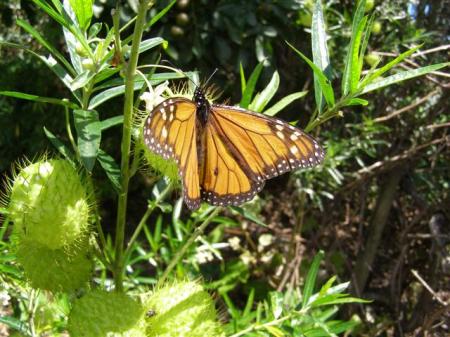
We are by no means alone in our dedication to assisting the procreation of monarch butterflies

We are by no means alone in our dedication to assisting the procreation of monarch butterflies

Monarch butterflies we have in abundance here. Judging by the search terms which bring people to our websites at this time of the year, others are equally enthralled by these ephemeral beauties. I keep seeing questions typed in to Google like: how many monarch caterpillars can a swan plant support (depends entirely on the size of your swan plant…) and how long does a caterpillar take to grow (about three weeks). Can a caterpillar chrysalis on something other than a swan plant was another much searched question. The answer to that is yes, definitely, and it pays to encourage them to do so by poking in some bushy twigs by the plant. Having them chrysalis on the swan plant itself can be a real problem if their very hungry younger siblings munch right down the bare stems and the defenceless chrysalis then falls off. At this time of the year, earlier generations have often hammered the swan plants for food and newer caterpillars are running short. You can finish growing caterpillars on sliced pumpkin but it is not a complete food so it is unsuitable for getting very little ones through their weeks of growing.

Swan plants grow readily from fresh seed and if you are even halfway serious about wanting monarchs in abundance next summer, sowing a row in your vegetable garden in very early spring is a good means of getting the plants to a well established grade for later season egg-laying butterflies. Swan plants are generally biennial (so last two years) but they don’t like heavy frosts. This year’s plants can recover to support the first of next season’s caterpillars with the early spring sowing as a back up for later generations in the season. However, you do have to keep the young plants netted to stop them being stripped while very small. Letting some annual flowers seed down in spots of the vegetable garden can also provide food for the butterflies.

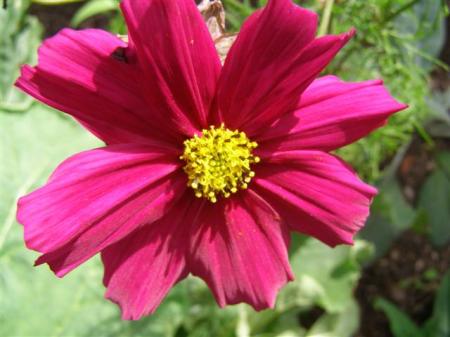
Food for the butterflies - a rather garish cosmos

Food for the butterflies - a rather garish cosmos

They need single flowers with visible stamens such as cosmos, marigolds, zinnias, daisies and poppies. A visitor stood in one of Mark’s vegetable gardens recently and suggested that it was not so much a veg patch as a mixed cottage garden.

The final word on the monarchs this season comes from one of our neighbours with whom we have had a running joke over time about stealing our monarch butterflies. Send them home, we have said. All the monarchs in this area are ours. Added Mark recently: please stop taking pot shots at our wandering monarchs. Ah, said neighbour riposted, those are the very rare and highly prized lacewing or whistling monarchs – the sound of the wind blowing through the holes in their wings. What more could we say?

Plant Collector: Amaryllis belladonna

Surprising perfection in the under-rated Amaryllis belladonna

Surprising perfection in the under-rated Amaryllis belladonna

Belladonnas naturalised on a vertical road cutting

Belladonnas naturalised on a vertical road cutting

Looking at the white perfection of the bloom just opening, it is not that easy to pick it as a common old belladonna, but that is what it is and just a random seedling at that. We tend to be a bit sniffy about belladonnas here and see them as roadside wildflowers to be taken for granted. Fortunately they thrive on benign neglect, preferring to be left undisturbed and quite happy to grow in quite difficult conditions. This one is on a vertical bank where Mark broadcast some seed several years ago.

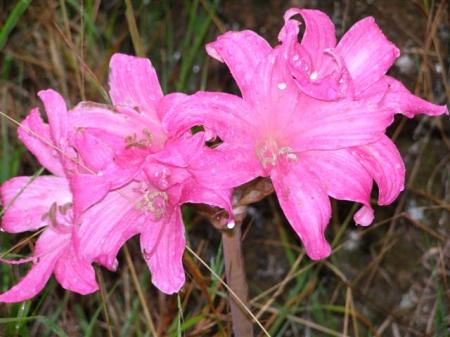
The amaryllis family has only one solitary member and that is the belladonna – which stands for beautiful lady rather than the more common epithet of naked lady. The reference to nakedness comes from the plant’s habit of flowering before any foliage appears. This is another bulb from the Cape Province of South Africa and it is summer dormant. The flower pops up well before it actually comes into growth for the season. The colour range is from pure white through a gamut of pinks – pastel to bright sugar pink to a deep cerise bordering on red.

The more common candy pink of the belladonnas

The more common candy pink of the belladonnas

Apparently there are now some double forms around but I have yet to see them. I found a tray of perfect white ones at the back of the nursery last year and made a spot in the summer garden for them but now I am wondering about revisiting some of the other clumps we have hanging around the place to feature them more as a late summer flower. Their only real downside is that they have rather a lot of foliage for much of the year so they are best planted in a position where they can be left to their own devices and their scruffier times are not intrusive. If you are planting belladonnas, they like to be baked in the summer sun and left with their necks above the ground.