Tag Archives: Taranaki gardens

Tikorangi Notes: Friday 17 December, 2010

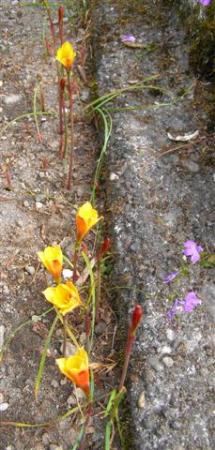
Straight after the rains, the zephyranthes appeared this week

Straight after the rains, the zephyranthes appeared this week

LATEST POSTS: Friday 17 December, 2010

1) Cornus prefer a drier, continental style of climate to our mild, humid conditions but Cornus kousa var. chinensis flowers prettily at this time of year.

2) Water features can be more of a challenge than many gardeners appreciate when they decide to install one – Abbie’s column.

3) A week out from Christmas and we give our hints for garden tasks in this busy week.

TIKORANGI NOTES: Friday 17 December, 2010
While seven or eight weeks without rain may be nothing unusual for other parts of the world, here it has us in serious trouble so the 25ml that has fallen so far this week has been hugely welcome. Not enough, but it is at least a start. And that is all it took to bring the pretty copper and yellow zephyranthes into flower. These gently seed down beside our driveway and flower intermittently in the gravel for an extended period throughout summer.

In the Garden this Week: December 17, 2010

• The rain earlier this week was welcome for those of us who received it, but hardly sufficient to break the drought. However, it is easier to keep water levels up than to let everything dry out to dust before you start to water again. That said, in our conditions, it should only be necessary to water recent plantings, container plants, fresh sown seed and parts of the vegetable garden. Devotees of roses will water them too. The rest of it can pretty much take care of itself unless you are on fine, sandy soils right on the coast.

• We watched aghast as the Yates representative on Prime TV’s Get Growing programme last Sunday demonstrated the use of Blitzem slug and snail pellets. She poured what must have been half a packet in a carpet of green on a very small area. Don’t copy her. You do not use this poison like fertiliser. You do not need to lay so much that every snail and slug must trip over it. The pellets have an attractant and you only need to use a few – no more than you can count on the fingers of one hand – in each target spot. These pellets can be fatal to pets and poultry and are not great for humans. Use very sparingly.

• If you are a traditionalist with a proper tree (as in one that used to be growing til it was lopped off in its prime to serve as a framework for your lights and decorations), keep the water topped up. If it is on the agenda for this weekend, the best way to extend its life is to re-cut the base as soon as you get it home and then plunge it into a bucket of cold water. Forget the aspirin in the water and the other suggestions – a fresh cut and plenty of fresh water is all that is required to make it last the distance.

• If Christmas dinner this year is at your place and you need to tidy up in a hurry, in order of importance the following steps will have the biggest impact: mowing the grass, removing large debris and rubbish, sweeping paved areas and entranceways, cutting clean edges to lawns and gardens and removing weeds from paved areas (boiling water is the fastest way). You may be surprised how quickly you can give the appearance of sprucing up.

• Give roses a summer feed to encourage them to keep healthy and produce more flowers. Clip off the spent flowers and diseased foliage as you go and remove them to the rubbish, not the compost.

• Give planting brassicas (the cauli, broc, cabbage family) a break over summer unless you are willing to wage constant war on white butterflies. There are many other crops you can grow instead, including most of the leafy greens which mature quickly. It is too late to sow peas now (we have had the best ever crop this year), but you can still be planting sweet corn, green beans, potatoes, carrots, courgettes, pumpkin and beetroot.

Tikorangi Notes: Friday 10 December

LATEST POSTS: Friday 10 December, 2010

1) Dactylorhiza are looking very pretty by our stream this week. We have always had this one as D.maculata though it may be the closely related D.fuchsii instead – Plant Collector.

2) Garden tasks this week as we look more like the end of summer with our extended dry weather.

3) Dreamers of the Day – a large presentation volume on the history of Auckland’s regional parks.

4) It may be that access to stands of giant bamboo are more common in our part of the world than many others, which may limit the opportunities for some to build a stylish bamboo obelisk or teepee for climbing plants but we show you how to do it in Outdoor Classroom this week.

TIKORANGI NOTES: Friday 10 December, 2010

Wondering about watering the rose garden

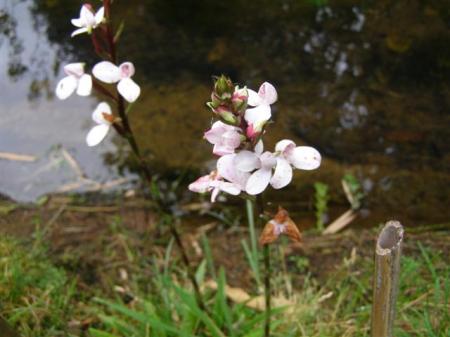
As our abnormally dry spell continues, we are starting to accuse Australia of stealing our rain. Both our daughters live in the east of Oz these days – in NSW and ACT – and both are complaining of the wet. On the other hand, Mark has been doing something never seen before here – watering the lawn. Just small areas of it initially but we are starting to wonder if we might have to do some more active management than usual to keep the place looking good for the WOMAD event scheduled here for March. Fortunately our water comes from a bore which we own and the supply has never let us down yet. I am wondering about watering the rose garden. These are things we don’t normally have to worry about at all, so regular is our rainfall. At least the little disa orchids Mark has planted down by the stream won’t dry out where they are and we are delighted with their first flowering this year.

The little Disa tripetalata naturalising by the stream, we hope

The little Disa tripetalata naturalising by the stream, we hope

Plant Collector: Dactylorhiza maculata

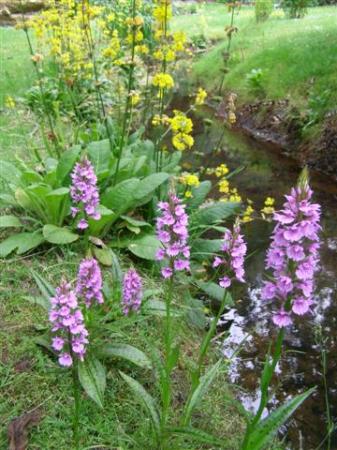
Dactylorhiza - doing better on our stream margins than in the garden

Dactylorhiza - doing better on our stream margins than in the garden

Dactylorhiza are terrestrial orchids – in other words, ground orchids. We have had this purple one for many years. It is likely that Felix Jury imported it here in the early fifties and it has gently increased ever since. It has taken us a long time to realise that it is happier in the cooler, damper conditions of our stream margins where these specimens are growing taller and lusher than those we have in rockery or other garden positions.

The rhiza part of the name refers to the root which is liked a forked tuber, or rhizome and it increases in a similar manner to many bulbs. Dactylorhiza are very widespread in the cooler areas of the northern hemisphere, occurring as far north as Scandinavia and even Alaska. While we have always had this one as D.maculata, otherwise known as the Heath Spotted Orchid, there is a bit of a question mark over that and it may in fact be D. fuchsii, the Common Spotted Orchid or even a hybrid between the two. The differences are subtle – are the markings lines? Is that pointed area in the lower lip like a small middle tooth or is it a lobe? Whichever, the foliage generally has interesting deep maroon spots which are an attractive feature, even without the flowers. Each flower spike is about 20 to 30 cm high (a happy plant will put up a taller spike) and carries masses of individual orchid flowers which open pretty much all at once. The yellow behind the plants in the photograph is the common Primula helodoxa.

In the garden this week: December 10, 2010

Alas, not from our garden
Alas, not from our garden

Better late than never - covering the strawberries

Better late than never - covering the strawberries

· The bright side of the current dry spell is that fungal diseases are not as common as usual. These tend to flourish more in times of high humidity. Despite that, it is a good idea to get a copper spray on to citrus trees as flowering finishes. We will not stay this dry and a copper spray can prevent premature fruit drop and a tendency to drop leaves.

· Pinch out laterals on tomatoes to keep them to one or two stems only. You want the plant to put its energy into forming fruit, not leafy growth.

· You can still plant for a late crop of tomatoes but you need to use small plants now, rather than seed. Get pumpkins and main crop potatoes in without delay.

· With summer just starting, it may seem far from your mind, but get leeks and celery in now if you want to be eating them in winter. They need all summer to reach a decent size.

· It is the last chance to start annuals from seed for late summer and autumn colour.

· There is not a lot you can be doing in the ornamental garden in this current extended dry spell, but continue with deadheading and deal to weeds. Push-hoeing is ideal in the current weather because the weeds will wither and die very quickly.

· The first flush of monarch caterpillars has eaten the swan plants of many, as far as I can tell from Google searches. You can finish off relatively large caterpillars on sliced pumpkin but it is not a total diet so no good for little ones. If you have the space, sowing a row of swan plant seed right now and making sure you keep it covered, will give you feed for later flushes of caterpillars. We target the late season, so we can get the monarchs wintering over in the garden, by sowing seed now but you do have to protect the crop to stop any eggs being laid on small plants. Very hungry caterpillars will demolish the lot extremely quickly with no regard for later generations.

· Mulch asparagus beds and let the remaining spears develop into leaf to strengthen the crowns for next season. Asparagus is a permanent crop but the crowns do have a finite lifespan – usually said to be about 15 years. Ours are considerably older than that but the crop this year was so poor, despite regular care, that we have had to resign ourselves to the thought that the bed has passed its use by date.

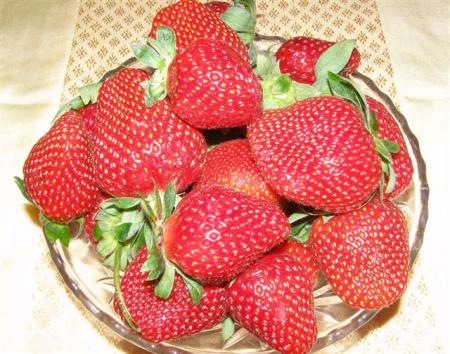
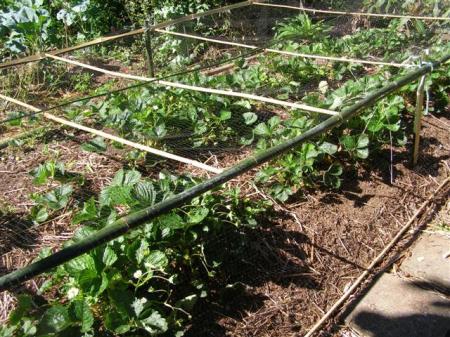
· Shamed by the very handsome strawberries I brought home from a local PYO place, Mark finally built an impressive netting cover for our bed, using our own bamboo, and we look forward to beating the birds to fresh fruit on Christmas Day.