Tag Archives: Taranaki gardens

A step-by-step guide to staking and tying plants

1) If you can avoid staking a plant, do so. A plant can rely on the stake and not build the strength to hold itself up. If your plant has a small root system and too large a top (referred to as the sail area because it catches the wind) reduce the volume of foliage and branches to cut back the sail area.

2) This is heavy duty staking carried out on landscape grade plants put in to a windy situation on a road verge. Two, sometimes three or even four tanalised batons are used with wide ties. This allows some flexing of the tree without it blowing over and the stakes will last for several years. The flexing of the tree in the wind encourages it to develop a natural taper to its shape which gives it strength. To allow this flexing, the ties should never be more than a third of the way up the tree. All this staking will be removed when the tree has developed the root system and strength to hold itself up.
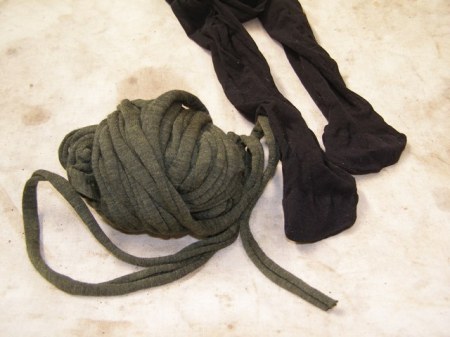
3) Avoid tying with string, rope or wire which will cut in to the bark and cause damage, potentially ring barking the trunk. For the home gardener, old pantyhose or strips of stretch fabric are commonly used or you can buy balls of interlock fabric tie at garden centres which are cheap and easy to use. Black, grey or muted green are less obvious in the garden. Strips cut from old inner tubes are another traditional tie.

4) Commercial growers use tying machines called tapeners which staple a flexible plastic tie in two movements so they are quick to use. However the tape does not break down in the garden situation so we avoid using a tapener except in the nursery because we don’t want little bits of black plastic through the garden.
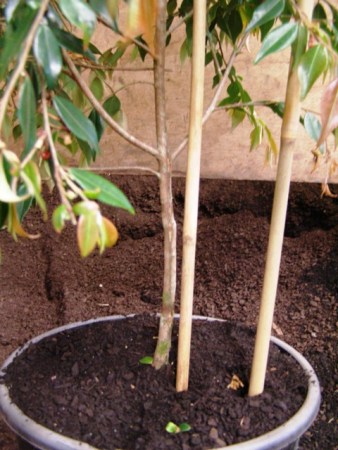
5) Never force a stake hard in by the trunk of the plant, large or small. If you do this, you are damaging all the roots on that area of the plant, usually severing them entirely. If you think of the roots like a piece of pie or an umbrella, you are potentially damaging an entire segment of the root system. How far out you place the stake depends on the root system but even a couple of centimetres can make a big difference on small plants. You can see in the photo how much more damage the stake near to the stem will do compared to the one a little further out.
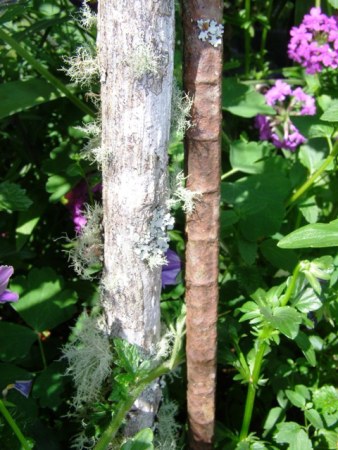
6) Bamboo stakes will usually last about a year before rotting off at ground level and this is often long enough for a plant to get established. Tanalised batons are a better option for longer term staking such as the trees in step 2 which will need stakes in place for up to 3 years. Where semi permanent staking is required for plants such as standard roses, metal stakes gently rust and become less obvious over time than other options.

Tikorangi Notes: Friday, 19 November 2010

Latest posts: Friday November 19, 2010
1) The romantic Moorish gardens of Andalucian Spain and the likely debt to it shown in modern, western gardens – Abbie’s column.
2) Manfreda maculosa – an herbaceous plant with a singularly dramatic flower spike topped with a rather anticlimactic flower.
3) Tasks in the garden this week include getting swan plant seeds sown without delay.

Tikorangi Notes: Friday November 19, 2010

Looking more cottage garden than rockery this week

Looking more cottage garden than rockery this week

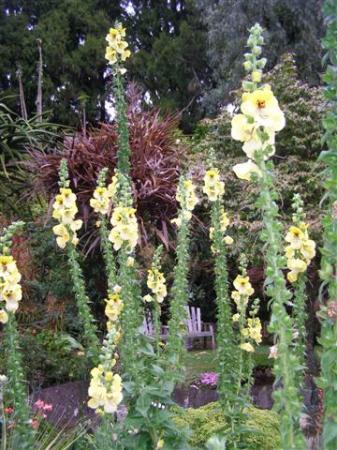
A particularly good verbascum for our conditions

A particularly good verbascum for our conditions

Drought is a relative matter. About three weeks without significant rain here and farmers are already fearing drought while gardeners are worrying about the dry. A light volcanic soil does not help because it dries out quickly but our rains are usually so predictable that we never have to water the garden. I have been pottering in the rockery, excavating a highly decorative but dangerously invasive equisetum (horse tail rush). A mere ten months or so and it was already making an escape for it, including between the rocks. Plants that burrow underground and pop up some distance away can be unnerving but the speed at which this equisetum was doing it indicated downright dangerous tendencies. Strictly one for a pot, I think, and even then it may be on borrowed time. The rockery is looking more like a cottage garden at this time of the year. Most of the spring bulbs have finished flowering but the splendid large flowered yellow verbascum (name unknown) gives some presence and height in November. One or two plants are left to set seed each year and it conveniently perpetuates itself.

In the Garden this week: November 19, 2010

• Get swan plants in without delay, especially if you are sowing seed. Ideally you want the plants to be growing strongly before the influx of summer monarchs appear, laying eggs which hatch into very hungry caterpillars. This may mean covering them at some stage or culling early eggs.
• In our climate, both potatoes and tomatoes generally need regular sprays with copper to keep blights at bay. If you don’t, you risk losing the plants. An application every few weeks is recommended, especially after rain. Warmth and humidity can lead to an explosion of fungal ailments.
• Do not delay on dealing to onehunga weed in lawns. This prickly weed can make life miserable for children in summer and if left unchecked, will spread alarmingly. The recommended treatment appears to be Prickle Weed Killer and I am told that if you spray now and again in February or March, you can pretty well eliminate the problem. This is not organic and we don’t know of any organic alternative, short of getting on your hands and knees and weeding the lawn.
• It is still fertilising time. With most plants in full growth, their ability to draw up the fertiliser and gain maximum benefit is at its peak. Cheap and cheerful fertilisers like our locally made Bioboost, blood and bone or nitrophoska blue are all that are needed for the garden, along with compost.
• Top priority for planting out in the vegetable garden are the crops that need a long growing season – the aubergines, melons, tomatoes, capsicums, chilli peppers, cucumbers, kumara and pumpkins.
• Keep planting salad vegetables for continued supply.
• Most of the root crops can be planted now – carrots, parsnips, potatoes, beetroot, yams and kumara.
• Plant leeks now if you want big ones to harvest next winter.

Tikorangi Notes: Friday 12 November, 2010

The very pretty Tecomanthe montana

The very pretty Tecomanthe montana

Latest Posts:

1) Jovellana punctata has been particularly charming in flower in recent weeks.

2) In The Garden This Week – recommended tasks for home gardeners this week as the weather warms up in late spring.

3) Hosta combinations that work – our latest Outdoor Classroom.

Tikorangi NotesThe end of our annual garden festival saw us wandering around like zombies on Monday – talked out and exhausted. It is amazing how 10 days of standing on concrete all day and meeting and greeting can take its toll. The festival is so important to us, delivering up half our annual total of visitors in a quick burst. The weather smiled on us again this year –sun every day and mild temperatures. This is not to be sneezed at in a situation where we start to feel personally responsible for the weather as we host out of town and overseas visitors. The offshore visitors were noticeably dominated by Australians this year.

The Tecomanthe montana which we grow in our meet and greet area was perhaps a little later with its blooming but it had sufficient blooms open to attract attention from visitors, many of whom look at just the flowers and assume it is a lapageria. No, it is a climber from New Guinea and rather tender. The plant we used to have in the garden succumbed to winter cold years ago but this one is under cover and performs consistently every year. The same can not be said of Tecomanthe venusta, which is even more tender. It flowers just often enough to justify our keeping it, but never rivals montana in flower power.

Tikorangi Notes, Friday November 5, 2010

The wonderfully strident azalea mollis

The wonderfully strident azalea mollis

Latest posts:
1) My unlikely global observations on the takeover of polyester resin outdoor furniture by the corporate giants.
2) The fragrant delight of Rhododendron Loderi Venus, in flower this week.
3) Garden tasks for this week.
4) The final Countdown to our Festival which is in full swing this week.
5) A little late in the season now, but Lachenalia aloides is a tried and true, reliable performer in winter.

The park is at its prettiest

The park is at its prettiest

Tikorangi Notes, Friday November 5, 2010
As our annual rhododendron and garden festival enters its last few days, our park is looking particularly fetching. The azalea mollis are such an OTT plant family – often bold and strident in their statement of bright colour. In a garden where we love colour, scent and flowers (forget all this restrained good taste which says form and foliage is most important – in a large garden we want flowers and to be able to go out each day and see something else coming in to bloom), the azaleas are a seasonal delight.

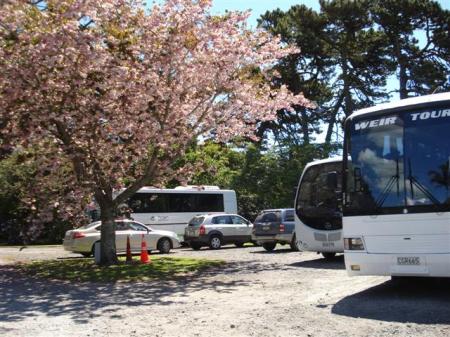
Parking can be a mission during Festival

Parking can be a mission during Festival

But in this ten day period which delivers up a hefty swag of our annual garden visitors, the logistics of handling visitors takes precedence. We have a visitor carpark which is perfectly adequate for 51 weeks of the year but is often woefully inadequate in that 52nd week. Poor Lloyd, our ever versatile and adaptable garden assistant, gets to double as carpark attendant. While we can sink a relatively large number of people in our garden without a sense of being overcrowded, the need to manage vehicles and to get coaches and camper vans off our busy road tends to become a bit of a mission at times. I was a little taken aback at the coach driver who suggested that if we cut out the Prunus Pearly Shadows in the middle, we would make it much easier to turn the coaches, but we were even more amused by the garden visitor who commented about our carpark that it was just like Sissinghurst. In miniature, perhaps.