Tag Archives: Taranaki gardens

Garden Lore: May 23, 2014

“Momordica – Cucurbitaceae – The Squirting Cucumber. An annual gourd-like plant, with woolly leaves, and yellow flowers, the fruit of which resemble a small cucumber; and which, when ripe, bursts the moment it is touched, scattering its seeds, and the half liquid, pulpy matter in which they are contained, a considerable distance. This quality made it a favourite, in gardens, a century ago, when some people were yet in a state of sufficient barbarism to find amusements in the annoyance of others; but it has now deservedly fallen into disrepute, and is seldom grown.”

Jane Webb LoudonThe Ladies’ Companion to the Flower Garden” (1840)

Vegetable time bombs, we call them

Vegetable time bombs, we call them

Garden Lore: Magnolia Little Gem

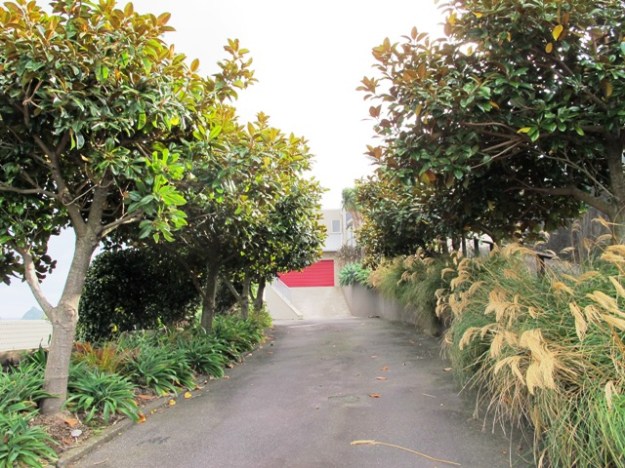
I stopped to photograph this driveway in town because it is like a vegetable time bomb waiting to give its owners no end of problems. What you are looking at is a narrow driveway flanked on either side by avenues of Magnolia Little Gem. At this stage, it still looks quite attractive. Little Gem is a good looking plant with glossy, dark green leaves and brown felted indumentum beneath. In summer, it will sporadically produce attractive white flowers. The mistake often made is in thinking that the descriptor “little” in its name, means it will stay small. While it will not get as large as some of the other grandiflora magnolias, it is still going to be an 8 metre tree and have a spreading canopy. You can already see it spreading.

In narrow spaces, you need narrow, columnar trees (technically ‘fastigiate’) which can give height and structure, without width. If you are going to choose a plant which forms a canopy, you need to keep the branching above the height of vans and small trucks – probably 3 metres up. Clip and shape from the very start so that you don’t have to undertake radical work when the trees become a problem.

It takes a lot more effort and expense to remove established trees which have outgrown their allotted space than it takes to plant them in the first place. It is better to get the selection right at the start.

First published in the Waikato Times and reprinted here with their permission.

Plant Collector: Rhododendron sino nuttallii

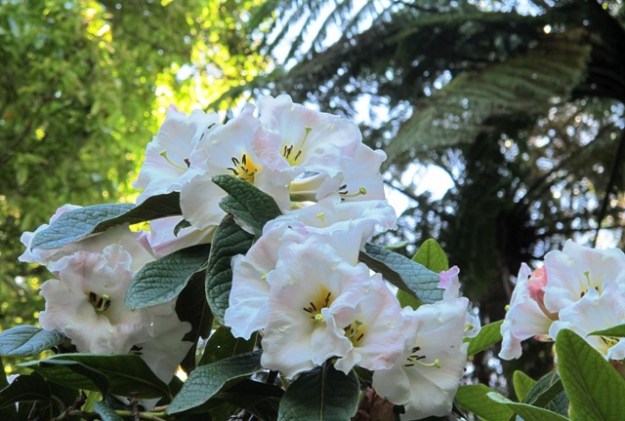
Just beautiful - R. sino nuttallii

Just beautiful – R. sino nuttallii

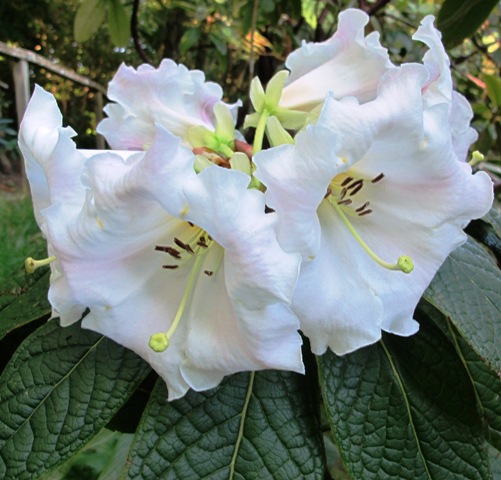
Oh my, but we are besotted with the nuttallii rhododendrons which flower on even as November draws into December. We would rate these in the elite class as far as rhododendrons go. Not only are the heavy, waxy trumpets large and showy, they are also very fragrant. This one is planted on a bank which was a good decision because we can look down on it and the scent wafts up. Some of the others here are several metres above nose and eye level so the scent is a bit academic because they are best viewed from afar.

The foliage is large and heavily textured (bullate for the botanical or like heavy seersucker for those of a sewing disposition) and over time the main stems develop beautiful shiny, peeling bark in a cinnamon colour. These are large and open growing shrubs so do not fit the tight and tidy mould preferred by some.

‘Sino’ just means it is the Chinese form of the species, as opposed to R. nuttallii which is found in Tibet, North Burma and northern India. The Chinese form is bigger and showier and more sensitive to cold temperatures. These plants are rarely offered for sale though you can sometimes find some of the hybrids that have been bred from them.

Rhododendron sino nuttallii

Rhododendron sino nuttallii

First published in the Waikato Times and reprinted here with their permission.

Plant Collector: Telopea (probably speciosissima) or Australian waratah

009
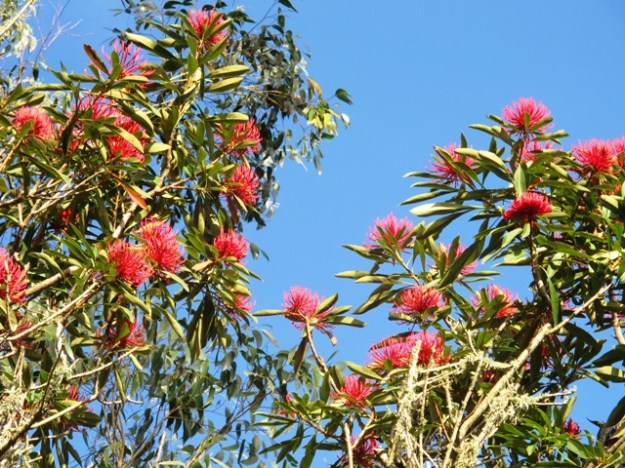
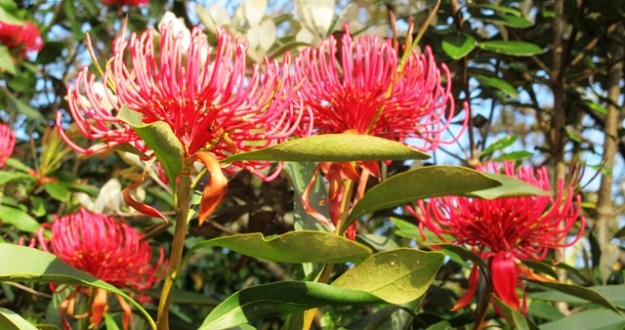
In days when we used to retail plants from here, we would have to keep a straight face when ingénues came in asking what the “lovely red rhododendron at the gate” was. Ahem – commonly known as a waratah, though not to be confused with the fencing waratah. It is the emblem of New South Wales and, like many Australian natives, is not too happy in the fertile, high rainfall conditions of much of this country. It evolved to grow in poorer, harder, drier environments though I see the gardening advice across the ditch is to give these plants semi shade and to water in summer. It has also evolved to survive regular bush fires.

Telopeas are members of the proteaceae family and we struggle growing most of those because of our regular rain all year. They do better in drier, coastal areas. Some years are much better than others for the telopea floral display and this year it may be the dry summer helped. The Australian advice is to cut the plant back very hard after flowering each year. We have never done this and ours tends to undergo a natural die-back process every few years. However, it has still reached the maximum height of 5 metres, owing to the fact that we don’t get bush fires to keep it down. The habit of growth is more shrubby than tree-like and foliage has that Aussie gum tree look. It is apparently a long-lived cut flower.
012
First published in the Waikato Times and reprinted here with their permission.

Plant Collector: Trillium sessile

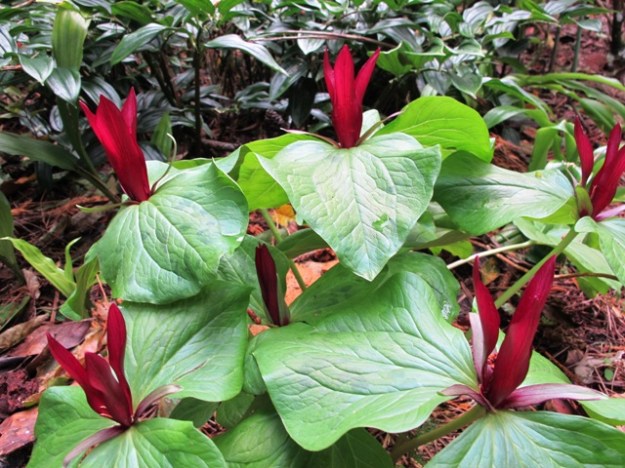
Trilliums! Not common in gardens in our area. T.sessile

Trilliums! Not common in gardens in our area. T.sessile

In the world of status plants for the garden, trilliums are right up close to the top. I am not entirely sure why. They certainly have a quiet charm and are a delightful addition to the spring woodland garden. They are not at all easy for most people to grow and are hard to source, but even that combination of factors does not explain the reverent awe accorded to their presence in a garden.

There are a relatively large number of trillium species (somewhere over 40) and most are native to North America, with just a few from Asia. They are deciduous perennials forming rhizomes below ground. The foliage dies down each autumn, to re-emerge the following spring (one hopes – it is not guaranteed) with fresh leaves and flowers – hence their common name of ‘wakerobin’. At times they are also referred to as ‘tri flower’ on account of their wonderful symmetry of threesomeness. Three heart shaped leaves hold three narrow sepals in the centre which surrounds the three petalled flower which has six stamens. How perfect is that? The dark red trilliums (usually T. sessile or descended from that species) are usually the most highly prized as garden plants, although different species introduce white, pink and yellow to the range.

Being woodland plants, trilliums want ground rich in humus and leaf litter which never dries out. They tend to do better in inland areas with colder winters where the clumps can get more size to them than we see in our coastal conditions. They can be raised successfully from fresh seed if you find a friend with a plant.

First published in the Waikato Times and reprinted here with their permission.

Tulips, but not from Amsterdam

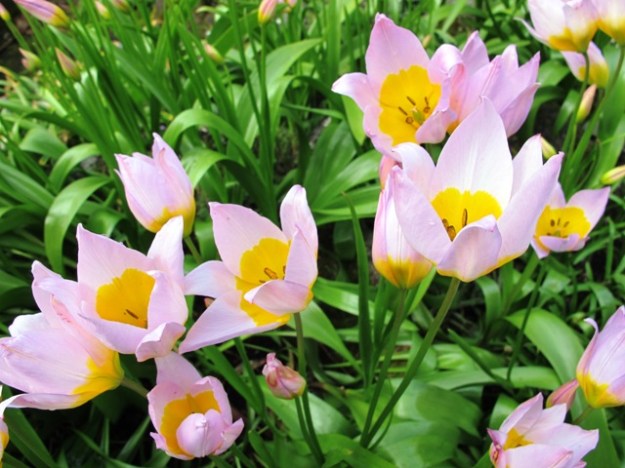
Tulips from Crete - T. saxatilis

Tulips from Crete – T. saxatilis

Tulips. They are Dutch in origin, aren’t they? Well no. The original tulips are no more Dutch than I am, but the modern hybrid tulips largely originate from the flat home of dairy, dykes, windmills and clogs. And in a love affair spanning 450 years, the Dutch have made this plant family their own.

We don’t grow many tulips in our own garden. The showiest by far is a tulip from Crete – T. saxatilis. Most people are surprised to find that there is a tulip from that Greek island because, after all, tulips come from Holland, do they not? In fact the species in the wild – and there appear to be somewhere between 70 and 100 different species recorded – do not originate from anywhere in Northern Europe. Instead, stretching from Southern Europe, through Northern Africa, the Middle East and spreading overland from Turkey to north western China, tulips have a wide territory. Many of them favour mountainous areas with hot, dry summers and cold winters and therein lies the hint to the problems people can have with getting the modern hybrids to flower past the first season in their garden. Most need a much greater winter chill than we can give them here.
Some species - we just don't know which one

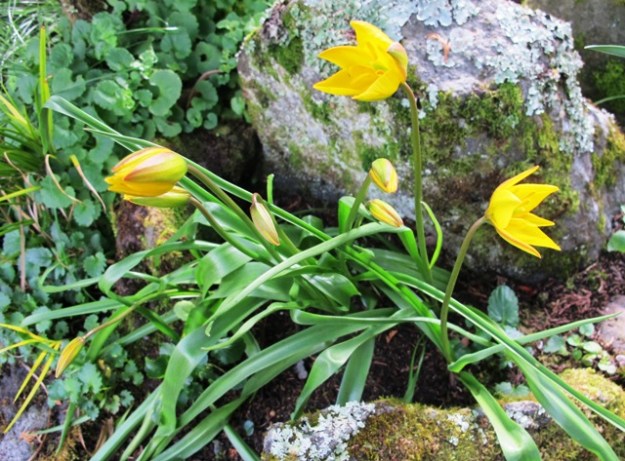
Some species – we just don’t know which one

We have three different tulips in the garden. The Cretan species is wonderfully easy-care and increases gently and reliably. I love the unlikely contrast between the lilac pink and bright gold. Then we have a pure yellow one which is inclined to nod its head. Mark thinks it may be a hybrid, not a species, though I am unsure of how he reached this conclusion. It never increases but it does at least return each year. And we have a small flowered, small growing species of unknown origin. Charmingly understated, might be the descriptor.
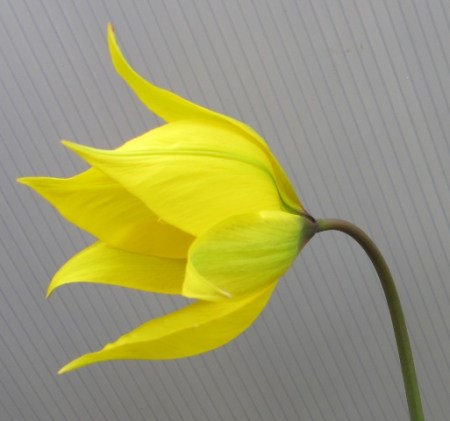
Indubitably tulip, but we have no name on it and it never increases.

Indubitably tulip, but we have no name on it and it never increases.

I am not the world’s greatest fan of modern tulip hybrids but concede I am in a minority. I have toyed with the idea of bulk buying bulbs of one or maybe two selected cultivars to drift through areas of the garden. A swathe of pure white tulips or maybe clusters of a deep wine colour might add to the early spring herbaceous plantings even though they may be a little clichéd. But I prefer to spend money on bulbs which have a life-span beyond just one season. I can’t bring myself to treat tulip bulbs as a disposable commodity. It seems a shocking waste of money, resources and effort.

I was a bit surprised to find that even in the UK, tulips are often treated as annuals because their repeat performance is patchy at best, despite the fact that their winters are much colder than ours. Tulip bulbs are much cheaper to buy there which may be a factor.

It is not that these hybrids all die after flowering for the one season. They just decline and flowering diminishes considerably in subsequent years unless you go to the trouble of lifting them, separating the offsets, chilling them and replanting in fresh ground. That is a lot of effort. Holland apparently produces fresh tulip bulbs by the billions each year, so I guess there is an insatiable demand from people who do keep replenishing supplies.

The early variegations and novelty breakthroughs were almost certainly caused by virus which, while giving variety, also weakens the plants over time. Nowadays, the variegations are the result of genetic breeding and selection, and considerable effort has been made to get rid of the debilitating viruses. Most of the modern hybrids descended originally from T. suaveolens, which we do not have in our garden here.
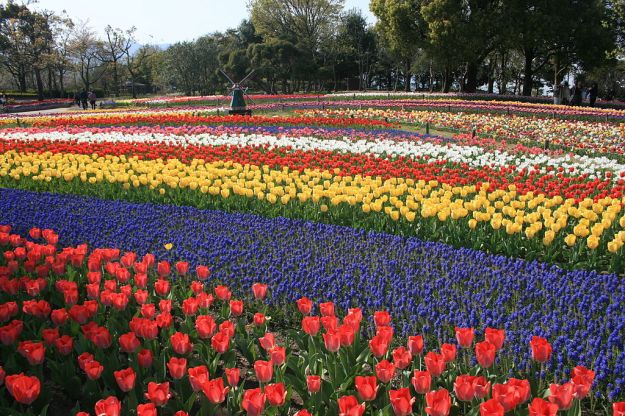
I went looking for a photo of tulip fields in Holland and found instead this one of tulip fields in Japan, pretending they are in Holland!

I went looking for a photo of tulip fields in Holland and found instead this one of tulip fields in Japan, pretending they are in Holland!

The history of tulips is fascinating but not without debate. The earliest cultivation of tulips was apparently recorded 1000 years ago in Persia. How and when they arrived in Northern Europe is disputed, but they appear to have been taken there in the mid 1500s. By 1637, what is now called “tulip mania” had hit Holland. Single bulbs could command fabulous prices – reportedly as high as 10 times the annual income of a skilled craftsman. But it was not just the wealthy plant collector who coveted these flowering plants. They had become an investment commodity, priced way beyond their actual value. This extraordinary situation has received a lot of attention because it was the first recorded instance of rampant, economic speculation on a product but there is ongoing debate about the extent and the detail. Economic data from 1637 is always going to be a little sparse and sometimes unreliable. Whatever, it makes a good story and “tulip mania” has entered the lexicon as a term for a freakish economic bubble, such as the sub-prime mortgage bubble in most recent times.

Going back to garden plants, in their simplest form tulips are generally cup-shaped and can face upwards or downwards. Essentially they all have strappy foliage and while it looks as if they have 6 petals, botanically they have 3 petals and 3 sepals. Ten times an average income seems an awful lot to pay for one of those.

First published in the Waikato Times and reprinted here with their permission.