Tag Archives: Taranaki gardens

Managing garden maintenance

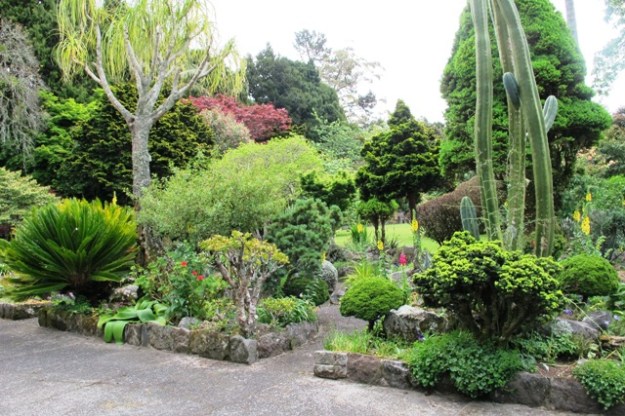
Close in by the house is under constant maintenance

Close in by the house is under constant maintenance

Garden maintenance. Oh yes, it is often like housework outdoors. No matter how much you do, it always needs to be done again. Vaccuming, tidying, dusting, spring cleaning – there are garden equivalents for the lot.

I admit I am not the world’s most dedicated housekeeper. I do it because I have to. If I found a gem of a reliable cleaner, I would find the money to pay this person to do it for me. But the times of my life when I have paid regular cleaners have also been somewhat irritating because they do not do it to my standards. Gems are hard to find.

Good garden help is equally difficult to find, I believe. Fortunately, because I don’t mind the garden maintenance side, I don’t feel the need to pay someone to do it for me. I have a wonderful book from 1984, vintage Alan Titchmarsh who is now a doyen of English garden television but who was a lesser known, bright young wit 30 years ago. It is called “Avant-Gardening, A Guide to One-Upmanship in the Garden.” In it he has a chapter entitled: “Having a Man In” and his opening line is: “Or a woman; but most likely a man.” He divides gardening help into Treasures and Tolerables. The Treasures, he declares, are rarer than blue roses.

I would love to quote the lot about The Tolerables, but it is too long. Edited highlights include: “They resent change. Their favourite flowers are …scarlet salvias, orange French marigolds, standard fuchsias and lobelia and alyssum. They love ‘dot’ plants. They have difficulty in recognising your treasures and pull them up as weeds…. The vegetables they grow will be their favourites, not yours. ….They dig beds where you don’t want them and act on ‘initiative’ without asking if you actually wanted the orchard felling…. They don’t let you know when they are not coming in (it pays to keep you guessing).” There is more in that vein.

Judging by the number of enquiries I have had over the years, good garden help is just as scarce nowadays as it has ever been. But, as with anything else, if you are only willing to pay the equivalent of minimum wages, you are unlikely to find a Treasure who knows what he or she is doing in your garden. A Treasure whom you can trust is even rarer and will need to be cherished.

The bottom line is that most of us end up doing it ourselves and gardening as a DIY ethos is deeply ingrained in this country to the point that it is often worn as a badge of pride.
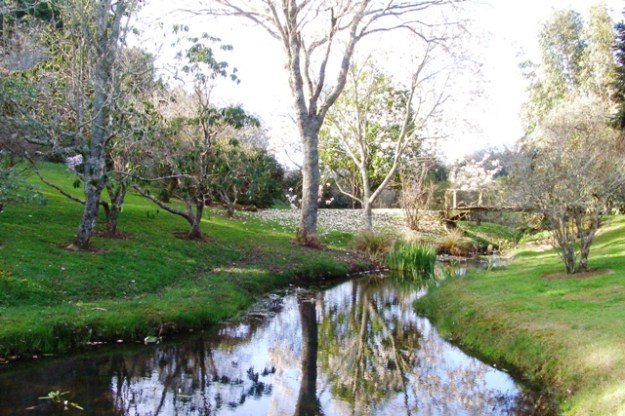
The outer areas are on a once a year maintenance cycle

The outer areas are on a once a year maintenance cycle

I credit the potted wisdom on garden maintenance I received years ago to senior NZ gardener, Gordon Collier. Think of the garden as radiating circles, he told me. The circle closest in to the house is where you carry out the most garden maintenance to keep it well presented. Essentially, you stay on top of it by keeping at it all the time. The next circle out should be on a seasonal cycle so you get around it four times a year. Then there is the outer circle which you do once a year.

This of course is big garden advice. A smaller urban garden probably does not take you beyond the second circle. I have always remembered his words because it gave a sensible and manageable framework for a large garden, and we are large gardeners here. It is worth thinking about if you are extending your garden. The further out you go, the less you will do in terms of regular maintenance. Plan from the start to keep it on an infrequent cycle and you won’t be making a yet bigger rod for your own back.

He Who Does the Majority of the Weed Control here (aka my Mark) would like it pointed out that this does not apply to weeding. Depending on the time of the year, he will start a weeding circuit as often as every three weeks. If you leave the weeding circuit to three monthly, or annually, you will never keep invasive weeds under control. The convolvulus will have smothered its host, the seedling cherries grown too large to hand pull and there will be a permanent carpet of bitter cress. Most weeds will have viable seed on them by six weeks – hence the three weekly cycle to catch the weeds missed on the last round.

That outer round of maintenance is the pruning, cutting out dead wood from shrubs, the removal of large debris, seasonal dead heading where necessary, cutting bank rank grass and a general tidy up. It is what I am doing right now.

The middle circle is hedge trimming, digging and dividing perennials, cutting back, staking, pruning, shaping, clipping and mulching.

The close in circle is… well… like vaccuming the living areas and washing the kitchen floor really. Frequent and ongoing. I just prefer to work outdoors and, in my case, without power tools.

First published in the Waikato Times and reprinted here with their permission.
Fruity facts (pragmatism over romance)

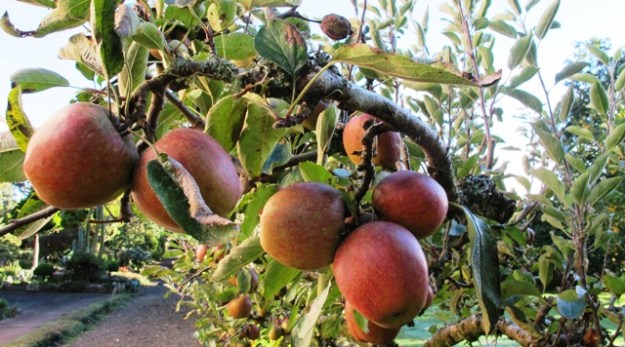
Apples are a reliable crop for us

Apples are a reliable crop for us

???????????????????????????????The whole concept of a home orchard seems to evoke romantic images, often based on childhood books. The swing hanging from the old apple tree, the lichen encrusted gate by which one enters, feasting on windfalls, maybe sitting on a tree branch munching sun warmed plums – you get the picture. Needless to say, it is always sunny and there are no wasps.

In recent years, with the explosion of interest in growing one’s own produce, I wonder how many trees have been sold to people with that soft focus romanticism. Just as I wonder how many dollars have been spent buying fruit trees which are entirely unsuited to our geographic areas. No matter how optimistic you are, I’m sorry we are just not going to produce good Black Dawson cherries in the mid north.

Most fruit trees need care. There aren’t many that you can just plant and leave. The reality is that if you want a crop, you are going to have to give the plants some attention. They are not like an easy care camellia that you can bung in the ground and then hack back a decade later when it has grown too large.

Orchards take space, more space than many people have. This is because fruiting trees need full sun, some protection from strong winds yet plenty of area around each tree to allow for good air circulation. That air movement is what helps to combat the build up of pests and diseases. Over-crowded plants will not crop well.

Mark’s mother planted an orchard here. She was not without romantic vision. Little of it remains now. However we do grow a lot of fruit and maintain a fresh supply all year round. Most of the crop is organic. Over time, the fruiting trees have been placed in appropriate positions around the garden rather than in a designated area. However, as we are stripping out our former nursery, Mark plans a return to the old orchard and he has been stockpiling trees in anticipation. But unlike most gardeners, we have space.

There is no doubt that fresh, tree-ripened fruit tastes better and to be able to wander out and gather a bucket of fruit is a simple activity that marks a quality of life beyond dollar value. Much of the fruit that is sold commercially has been sprayed to make it look good for the consumer (pock marked skins just won’t do), picked green and cool stored. It is never going to compare with home grown produce, except in the looks department.

You are probably not going to achieve self sufficiency in fruit on a small urban section. But you can have the delight of some crops. Just think, before you choose what trees to buy.

Feijoas - one of the few plant 'em and leave 'em fruit crops

Feijoas – one of the few plant ’em and leave ’em fruit crops

The only fruiting trees and shrubs I can think of that can be planted and then ignored except at harvest time are feijoas, passion fruit, what we tend to call the NZ cranberry (myrtus ugni), the Chilean guava (Psidium littorale) and avocados (but generally you need to live within 5km of the sea to grow avocados successfully in this country). Pretty much everything else needs work.

Some fruiting plants need quite a bit of work – vines like grapes, raspberries and kiwifruit are not worth giving garden space unless you are willing to actively manage them. Given the major disease issues with kiwifruit in the Bay of Plenty, they are probably best avoided for a few years anyway. Besides they are frost tender, so not suited to inland areas.

Some fruiting plants need a different climate altogether. Cherries and apricots, in particular, thrive in conditions where winters are dry and cold and summers are dry and hot. Nectarines and peaches are similar but a little more tolerant of humid, temperate climates. However, if you want consistent cropping from them, you are probably going to have to spray for disease. Plums are the easiest of that range, but we find they are intermittent croppers and will skip some years altogether.

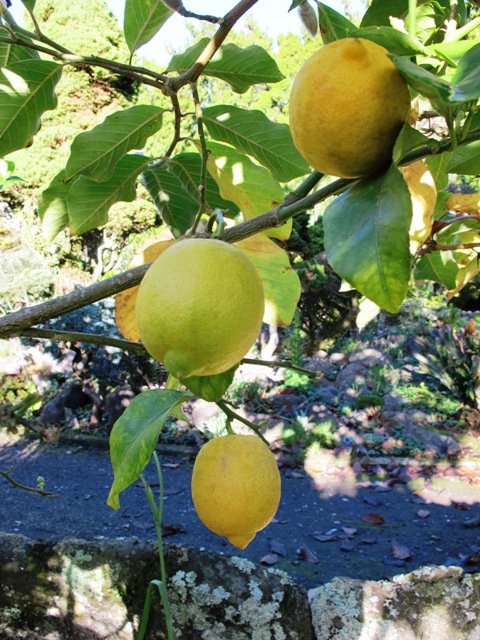
The modest lemon - common in many NZ gardens

The modest lemon – common in many NZ gardens

We grow a lot of citrus but we are coastal so don’t get much in the way of frosts. Oranges are our year-round staple fruit and we also have grapefruit, mandarins, limes, lemons and tangelos. Inland areas of the Waikato have summers that are plenty warm enough, but anything other than the ubiquitous lemon is going to be problematic without some frost protection. We get away with just one spray of copper in winter on the citrus.

The pears crop well, but not every year. As ours are not on dwarfing root stock, it takes an extension ladder to pick the crop but at least the trees survive on benign neglect. Apples really need annual pruning and some active management for pest and disease control. Our most successful ones are free standing espaliers on dwarfing stock, which allow plenty of air movement. Generally, they only get a copper spray once a year and occasional intervention when the codling moth gets going. Apples in our household are quartered, peeled and cored for eating because they are less than perfect. But they crop prolifically every year and taste good.

There is a whole range of lesser known fruit now on offer for sale – medlars, persimmons, pomegranates, kaffir lime, novelty citrus like Buddha’s Hand, to name just a few – but where space is limited, you are probably better to stick to the tried and true that will crop consistently.

First published in the Waikato Times and reprinted here with their permission.
Plant Collector: Nerine filifolia

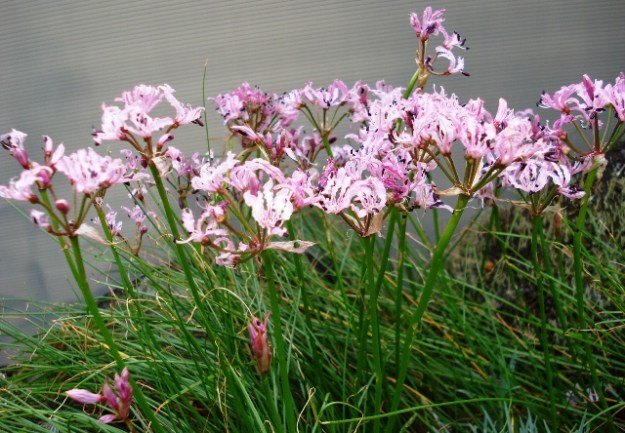
The daintiest of nerines - N. filifolia

The daintiest of nerines – N. filifolia

Nerines are a star of our autumn garden so the appearance of N.filifolia always arouses that slight sense of autumnal melancholy in me, coinciding as it does with the realisation that the days are getting shorter again. But the references tell me that in fact it is summer flowering and certainly it is always the first nerine to bloom here. It is also the daintiest member of that family that we have. It is tiny. While the stems can be about 25cm long, individual flowers are only a cm across at most with particularly frilly, waved petals in deep pink and nine flowers to each head.

The filifolia part of the name means fine foliage, grass-like in the vernacular. With us it is evergreen. In harder climates, it may lose its leaves. Like all nerines, it is a South African bulb, from the Eastern Cape area. It builds up easily and is not fussy in the garden, as long as it doesn’t get swamped by stronger growing plants.

Nobody could call it spectacular. It is just one of those little treasures that adds detail and seasonal interest to the garden. The problem will be sourcing bulbs. You will probably only find it from bulb specialists or other gardeners, though Trade Me is always worth watching for odd plants that are not widely available these days.

First published in the Waikato Times and reprinted here with their permission.

The Chelsea chop comes to New Zealand

Lobelia, phlox, campanula, aster, pensetemon and coreopsis - all candidates for the Chelsea chop here

Lobelia, phlox, campanula, aster, pensetemon and coreopsis – all candidates for the Chelsea chop here

We are fairly dedicated viewers of the long-running series BBC Gardener’s World. Of late it has been on free to air Choice TV (interspersed with huge quantities of advertising) and sometimes it turns up on the Living Channel. There was a programme that screened here last November which demonstrated the technique of the Chelsea chop. I tried it in a small way and will be doing a great deal more of it this coming year.

The Chelsea chop came by its name, apparently, because at the end of the annual Chelsea Flower Show, many surplus plants were returned to nurseries. These plants in full growth, nearing or at their peak, were often cut back hard. Presumably some were plants forced into early growth to peak for the show and that early growth can be leggy. Plants responded with greatly increased vigour and put on extended floral displays with much bushier and more compact shapes.

Thus did the term the Chelsea chop enter the lexicon of English gardening.

Right, I thought. Chelsea is towards the end of May which translates to November in our hemisphere. I headed out with the snips to experiment. It seemed extreme because I was cutting off flower stems which were already well advanced. In some cases, I cut half and left half. I can now report that it works and I will be doing a great deal more of it next spring.

Important points to note are that we are talking about perennials here, not shrubs or bulbs. You need to understand your perennials because it only works on varieties which repeat flower. If you snip the ones which only flower once, such as irises or aquilegias, you won’t get any flowers at all.

I tried it on perennial lobelias, sedums, penstemons and asters.

The unchopped lobelias have shot up their flower spikes to over 1.5 metres and they have promptly fallen over in the welcome rain this week. The plants I Chelsea chopped are only a few days behind in their stage of flowering but have tidy, sturdy stems about 50cm high. They are much better in the garden borders.

Sedum, left to its own devices and falling apart already

Sedum, left to its own devices and falling apart already

Many readers will understand when I complain about the sedums which grow brilliantly from such tidy rosettes at ground level but when they reach a certain point of being top heavy, they fall apart. The Chelsea chopped ones are a more compact and holding together at this stage.

I cut the asters because I didn’t want them to flower until late summer and they were threatening to do it too early. They are just opening now, on lovely bushy mounds of plant, and should take us into autumn.

I see the Telegraph website advice is to do it with Campanula lactiflora (which can get a bit too tall and fall over if you don’t stake it), rudbeckias, echinaceas and heleniums as well. Their writer advises to prune back by a third. Essentially it is a more extreme version of pinching out plants at their early stages to encourage bushier growth.

Perennial gardening is our current learning project here. We have been working on it for a few years now and the more we learn, the more we realise there is to learn. New Zealanders don’t have a great record in perennial or herbaceous gardening. We lean more to bunging them all in together in mixed borders, or working from a very limited palette in large swathes of the same plant.

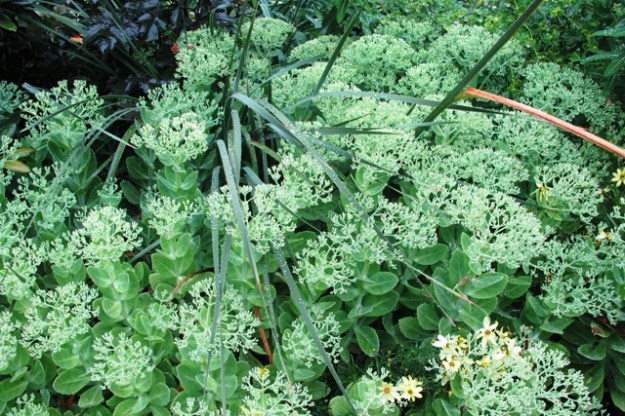
Sedum, cut back last November and holding itself well. Flowering is unaffected

Sedum, cut back last November and holding itself well. Flowering is unaffected

The mix and match approach to perennials is very English. They just do it so much better than anywhere else we have seen. Underpinning it (at its best) is a wealth of experience in successional flowering and good combinations. It is not just flower colour combinations, it is also compatible growth habits. This may be growing a naturally leggy plant (such as Campanula lactiflora) through a plant that is sturdy enough to support its leaning companion. It is making sure that a big voluptuous plant can’t flop all over a low growing, more retiring specimen. It is getting variations within the foliage as well as the flowers. It is getting the plant shapes right.

And it is not just peak flowering looking its best for three weeks of the year. It is understanding which combinations will take the garden through the season from spring to autumn, so as one finishes, another star takes centre stage. Judicious use of the Chelsea chop can extend the display, staggering flowering through the season.

There is a lot to it. No wonder people opt for mass plantings of the same plant. It is much easier. So too with the cottage garden which does not require the same level of skill. This type of intensive gardening is not to everybody’s taste but we are finding it interesting to learn. To be honest, I had not appreciated the skill that goes into putting in a really good planting of herbaceous material.

I will be doing my best impersonation of a garden hairdresser come this November. I will be out there snip, snip, snippin’ away.

First published in the Waikato Times and reprinted here with their permission.

Plant collector: Jacaranda mimosifolia

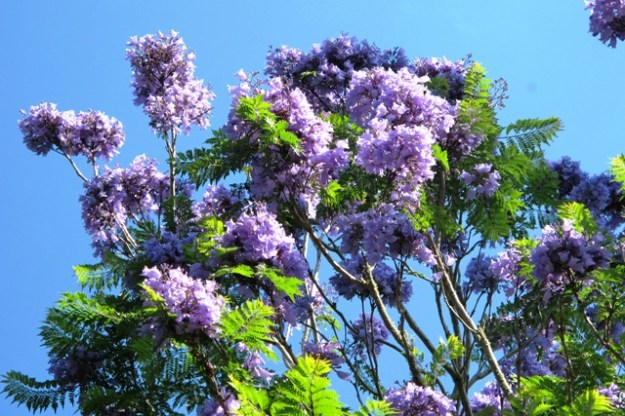
The summer delight of the jacaranda

The summer delight of the jacaranda

South Africans could be forgiven for thinking that this tree is one of their indigenous species. Pretoria has so many planted that it is apparently a haze of blue in late spring to early summer. In fact it comes from Bolivia and Argentina but is a worldwide hit because blue flowered trees are not common at all when you think about it. Nearer to home, when we last visited Whakatane, they too had used this summer flowering delight as a street tree. But it is nowhere near as common where winters are wet or in inland areas because it is a subtropical plant. Our tree is growing in a protected position, surrounded by other trees, rather than standing in solitary splendour so its blue-as-blue floral display is best seen out of our upstairs windows.

Jacarandas are deciduous and make an airy, open tree. After many years ours has reached around nine metres high, though it will have been stretched up by the trees around it. The flowering season lasts many weeks but it does appear that cooler temperatures delay the season until mid summer. In less than ideal conditions, it will need a sheltered, favoured position with excellent drainage in the warmest possible situation. It is classified as a member of the Bignoniaceae family though most gardeners will just recognise it as a legume.