Tag Archives: The plant collector

Plant Collector: Schima wallichii subsp. noronhae (probably)

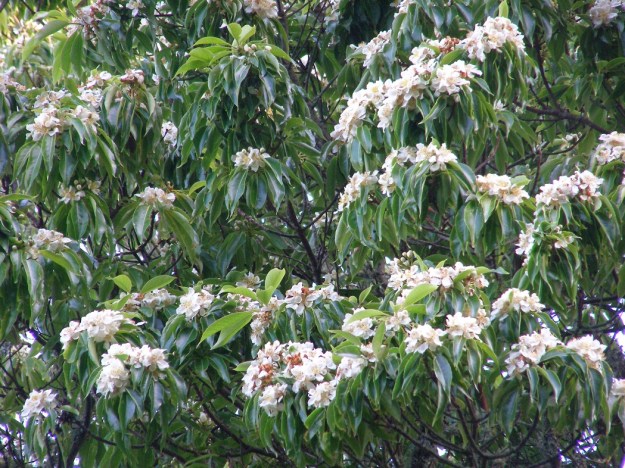
Schima, probably noronhae

I went on a bit of a search for the accurate species name of this tree in flower here, trying to sort out whether it was Schima wallichii or Schima noronhae. The naming of plants can be a fluid affair with reclassification happening often but schimas are more like quicksand than fluid – described by the most recent, authoritative tome on trees (New Trees) as simply a mess. What we do know is that it is that schima are a somewhat tender tree family from subtropical and tropical Asia and this particular specimen is rather large now. We live in a two storied house with reasonably tall gables but this tree is now closer to a third story level.

The little white 5-petalled flowers are pretty enough en masse this week, but it is the new growth at the end of October which I like more. The fresh young leaves are bright lime green and it is like a large beacon in the distance. Soon after the new leaves arrive, it drops all its old leaves in a whoosh. It is an evergreen – it is never totally bare, but most evergreen trees gently shed old leaves all the time, not in one hit. We have a number of schimas here (S.khasiana is even larger) but as far as we can make out, this one is S.noronhae. They belong to the theaceae family and are distant relatives of both camellias and gordonias. Schimas are commonly raised from seed – there don’t appear to be named clones yet though in time, no doubt there will be selections made to be grown by people with plenty of space and very mild conditions.
Plant Collector: Cordyline petiolaris

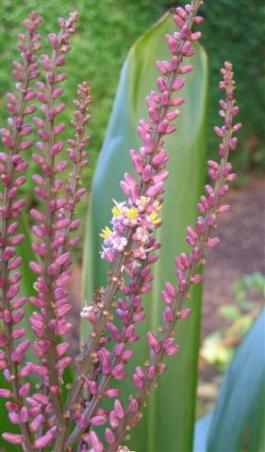
The Paris pink and yellow flowers of Cordyline petiolaris

The Paris pink and yellow flowers of Cordyline petiolaris

I have been waiting for weeks for these cordyline flowers to open and finally it is starting to happen. It is not that they are overly spectacular, more that they are an unusual Paris pink in colour with golden centres. In due course, they will turn to eye-catching red berries which hang on for a long time and are widely regarded as the more spectacular feature. Though it should be added that the wide, spatula-shaped leaves measuring up to 8cm across are also eyecatching.

Cordylines are of course what we commonly refer to as cabbage trees but the family is a little larger and geographically more widespread than our iconic native species, C. australis. This is an Australian species which occurs in the rain forests of northern New South Wales and Queensland. Our loyal cabbage tree moth whose offspring caterpillars chew the leaves of our native cabbage trees to shreds does not appear to like our Australian neighbours and consequently the foliage stays clean which is a distinct bonus in a garden plant. However, its flowers lack the heady summer fragrance of our native forms. The plant is somewhat hardier than its subtropical origins suggest, though it won’t tolerate heavy frosts. Given moist, sheltered conditions, it is not difficult to grow and will eventually reach about 5 metres high, keeping leaves down most of its length. It can be propagated relatively easily from stem cuttings or raised from seed.

Plant Collector: Lilium regale

Lilium regale - often called the Christmas lily in New Zealand

Lilium regale - often called the Christmas lily in New Zealand

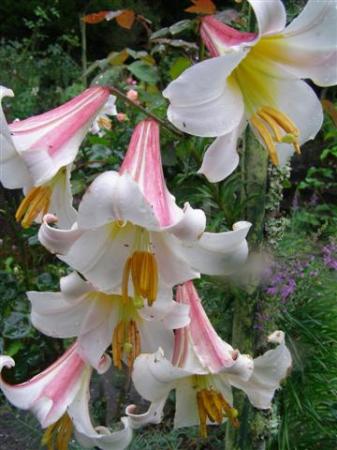
There seems to be a little confusion as to whether Lilium regale or Lilium longiflorum is the Christmas lily in New Zealand, but I can’t see that it matters. My guess is that florists may refer to the latter as the Christmas lily because it commonly comes with pure white flowers and is a reliable standby for picking, much favoured in floristry. But many gardeners associate the regal lily with this festive time of year. It too has the wonderfully fragrant white trumpets but usually with deep red or purplish markings on the back of the petals. L.regale comes from the Szechuan area of China whereas L.longiflorum is from Japan.

There is nothing too difficult or rare about either. L.regale gets to just over a metre tall and generally we get away without needing to stake it, especially when it is grown in the rose garden and has some taller plants around it to prop it up if it starts to list too far. If you have both sun and good soil, you are fine and it should reward you with eminently pickable flowers to adorn the Christmas table. Like most lilies, the bright pollen falls off rather freely and will probably stain the white damask Christmas tablecloth. Apparently you can brush the pollen off the stamens if you are working in dry conditions. Alternatively, nip the tops off the stamens but leave the anthers in the centre. Don’t harvest the flower stem right back at bulb level. It needs some length left because the stem contains both leaves and flowers and the bulb needs its energy replenished through its foliage or it will waste away.

Plant Collector: Cornus kousa var. chinensis

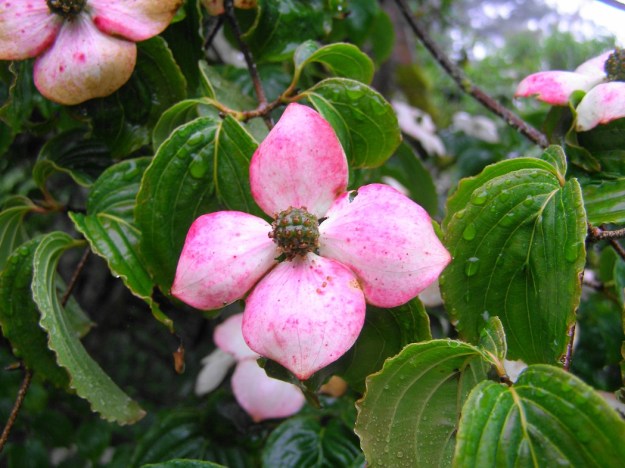
Pink and white all over - Cornus kousa var. chinensis

Pink and white all over – Cornus kousa var. chinensis

The cornus are a big family, commonly referred to as dogwoods. In our climate where we can grow most plants, cornus are not as widely featured as in other areas of the world because we are really too damp and too mild for most of them. They perform much better in a drier, continental climate with hot summers to ripen the wood, sharp seasonal change to trigger the autumn colours for which many are renowned and a good winter chill. Our C. kousa has had its hiccups in life (dieback threatened it a couple of years ago, possibly due to wet roots) but it battles on and in early summer the pink and white flowers are a seasonal delight, albeit a little brief. The welcome rain this week shortened its season.

Curiously, the flower is actually the dull, nubbly bit in the centre. What look like four pink and white petals are actually bracts – in other words specialised leaves which protect the flower buds, so not petals at all. This is common to all the dogwoods and to many other plants as well, including lacecap hydrangeas. Kousa is common in Japan and also found in Korea but Glyn Church tells me the form we grow in New Zealand is actually the one from central China, collected in 1907. After several decades, ours is a narrow, columnar tree about six metres high. When we were last in England, we saw many hybrids between C. kousa and C. nuttallii, some with spectacular, large flowers which were very showy indeed. Kousa shows resistance to anthracnose which has decimated the cornus display overseas and the new hybrids are, in part, an attempt to breed resistance to the disease.

Cornus kousa can age to deep pink

Cornus kousa can age to deep pink

Plant Collector: Dactylorhiza maculata

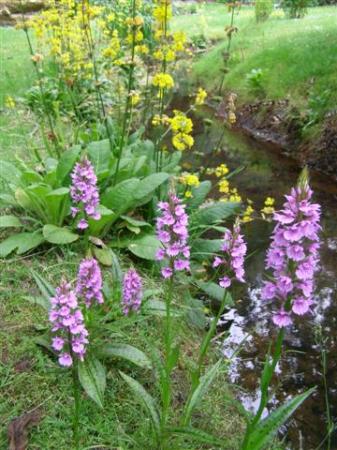
Dactylorhiza - doing better on our stream margins than in the garden

Dactylorhiza - doing better on our stream margins than in the garden

Dactylorhiza are terrestrial orchids – in other words, ground orchids. We have had this purple one for many years. It is likely that Felix Jury imported it here in the early fifties and it has gently increased ever since. It has taken us a long time to realise that it is happier in the cooler, damper conditions of our stream margins where these specimens are growing taller and lusher than those we have in rockery or other garden positions.

The rhiza part of the name refers to the root which is liked a forked tuber, or rhizome and it increases in a similar manner to many bulbs. Dactylorhiza are very widespread in the cooler areas of the northern hemisphere, occurring as far north as Scandinavia and even Alaska. While we have always had this one as D.maculata, otherwise known as the Heath Spotted Orchid, there is a bit of a question mark over that and it may in fact be D. fuchsii, the Common Spotted Orchid or even a hybrid between the two. The differences are subtle – are the markings lines? Is that pointed area in the lower lip like a small middle tooth or is it a lobe? Whichever, the foliage generally has interesting deep maroon spots which are an attractive feature, even without the flowers. Each flower spike is about 20 to 30 cm high (a happy plant will put up a taller spike) and carries masses of individual orchid flowers which open pretty much all at once. The yellow behind the plants in the photograph is the common Primula helodoxa.