Tag Archives: The plant collector

Plant Collector: Edgeworthia gardneri

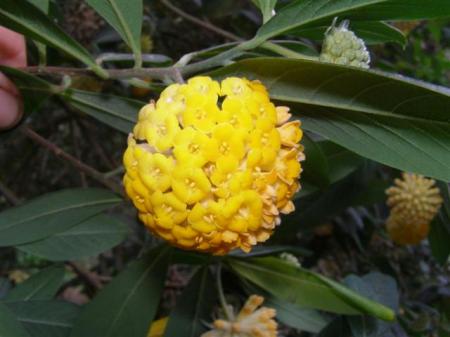
The scented golden orb of Edgeworthia gardneri

The scented golden orb of Edgeworthia gardneri

This plant has a very curious flower head – fully rounded golden pompoms of tightly packed, almost waxy flowers. Sweetly scented too, which is not surprising because it is a close relative of the daphnes, but because it does not mass flower, it lacks the fragrant oomph of its cousins. Each flower head is only about 3cm across, not much larger than an old fashioned gobstopper. Gardneri is still newly introduced to the west – it comes from Nepal – not easy to propagate from cutting and rare. I tell you this because several years ago we did manage to get some plants successfully growing and offered them on the mailorder list we used to put out. At the same time a gardening magazine showed a photograph of the flower but gave no idea of the size. Somebody in Palmerston North tracked us down and ordered the plant. We shipped her down a splendid specimen but she was not happy. She was expecting a flower more akin, I suspect, to the size of a cricket ball rather than a pingpong ball. She sent back this rare and choice shrub. It cost her more in freight than the plant was worth, but clearly it was a matter of principle because she felt short-changed by the size of the flower.

There are only two, maybe three, species of edgeworthia. The more common Chinese form, papyrifera or chyrsantha, is deciduous but gardneri is fully evergreen and makes an open, airy bush with a graceful appeal. It is not particularly hardy and won’t thrive in areas with cold winters. It has good nectar for the tuis and we are planning to add another plant in full sun to feed our butterflies.

Plant Collector: Tulipa saxatilis

Plant Collector: Tulipa saxatilis

Plant Collector: Tulipa saxatilis

I am not a great fan of the common tulip and even less so of the novelty forms so prized in colder, northern European gardens. But get back to the original species, (how they occur naturally in the wild) and it is a different matter altogether. This very pretty tulip is a combination of soft lilac with a yellow throat which is not the world’s most obvious colour scheme but generally the colours of nature do not clash. It hails from the island of Crete (the home of Zorba the Greek) though apparently it is also found in Turkey. In their natural environment, these are wild flowers and if you have ever visited the Greek islands or the coast of Turkey, you will know that conditions are hard with poor stony or clay soils, very low fertility, drying winds and next to no rain for most of the year. These are not conditions that we can replicate in the garden here but Tulipa saxatilis is not too picky and has thrived in our rockery for many years. With open conditions and excellent drainage, it is genetically programmed to be a survivor.

This is an early spring bulb, so it starts to grow in winter (triggered by autumn rains) and flowers in early spring for a period of several weeks. Each bulb puts up a stem which flowers its way down in succession so you get several blooms per bulb. It is a good example of a bulb which will find the depth it is happiest at in the soil so it will often drag itself down quite deep and it is a rarity amongst the tulips because it runs below ground. Because the foliage doesn’t hang on very long, it lends itself to being co-planted with a summer perennial which is dormant when the tulip flowers. We have had a dwarf species oenothera, better known as Evening Primrose, interplanted with our main bed of Tulipa saxatilis for many years and it comes into its own as the tulip goes dormant.

Plant Collector: Illicum simonsii

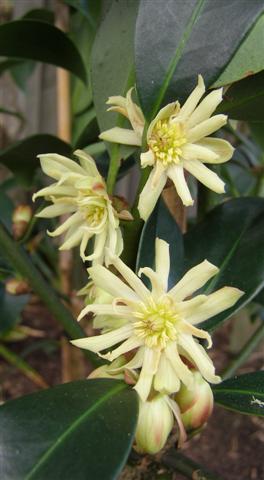
The small, waxy flowers of Illicum simonsii

I would be telling porkies if I said that these lovely soft lemon flowers are spectacular. Understated might be a better descriptor, maybe subtle. They only measure about 2cm across but they are really interesting, looking like miniature waterlilies cast out of wax. If you think they remind you of something else, you may be thinking of star anise which is the seed head of Illicum verum. Don’t be tempted to try the seeds of other illiciums – most are poisonous. Until I looked it up, I had assumed that Illicium anisatum should be the source of star anise –far from it and anisatum too is very toxic. Simonsii is still a relatively rare shrub in cultivation, originating from the Yunnan and Sichuan areas of China. It is evergreen with a lovely glaucous blue tone to its sturdy leaves and grows much more upright than most other illiciums as well as being more tolerant of full sun and relatively dry condtions. If you break a leaf, you will discover immediately how aromatic the foliage is. Whether you like the aroma or not depends a bit on your attitude to wintergreen or Vick’s Vapourub. It smells a little too close to the bizarre raspberry Sarsi drink we once bought in Kuala Lumpur – in itself an unforgettable experience.

Illiciums are a genus all of their own though they have a distant botanical alliance to magnolias but you could never tell that from looking at them.

Flowering this week: Backhousia citriodora

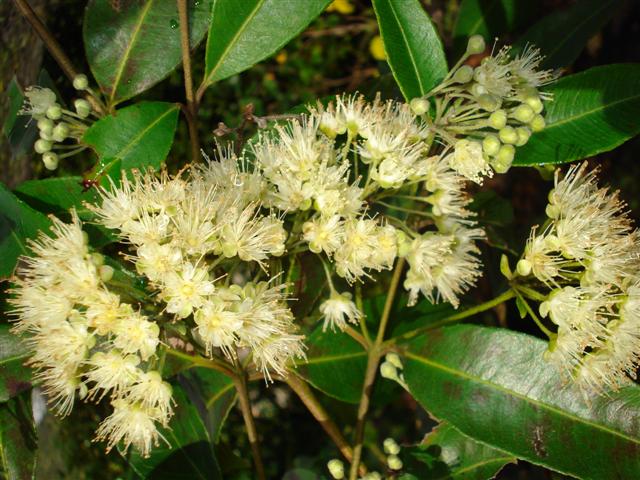
The lemon fragrance from Backhousia citrodora has to be experienced to be believed

I would be the first to admit that the creamy fluffy floral clusters of this small(ish) tree are not showstoppers though they are pretty enough in their own way and make a change for autumn flowering. Nor are the long narrow leaves eye-catching though the red-brown velvety new growth is very tactile. In fact, the visuals of this plant are remarkably modest especially when you consider it is an Australian from the coastal rainforests of Queensland and northern New South Wales. The knock-you-dead aspect is the lemon fragrance when you crush or even brush past a leaf and the flowers also exude wafts of lemon. It has quite the most delicious lemon scent of any plant I know, bar none. This is apparently because Backhousia citriodora, commonly referred to as the lemon myrtle, has higher concentration of citral (lemon oils) than many other plants, including lemon verbena. In fact it is harvested commercially for lemon flavouring. I have to admit that I have not tried it in a culinary context but I will do so. You can apparently use the leaf whole (like a bay leaf) or chopped and it will give a lemon flavour without the problems of curdling, even in milk puddings. So I have read.

While not overly hardy, if given some protection when young, the backhousia should be able to grow throughout most of our area. I have seen it in a protected valley in Canberra Botanic Gardens where apparently it can survive frosts of 8 degrees. It is a member of the myrtle family and it can be clipped. This may be a plant to put alongside a bay tree in the vegetable garden or plant it by a path so you can pluck a leaf to sniff when you pass.

Flowering this week – our rather rampant bougainvillea

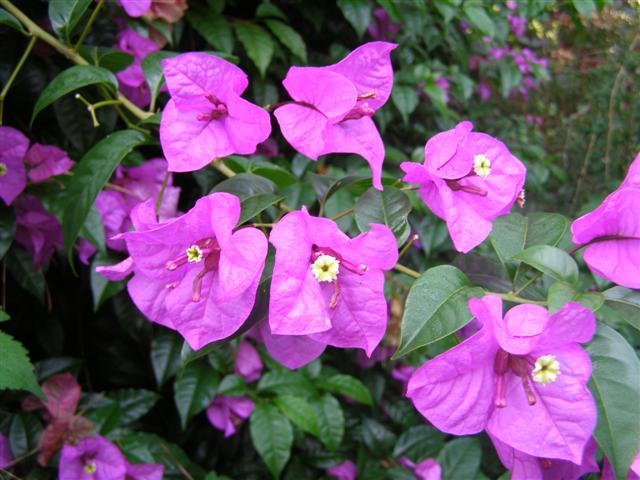
Decidedly rampant, extremely spiny but quite spectacular - the bougainvillea

Decidedly rampant, extremely spiny but quite spectacular - the bougainvillea

Not, as we assumed, originating in the Bougainville Islands, but named for the French explorer, Louis Antoine de Bougainville and hailing from South America. We think this form is glabra, from Brazil. There is nothing rare about these scrambling climbers and they are appreciated throughout the temperate and tropical world for their display which can be all year round in latitudes close to the Equator. Here they peak in summer to autumn. It is not the insignificant flowers that make the show but the coloured bracts which surround the flowers and hang on for a long time. The colours range from the royal purple of this variety through cerise, red, pink, lilac, orange, gold and white. Left to their own devices , these can be formidable plants. Ours smothered a dead tree to around ten or fifteen metres high, and a little shy of that figure in both width and depth until the host tree rotted and fell over bringing down most of the bougainvillea with it. It then became a major mission because one of the other characteristics of this genus is its many sharp thorns.

Most of what are sold now are hybrids and they are not left to their own wayward habits as we have done. They are easy enough to trim and shape when small, sometimes trained as standards. We saw some really interested topiary specimens in Bali where three different colours had been grafted onto one stem and then trained to shape as a curious container plant. They are also recommended for hedging and with their thorny ways, they may be just the ticket to deter burglars in crime-prone areas with a mild climate.