Tag Archives: The plant collector

Plant Collector: Vireya Rhododendron Satan’s Gift

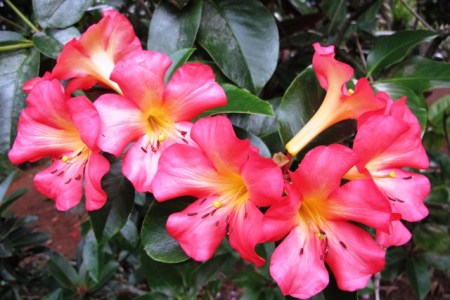
Satan. I'm afraid it is vireya rhododendron "Satan's Gift", not Santa's Gift

Satan. I’m afraid it is vireya rhododendron “Satan’s Gift”, not Santa’s Gift

The trouble with vireyas is that they have an aversion to frost so they are really only a garden option for those in mild, coastal areas. Inland (where frosts are much greater), you need to be a careful gardener willing to give them protection and maybe bring them under cover. But they can be such a rewarding plant with their extended flowering habits. This one is Satan’s Gift, one of the best varieties named by the late Felix Jury and certainly the showiest and the most fragrant.

Felix was a complete agnostic so the word Satan merely evoked hot colours to him but over the years, we have seen more religious people struggle with the name. Indeed, we have seen it offered for sale as Satin Gift, Jury’s Gift and the hilarious Santa’s Gift. (Note to such people: it is fine to shun a plant because you don’t like its name, but it is not okay to rename that plant to something you find more acceptable). We were once told that it was the only plant in Eden Gardens in Auckland, a memorial garden, without a name plaque. We just think it is a splendid cultivar to have in the garden.

This is a cross between two different species (konorii x zoelleri) which gives it hybrid vigour. It is particularly bushy and well furnished and flowers more than either of its parents.

Besides not liking the cold, vireya rhododendrons need great drainage. The fastest way to kill one is to keep it with waterlogged roots, whether in a container or the garden. In the wild, most are epiphytes and grow up in the trees.

First published in the Waikato Times and reprinted here with their permission.
Plant Collector: Sasanqua camellia Crimson King

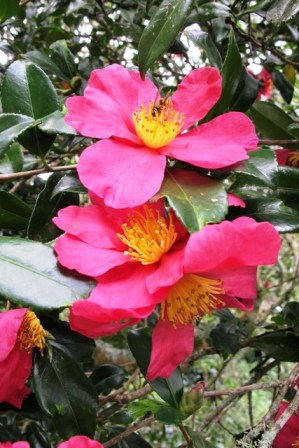
Crimson King - harbinger of autumn

Crimson King - harbinger of autumn


Crimson King forms a graceful, open shrub when mature

Crimson King forms a graceful, open shrub when mature

Crimson King heralds the arrival of autumn. It is a sasanqua, one of the autumn flowering camellia family from Japan. Too many people seem to think that sasanqua is synonymous with Setsugekka (how clichéd is the Setsugekka screen planting?) and only comes in white. In fact there are a relatively large number of family members, including Crimson King. It has the usual sasanqua attributes of finer foliage and a graceful, open habit of growth as it matures. In addition to that, the exceptionally long flowering season means it will last well in winter.

Single flowers have just one row of petals and exposed yellow stamens in the centre. The birds and the bees, and indeed the butterflies, need these stamens exposed to be able to feed from the flower. Big full forms or sterile formal flowers are not a source of pollen and nectar. Most sasanquas lack the highly refined flower forms so prized in japonica camellias but single flowers like this shatter and dissipate without ever leaving a sludgy mess below. There is also a simple charm in such a simple flower.

Sasanquas are renowned for being one of the most sun and wind tolerant types of camellias. They also flower early enough in the season to avoid the dreaded camellia petal blight. Overseas reports say that they can suffer from this dreaded fungal ailment but we have never seen it in our sasanquas here. Crimson King has a pleasant scent if you stick your nose right in the flower but I think that the faint waft of fragrance in camellias is rather over-hyped.

First published in the Waikato Times and reproduced here with their permission.

Brugmansia Noel’s Blush

Brugmansia Noel's Blush

Brugmansia Noel's Blush

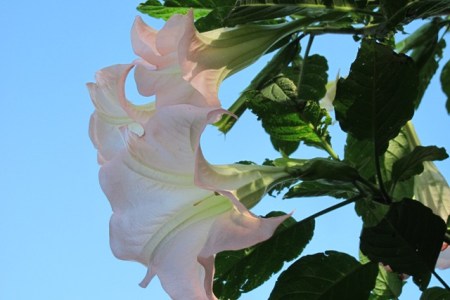
The late summer sight of this brugmansia in full bloom is striking and the trumpets are a pretty peachy pink in colour. Each bloom can measure 25cm long and up to 20cm across which is on the large side. I was reading a description which said strongly scented which I can’t say I have noticed so I rushed out to sniff. No scent in the morning, I am afraid. It appears they are night scented which is an indication that pollination is carried out by night flying insects, usually moths. The plant itself is a big rangy thing of no beauty – you have to work at keeping it more compact and bushy if you want a tidy plant. Otherwise it is just an overgrown solanum which wows when in flower.

This particular one was named for the late Auckland gardener and plantswoman, Noel Scotting and it came into the country about twenty years ago. Brugmansias are all South American and there seems to be quite a bit of shuffling of species, even though there are not many different species to shuffle. I lean towards the likelihood of this being B. suaveolens from south east Brazil. Or it may be a hybrid. All brugmansias are frost tender.

Brugmansias used to be called daturas, to which they are closely related. They are also very toxic. South American tribes have long used them in traditional medicine for purposes as varied as treating dermatitis, arthritis, prophecy, a ritual hallucinogen and, most scary of all, apparently to discipline naughty children by opening them up to the voices of their spirit ancestors. It sounds like scaring them witless to me. All parts of the plants are toxic and fortunately synthetic illegal drugs have replaced their occasional recreational use which was all too often fatal.

The double white brugmansia featured earlier in this series.

First published in the Waikato Times and reprinted here with their permission.

Plant Collector: Clematis tangutica

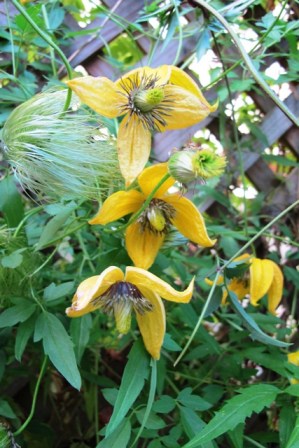
The early autumn charm of Clematis tangutica

The early autumn charm of Clematis tangutica

We have been gently enjoying the bright yellow, hooded bell flowers of Clematis tangutica, one of the later flowering varieties for the season. There may be a mere four petals and some purple stamens in the centre and the flower is only 7cm across, but they are very charming. The silky seed heads are a particularly ornamental addition especially as we have both seed heads and flowers on the vine at the same time.

C. tangutica is one of the very best yellow coloured clematis. It hails from north western China into Mongolia which means it is completely cold hardy. It is a clematis type where all that is required is to cut it off about 20cm above the ground some time during winter when it is dormant and leafless. They don’t come much more easy care than that. It means you can grow it scrambling through other plants if you wish, and it shouldn’t smother them. Ours is growing up a trellis.

We have never noticed our plant seeding down but I see it comes with a warning to weed out seedlings so it must have that capacity. This means that it is highly unsuitable for planting near native bush and reserves and would probably no longer be allowed into the country. We don’t need another old man’s beard smothering our native forests. In a garden situation where we have had it for a decade or so, it has not displayed these wayward habits so we are happy to continue giving it garden space so it can charm us from late summer through to autumn.

First published in the Waikato Times and reprinted here with their permission.
Plant Collector: Norfolk Island Pine (Araucaria heterophylla)

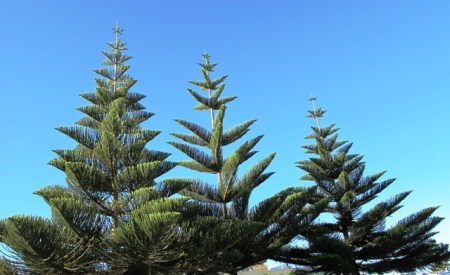
The urge is to put a Christmas star on top - Araucaria heterophylla

The urge is to put a Christmas star on top - Araucaria heterophylla

I am very fond of Norfolk Island pines in the landscape though they should come with a warning not to ever, under any circumstances, plant them in a suburban setting. We once owned a house where the neighbour’s Norfolk Island Pine robbed us of several hours of sunshine a day.

These are not actually members of the pine tree family. They are araucarias and this one is A. heterophylla. That name is used synonymously with its earlier name of A. excelsa but heterophylla is the correct one these days. The best known araucaria is the monkey puzzle tree (A. araucana) and it hails from Chile. At least these are true to their name in that they come from Norfolk Island which gives a hint to ideal conditions – mild and coastal. Last time I was in Napier, I thought their seafront avenue specimens looked a bit scruffy but any tree that can survive and grow in the full blast of salt spray and wind is a bit of a wonder. The tough, tightly whorled leaves encircling the branches will have evolved to cope with salt spray. Even so, any tree is going to look lusher with a smidgeon more shelter or planted a little further back from the seashore than those Napier specimens.

It is that perfect, open pyramid shape that makes it such a fantastic landscape tree where space allows. You just want to put a Christmas star on top every time you look at one. Potentially they can grow huge, up to fifty or sixty metres over time and that is massive. This is not a tree that will look attractive if you try and top it to keep it lower. Its application is probably limited to public plantings and farms but viewed from afar, they make a great visual contribution.

First published in the Waikato Times and reprinted here with their permission.