
Most of the drawings and photographs I have seen of espaliered fruit trees are at the initial stage, showing how to start. So when I saw established examples of espalier in England, I photographed them.
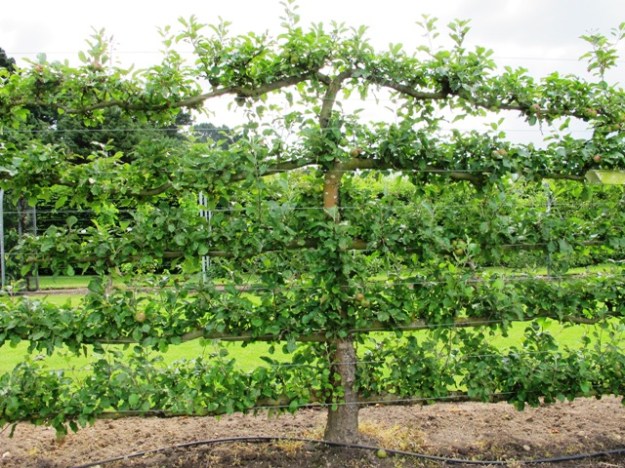 1. The freestanding horizontal espalier. You can see clearly the advantages of a two dimensional plant. Good air movement will reduce disease. It is easy to tend the plant and the fruit all receives equal sunlight. You can also see that the supports are heavy duty. This is not an exercise to be done with a few bamboo stakes and stockinette ties.
 2. The cube requires some heavy duty framing but is quite stylish, even if I was worried by the top branch that was trained back on itself. Using a frame which gently rusts as it ages will make it less visually intrusive than the tanalised pine we often favour in this country. It is the plant shape you want to emphasise, not the support structure. This design allows good air movement through the centre of the tree.

 3.The diamond row was visually the strongest in terms of pattern. I raised my eyebrows at the potential rubbing of bark where branches cross. Stem damage can let disease into the plant and a rule of thumb in all gardening is to avoid crossed branches. Presumably in an intensively maintained espalier, you are replacing the branches regularly with fresh growth so there is a bit of leeway if this is the look you want.
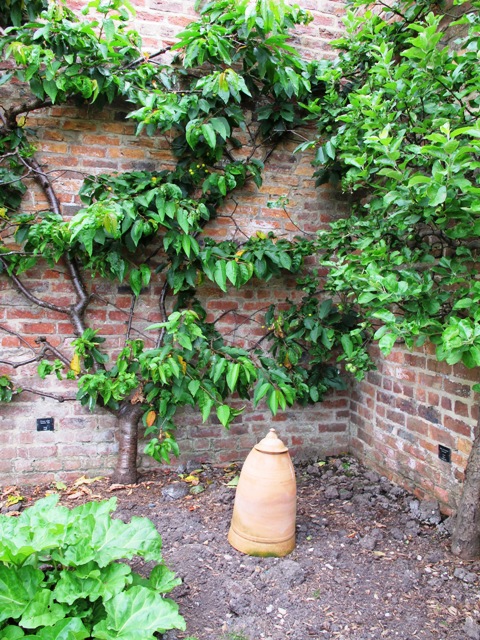 4. There is little doubt that your fan-shaped espalier will look better if you clad the fibrolite garage in old brick veneer and casually pose a stylish, vintage, terracotta forcing pot in front. The advantage of espaliering against a wall is the increase in heat for marginal crops. We don’t need to do it for apples and pears in this climate but I can see that it could work well for figs and some of the stone fruit.
 5. I have mentioned trendy stepovers before – the training of an espaliered fruit at knee level. This is a dry climate technique and where rains are light and misty. Our torrential downpours will cause rain splash and spread disease faster than you can blink. We need maximum air movement and to be above the splash line in our humid climate. That said, you can see disease in this example. I have yet to see one which remains at step-over height all growing season.
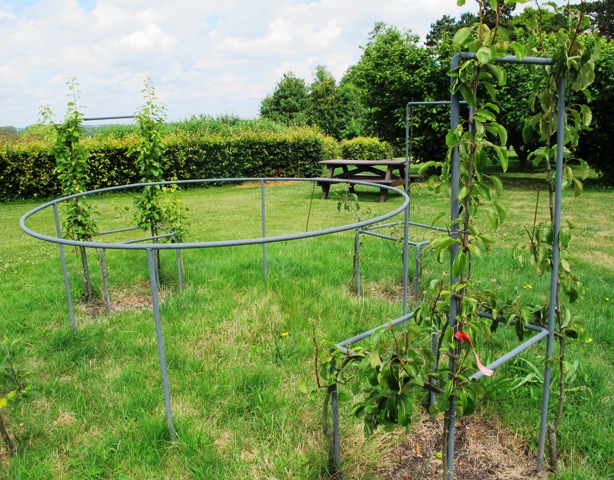 6. These table and chairs are obviously not yet established. I offer them as an idea without comment, secure in the knowledge that regular readers will know exactly what my personal opinion is likely to be. However, for those who like a little novelty in their garden, here be they. I even recorded some instructions for you.

First published in the Waikato Times and reprinted here with their permission.
Tag Archives: Tikorangi: The Jury garden
Petal carpets, the garden in September
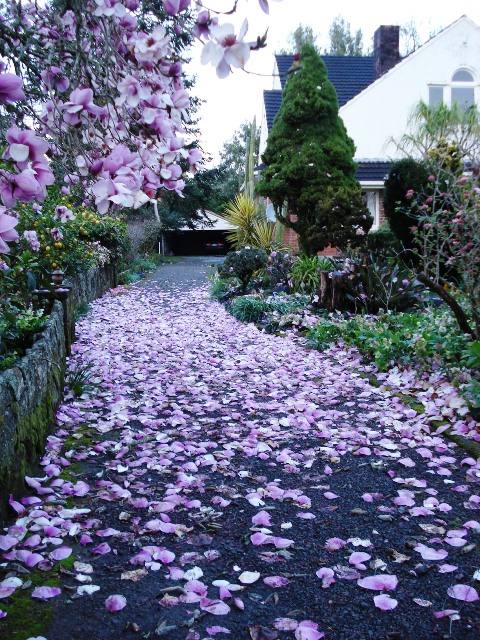
Petal carpets are a second delight
Petal carpets feature large for us. Spring storms may batter plants in bloom but with large trees, the strewn petals offer a second delight, albeit shorter-lived. These used to be more problematic before we discovered a bane of suburban life that is a boon for large gardens – the leaf blower. Once the petals start to discolour and decay, we blow them onto the garden beds where they can quickly rot away to nothing. There is nowhere near the nutritional compost value in fallen petals that there is in leaves, but they are part of the cycle of nature.

Magnolia Iolanthe
The big-leafed rhododendrons in our park are already passing over. They are showy but flower very early in the season and are vulnerable to frost. They are also difficult to propagate and take up a lot of space so you rarely find them offered for sale. If you are determined, raising them from seed is the best option for the patient gardener. Other rhododendrons are opening however and the season extends right through to Christmas.
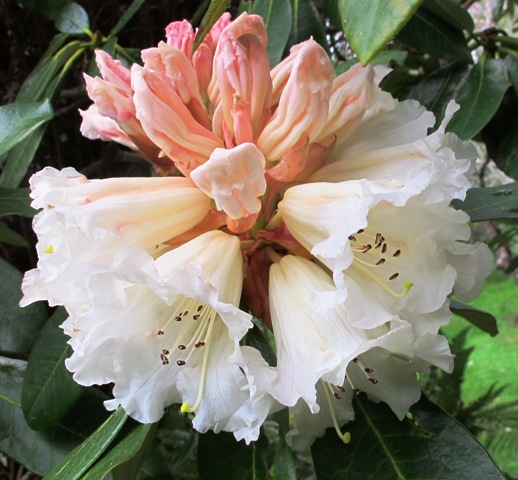
Rhododendron ‘Eyestopper’
I am madly digging, dividing and reorganising summer perennials. We returned from our trip to see English summer gardens inspired and energised. We were very focussed this time, wanting to see the contemporary gardens rather than the classics like Hidcote, Sissinghurst and Great Dixter. Gardening, after all, moves on and the Arts and Crafts garden style derives from the first decades of last century.
We haven’t heard much in this country about the New Perennials Movement, naturalistic gardening, the Sheffield School and prairie gardening but it has been as big a revolution in garden design and planting as the garden rooms of Arts and Crafts were in their day, or the cottage garden genre that followed. It is a whole lot more than just adding in grasses to perennial plantings, as some sniffily deride.
We were lucky to get into a few private gardens that are not open to the public and we looked at the work of some of the major designer-practioners – Piet Oudolf, Christopher Bradley Hole, Tom Stuart Smith and the late Henk Gerritsen, as well as lesser-known gardeners.
Our conditions are different so it will never work taking the lessons from another country and imposing them here. We need to use different plants in many cases (pampas grass is on our banned list and the lovely Stipa tenuissima is threatening to become a noxious weed according to the Weedbuster’s website). Our management also requires different strategies and some of the gardening practices we saw just won’t work here.
But the underpinning philosophy is relevant and many of the ideas are challenging our preconceived notions. We are serious about the move to more environmentally friendly gardening even though it will push the boundaries of what most New Zealand gardeners regard as acceptable in terms of tolerance for weeds. Our interests also lie in extending our spring flowering well through summer and into autumn and we can’t achieve this without managing perennials much better. No matter. We are inspired. And as gardeners, we take the longer term view.
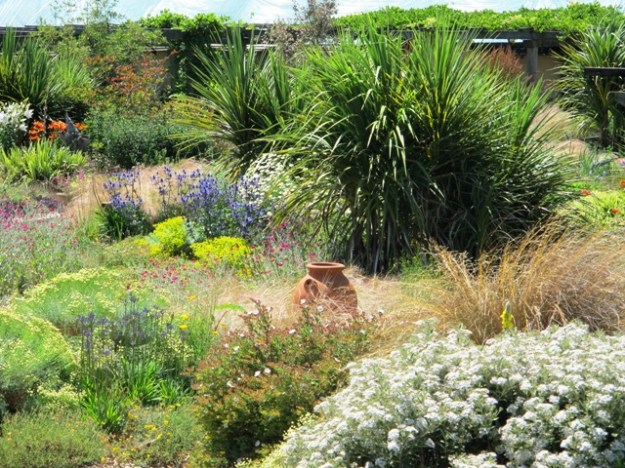
Wildside in North Devon was the one that excited us most
First published in the New Zeakland Gardener and reproduced here with their permission.
Points of interest
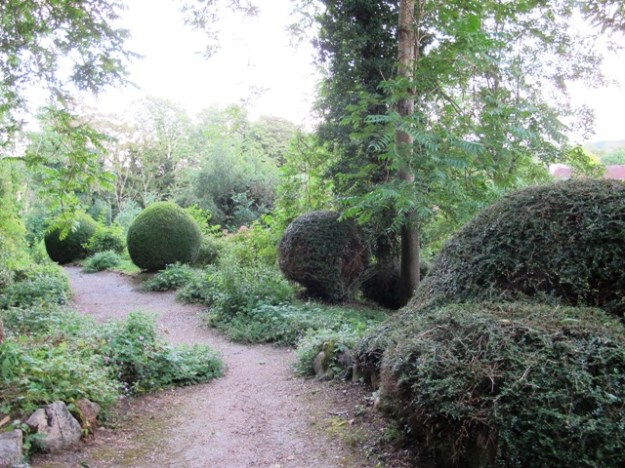
In an otherwise undistinguished garden in Giverny village, these clipped hummocks gave real impact.
Formal gardens will often have pretty much everything clipped. If you have ever been to many Italian gardens, you may have noted the inclination to clip everything – at times to within an inch of its life. It photographs well. In fact we have often found that the photograph can be better than the real thing when you get to see it.
The modern New Zealand garden is characterised by clipped hedging, often carried out with military precision whether 30cm or 200 cm high.
But if you don’t want a formal garden or clipped hedging, there is a middle path. Punctuation marks.

Clipped accent plants give form in this garden which has predominantly loose herbaceous plantings and grassy meadows. Pettifers near Stratford on Avon.
It is a technique that you can transfer to many situations. At its simplest level, a tightly clipped shrub gives a focal point of order in a casual or chaotic environment. If your garden looks an unkempt mess, try it. You may be surprised at how a formal shape can make the disorganised areas alongside look as if they are intentional.
A sequence of clipped punctuation points gives coherence or visual order to an otherwise disorganised space. Sometimes it is a deliberate design feature, other times it may be closer to an act of trickery by a laissez faire gardener.
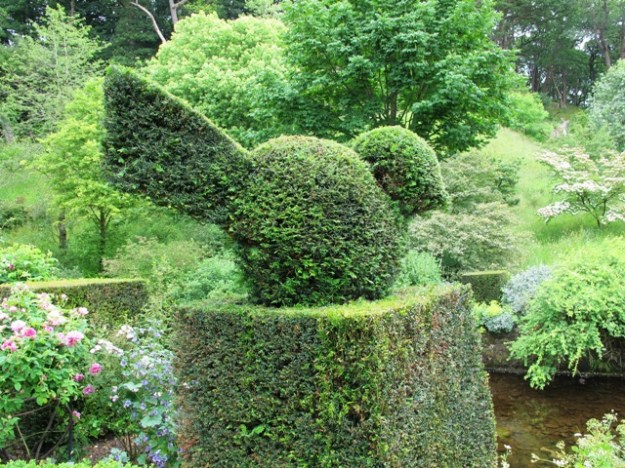
While the topiary bird at Gresgarth may be beyond the amateur, the sharp lines give contrast to the informal plantings and design.
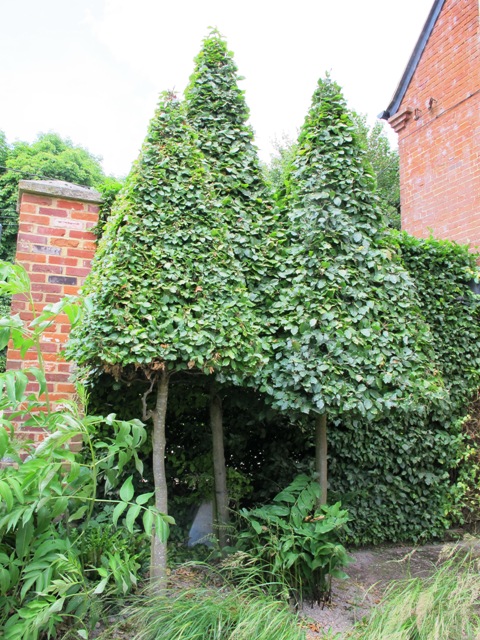
Pyramids on stilts give an accent point, a breathing space between two very different gardens at Bury Court.
I have also seen small groupings of clipped shrubs used as a breathing space, a quiet linking device between two very busy but different areas of a garden.
Various shrubs can be clipped effectively. There are the tried and true hedging plants of buxus, lonicera and teucrium. Yew is a classic clipping candidate.

Often referred to as “pudding trees”, these Chamaecyparis give structure in the otherwise informal cottage garden made by Margery Fish at East Lambrook Manor
Camellias clip well. If you can cope with the prickles, so do hollies. Choysia ternata takes clipping. Evergreen azaleas take clipping and shaping well. So indeed do our native totara and matai. Some conifers can be clipped, some cannot. The mark of one that does not take clipping is a failure to sprout afresh from bare wood (in other words, where you have cut below the external leaf cover). It can be terribly blotchy and twiggy on conifers, if not terminal. Do some research first before you try this on your prized specimen.
The more you clip, the denser the new growth becomes so the tighter shape you get as a result. But if you are considering a first hard clip to establish a shape, do it right now. This very weekend is good. That is because at the end of the day, most plants are on the cusp of breaking into fresh spring growth (spot my political allusion). The aim is to clip before that happens, stimulating the plant to make fresh new growths at the point where you have cut it back. You will generally have to follow up with a tidy-up trim of long new growths a bit further down the season, but the first clip is the most radical shaping. Once established, you can often get away with just once a year.
Or clip on special occasions when you want your garden to look sharp, cared for or creative.
First published in the Waikato Times and reprinted here with their permission.
Plant Collector: Magnolia Iolanthe

The inimitable Magnolia Iolanthe
I cannot let the season pass without celebrating magnolias. At this time of the year we live and breathe these flowering trees and the settled weather has meant a particularly good season this year. Not all of them get as large as this glorious specimen of ‘Iolanthe’. In this country, it is a lucky tree that is permitted to survive into its sixth decade without being unceremoniously severed from its roots.
Iolanthe was the product of Felix Jury’s first attempts to hybridise magnolias. He was looking for larger blooms with good colour. Certainly the bloom is still exceptional with its large cup and saucer form. The colour has been criticised for its lavender hue, but I can tell you that it remains spectacular. Because it sets flower buds down the stem, it has one of the longest season of any of our many magnolias here. Some only set buds on the tips where they all come out at once. As soon as they pass over – or if they are hit by strong wind, heavy rain or frost – that is it for the year as far as floral display goes. Not so with Iolanthe. Twice we have seen the display turned to mush by extraordinary frost events but a few days later, a fresh flush of blooms has opened and the display is back. From first to last spring bloom, we get about two months of flowering, of which maybe three weeks is full glory. It repeat flowers in summer, though as the tree is then in full leaf, it is nowhere near as showy or prolific – more a bonus than a mainstay.
Iolanthe and Serene are the only plants for which Felix ever received external payment. We recall this because it was in our early married days when we were impoverished students. He gave the fee of a couple of hundred dollars to Mark. It was not the sort of event one ever forgets.

First published in the Waikato Times and reprinted here with their permission.
Garden Lore
A garden is a delight to the eye, and a solace to the soul; it soothes angry passions, and produces that pleasure which is a foretaste of Paradise.
Gulistān (The Rose Garden) by Sa’ Di (1258)
More on narcissi
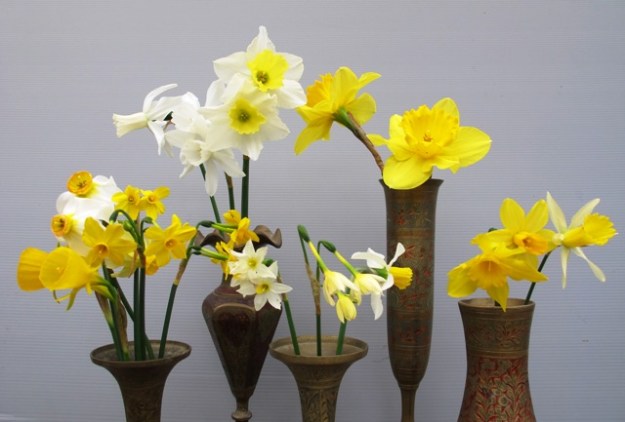
It was a full month ago that I wrote about daffodils and showed those varieties that were in bloom at the time. In peak bloom, in fact. We had hosts of golden daffodils in flower. We still have. I headed out to gather samples of the varieties currently blooming.
In the vase on front left, we have the three showiest for this time of the season – the bright yellow cups of Narcissus bulbocodium, Narcissus ‘Beryl’ and a dainty little N. jonquilla species which, despite its diminutive size, packs a powerful perfume.
In the centre front vase is a named dwarf variety which we have lost the name of. Mark thought it might be Narcissus ‘Snipe’ (who calls a dainty daff ‘Snipe’?) but the clever internet shows me that the one on the right is more likely to be. The lemon one in the middle is Narcissus ‘Hawera’ which is not growing as strongly as some of the other varieties for us. On the right we have the last blooms of Narcissi x odorus, ‘Tete a Tete’ and ‘Twilight’ – all featured a month ago and only now finishing. These are ones I mentioned don’t set seed. This is why they have such a long flowering season.
In the vases at the back, they will be named varieties on the left but we don’t have their names any longer though one is probably ‘Thalia’. I quite like the white daffodils. To the right, the classic King Alfred type is at its peak for us.
If you love narcissi, you can extend the season past two months by growing a range of different varieties.
First published in the Waikato Times and reprinted here with their permission.

