Tag Archives: Tikorangi: The Jury garden

Let there be light

Part 1: Gaudi and the Sagrada Familia

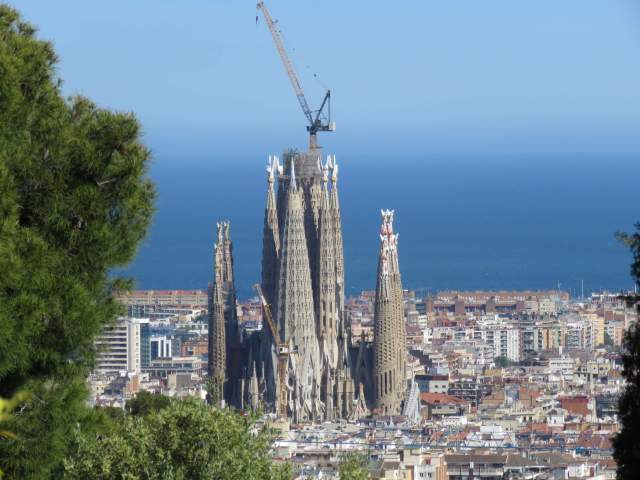
It is hard to grasp the scale of the Sagrada Familia when beside or inside it. Here it is as seen in the distance from Park Güell

I had never been to Barcelona before landing there on my May trip. My few days in Barcelona turned in to a crash course on Gaudi and I loved every minute of it. I wanted to see the Sagrada Familia, having heard so many others speak of it. To that, my daughter added Park Güell and Casa Batlló and I knew absolutely nothing at all about them before I visited. Clearly I did not do a lot of research in advance and this may not be a bad thing because it meant I had no expectations at all. And verily, I was amazed.

I knew the Sagrada Familia had been under construction for quite some time but I thought I had read that it had finally been completed. It hasn’t been completed yet and that shouldn’t surprise us. Many of the major churches and cathedrals from times past took a century or more to build and even then had more additions in subsequent centuries. The Sagrada Familia is technically designated a basilica by papal decree, not a cathedral, and construction has been ongoing since it was started in 1882.

Even the ceilings are remarkable with their detail
and the cloisters

I checked and it seems that it is scheduled for completion in 2026 but I think that might just be the towers and, with six still to go, I wouldn’t bank on that date. The planned main entrance and additional decoration and sculptures will see work continuing well into the 2030s. The scaffolding, cranes and protective shields will likely remain in place for a while longer yet.

No matter. What has been completed is astounding and takes quite a bit to visually absorb. The sheer scale is impressive as is the detail and complexity. I am sure that any readers who have seen it will agree that it is quite simply an extraordinary building.

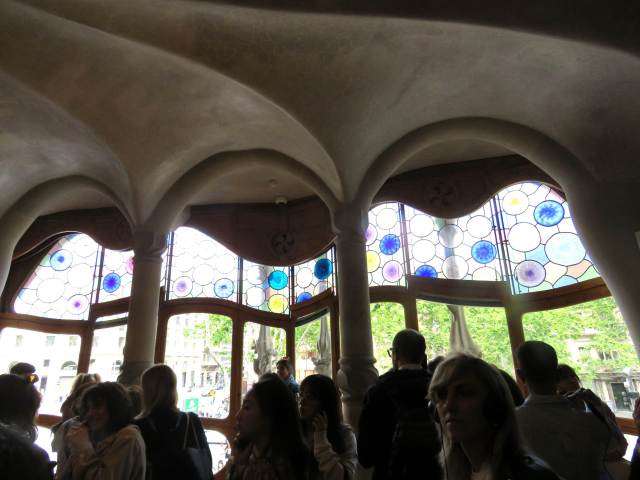
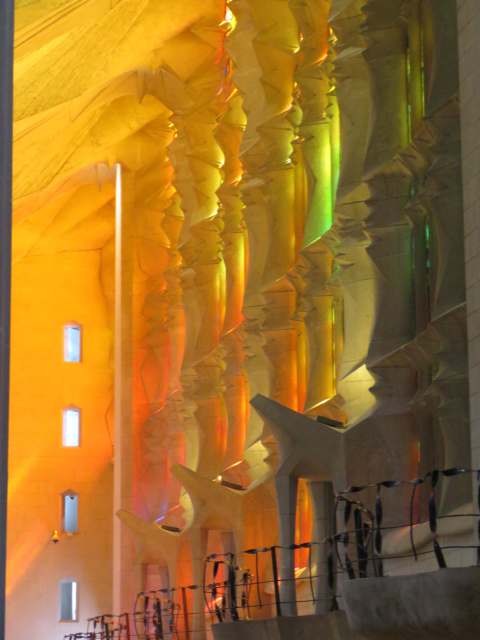
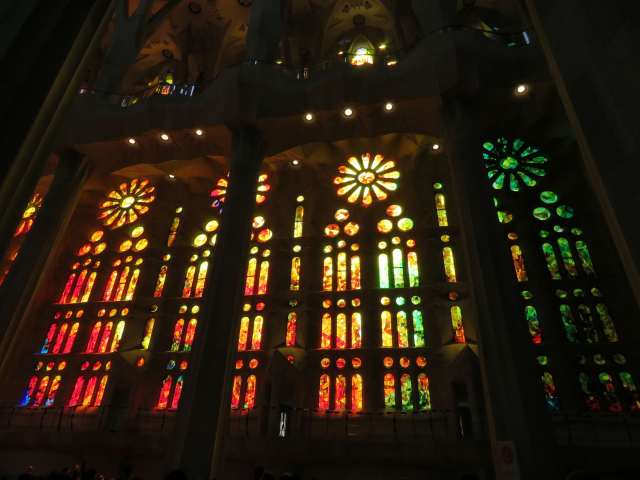
Flooded with late afternoon light

The stained glass is certainly impressive and varies from traditional to contemporary and the colour palette changes for different walls.  But it was the interplay of architecture and afternoon light that simply took my breath away. Much of the Sagrada is impressive, interesting, curious, even odd at times but the light – the light was an emotional experience for me.

Antoni Gaudi was an architect but his skills and creativity went well beyond the designing of buildings. While hailed as the leading practitioner of the style now termed ‘Catalan Modernism’, I think his work is so individual, varied and unique that it probably warrants its own category as simply ‘Gaudi’. The Sagrada is described as a meeting between gothic style and Art Nouveau. I would add Arts and Crafts into the mix, too.

Above the entry on the first side of the basilica to be completed
And the more recent entry completed on the opposite side

I found the contrast in styles between the entrance that was completed first in a more traditional style and the cubist approach to the more recent entrance on the other side very odd. From what I read on line, considerable effort is being made to keep to Gaudi’s vision so he must have left some records to hint at the blocky, Cubist style of ornamentation and religious imagery.

And then there is the very odd whimsy of the coloured fruit on top of the gables.

To be honest, I am just not sure what was in the architect’s mind just here

The Sagrada Familia remains the magnus opus of Gaudi but was by no means his only work. More on the grandeur, the detail, the mastery of light, the whimsy and, dare I say it, the occasional descent into kitsch in the next part on  Park Güell.

Grave matters

I am back again. Not quite firing on all cylinders yet but getting there. Back again from where, you may or may not wonder – Barcelona and the south of France. Alas, in Nice Covid finally tracked me down after I had managed to avoid it for a full four years. Fortunately, it has been a fairly mild case for which I give credit to my many vaccinations and boosters but I do not recommend flying long haul when still in recovery. It did rather set me back.

Fortunately, the unwanted Covid experience was towards the end of my trip so I managed to pack in plenty before being forced into isolation. I need to gather my thoughts on the larger topics but thought I would start with a minor diversion into graveyards. I have never taken a great deal of interest in graveyards generally, although I have written often enough about the pretty flower combinations in Te Henui Cemetery in New Plymouth.Te Henui has set a high standard for graveyards in general.

Space saving in Barcelona

It was entirely by accident that daughter and I stumbled upon the space-saver approach of a cemetery in Barcelona. I don’t know how the logistics work of fitting several members and generations of the same family into one of these coffin-sized stacked compartments. Some of the stacks were seven stories high which must give some challenges when it comes to opening the entrance to add another deceased. Are they maybe just adding ashes in urns?

A modern approach to space saving across the border in the south of France

I found the modern version of the grave condominium in a small French graveyard in Montesquieu-des-Albères, the village closest to where my daughter is living for this year. These were three high, two deep and fully coffin-sized but clearly modern so not yet accommodating generations of the same family.

This burial technique may be utilitarian and lacking aesthetics but I can certainly see the practicality of it in terms of saving space while still enabling some sense of a permanent memorial. I had never really thought about the nature of graveyards before – that a one-off payment can secure a single plot that then becomes a permanent – sacred, even – installation where any maintenance becomes the responsibility of some other body to care for and respect the deceased down the decades and centuries. It is a curious concept, when you think about it. Over time, graveyards can take up a lot of space if they are predominantly one individual per plot.

Family tombs in Montesquieu-des-Albères

In death as in life, graveyard real estate can make differing social and economic status crystal clear. We have not generally gone for the family tombs in Aotearoa New Zealand. The French seem to be quite big on tombs and they do make a statement on the standing of la famille.

These graves, memorials and tombs in Montesquieu surround a church whose oldest parts date back to (wait for it) 1123.

I photographed the only pretty part of this cemetery. Overall, it could not hold a candle to our Te Henui one for plantings and beautification. Death can be a very austere experience.

When it comes to tombs and memorials, this one to the Hanbury Family in La Mortola, a botanical garden just across the Italian border from Nice, set a high standard for aesthetics and grace. I felt we might have sold Mark’s parents short. Both were cremated, in accordance with their wishes, and we brought their ashes back to the garden here that they created. It seemed entirely appropriate at the time. It is only when I saw this Hanbury memorial – which, if my memory serves me right, may house some of the family ashes – that gave me pause to ponder whether we should have done more. But I think it would have looked somewhat ostentatious and out of place in our garden.

Not the Chagall grave in the cemetery of St Paul de Vence but a good example of the preference for fake flowers and fake plants

I walked to the village cemetery at the end of the hilltop village of St Paul de Vence, drawn to see the grave of Marc Chagall who spent some time living there at the end of his life.

The graveyard chapel recorded that it was first mentioned back in 1356 so probably not quite as old as the church in Montesquieu.

I did find one grave that was adorned with living, flowering plants but it was unusual. The families of St Paul de Vence favour the longevity of fake blooms.

Back on tombs, I am not sure that there is much that is bleaker than a long disused family tomb. The Famille Lambert and Famille Flour appeared to have fallen into oblivion which was somewhat poignant to see.

The grave of Marc Chagall and family

The grave of Marc Chagall, however, has a casual but vibrant energy to it that belies his death in 1985. It also accommodates his second wife, Vava Chagall and a third person clearly attached to Vava because he bears her maiden name. If you look at Chagall’s lifetime of work, the grave seems all the more appropriate. It is clear that it is tended regularly to this day but I am not sure about the fake pink rose.

Autumn delight

The rockery plantings are complex and varied but that is what makes it all the more interesting to us

I am not quite gone yet; on Wednesday I start the long haul over to Barcelona and then the south of France.  In the meantime, the rockery has been bringing me much pleasure. If I ever have to downsize both house and garden, I might be tempted to turn any new, smaller garden into rockery.  Rockeries lend themselves to highly detailed, high-interest level gardening and I can see I could be quite happy pottering in a rockery – as indeed was Mark’s dad, Felix, in his later years. It is a particularly absorbing area to garden, even if there are times I regard it as the gardening equivalent of micro-surgery.

There was quite a bit of excavation and construction that went into our rockery, especially given it was a blank canvas and largely flat to start with.

Ours is a raised rockery with different levels so it has detail in its design, not just in its plantings. Mark’s mother always used the plural ‘we’ when she talked about building the rockery, but we think it more likely that she designed it and then supervised Felix in its construction, which included some excavation to achieve different levels. Every original garden structure here was done by hand or, on occasion maybe, using horse power. Felix did not have a tractor or access to any of the machinery we can call on these days.

As our rockery measures some 20 metres by 10 metres, it is not small and it is certainly not low maintenance. Because it is largely raised beds and pockets of soil for separate plantings, it dries out and heats up in summer. Our frequent heavy rains drain quickly but that also leaches a lot of the nutrients out of the soil in the process. Bulbs generally need excellent drainage and many thrive in poor soil so they are quite happy in this environment. We try to get around with a thin layer of compost every spring and when I excavate a pocket to sort out its contents, I will add compost when I replant. But the soil overall is pretty impoverished and generally lifeless in the summer heat. There are almost no earthworms in summer but they seem to return as temperatures cool.

Rockeries are traditionally a re-creation of rocky mountain slopes to grow alpines. We can’t grow alpines here where our conditions and climate are anything but alpine. Our rockery basically consists of elderly dwarf conifers of considerable character and a few cycads giving all year round structure, offering some shadier areas beneath for bulbs of many descriptions. Smaller bulbs and many species rather than bigger hybrids which look out of scale, with one notable exception.

Nerine sarniensis hybrids

That exception is the Nerine sarniensis hybrids, most of which were bred and selected here although we have a few of the early Exbury ones and some of the species nerines. They are sensational at this time of the year. Along with Cyclamen hederafolium and the ornamental oxalis, they keep the autumn rockery full of blooms and colour.

Not all oxalis are equal. Some are much more floriferous and better behaved than others. This is O, luteola and it makes an excellent garden plant,

Last year, Zach reassembled the oxalis collection. Years ago, I planted them all out because I didn’t want to be repotting them every year and he set about retrieving some of each. We had only lost one or two inbetween times and he now has over 30 varieties in pots – most from the garden and a few extras he has picked up from local markets.

It is hard to fault Oxalis purpurea alba with its long flowering season, mass blooming and non-invasive ways.

A much maligned genus, the oxalis shine at this time of the year. We are only a few months off the short snowdrop season and the start of the dwarf narcissi and lachenalias. There is always something of interest going on in the rockery and it is constantly changing as different bulbs and plants take their time to shine. Always, Mark and I remember Christopher Lloyd saying in conversation on a TV programme, “I think you will find high maintenance is a great deal more interesting.” We could not agree more.

Reflections and plans (with unrelated photos)

Mahonia. Which one we don’t know. Neither of us has ever been interested enough to look into the different mahonias but this one does put on a good display in autumn and is alive with the hum of bees.

I had cause recently to look up how many years I spent writing weekly for newspapers. EIGHTEEN YEARS, first for Taranaki Daily News, then adding the Wanganui Chronicle and finally the Waikato Times.  You could knock me down with a feather. It is so long ago that I started by faxing my articles to the paper. There are children alive now who don’t even know what a fax machine was and how magical it was for its brief office reign. No wonder I have such a big back catalogue of writings because on top of the newspaper contracts, there were shorter stints with magazines.

More of the mahonia

The high point was probably when a survey conducted by one of the newspapers had readership of the garden pages (where I was the main contributor) ranking higher than the sports pages. You would never guess that by the current invisibility of gardening in the media and the amount of space and time still given to sports coverage. But times change.

There are times, I admit, when I feel I have nothing left to say that I have not written before and I wonder what I can photograph that I have not shown before. Quite a large part of that is the result of our personal world becoming so much smaller. I have always relied on seeing gardens that are new to us, new landscapes, talking to more people for the stimulation of new perspectives. The last time we did a major trip overseas – I don’t count Australia as overseas – was 2017. Covid saw us cancel our 2020 plans.

Self-sown Moraea polystachya just out from the back door. it is probably the longest flowering of any of the autumn bulbs and belongs in the iris family

I am flying off to the south of France in ten days time, via Barcelona as the closest airport to where our second daughter, her partner and their beautiful baby live across the border. I think it may be my last long-haul trip in the face of an uncertain future with climate change and geopolitical upheaval. I haven’t been to that northern corner of Spain or any of the south of France so I expect to be invigorated with new sights and experiences. We have scheduled Gaudi’s Park Güell for the day after I arrive.

The rockery is bursting with colour as it hits its autumn peak.

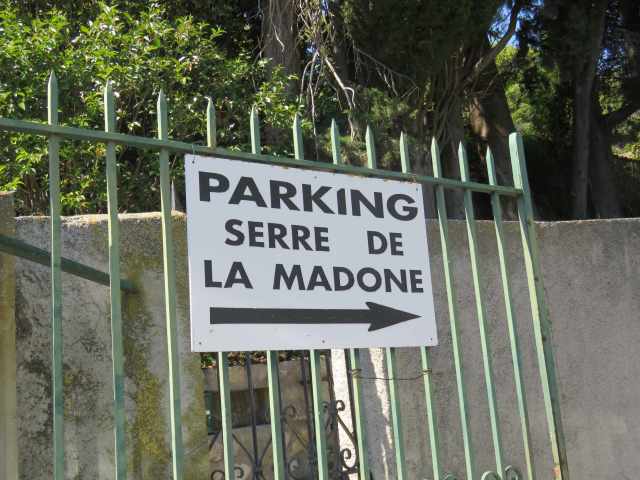
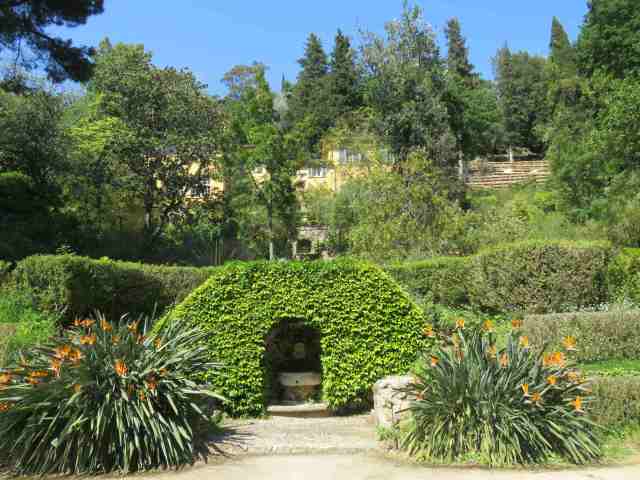
In the middle of my trip, I am heading east, to what used to be known as the French Riviera. There I am joining a six day tour of the gardens in the area around Nice, starting with Lawrence Johnson’s indulgence called Serre de la Madone. Johnson is most famous for creating the garden at Hidcote Manor, which which just blew our minds when we first saw it, back in 2009 I think. At the time it was, quite simply, everything we aspired to with our own garden. In the years since, our directions have changed and I doubt that we would respond so intensely now but I have always wanted to see his French garden which is, I believe, very different to his English one.

I expect to return stimulated and inspired from seeing these largely classical French gardens with forays to Monte Carlo and across the border to Italy. Crossing borders in Europe never fails to delight me, as a New Zealander whose nearest neighbour is a minimum 3 hour flight away. I am anxiously watching the situation in the Middle East and the flooding in Dubai because I am flying that way. For overseas readers, to get to Europe or the UK from here involves two long-haul legs. We can do it via USA or Asia with with two flights of 12 hours each, give or take. Or we fly via Dubai or Doha and that starts with a non-stop 17 hour flight from Auckland, followed by a shorter second leg. That 17 hour flight is quite a lot … a lot of something, probably endurance.

Back to more local concerns: this path of pavers marks a degree of resignation to the inevitable. Ralph had established a speed track across the bed – the shortest distance out to the carpark. After all, he needs to respond quickly to any vehicle or strange voices because, you understand, he is never sure whether it is a maniacal axe-wielding man intent on doing harm or the lovely electricity meter reader who feeds him dog biscuits. Speed is of the essence.

I debated about trying to block him off but he would jump any barrier up to a metre high and the potential for injuring himself on bamboo stakes is pretty high. I think we can conclude Ralph won that round.

A dwarf crabapple in the rockery . Its name is lost in the mists of time but in all the decades it has been there, it is still only a metre and a half in height.

“You’ve got mail”

Two interactions this week brought me unexpected pleasure.

The first was an email from Michael in Portland and I was so touched by his words I asked his permission to share it here. I post it without comment except to say that the ‘Dark Tulip’ Magnolia he refers to is of course our Magnolia ‘Black Tulip’.

Magnolia Black Tulip ihere

Hello! 

This is a bit of story, but I want to express how grateful I am for your Dark Tulip Magnolia. 

I grew up in Mississippi, which is in the southern part of the United States and southern magnolia is the state flower. When I was about five years old my father took me to a garden center where we bought a small southern magnolia. He told me that was “my” tree. I loved that tree and it became a symbol of my childhood and my relationship with my dad. I’m in my late 30’s now and I live in Oregon, which is +2,000 miles from Mississippi. I rarely go back to Mississippi, but when I do I always drive by that house to sit at look at that giant magnolia from my car. My dad died unexpectedly almost two years ago and magnolias are still very much connected to him in my mind. 

I’ve always wanted a magnolia of my own, but I’ve been living in apartments my entire adult life. This winter, I finally moved into a house with a (small) yard. I knew I wanted to plant a magnolia even if I had to grow it in a pot (for now). I went to a nursery here in Portland and the moment I saw your Dark Tulip Magnolia, my heart jumped! The blossoms stopped me in my tracks. The flowers immediately sent me back to so many childhood memories, to memories of my father planting our tree. But yet this magnolia is… an evolution of something… the unbelievably deep and soul moving burgundy is stunning! It’s hard to express, but your Dark Tulip Magnolia has become a symbol of growth after loss, of moving forward, of change. It’s deeply poignant to me. 

I purchased my first tree of my adult life: your Dark Tulip Magnolia. I have it in a very large container, which I know is not ideal, but it is the best I can do for a few years. I am determined to learn everything I can and do my best to help it thrive. This living art you’ve created has played a role in healing my heart and in my life story. It is the most beautiful tree I have ever seen. 

Michael’s plant

I know the Dark Tulip Magnolia has been around for years, but it is new to me and I’ve been reading everything I can find about how to keep it healthy. I want you to know that your work has created profound meaning in my life. I am so grateful for the years of work you’ve put into creating such beautiful trees. 

Thank you for the beauty you’ve contributed to the world and to my life. 

Michael

Magnolia Black Tulip – the first magnolia of Mark’s breeding that he named and released

It is always rewarding when people derive pleasure from plants bred here by Mark and Felix before him. When one touches somebody in a deep emotional, almost spiritual way, that is next level altogether.

The rare delight of a hand written postcard

The second  treat this week was when the mailbox delivered up the rare specimen of a handwritten postcard. In a week when NZ Post announced the demise of posties, to be replaced by courier drivers, a handwritten card seemed especially poignant. It was a letter of appreciation from a reader of this site. The bit that made me laugh out loud was: “But I really had to say a big thankyou for ‘sad beige’!!!! So funny (and sad!)”

I read that bit out loud to Zach as he came into work that morning and he snorted in delight. It was he who gifted me ‘sad beige’ as in here , here, and here.

Appreciative comments from readers are always treasured but readers who share my sense of humour are gold.

Back in the days when people still bought and read newspapers, I used to get more feedback on the garden pages I wrote from 1997 through to 2015. I just looked up those dates and I am stunned I kept it up for 18 years. Mark used to call the incoming mail my ‘fan mail’. I kept the special ones and I shall add the postcard and the email to that file. I am a bit sorry I can’t store the phone calls I used to receive from elderly gents wanting to discuss growing potatoes. This was in the days of landlines and phone books, you understand, a time when there were quite a few elderly gentlemen wanting to discuss potatoes. Never having grown a potato in my life, I would hand those calls over to Mark who was far better equipped on the topic. They were oddly charming, in a niche sort of way.

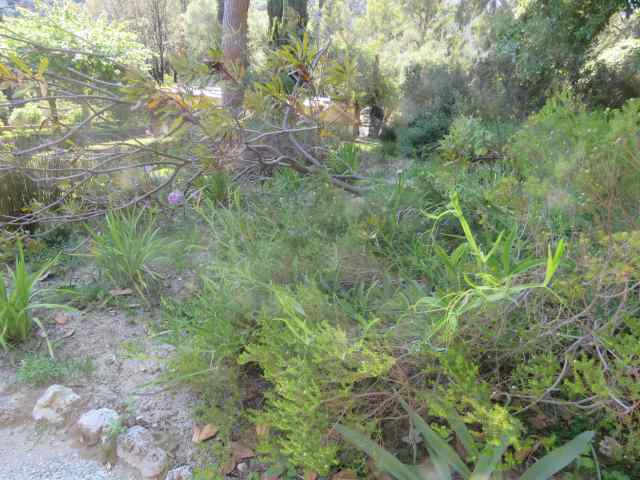
Early autumn in the Wild North Garden