Tag Archives: Tikorangi: The Jury garden

Spring has sprung

Spring has sprung

The grass has riz

I wonder where the boides is.

I had to do a little search on that bit of doggerel from my childhood and it appears there are multiple versions – although this one is the most common – and it may or may not have originated from Ogden Nash. But here we are; spring has indeed sprung. A visiting friend last weekend got out of his car and stood, momentarily transfixed by all the bird song he could hear so that was a nice way to start a visit. We don’t need to wonder where the boides are because they are here.

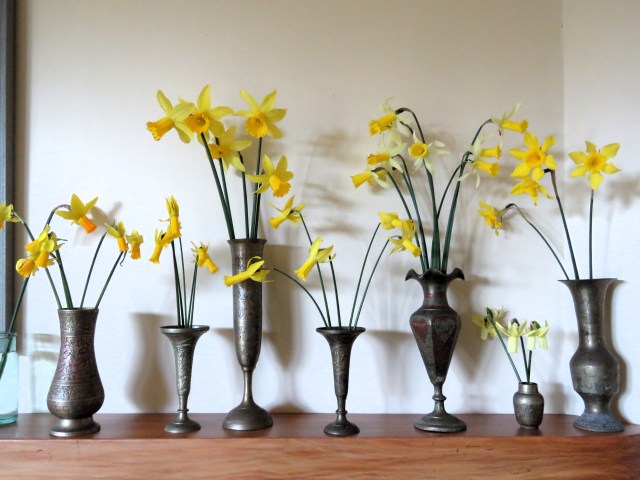
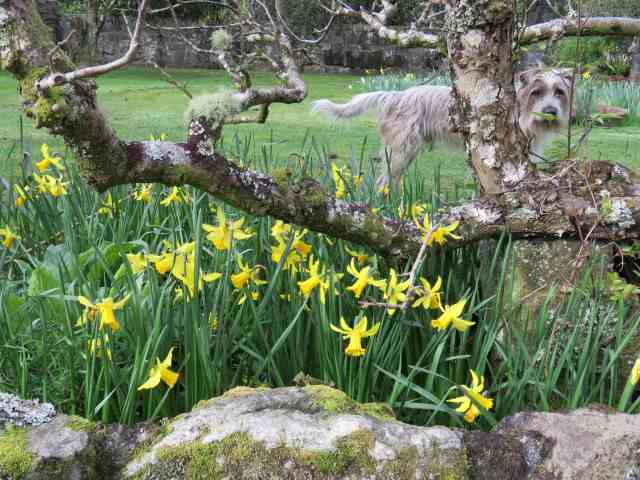
With Daffodil Day officially scheduled for the last day of winter next Thursday, all I have to offer today is a host of golden narcissi, that your heart, like William Wordsworth’s, may fill with pleasure and dance with the daffodils.

Ralph is no respecter of the garden but he does add a certain ambience to the ‘Peeping Toms’ beneath the old apple tree.

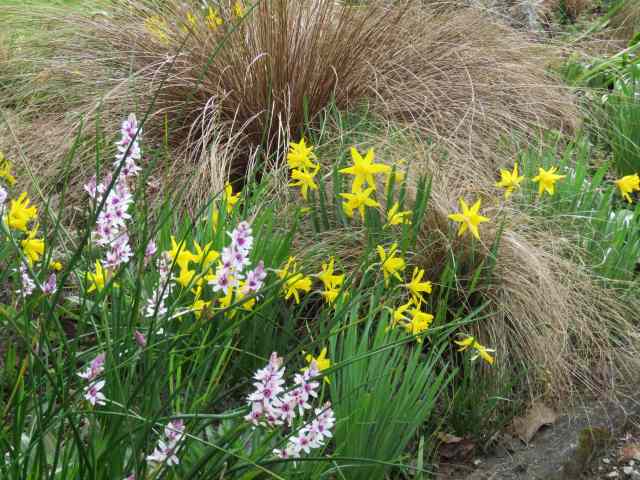
I see the pink and white Onixotis triquetra has been reclassified by some as a wurmbea but I am not sure I can cope with that; it is seen here with cyclamineus hybrids and our native brown carex grasses. We favour the early flowering dwarf narcissi and those within the cyclamineus group are hands down the best performers in our climate.

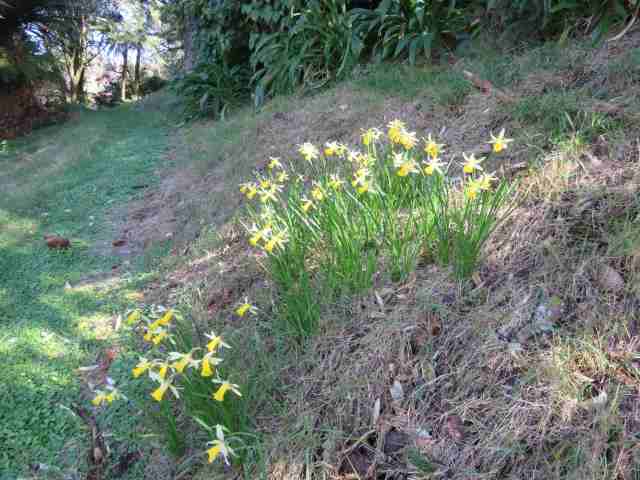
While we have many narcissi in more cultivated areas of the garden, it is the clumps that have naturalised well on the grassy banks of the park that make our hearts sing the most. There is something magical about seeing bulbs naturalised in more casual settings. This one is ‘Twilight’, a most successful cultivar bred by Mark’s dad, Felix Jury.

We favour early flowering varieties because they are pretty much over and dying down before the narcissi fly is at its most active. And we opt for the dwarfer types because we like their more delicate, somewhat refined appearance and they generally hold their heads up better. The larger the flower, the heavier it is and they are much more vulnerable to being beaten down by early spring storms.

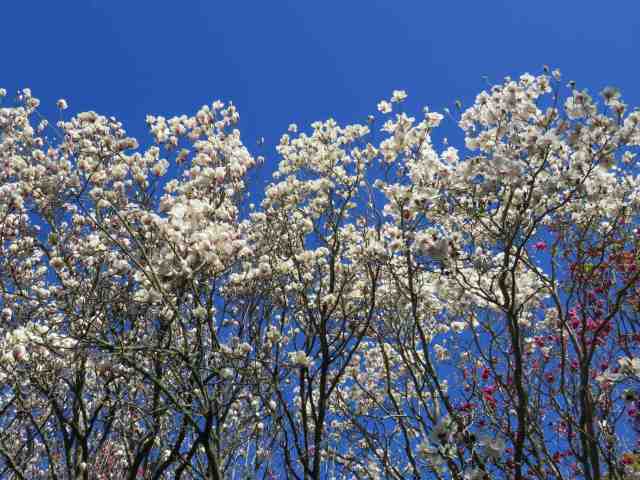
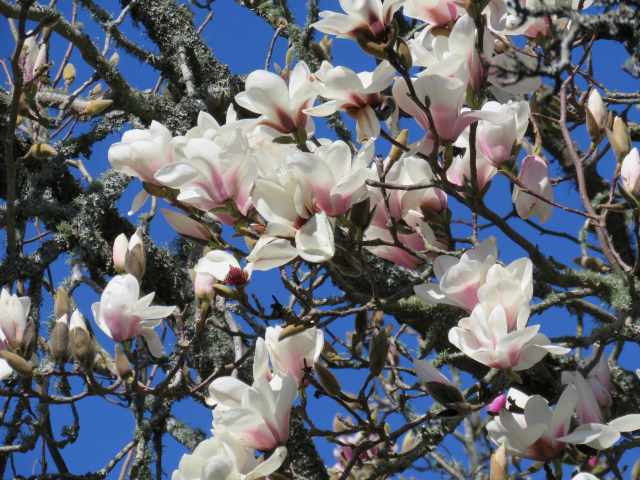
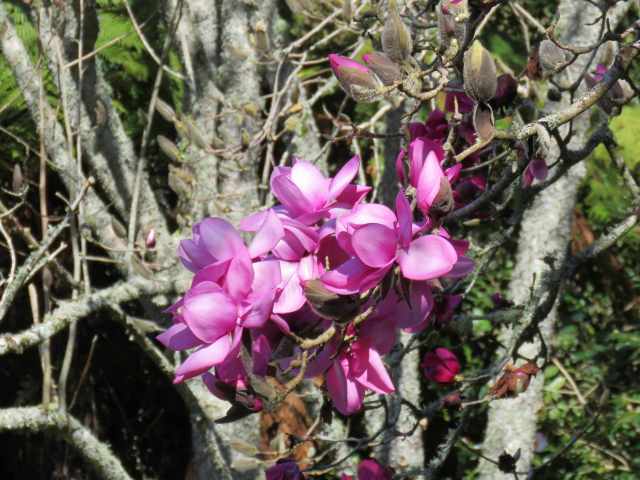
The snowdrops are all but over, the magnolias are not yet peaking. This week belongs to the golden narcissi.

Found! Maybe the worst plants of the year.

I found one of the worst plants I have seen a long time in a Sydney garden centre. Vile, just vile. Variegated bougainvillea. ‘Novelty plants’ say I, sniffily.

The plant retail market has always had a penchant for novelty plants. I am guessing many customers cry, “Oh that is unusual! I must have that!” They are the plants that tend to be one season wonders in retail, although sometimes you may come across a survivor in a garden. Too many of them are variegated forms of a perfectly good original and most of these variegations are chance discoveries rather than the result of a controlled breeding programme. To this day I remember a nasty variegated oleander in Spain – yellow and green foliage with flowers that may have been kindly described as Paris pink when contrasted with dark green foliage but just looked dirty pink against the yellow foliage. There was a new spirea everywhere in the UK on one trip maybe 15 years ago, sporting the same unattractive colour combination. It clearly made a strong impression on me at the time because I have never forgotten how unappealing it was. Similarly, I still rate the Rhododendron ‘President Roosevelt’ as the most hideous rhododendron I have ever seen and we used to specialise in rhododendrons in the nursery.

Judging by the extra rows of the white one, Australian gardeners are as enamoured with white flowers as New Zealand gardeners. In this case, I think that is a mistake.

Gardeners in climates with lower light levels are a great deal more enamoured with variegated plants than we are here because they can light up a bleak scene and add colour. In our bright light, those variegations burn readily, unless they are in deep shade and a green and white (or yellow) leafy plant with brown edges and splotches is not attractive at all.

Not just vile, in my opinion, but insipid too, in white. And my money is on those white bracts burning in the Antipodean sunshine.

I am unconvinced anyone needs these variegated bougainvillea and I am pretty sure Australian gardeners will have as many problems with sunburned variegations as we do here in Aotearoa NZ. They have similar clarity of light and very bright sunshine. Mind you, I did a quick search on variegated bougainvillea and I see they are not uncommon and attract some fans around the world with selections which are considerably more awful than these.

I am fond of bougainvilleas but they are not a good long-term option for the faint-hearted. Our one specimen is huge and showy but r a m p a n t. It needs drastic action to restrain it once a year and this is a job that I am glad Zach has taken over because the many thorns are very sharp. Fortunately, it decays quickly so we can prune and thin, stacking the lengths at its base and they rot down to very little over the following year. Ours is so old that it largely holds itself up so at least we don’t need to tie it to a frame.

Bougainvilliea in Xishuangbanna in southern China
And in Sermoneta in Italy

I like to photograph bougainvilleas around the world because, like jacarandas and poinsettias, they seem to be a universally popular plant in areas where they can be grown. I still think the cerise one we have and the red are the showiest and cleanest. I first saw a pale orange-yellow form in Greece – popular on the isle of Kalymnos from memory, but I can’t find photos of it in my files. I wasn’t sure I liked it much; it looked a bit insipid. We saw triple-grafted plants in a nursery in Bali – three colours on one root-stock and they were an interesting novelty for container growing. I had forgotten it came in white as well until I saw it in the Sydney garden centre last month and all I can think is that yes, it is possible to take a spectacularly showy plant and turn it into the most insipid option of all!

Those variegated bougainvillea are unlikely to ever be as charming as this one, also in Sermoneta.
and in Fiumucino near Rome airport.
Golden in Melbourne, though it might ensnare passing pedestrians.

‘Doing the broms’

I have been ‘doing the broms’, as we say here. That is the once-a-year thorough workover in the Rimu Avenue. We have complex subtropical woodland planting throughout this area, but in square metreage terms, bromeliads are the dominant plant. This always brings back the memory of the rude old biddy who got into the garden for free on account of being brought here by a neighbour up the road. “I loathe bromeliads,” she declared as she stood in the middle of the Rimu Avenue. “Well you won’t like this part of the garden then,” I replied crisply, getting out of their company as fast as I could. When it comes to insults, I am like an elephant – I never forget.

More a symphony of texture and form than bright colour for much of the year
It is not entirely bereft of bright colour. The Hippeastum aulicum are glorious at this time of year and clivias in yellow, orange and red will follow

This avenue has long been one of our most admired areas. First started in the late 1950s, by Mark’s dad, Felix and then doubled in length 40 years later by Mark, it is probably unique in terms of an interesting, remarkably sustainable and low maintenance woodland garden adapted to our climate. Because it is completely frost-free, we can grow true subtropicals beneath the towering canopy of rimu trees (Dacrydium cupressinum) which are now over 150 years old. All up, it is an area somewhere over 2500 square metres, maybe even near 3000.

The Rimu Avenue is roughly 100 metres in length and variable in width

It is undemanding in terms of maintenance. During the year, we will remove dead branches and larger debris that falls from above. It is largely free of weeds, being in shade and having been gardened for so many years, although we are forever removing seedling prunus, nikau palms and wretched bangalow palms. Since we cut down the seeding bangalow (Archontophoenix cunninghamiana), the incidence of those seedlings will phase out in a few years.

We like a highly detailed garden and, while this area may be low maintenance by our standards, it remains diverse and detailed.

Once a year, I start at one end and work my way to the other end, picking over every plant. Yes, it is a big job and it takes about two weeks of intense labour but the difference is rewarding and it is not heavy work. When I say two weeks, it is probably 60 hours which represents just over an hour a week across the year to maintain a major area of garden. I admit that does not include Zachs’s time as he works along the margins or Lloyd’s time removing my mountains of debris. So maybe this annual exercise equates to an average of two hours a week, except we do it in one hit.

Lloyd must have dealt with about 20 times this volume so far. it is a prodigious amount.

When I say mountains of debris, I mean that Lloyd is removing about two packed wool bales a day of my prunings. We used to dump it in our bush across the road to rot down in its own time but this year, Lloyd has been putting it through the mulcher and then using it in compost which is more labour intensive, but we get to use the end result. You can never have too much weed-free compost.

Before
and after

It is the bromeliads that generate most of the waste. Almost every bromeliad only flowers once and then the centre dies off – although the dying process can take more than a year or even three. While this is happening, the plant puts new shoots or pups out from the base of the old crown, or adjacent to it, and it is those new growths that will flower in the future. You can leave them to their own devices and the oldest parts will eventually die, dry and become dislodged but the clumps can get very congested and messy. I go through and remove the crowns that flowered last year.

Before
and after

The strategy to removing them is to take the time to look at each variety to see where the new shoots are coming from. Some appear from inside the bottom layer of leaves so if you just cut through the base of the rosette, you are cutting off all the replacement young growths. Every variety is a bit different but that is also what keeps the task interesting. They will all be shooting from somewhere near the base if the time is right to remove the old crown.

And the last before
and after.

Even though we have been doing this for years, it never fails to amaze us just how much volume is removed and yet the remaining planting never looks bare. It just looks fresh. It is one of the more rewarding garden maintenance tasks on our gardening calendar.

Those are monstera – the fruit salad plant – climbing up the trees. A long way up.

It wasn’t just the bromeliads. Zach and I removed huge amounts of Monstera deliciosa which had become monstrous indeed. We are fine with them climbing up; they add to the tropical look. Spreading outwards was another issue and removing most of the stems from the lower two metres opens up the views through which gives the feeling of more depth and distance in the garden. As he hauled out large amounts for mulching, many with aerial roots, Zach was musing how appalled plant sellers on Trade Me would be to see the wanton destruction of plant material they could sell at exorbitant prices!

Then and now. A magnolia (michelia) story.

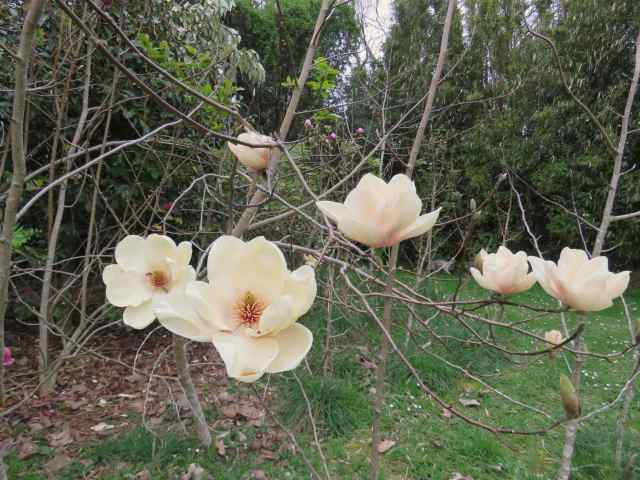
Fairy Magnolia White on the left, ‘Bubbles’ top right and the first flowers to open for the season on Fairy Magnolia Cream bottom right

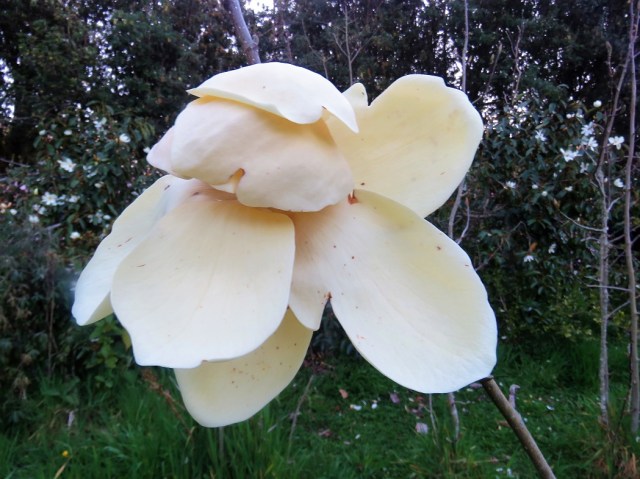
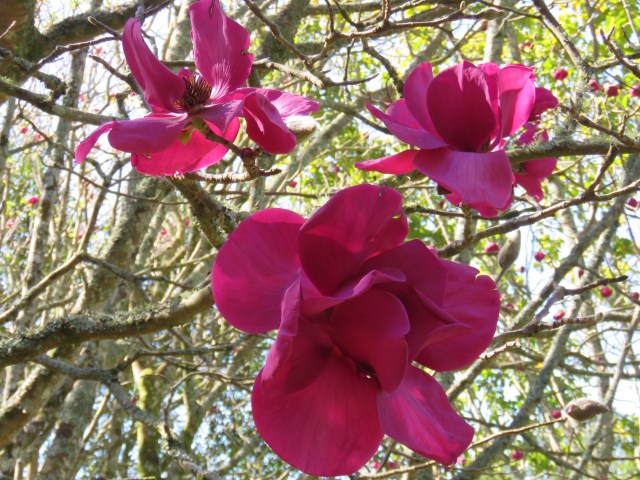
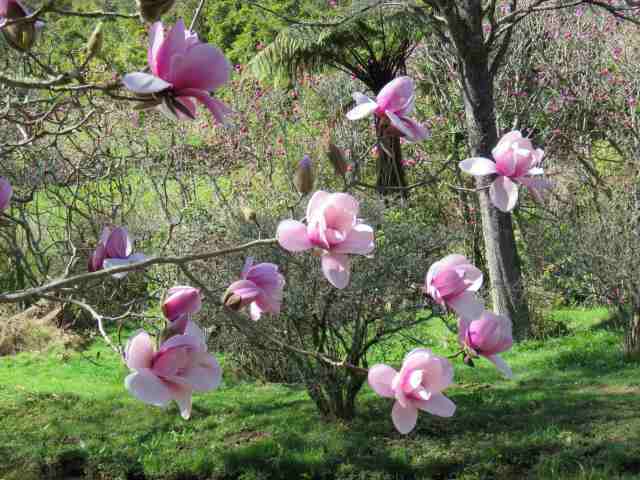
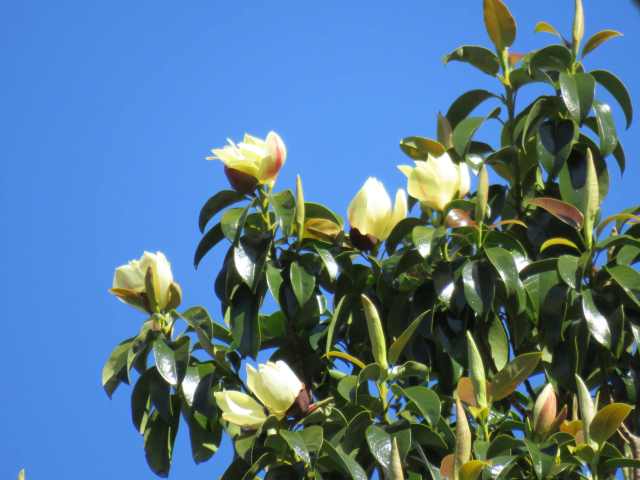
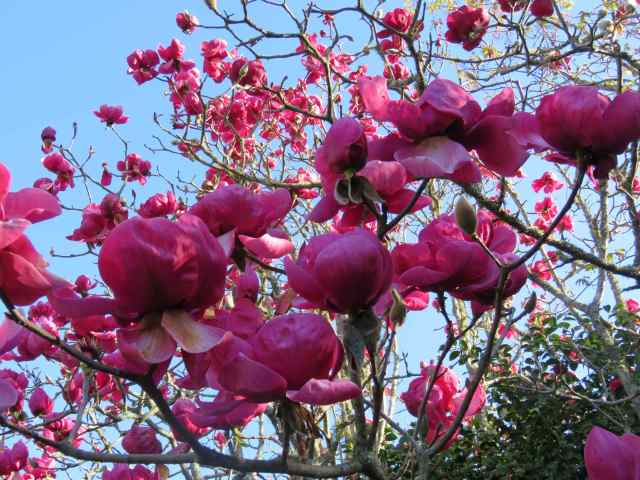
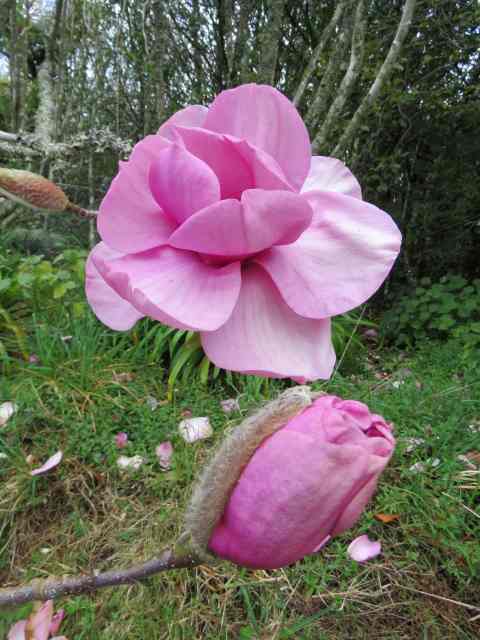
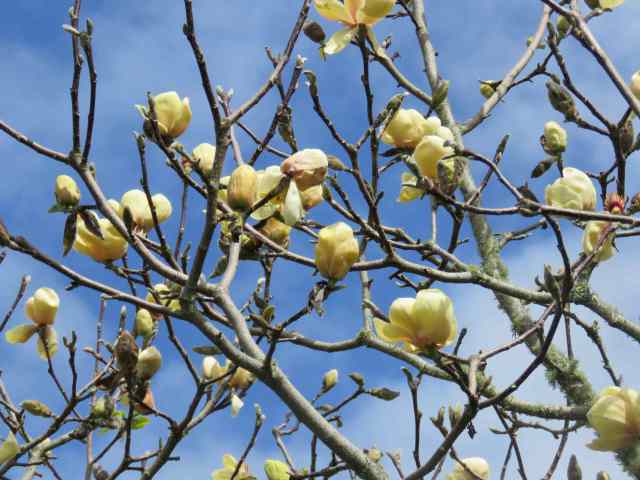
In the early stages of the magnolia season, our display is dominated by red deciduous magnolias and white michelias. The other colours come later in the season and that is particularly true of the michelias, where we now have significant variations.

Michelias are now classified as a subsection of magnolias and technically are named Magnolia xxxx but we still find it helpful to refer to them as michelias for clarity. They are, of course, evergreen but not with the big leathery leaves of the American Magnolia grandiflora types.

Magnolia x foggii ‘Bubbles’

It was finding M. ‘Bubbles’ in bloom with flowers at a height I could pick that started me lining them up. Back in their day, ‘Bubbles’ and its sister seedling ‘Mixed Up Miss’ were breakthroughs in the world of michelias. There is a third named one in that set but I have only ever seen ‘Hint of Pink’ in Auckland Regional Botanic Gardens. They were the work of the very late  Os Blumhardt – a notable plant breeder who lived in Whangarei and is probably best known internationally for his successful deciduous Magnolia ‘Starwars’.

He didn’t raise many michelia seedlings, as far as we know just the one batch. I see we first started selling ‘Bubbles’ and ‘Mixed Up Miss’ around 1992 and we would have been onto them pretty early because Os was a personal friend and very generous with his plant material. He probably did the cross in the late 1970s, maybe early 1980s and he provided the inspiration to Mark to see what he could do with this plant family.

‘Mixed Up Miss’ at Auckland Botanic Gardens. The flowers are small and so high up on our tree that I can’t photograph it

In their day, they were terrific. ‘Bubbles’ was harder to propagate from cutting and had larger flowers and foliage. ‘Mixed Up Miss’ was the perfect nursery plant – easy to propagate, set flower buds on a young plant and looked extremely attractive and neat standing about a metre high in its pot. It has smaller flowers with slightly more colour but there isn’t a lot in it.

M. doltsopa flower

Os was doing this work before M. laevifolia (formerly known as M. yunnanensis but more widely marketed under a plethora of names including ‘Honey and Cream’) was even in the country. He used two of the common species that were here – M. doltsopa and M. figo. In the world of magnolias, this particular cross is referred to as x foggii (after American breeder John Fogg who is credited with the first hybrids from this cross in 1972).

All that white in the centre is our Magnolia (michelia) doltsopa. Yes, it is somewhat large

M. doltsopa is a variable species. I only have photographs of our specimen which is spectacular and takes up an area of space roughly equivalent to a small, urban apartment block. They are not all as huge as that but they do have large flowers.

Magnolia (michelia) figo.

M. figo will be better known to many readers. It is smaller growing and sold widely, particularly favoured in warmer areas. Its flowers are verging on insignificant to the point where I have never bothered photographing them so I had to grab an image from Wiki Commons. It is a handy, evergreen plant that you can keep compact by pruning often, although its foliage turns rather yellow in full sun. It is mostly grown for its strong fragrance which has always reminded me of Bubblegum chewing gum so loathed by my mother. It only gets fragrant in the late afternoons and evenings, though.

‘Bubbles’ in the centre after 35 years or so. It is in full flower but not exactly a showstopper
For comparison, Fairy Magnolia White in flower with Camellia yuhsienensis in front. The larger, more open flowers are much more distinctive

These new hybrids of Os’s were a breakthrough in terms of more user-friendly garden plants. Alas, some plants get significantly more spectacular with age but others don’t. And on a property with literally hundreds of white michelias from Mark’s breeding programme, you would not look twice at our specimens of ‘Mixed Up Miss’ and ‘Bubbles’. Picking flowers of ‘Mixed Up Miss’ defeated me because I would have to carry a ladder to the farthest reaches of our park where it is now very tall and leggy. You could keep them more compact and bushy by frequent pruning if you are in a smaller garden but the following generations of hybrids are a significant improvement.

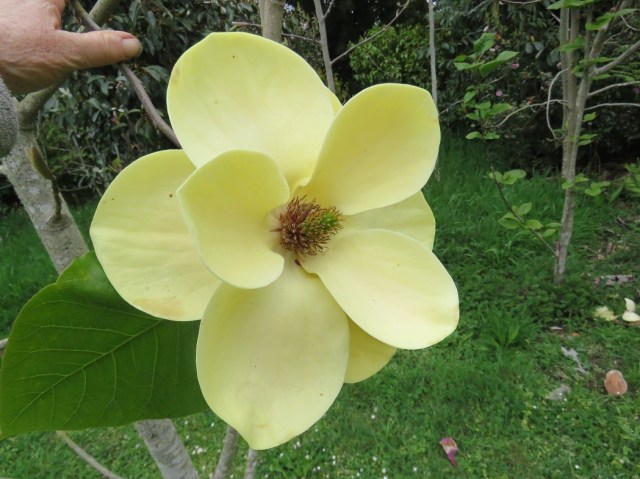
Magnolia laevifolia (formerly Michelia yunnanensis) ‘Velvet and Cream’

Mark has used both ‘Bubbles’ and, more often, ‘Mixed Up Miss’ extensively in his breeding but he also had the huge advantage of being able to add in M. laevifolia. While he has tried a few of the other species michelias we have in this country, it is line breeding with those early x foggii hybrids (so doltsopa and figo) with laevifolia that has given the huge range in flower colour and growth habit that he has reached in his later generations of michelia hybrids. The first three releases are all under the brand of Fairy Magnolia (White, Cream and Blush) and are now widely available here and overseas.  

Mark’s Fairy Magnolia Cream on the top left with Fairy Magnolia White below and a random selection of seedlings which are also coming into flower. There is a whole lot more to selecting a plant for release than just a pretty flower but even that is difficult when looking at 80 or 100 plants of the same cross, all of which are white.

None of the later selections are on the market yet although there are three coloured ones being built up for release and there will likely be another three to follow at some stage when we have made the final selections. It is not a quick process so don’t hold your breath.

Yes, we have colours coming through. Not all michelias are white or cream.
Fairy Magnolia Cream and Fairy Magnolia White. Blush has yet to open its pale pink flowers.

Marking Matariki

My personal marker of Matariki – our maunga, Mount Taranaki, and Magnolia campbellii.

Our second official marking of Matariki, the Māori New Year, has been a curiously moving experience for me and for many others, it seems. It became a statutory holiday last year for the first time, one of eleven paid days off, alongside Christmas, Easter and the increasingly irrelevant monarch’s birthday which bears no connection whatever to the actual birth day, be it Edward V111, Elizabeth 11 or Charles 111. Curiously, I have only just discovered that it was the aforementioned Edward who moved the official date to June (he was born in November) in the hope of better weather for the day. Let that not affect those of us in the former colonies; finer weather be damned. We still keep to the midwinter date of the first Monday in June. But I digress.

I have written about Matariki before   in the context of the start of a new year and my wonder that, in pre-European times, Māori arrived at a time for celebrating the occasion that corresponds very closely to the winter solstice and the European convention for New Year on January 1, except that it is six months apart, as befits a different hemisphere where the seasons are reversed. The timing of Matariki is determined by the rising of the star cluster known elsewhere as the Pleiades.

Our kauri which is the Māori name for what is botanically Agathis australis, one of this country’s most venerated trees. They can live well over 1000 years so ours is a mere baby at just 60 years. Sadly, most of the oldest trees in this country were felled in just a few decades after European settlement in the mid 1800s.

While most of our statutory holidays in this country are simply paid days off – welcomed by wage-earners and deplored by business-owners – Matariki is bringing a welcome character of its own. It is not just about the start of another year. It is about honouring the past and especially those who have died in the past year, celebrating the present and looking with hope to the year ahead. I see resistance to attempts to commercialise the day in the manner that Easter has become more about chocolate eggs, bunnies and hot cross buns than about the story of Christ. Matariki is our unique celebration here in Aotearoa New Zealand and the occasion this year has been dominated by Māori voices and a Māori perspective on marking the end of one year and the start of another. I have found it an affirming and positive experience.

Magnolia campbellii against the snow
Drawing back from the camera zoom, you may be able to spot a very small white peak to the left of the trunk of the tree fern, the magnolia and a veritable United Nations of plants dominated by our native tree fern in the foreground.

Even before we started to mark Matariki officially, I saw this time as the start of a new gardening year. For me, the opening of the Magnolia campbelllii brings fresh promise in the middle of winter. I did think that I should be illustrating this post with photos of native plants in the garden, entering into the spirit of this special time. We grow a surprisingly large number of native plants but always integrated with other plants from around the world. And as we were walking around the garden with friends from Auckland yesterday, I was rather too distracted to focus on singling out specimens of indigenous flora. I may make it a project next year.

Self-sown tree ferns. We have five different species in this country; I think we have four of the five species seeding in our garden but I am a bit vague about the differences on a couple of them. They are more prized overseas than here where we take them for granted.

I have my own personal celebration of Matariki this year. I am off to Sydney on Tuesday to meet the newest member of our family – a small granddaughter who is way too young to realise that she brings together the threads of Aotearoa (her mother), France (her papa) and Australia (her birthplace). This means there won’t be a post next Sunday

Ngā mihi o Matariki, te tau hou Māori

Happy Matariki

I think those are one of our native gahnia grasses (cutty grass) edging a pond in the Wild North Garden. With Ralph carrying out his usual photobombing intrusion.