In different times, we would have been in London now for Mark to attend a special presentation. He has been awarded the RHS Veitch Memorial Medal although I don’t expect many people in this part of the world to understand just how big that honour is.
Felix’s medal. Mark’s may take a while to arrive from the UK. International mail is much slower than it used to be.
The Veitch is the highest honour Britain’s prestigious Royal Horticultural Society award to people who are not citizens of that country. It is also the highest international honour we know of in our field – a literal medal that is gold in colour but I rather doubt that it is made of gold. I draw a comparison to the medals earned by sportspeople when they win a world championship. For us, the honour is in that league.
Mark Jury
We have known for about two months that Mark is one of this year’s recipients but were asked to keep it quiet until after the presentation ceremony in London yesterday. They usually award about four Veitch medals a year, covering the globe. For us, it is doubly special because Mark’s father, Felix, was awarded it in 1992 and this is one of the very (very) few times, that two generations from one family have received it. I still remember Felix’s quiet pride to be honoured internationally for his work in plant breeding.
I trawled the list of recipients down the years and oh my, but the company is very elevated internationally. As far as I could see, Mark is the thirteenth New Zealander to have been honoured since its inception in 1870, of whom only three others are still alive (Alan Jellyman, Keith Hammett and Bev McConnell).
For Mark, it is even more of an honour to have been nominated by international colleagues. Last year alone, over 425 000 of his cultivars grown under licence were sold internationally. This does not include production and sales of plants he has bred but we did not retain ownership rights over.
Our thanks go to Anthony Tesselaar Plants, our Australian-based agents, who have had the role of managing Mark’s cultivars on the international market over many years and who have always acted in his best interests.
In the manner of magazine writers these days, I interviewed Mark with quickfire questions on his plants. Well, to put it more accurately, as we sat having an afternoon cup of tea, I double-checked my preconceptions.
Magnolia ‘Felix Jury’
Favourite magnolia you have bred: Magnolia ‘Felix Jury’. (Named for his father because it was what Felix was trying to get to in his earlier generation of breeding).
Rhododendron ‘Floral Sun’
Favourite rhododendron: ‘Floral Sun’. (To quote Mark from an earlier time when he was unusually extravagant in his assessment or maybe had been drinking wine, “If I never breed anything as lovely as that again, I will die happy.”
Vireya rhododendron ‘Pink Jazz’
Favourite vireya rhododendron: ‘Pink Jazz’ (which is why it is named for our first-born child in an oblique sort of way).
Camellia ‘Fairy Blush’
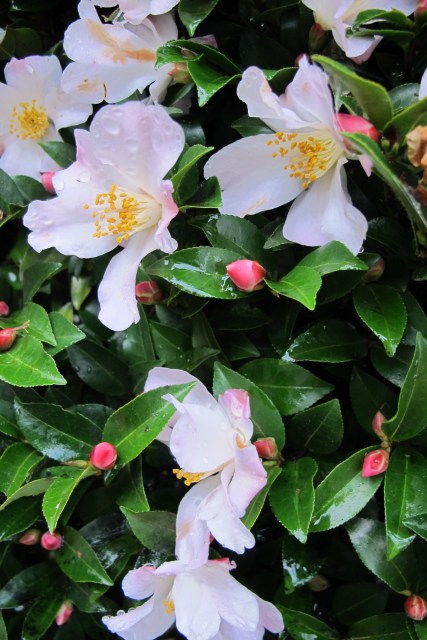
Favourite camellia: ‘Fairy Blush’ (known here as the one that got away from us in terms of retaining ownership rights. It was the very first plant of his own breeding that Mark named and released on the open market).
Fairy Magnolia Blush
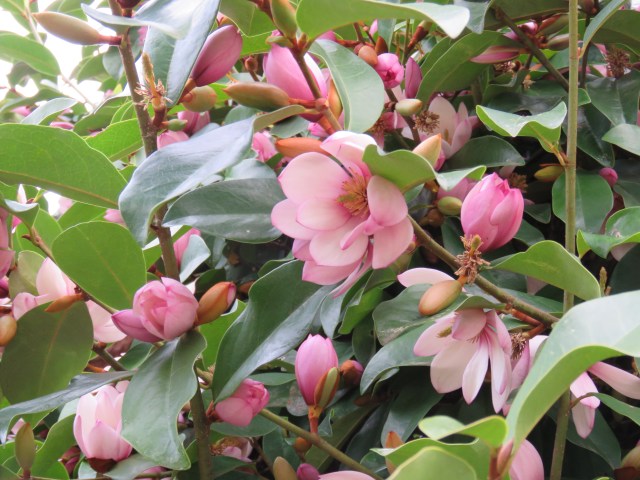
Favourite michelia: “RFA,” he replied. “Room for improvement”. The michelias are on ongoing project at this stage, but of those already released, he named ‘Fairy Magnolia Blush’ because it is the first to bring colour into the range.
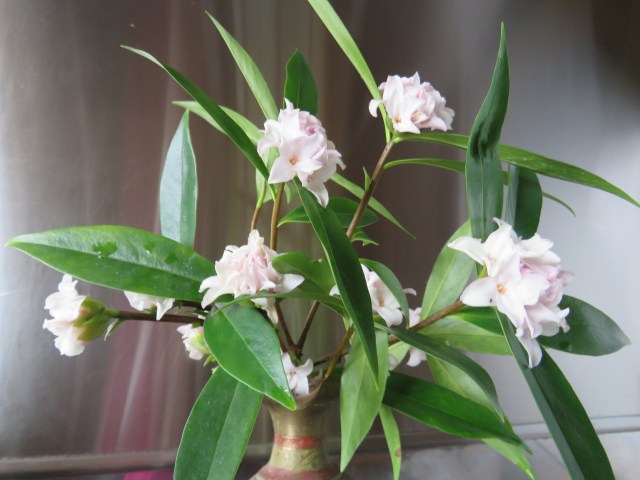
Daphne ‘Perfume Princess’
Biggest surprise: Daphne ‘Perfume Princess’.
It is not so much a red letter day here as a gold medal day and that does not happen often.
First written for Woman magazine and published on line only in January, on account of them ceasing publishing hard copies for distribution. A summary, really on our exploration and then creation of gardens that star in summer.
While we do exceptionally good spring gardens in Aotearoa New Zealand, the same cannot be said about our summer gardens. The best display I have seen was at Auckland Regional Botanic Gardens several years ago and that was large-scale amenity planting in a public garden. Domestic gardens are different.
We looked around our own garden in summer and it seemed very green. We get summer rainfall so we are always green but we wanted flowers, a summery feeling. Hydrangeas and woodland were not doing that for us. When we closed the plant nursery on site, an expanse of flat, sunny area was freed up. It was a blank canvas and that is a rare thing in an established garden. Here was an opportunity to do something new and create an area dedicated to summer.
We set off on our first trip to reconnoitre summer gardens in the UK in 2009, with the idea of looking at gardens comparable to ours – in other words, large, private gardens managed predominantly by the owners on a comparatively small budget. And we wanted to have a look at Gertrude Jekyll’s legacy. To be honest, the Jekyll legacy looked a little dated in the hard light of 2009 and we were equally underwhelmed by the gardens recommended to us personally by a UK guidebook writer. We abandoned that plan halfway through and instead took in some of the high-profile, historic gardens – the likes of Hidcote, Hestercomb, Great Dixter and Sissinghurst.
On our next trip, we were better prepared. Tim Richardson’s book ‘The New English Garden’ had come out and that is an excellent resource in getting to understand modern directions. We knew we wanted to see the gardens of our era and we did. It was inspirational. We also discovered some of the contemporary garden designers whose work we found particularly interesting. By the time we made our third trip, we were starting to search out gardens by those particular designers, both private commissions and public projects.
Alas Covid forced the cancellation of our most recent foray so we may never get to see the wild flowers on the Pindos Mountains in Greece and the home gardens of some of the UK designers we were tracking. But we had learned a great deal.
Firstly, summer gardens are about herbaceous perennials grown in full sun. Like so many other NZ gardeners, we had largely treated perennials as the ground level filler to layer with trees and shrubs. Most of us do mixed plantings in this country – trees, shrubs, perennials and bulbs and, of these, perennials are often the afterthought. We needed to make them the stars and to do that, we had to learn how to grow them well and which ones would thrive here without becoming thugs or weeds.
Trees, shrubs and hedges might be used with perennial plantings to give height, form and stature, but sparingly, spaced widely, playing second fiddle.
It was Tim Richardson, who gave us the concept of gardens that are immersive, not pictorial. The contemporary gardens we liked were wrap-around experiences where one is in the garden, not looking at the garden from strategically designed viewpoints. This is often achieved not only by leaving out vantage points entirely but also planting in bigger blocks, drifts or swathes to draw you through – a journey, if you like, not a static view.
Height matters. None of these modern gardens are carpeted in ankle-high to knee-high, tidy, little clumps like a modern take on Victorian bedding. Most are from waist height to towering above head-height so you really do feel immersed.
Nor did any of these gardens have neat little edging plants or clipped baby hedges at the front of the border, so favoured in this country by gardeners who feel it makes a garden look tidy and defined. What these edgers do is to create a demarcation line, a visual barrier which impedes the immersive experience.
Colour matters. Big, bright and bold, in the main, sometimes bordering on garish, certainly exuberant but always in controlled combinations of colour and texture.
Sustainability is key. The classic herbaceous twin borders have always been regarded as labour intensive with on-going staking, deadheading, weeding, digging and dividing. The New Perennials style of gardening has factored in the need to reduce labour input and much of that comes down to plant selection. Ideally, working with plants that don’t require individual staking and ongoing deadheading is one goal, as well as plants that don’t need to be lifted on a frequent basis. That said, I do a lot more deadheading now than I expected because too many plants will seed down and spread enthusiastically if I let them go to seed. Reducing weeding comes down to getting control of the weeds right from the start, allowing each plant to stand in its own space at ground level rather than intermeshing its root systems with its neighbours and keeping mulch topped up.
Dutch designer Piet Oudolf is a giant in the New Perennials movement. We loved the small private commission we saw of his at Bury Court but his recent work is more akin to grand scale amenity planting, getting – dare I say it – a bit utilitarian even. It is also very seasonal. We arrived a week too early to see his plantings at Pensthorpe Natural Park in Norfolk so all we saw was the promise of what was to come.
We found ourselves more drawn to the work of Dan Pearson, Tom Stuart-Smith, Nigel Dunnet, James Hitchmough and Christopher Bradley-Hole.
It is different in Aotearoa. We knew that. We expect our gardens to work a lot harder all year round. We also use a whole lot more evergreen plants; 99% of our natives are evergreen and most gardeners also lean more to evergreen exotics. We don’t make gardens that disappear below ground almost entirely in winter.
We also worked out that all the many plant lists put out to support these contemporary styles are of little relevance in our climate. They are tried and true performers in the northern hemisphere in places with colder winters, lower light levels and different soils. Some of their key plants just don’t like our temperate to sub-tropical climate, others become rampant thugs. We needed to work out which plants would thrive but be relatively undemanding in our conditions. Fortunately, Mark had been buying and acquiring perennials for years, planting them out and leaving them to their own devices to see how they responded, so we had some material to start with.
We created our summer gardens and goodness, concentrating on perennials gives a much faster result than working with trees and shrubs. By the second summer and autumn, they looked well furnished. And they work, to some extent, 52 weeks of the year, not just in peak summer. I admit we were working on a larger scale than most domestic gardens – around 2000 square metres of largely blank canvas – and with the advantage of a nursery background so we could raise most of the plant material ourselves.
If your lot in life is much, much smaller, it is a question of being more selective and scaling down the proportions but not the plants. Dwarf plants will never achieve the exuberance and generosity of this garden style.
What did we end up doing? A lot of looking, discussion, planning and marking out the space using tall bamboo stakes happened before any groundwork started, let along planting. You can reduce this time by employing a professional but that is not our way.
We planted five separate gardens with a sixth still under development. One key element was avoiding using the same plants in each garden; there is very little repetition beyond a few structural plants. If you keep repeating the same plants, it just ends up making the whole area look the same.
Tom Stuart Smith’s terrace at Mount St John in Yorkshire
Our curtsey to Tom Stuart Smith in our colour-themed Wave Garden
The Wave Garden drew inspiration from Tom Stuart-Smith in the definition achieved by undulating hedges giving form (we used little Camellia microphylla) with tall plants in the central enclosures and lower plants in the outside bays. It is the only colour-themed and block-planted garden we have, limited to blue and white.
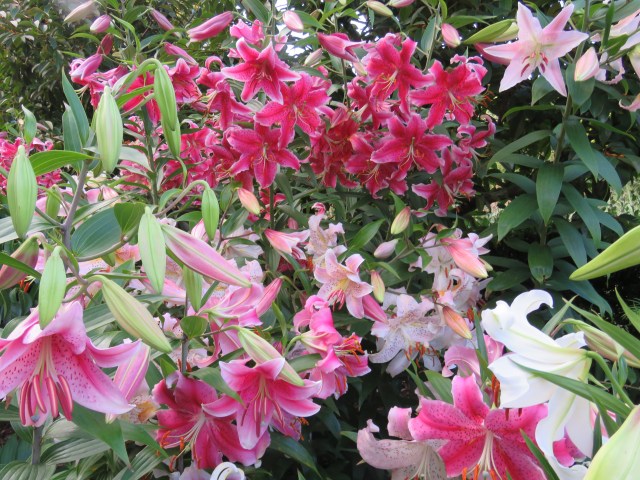
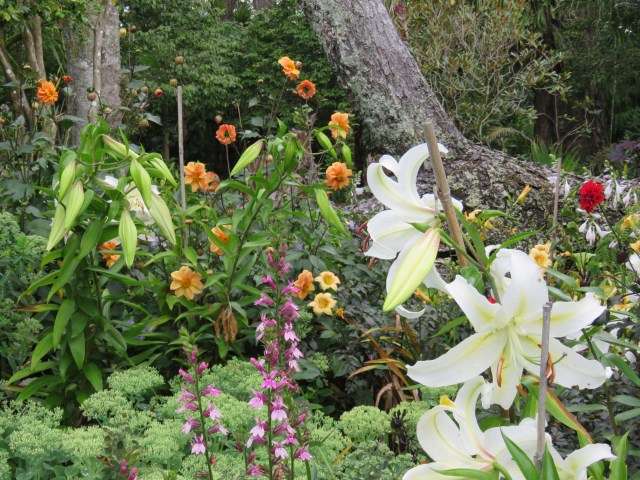
The adjacent lily border is the only part of the garden dedicated to a single plant – OTT auratum lilies that Mark raised from seed. Thirty metres of them is a pretty astounding summer experience.
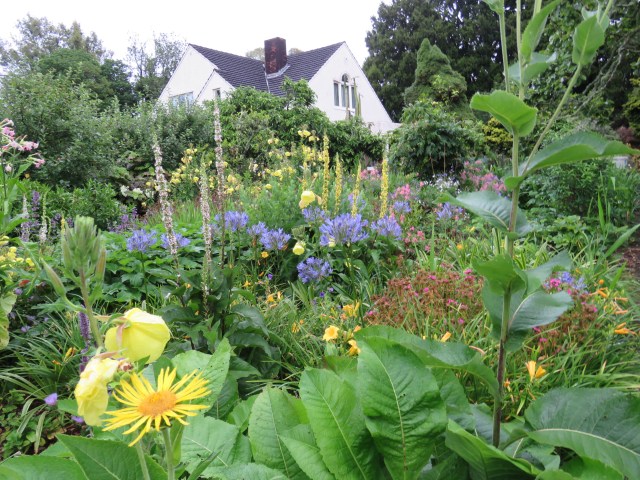
Our twin borders, probably more Pearson than Oudolf in influence – or maybe neither.
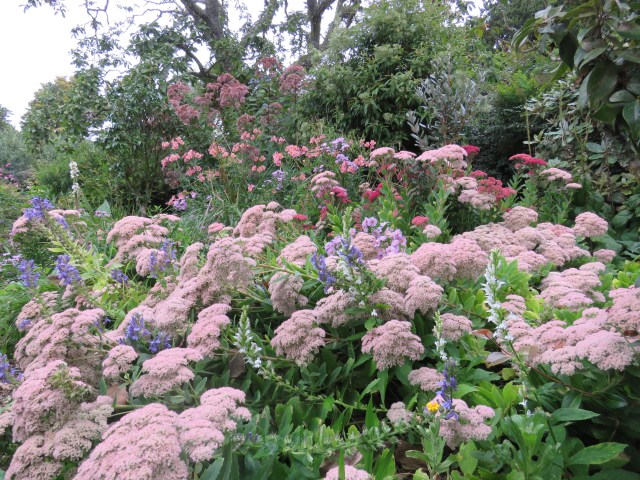
The twin borders have a distant debt to Dan Pearson. As I planted them, I kept muttering words like ‘rhythm’, ‘flow’ and ‘echo’. They are largely evergreen perennials and earn their keep visually from early spring through to very late autumn. We kept some unity by eliminating any plants that flower in pale to mid pink although cerise is fine. Red has been used sparingly.
Christopher Bradley-Hole’s grass garden at Bury Court in the UK was about texture and movement, not flowers
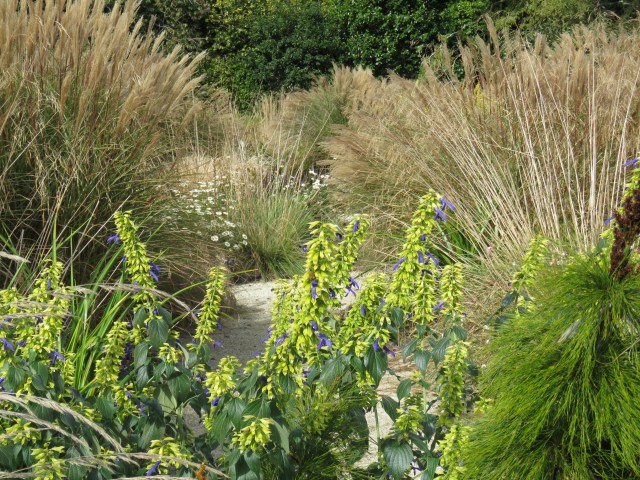
Our Court Garden was heavily influenced by the Bradley-Hole garden but very different in both design and plant selection
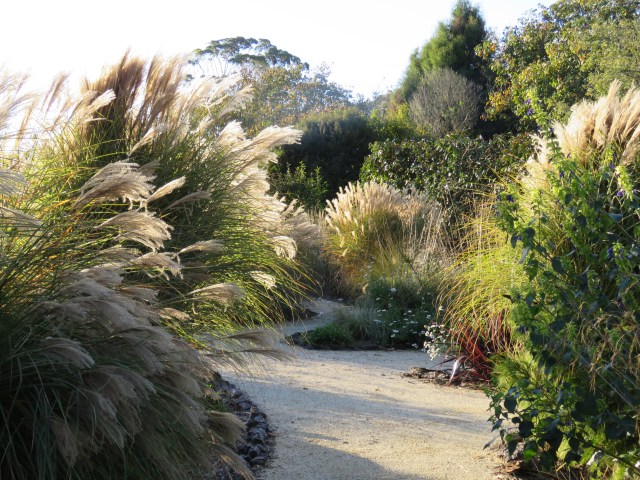
The Court Garden is the large centrepiece and was inspired by Christopher Bradley-Hole’s grass garden at Bury Court, although different in both design and plant selection. The focus is on big grasses and plants with grassy or spear-shaped foliage. By the end of summer, it is above my head in height and full of movement with just the gentlest breeze. I used a limited range of plants and over half of them are our larger native grasses, silver astelia and flaxes in burgundy and black so there is plenty to see all year round. It is a place for larger growing flowers too – apricot foxgloves, large salvias, a few single dahlias, tall helianthus, Inula magnifica and the like.
Nigel Dunnett’s perennial meadow at Trentham Gardens
Inspired by Dunnett, our bee and butterfly garden
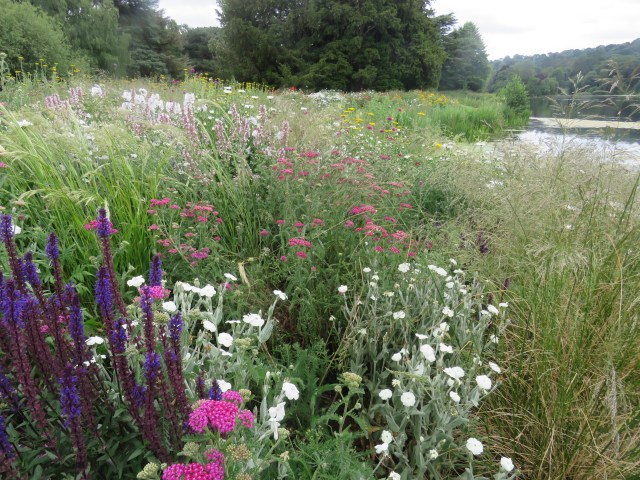
Finally the bee and butterfly garden owes a debt to Nigel Dunnett, particularly his magical perennial meadow at Trentham Gardens near Stoke-on-Trent. My mental image was of a perennial meadow but really it is halfway to a riotous cottage garden.
As yet more heavy rain falls this weekend on already saturated ground in northern and eastern areas of Aotearoa New Zealand, I make no apology for pulling out photos I have used before, showing alternatives to huge slabs of concrete or paving around homes.
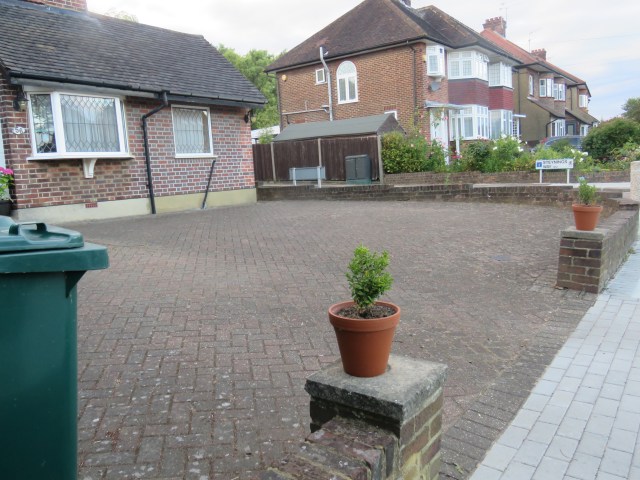
This is in London but too many of our urban areas are heading down this track
Most of us are not in a position to influence urban planning, but we can have an impact on our own property. Putting in large areas of sealing and paving, mostly to accommodate car parking or to ‘reduce maintenance’, is a significant problem contributing to urban flooding.
I have said it before, if you want a low or no maintenance section, move into an apartment – preferably one with underground carparking so the footprint of the building and housing cars remains as small as it can be. The alternative of concreting or paving your section is not only aesthetically unpleasant, it is environmental vandalism.
When accommodating cars is more important than anything else
When I took these photos, the concern was more for preserving aspects of nature, providing habitats and food sources for the natural world. This month, it is about drainage, in this country at least. All that rain falling from above has to go somewhere and if you have surrounded your home with impermeable surfaces, it has no choice but to run off and contribute to storm water systems that are overwhelmed. When an area is planted, the ground is permeable and the root systems create little channels for the water to flow down deeper into the soil. Even mown grass will do this, once it is established.
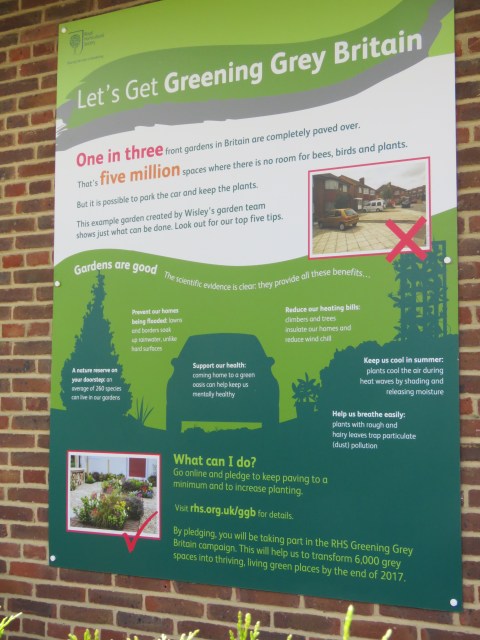
The education boards at RHS Garden Wisley in the UK claim that one in three front yards are fully paved now. Our major urban areas may not be lagging far behind in this country as sections get ever smaller and houses – almost all single storey and detached – get ever larger, leaving little space devoted to wheelie bins and car parking.
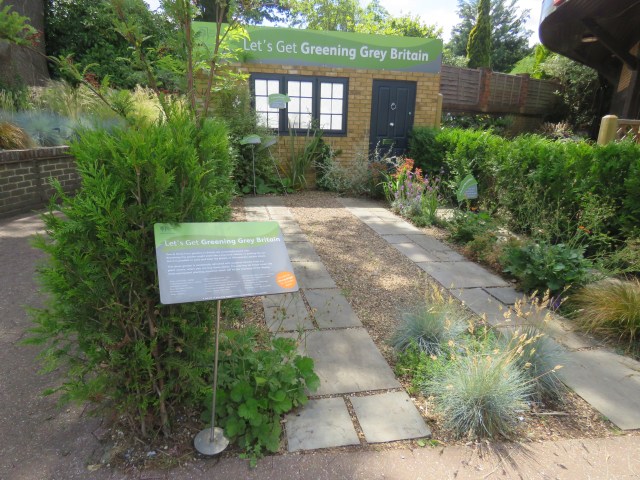
Wisley’s alternative display shows the use of spaced pavers, gravel with plants in it and recommends clipped hedging rather than solid fences on the boundaries. Just don’t lay an impermeable lining below the gravel – often recommended to ‘reduce maintenance’ but entirely defeating the drainage function of this type of driveway. Yes, it will take a bit more work to maintain than just getting the leaf blower out onto a slab of straight concrete or seal on a Saturday morning, but how much more pleasing is it visually? And it will absorb a whole lot more excess water.
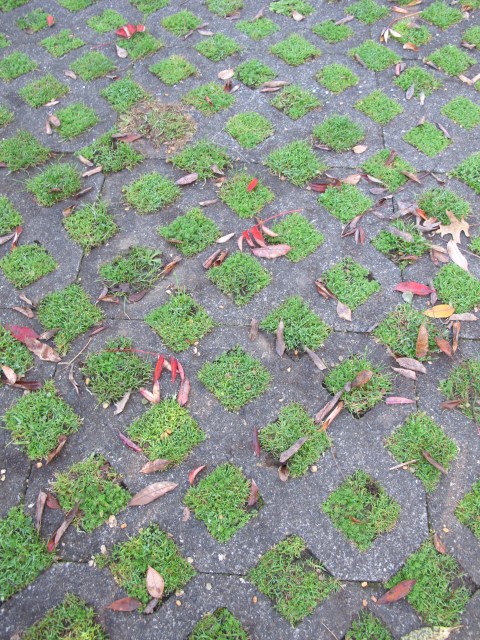
I photographed this driveway in Auckland. It is another alternative, allowing drainage while giving a hard surface on which to park the wretched motor cars that are so demanding on space. Laid properly, it should be level enough to run the lawnmower over it or to allow for sweeping, if need be.
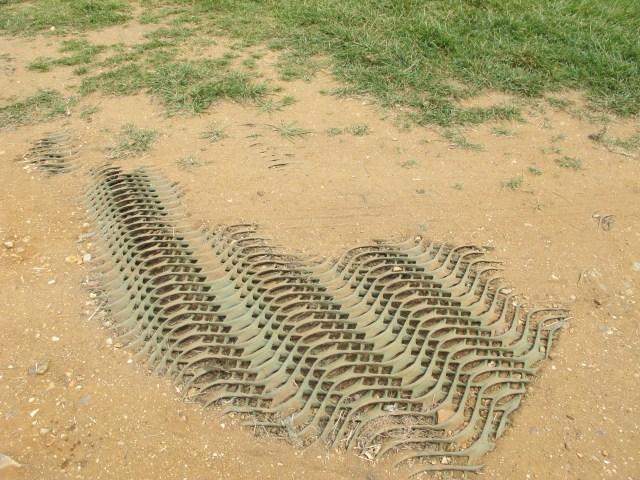
This subsurface reinforcement looks as though it may be made from recycled tyres. It was very dry at the time I spotted it exposed in a few places in a distinctly utilitarian carpark. It is another way to solve the problem of an area that would become a mud bath in wet conditions leading to a rough, rutted surface as it dries. It could be over-sown with grass to be mown in areas where there is lower vehicle traffic – like a front section.
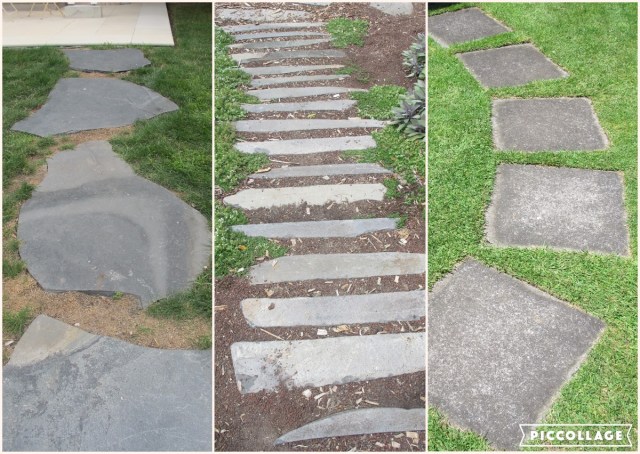
When it comes to paths, there are alternatives to a solid surface and the ones I have photographed are all using paving slabs. The one on the right would take a bit of extra maintenance to keep that sharp look because it involves using an edging tool around each paver but most of the time, the lawnmower would run straight over it. Don’t even think about spraying the edges because it would look awful with a brown, sprayed border around each paver. Again, the laying is important to get a flat surface that doesn’t become a trip hazard.
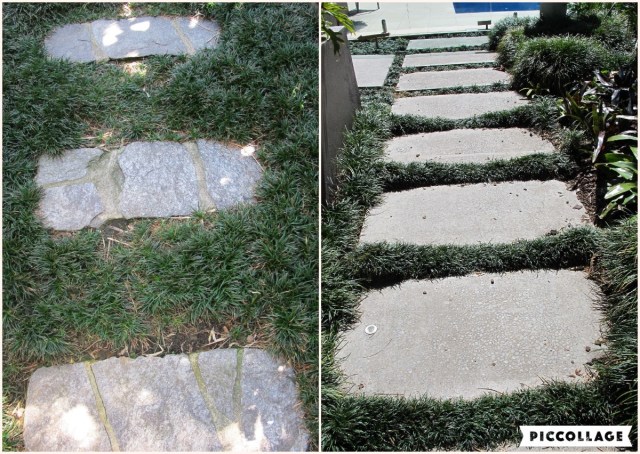
Planting around large pavers in mondo grass (Ophiopogon) gives a softer look that is really pleasing to my eyes. It is also one of the lower maintenance techniques because the mondo grass will choke out most weeds and it is extremely hardy, even to heavy foot traffic. Maintenance is just a matter of getting in and thinning it out when it starts to look too congested, which can be done with an old carving knife or a cheap flax cutter.
Wider pavers give a generous look befitting, even, to a main path to the front door.
When we last lived in a city – and I admit that was loooong time ago – we walked. A lot. It was pre-children so we probably had a lot more time on our hands. Walking in a city is a great way to get ideas, to see what is growing successfully and what is not, to influence your likes and dislikes and to look for alternative ways to accommodate modern life and vehicle dominance without damaging the environment. I don’t think many of us saw drainage as being one of the more confronting aspects of climate change.
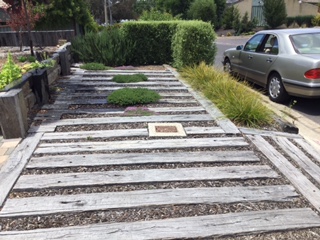
Reader Susan has kindly sent this photo of another design that combines functionality with both drainage and aesthetics. Those are railway sleepers filled with coarse woodchip. Fine woodchip runs the risk of either compacting in some conditions or simply floating away in a flood to block stormwater drains.
To say it has been a difficult week would be an understatement, at least for those of us living in Te Ika-a-Māui or the North Island, as it has long been unimaginatively named. My heart goes out to the many thousands who have had their lives turned upside down, are currently displaced or have lost everything they owned this week.
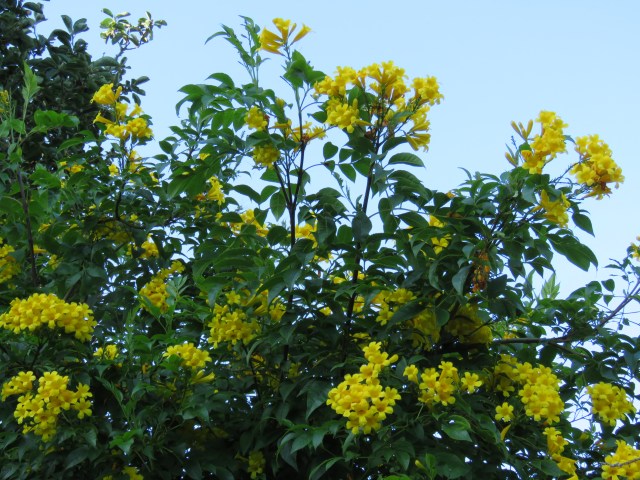
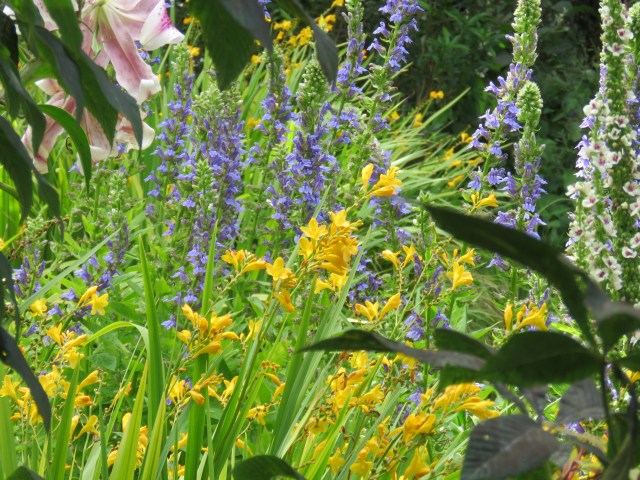
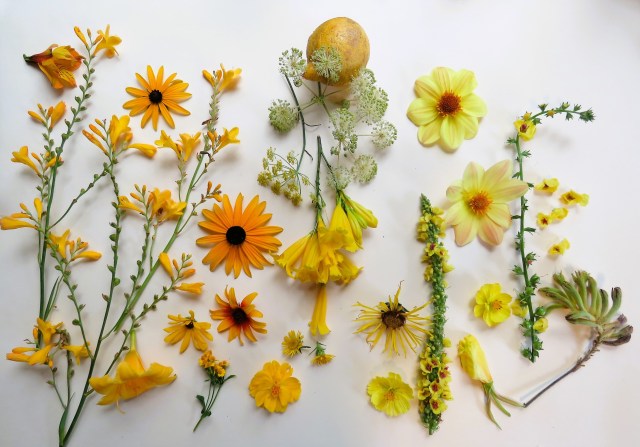
We are all overwhelmed by images of damage and loss this week so I chose to go with totally unrelated photos in yellow. This is Tecoma stans.
I just looked up the population and I see it is just shy of 4 million people living in the North Island. Given that Cyclone Gabrielle hit hard in Northland, Auckland, Coromandel, Bay of Plenty, Tairāwhiti and Hawkes Bay with lesser effects throughout much of the rest of island, it is not an exaggeration to say that the impact has been felt by at least a couple of million people, probably more. As I write this, we are still learning about the scale of damage and loss.
Rudbeckia
After taking a direct hit from Cyclone Dovi exactly a year ago, we spent Tuesday in a state of extreme anxiety as the winds hit us again. We didn’t get the rain and sea surges that have drowned the eastern coast and places north. There was some damage here but nothing on the scale of Dovi and negligible compared to the damage suffered elsewhere. I didn’t bother photographing it because it would seem trite compared to the loss and destruction in badly hit areas.
Echinacea laciniata ‘Herbstsonne’
When the earthquake hit on Wednesday night, it seemed like the universe was conspiring against us. At 6 or 6.1, it was a solid shake lasting quite a long time. It made me realise how frayed my nerves are and I don’t generally suffer from frayed nerves. I am not alone in that. I imagine the current high state of anxiety across our country is similar to that experienced across Australia during their horrendous fire season of 2019-2020. A few high profile, shrill voices blame the media; some even accused the media of over-hyping the anticipated arrival of Cyclone Gabrielle and causing unnecessary anxiety. Those voices went silent when Gabrielle turned out to be at the extreme end of the worst case scenario.
Crocosmia and blue lobelia
We live in difficult times. Those of us largely unaffected by Gabrielle may hope for a quiet breathing space, time to gather our thoughts, maybe even to experience a little boredom in normality, as we used to know it. But those who have been hit so very hard by this natural disaster don’t have the luxury of hoping for even that.
Helianthus
Stay safe. And if you or people close to you are among the badly affected, may you at least be able to see a path through this catastrophe in the weeks ahead and to find hope after despair. The sun will shine again, which is why I picked the colour yellow to accompany this post.
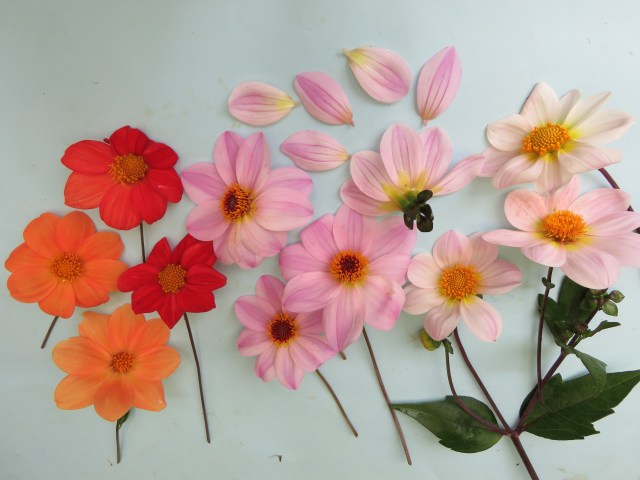
My starting point was dahlias, single and semi-double flowers
I was intending to write about dahlias this week. Not that we grow many dahlias but I see friends posting many photos of huge, specimen blooms in a range of colours and complex forms. I was going to plead the case for the simplicity of single and semi double blooms in a garden setting and argue that those big novelty blooms are perhaps better grown in a row in the cutting garden than in mixed plantings in flower beds. I like the light, airiness of the simpler forms in the garden.
We don’t know if this orange dahlia with its dark foliage is a named form or a seedling from the red ‘Bishop of Llandaff’ beside it but it is very attractive.
But then I got distracted by the colour orange because this year, my favourite dahlias are the orange ones and I have not been greatly enamoured of that colour since I was a child when I desperately wanted an orange bedspread. My dear mother always did her very best to meet our requests but we were only ever a step or two above the poverty line so it was always a case of near enough has to be good enough. She found some velvet being remaindered but it was more red than orange so she made the bedspread and assured me it was *tangerine*. It may have been tangerine-ish but it wasn’t the pure orange I had dreamed of. I remember swallowing my disappointment to express appreciation, knowing she had done the best she could.
A selection of orange flowers from the garden with three tangerines in memory of my mother and a monarch butterfly that died of natural causes. Reader, my velvet bedspread was not the colour of these tangerines.
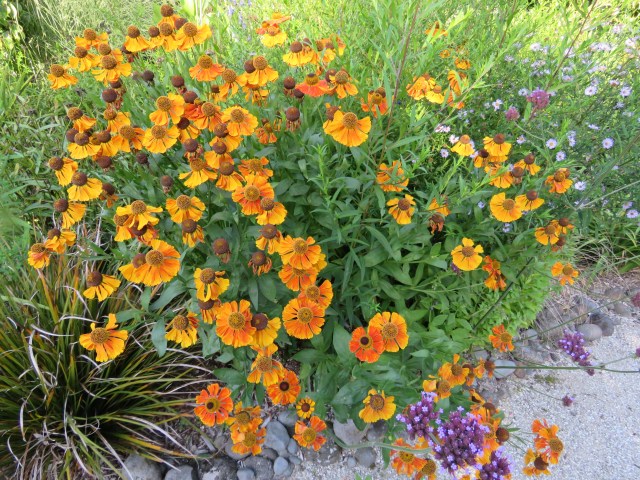
I turned my eyes to orange flowers in the garden and was surprised when I picked flowers from a dozen different plants. The orange – and yellow – cosmos we planted in the rockery for late summer and autumn colour are looking particularly cheerful and they started flowering within two weeks of my planting out tiny seedlings a few centimetres high. And this week, it is the heleniums that are the stars of the twin borders.
Heleniums or sneezeweeds
Every year, I forget whether these are helenium, helianthus or helianthemum and I have to google them to refresh my memory. Maybe I could call them sneezeweeds instead. That is the common name conferred upon them when, in times gone by, the dried leaves were used in snuff to encourage sneezing in order to rid the body of evil spirits. Fellow sufferers of hayfever, take heart. We just didn’t know that we were expelling the bad spirits from our bodies without having to resort to snuff. That said, I am not aware of the helenium flowers making my hay fever worse.
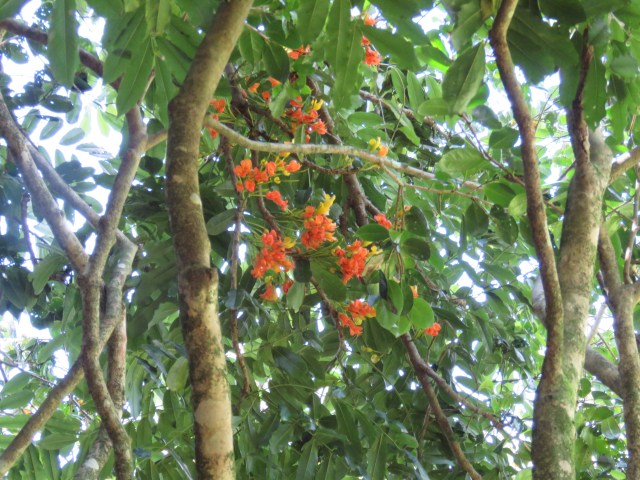
Castanospermum australe, black bean tree or Moreton Bay Chestnut
The Castanospermum australeis having a particularly good season. The tree is well over ten metres tall now and we usually only see the flowers from a distance right at the top. This year, we seem to have more growing beneath the foliage as well so they are only about eight metres up. Being native to the more tropical parts of Australia, it may be enjoying the milder winters and warmer summers we are now experiencing.
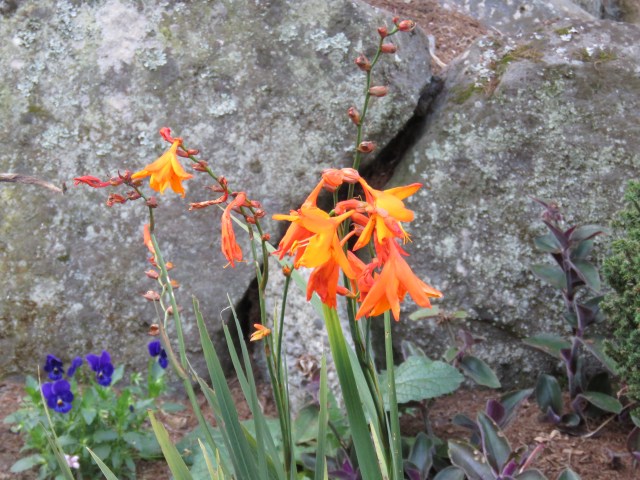
A crocosmia on steroids in the rockery. It may be a similar colour to the common roadside weed but the flowers are huge by comparison and it is very slow to increase. We think it is the form named as ‘Star of David’.
When it comes to orange as a colour in the garden, a little can go a long way. It is a very strong colour in its pure shades. Mark’s advice is to include plenty of other plants from the other side of the colour wheel – so in the blue and purple shades, although green also acts as a visual foil. Personally, I am not so keen visually on a whole lot of orange combined with either red or yellow and pastel pink is problematic.
I would have said I never wear orange, but that changed as of yesterday when this orange cardigan arrived. In self defence, I tell you that it is just for summer gardening, 100% cotton, has the all-important pockets and was reduced from $100 to $25. I was just a little alarmed by the colour. I may have thought of it more as burnt orange when I ordered it but it is Very Orange. At least I will not be difficult to find in the garden. When I come to think of it, it is probably the very shade eleven-or-twelve-year-old me had envisaged for my bedspread.
My thoughts are with northerners this weekend, particularly in Auckland, Coromandel and Northland, who must feel as though they have the sword of Damocles poised above them as they await the arrival of Cyclone Gabrielle. It is one week off a year since we learned what cyclonic winds can do when we took a direct hit from Cyclone Dovi. That was bad enough and we didn’t get the torrential rain that is predicted with Gabrielle, falling on land that is already saturated and further threatening infrastructure already badly damaged by the recent extreme weather and flooding in those areas. May you stay safe. We will breathe a sigh of relief if the dire predictions do not come to pass for you in the next few days.












 Tikorangi The Jury Garden