Well goodness gracious me.
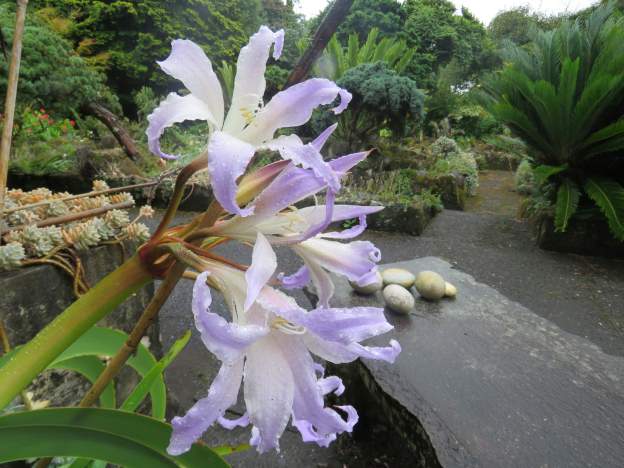
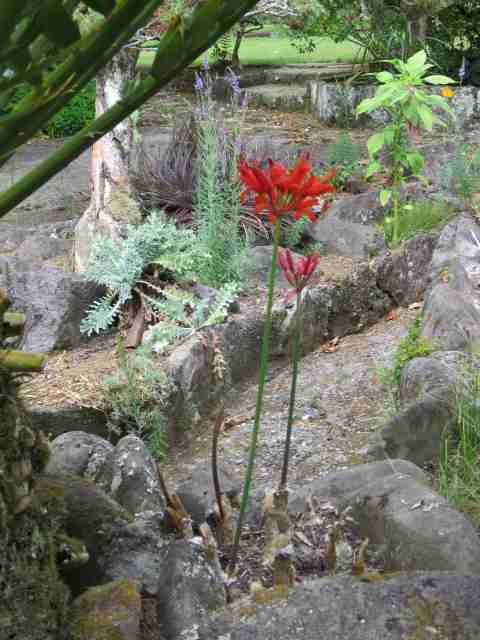
It seems that our highly prized Worsleya procera is more highly valued than we thought. I mention it most summers because it is lovely, really lovely, in bloom, usually late January to early February for us. It is unusual and even more so to manage it as a garden plant, which we do. In cultivation, it is commonly kept to a container and grown in controlled conditions. That is unless you happen to live on a granite cliff beside a waterfall in Brazil, that being its natural habitat.
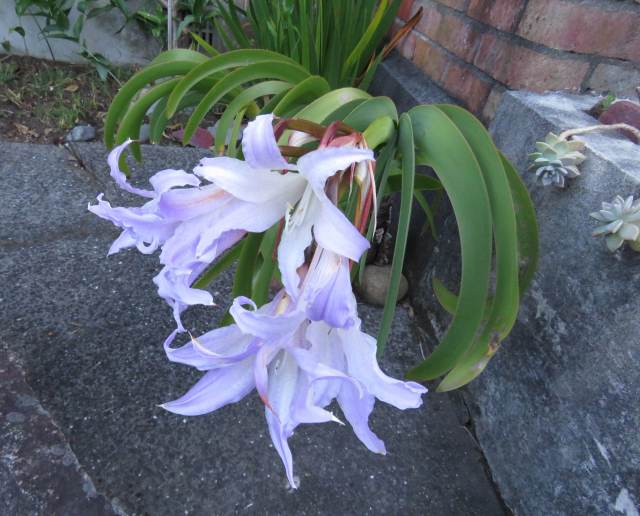
I knew it wasn’t common and that is because it is very slow to produce offsets (new baby bulbs), that while it can be grown from seed, it is not usually self-fertile and you need two different clones to get viable seed. Then it is likely to take 15 years or more from seed to get a bloom. So it is not what is known in the trade as a ‘good commercial plant’. I doubt that it is available for sale in this country.
I discovered recently that it is highly prized in Australia. It popped up on a Facebook page for aficionados of unusual bulbs in that country. Canberra daughter is developing an interest in unusual bulbs and she tells me the worsleya is a hot fashion item. She stunned me with a photo of a single bulb, close to flowering size, that she photographed at Sydney Botanic Gardens.
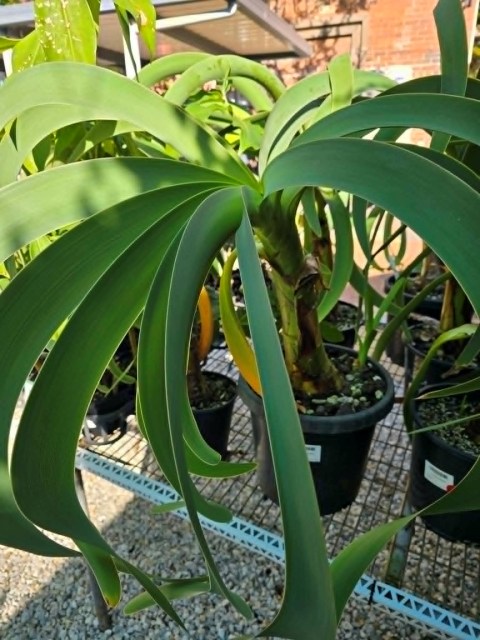
$980. Australian dollars. For a single bulb. That is $1141.74 New Zealand dollars on the day I write this. You could have knocked me over with a feather, even allowing for the bulb being blooming size. Small bulbs are available in Australia at $A90 for a one year old and $A180 for a three year old. They may flower in a decade’s time if you take care of them.

Tulip mania is the term coined for the time from 1634 to 1637 when a peculiar event happened in the Netherlands and a single tulip bulb of a desired clone could be valued as highly as ‘four fat oxen’.
Similarly, but a great deal more recently, a single bulb of a special snowdrop (Galanthus) sold in the UK in 2022 for £1,850 ($4317.09 NZ at today’s exchange rate).
The worsleya has yet to reach these heady levels but we do not have a snowdrop with a bright yellow ovary in our garden. Nor do we have a seventeenth century tulip called ‘Viceroy’. But we do have about a dozen worsleyas, of which maybe four are flowering size. Maybe the rest will bloom before we shuffle off the mortal coils in a decade or two.
I am not sure that Mark ever paid above $15 for a single bulb of any plant and he probably had to have a cup of tea and a wee lie-down to recover from that extravagance. With inflation, we might pay $30 or $35 if it was something we really wanted and we were reasonably confident it would grow and flower here, in our conditions.
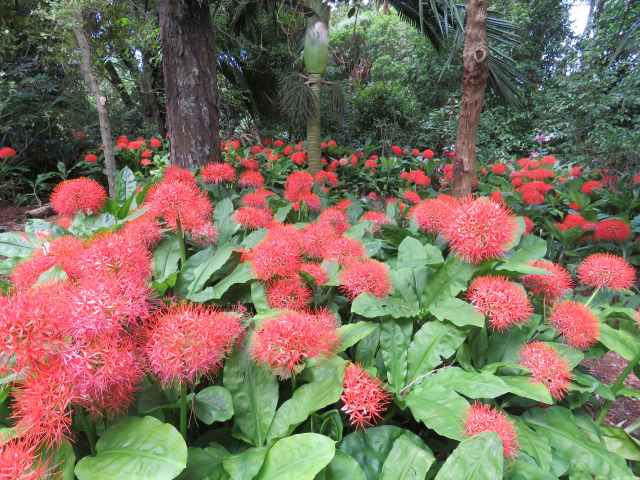
I was shocked enough to be told that somebody our Zach witnessed was paying around $40 per bulb for single potted specimens of Scadoxus multiforus ssp katherinae which were not yet flowering size. We have a very large amount of it here and it is easy to grow, to increase and to naturalise. The same can not be said of the Worsleya procera so maybe its sale price matches its rarity.


 Tikorangi The Jury Garden