
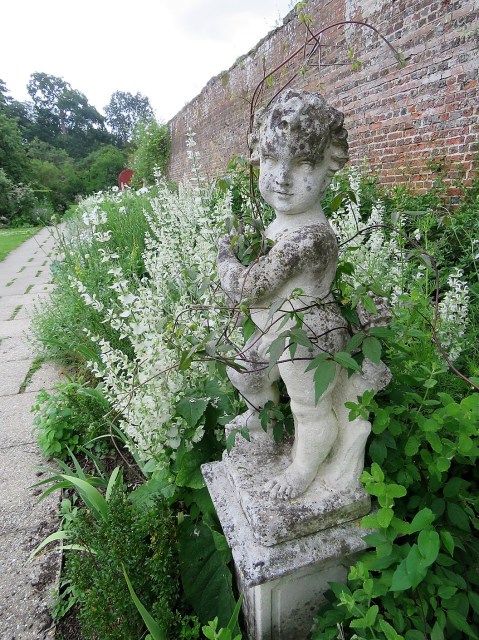
The white border at Parham
Parham was the only garden we went to on our recent trip without knowing anything about it in advance. As a result, while I have a fair number of photos and recollections, I lack an overview, a wider context. There is an interesting lesson for me there on future trips – we learn more if at least one of us does a bit of advance research on the destination. When we live so far away, making a second visit is unlikely so we need to short circuit the familiarisation step to have any hope of getting beneath the superficial.
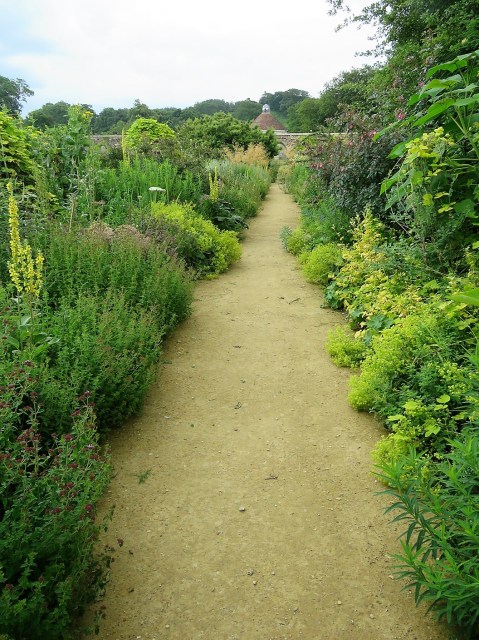
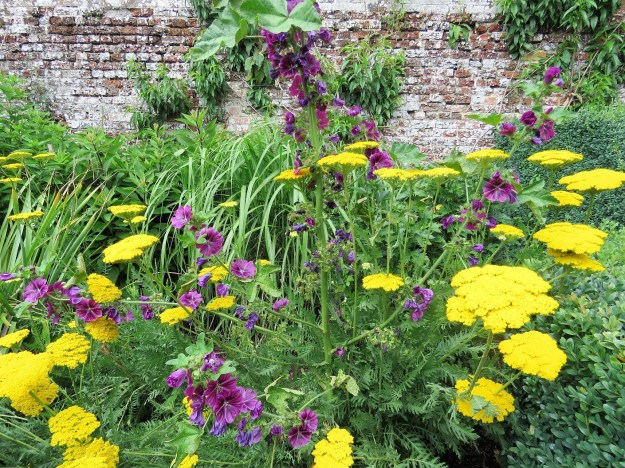
The yellow border at Parham
That is why I only offer this as ‘impressions of Parham’. Just for context, it is a private house, garden and estate in Sussex that opens to the public. They say house. We New Zealanders are more likely to describe it as a mansion. Or stately home, at least. Big, historic – Elizabethan in fact. That is the sixteenth century one, not last century’s one who is still with us. We did not tour the house. I did not even think to photograph it. Nor did we look at the estate, a 16th century deer park and working farm, or test the on-site café which serves locally sourced food including from the garden. I can report that the plant centre had some of the best displays I have seen in a garden centre and good plants on offer and that the gift shop was better than many I have visited and not exorbitantly priced. I bought myself a souvenir – a pretty milk jug with Redoute’s roses on it. I don’t even think we found the Pleasure Grounds. It was just the extensive walled gardens that we looked at. But, as you may gather, this is a multi-faceted operation which has to work hard to keep it financially viable and in private ownership.
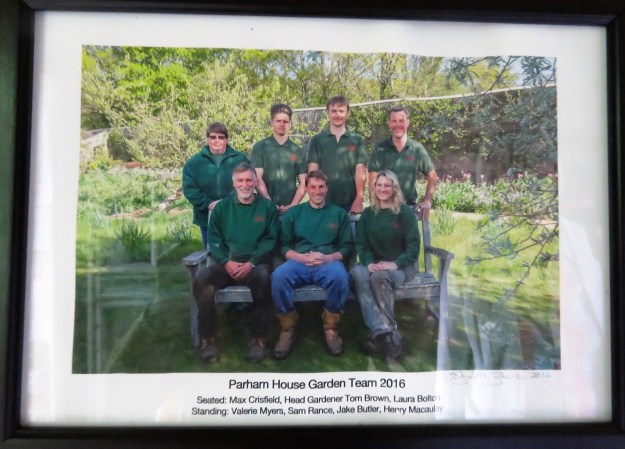 There was a team of seven hard working gardeners though I can’t tell you if they are all full time. We met the head gardener because he did his apprenticeship under the eye of our friend who took us there. Britain still has an enviable tradition of training professional gardeners. I have seen a few gardeners at work when we have been out touring, and I can tell you that these Parham ones were hard workers and focused on tasks to hand.
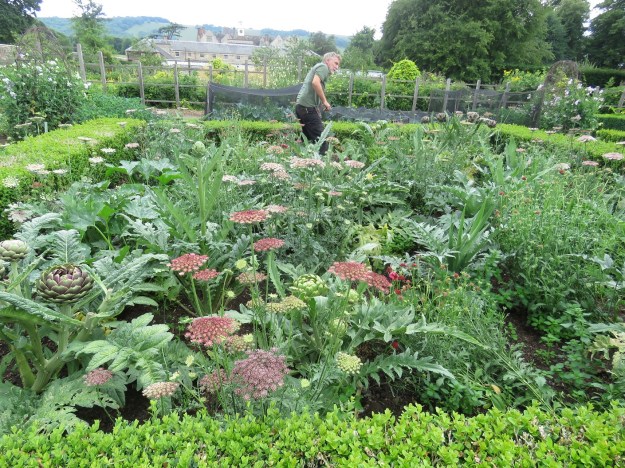 From memory, they are required to provide 30 buckets of blooms to the big house a week. That is a huge amount and they must be hard pressed in winter. But the production of both food and cutting flowers was impressive – highly productive, in fact. Also done without chemical sprays.


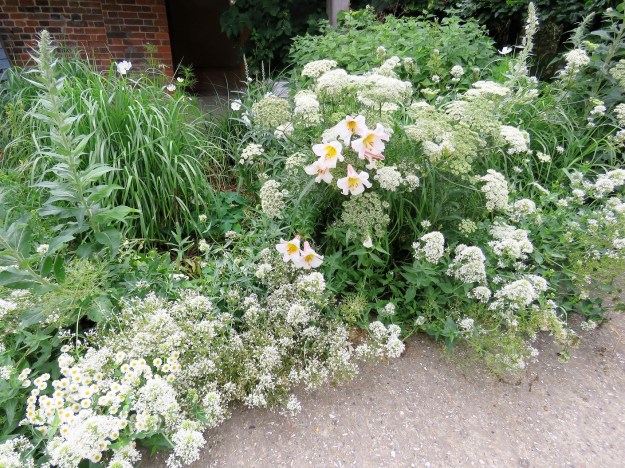
 The herbaceous borders were another modern take on classic design and techniques. The blue border was the most recent to have had a major makeover and it certainly looked glorious. I complimented the woman in blue whom I photographed strolling through the border, for her superb choice of toning colours. The yellow border was less flowery on the day but carefully composed and easy on the eye. The shorter white border was also at peak border perfection that the Brits can do so very well. If there was a red border, I missed it entirely but I do not think there was.
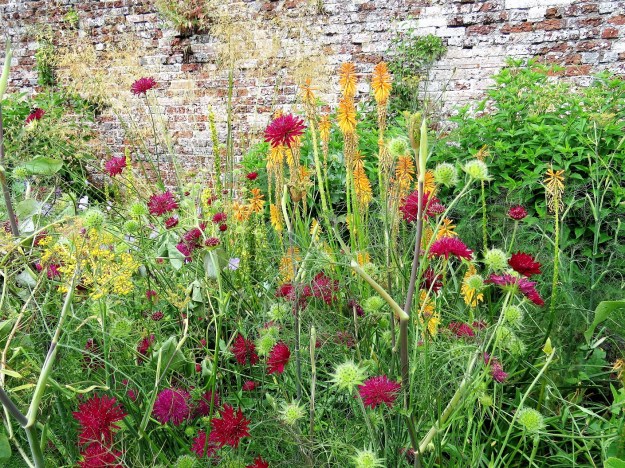
Along the back wall – for this is all contained in a walled area – were the hot, vibrant colours and combinations, many of which were designed to zing.
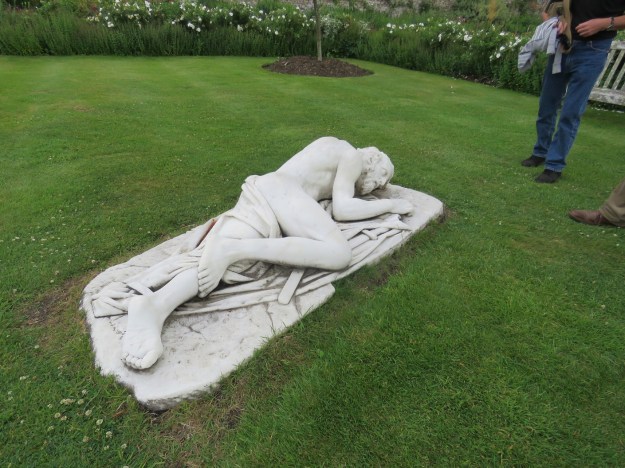
 Some of the statuary was… very white. Not necessarily to my taste. Some were more subtle than others. This was not. I am sure there will be somebody out there who can explain the significance of this figure and the inscription he is marking out with his finger.
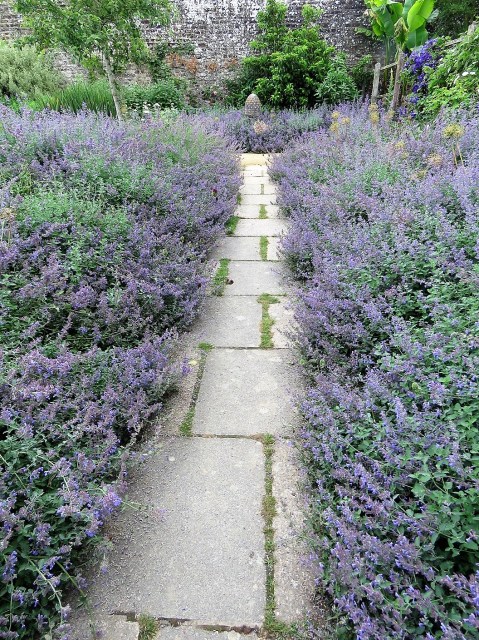
Railway tracks of blue nepeta that many of wish we could achieve in NZ but rarely succeed
What we saw of Parham’s gardens were predominantly herbaceous or productive and sometimes both at the same time. They were not flashy or even particularly innovative, but they were very good. It is an example of high level horticultural excellence. Presumably it is tourism, both domestic and international, that enables a private estate such as Parham to maintain this level of excellence.
If you want to see more photos and get more detail, I have matched again to an album on our Facebook page.

 The front garden was the first to be done and is a walled area. We have seen a number of large scale Oudolf plantings now. Bury Court is early Oudolf but, more interestingly, it is domestic and private in scale and design which makes it very different. The perennial plantings are still big, bold and bouffy but on a scale suited to this environment. I look at the photos and I see how much thought has gone into the combinations and juxtaposition of plants but when you are surrounded by them in person, it is more an experience of being enveloped by the vibrancy.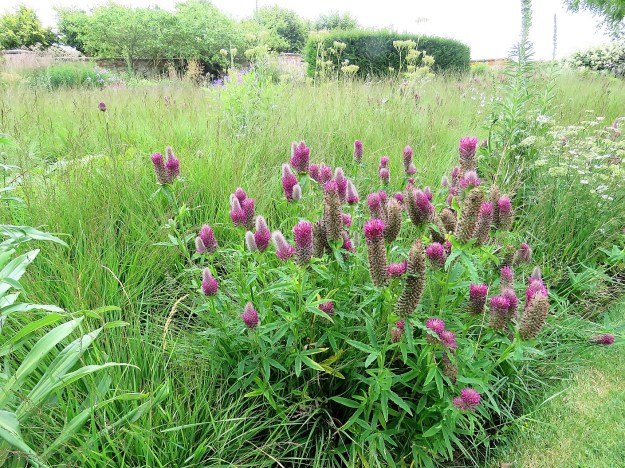
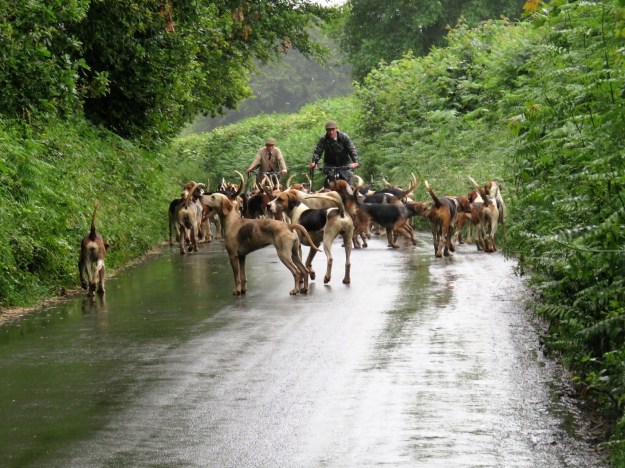 The hunt dogs! Or hounds, I have just been informed (see reader comments below). Indubitably hounds. Out for a morning run on a Devon lane with their keepers on bicycles. Beautiful hounds, so very well trained and an interesting scene but still incomprehensible to me. English garden media personality and writer of steamy romantic novels, Alan Titchmarsh, may defend foxhunting on the grounds that it is, apparently, a traditional part of country life – country life, that is, as experienced by the toffs who cry ‘tally-ho’, not so much a traditional pursuit for the peasantry. But tradition alone is not a justification for anything, really.
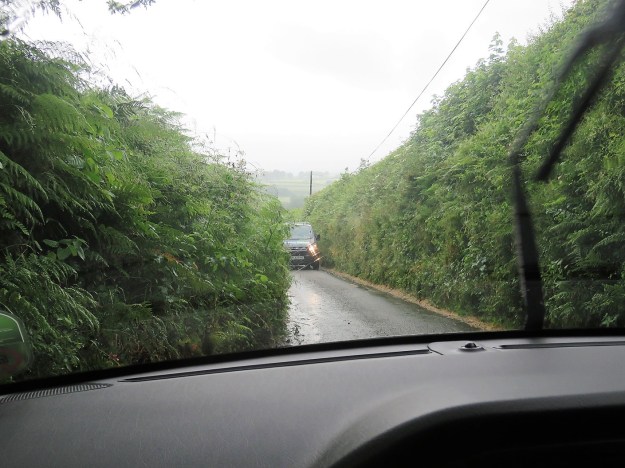 The Devon roads can be notoriously narrow, though they are by no means alone in that. These roads can carry more traffic than the upgraded, single carriageway that passes by our place at home but there does not appear to be an uproar with loud demands that they be widened, straightened and allegedly made ‘safer’ for cars and trucks. It means drivers must be fully alert, dropping speed to meet the conditions, courteous and capable of backing up to the passing bays that are dotted along these roads. It is a very different ethos to the aggressive driving on New Zealand roads. If we were more defensive, tolerant and patient drivers, maybe our corner of the world would be a better place?
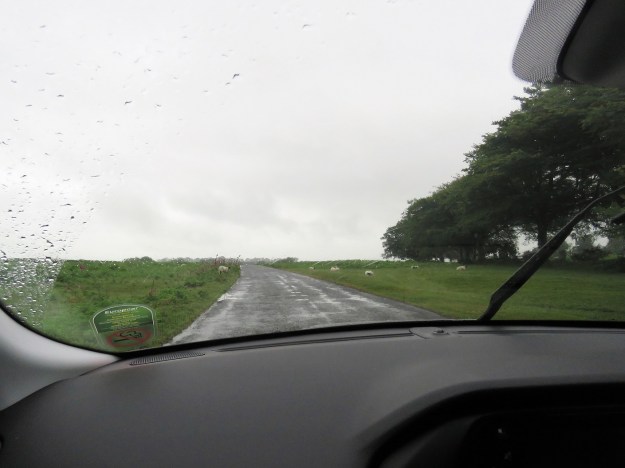 We went to south Devon to have another look at one of our all time favourite gardens – Wildside. More on this garden in a future post, but it is on the edges of Dartmoor. It rained on our day there, though fortunately it was not cold. There is a certain evocative gloom to the open moorland on a grey day with low light levels. Because I have always done my reading from across the world in New Zealand, the geographic location of different moors is hazy at best (though I think I have the heaths and heathers of Scottish moorland separated in my mind). I kept thinking of the likes of Daphne du Maurier but I see she set ‘Jamaica Inn’ on Bodmin Moor which is the next one down and Dartmoor belongs to ‘Hound of the Baskervilles’. But one can imagine this landscape with the bleak winds of winter blowing across it and it certainly has its own identity, including the roaming stock and lack of fencing.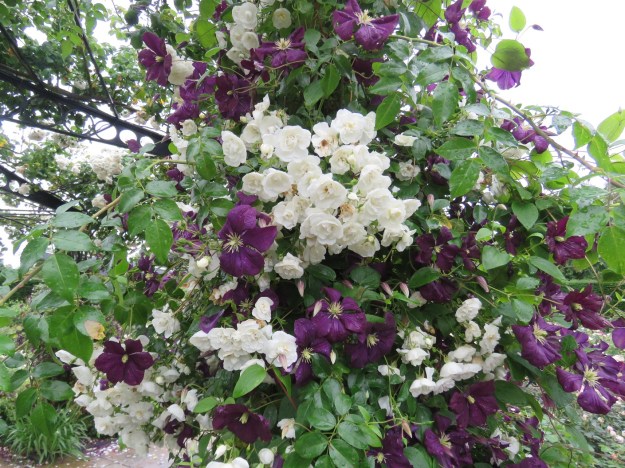
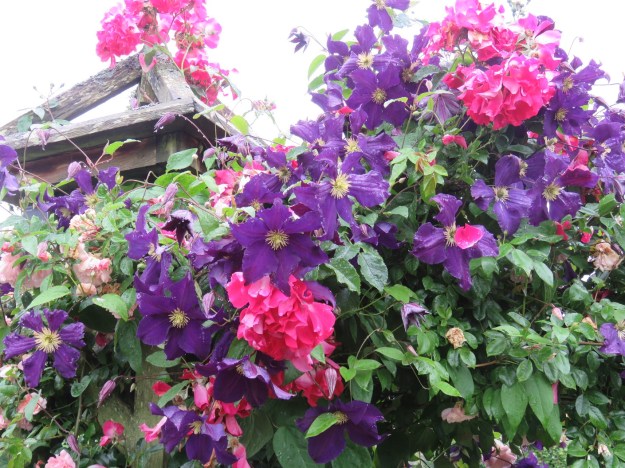 While in the area, we headed over to see the RHS garden, Rosemoor. The original garden and accompanying land was gifted to the RHS by Lady Anne Berry, now a long-time resident of Gisborne. Lady Anne had been particularly kind to us in our earlier years so we were pleased to finally get to see Rosemoor. While the traditional rose garden left me unmoved, the rose and clematis combinations in the adjacent garden enclosure were a delight.
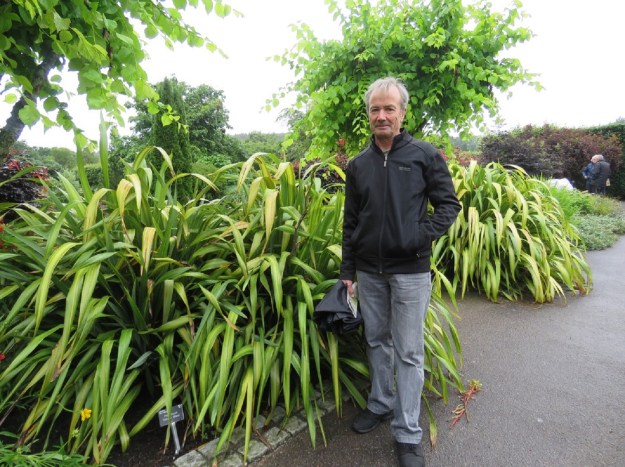 I make Mark pose for vanity photos beside what we call ‘Jury Plants’ as we come across them around the world. Part gentle boasting, part family record. In this case it is Phormium ‘Yellow Wave’, bred by his father Felix and one of the first generation of variegated flaxes for home gardens. He never received a cent for it (or a penny, as it would have been back then) and is rarely credited with it. It is not easy to keep good foliage on phormiums in New Zealand so Felix moved on to astelias and then clumping cordylines in his attempts to get an extended colour range into plants with this habit of growth and foliage. Eventually, this led to our Cordyline ‘Red Fountain’ but Phormium ‘Yellow Wave’ continues to hold some ground internationally.
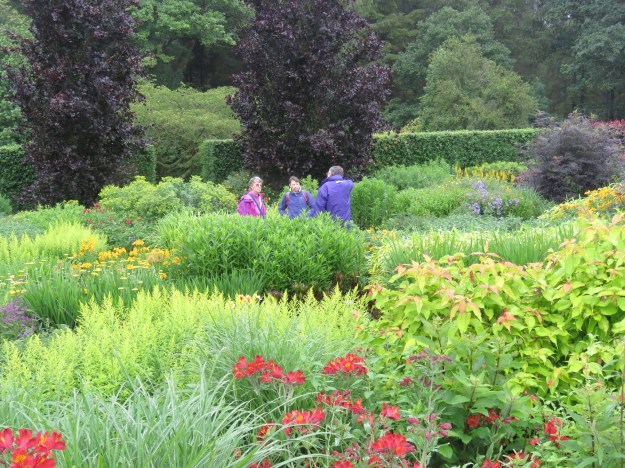 Still at Rosemoor, the herbaceous plantings are terrific. If you are looking for a middle road between the traditional herbaceous border and the grassy new wave look of Oudolf, Stuart-Smith and New Perennials proponents, you probably end up with something closer to these Rosemoor beds and borders. Lots of vibrant colour and care with combinations, often quite tight colour toning but also lighter on plant options that need continual maintenance to keep them flowering and looking good. However, these are herbaceous plantings for large, public spaces, not so much for downscaling to the home garden. You can see more in the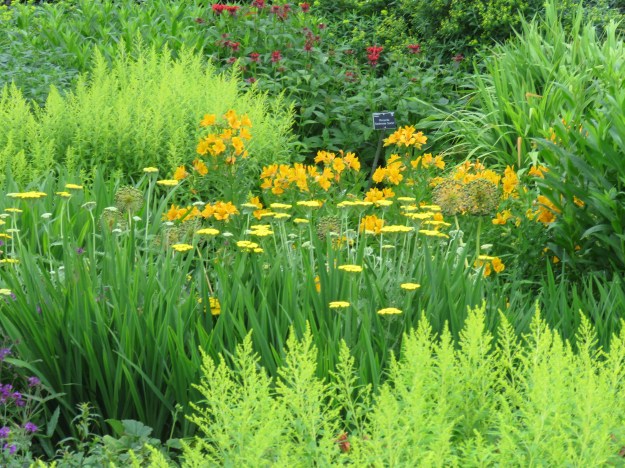
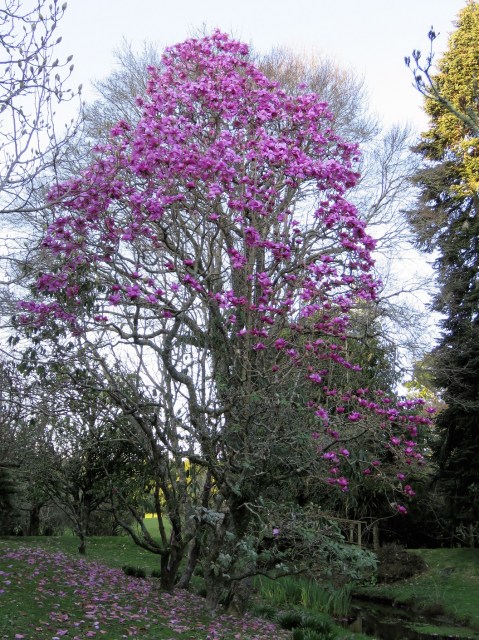
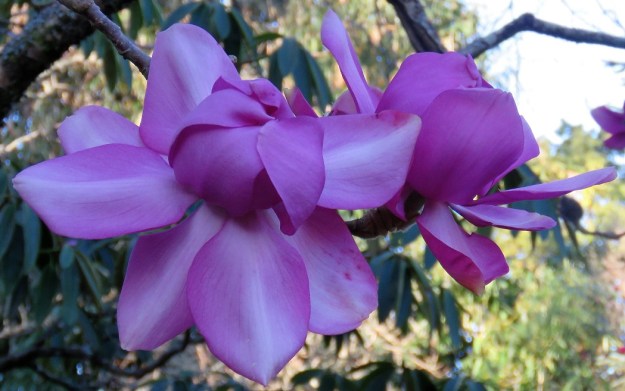
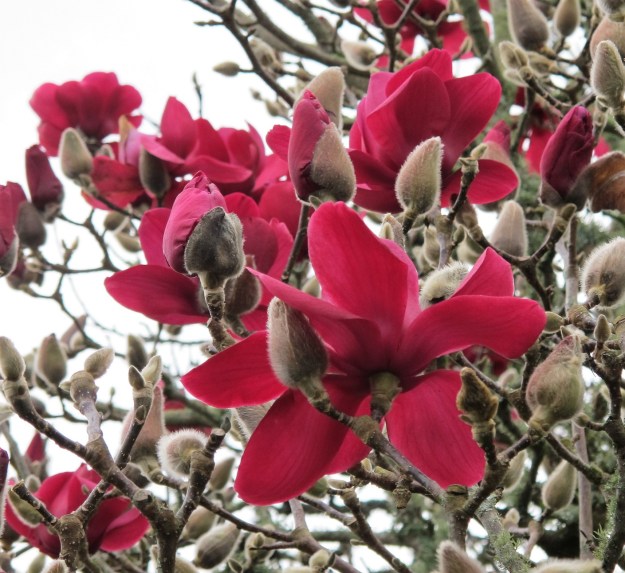
 The true ‘Lanarth’ finally flowered here in the 1960s and it became the key to Felix’s best known success – the colour breakthrough from purple into red tones, first seen in Magnolia ‘Vulcan’. The rest, as they say, is history and New Zealand is now recognised internationally as the home of the best red hybrids. These days with the downstream breeding, the purple tones of ‘Lanarth’ are being eliminated in favour of purer red shades. Now it is the case that there are several good red magnolias on the market, but no large, purple-flowered, garden-friendly improvement on the original ‘Lanarth’ that we have seen. It has been attempted. We just haven’t seen one yet that we think is as good as, let alone better than the original.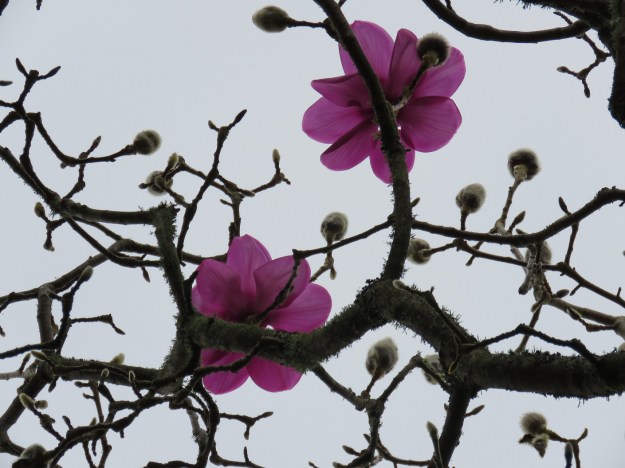


 Tikorangi The Jury Garden