

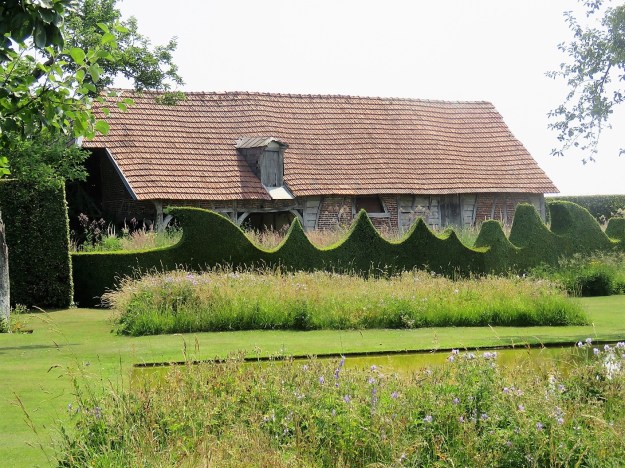
Le Jardin Plume – a modern garden near Rouen in Normandy
Green walls. Or hedges as they are usually called. We were amazed at the tightly clipped, breaking wave hedges at Le Jardin Plume in France, having never seen anything quite like it. They contain the feather garden for which the entire property is named and as such, perform both a practical and aesthetic function. On that practical level, they shelter the very large perennials which could otherwise be beaten down by summer thunderstorms and, presumably, winds sweeping across the flat landscape. And the tight clipping and distinctive form are a complete contrast to the dynamic waves of grasses and tall, slender perennials.
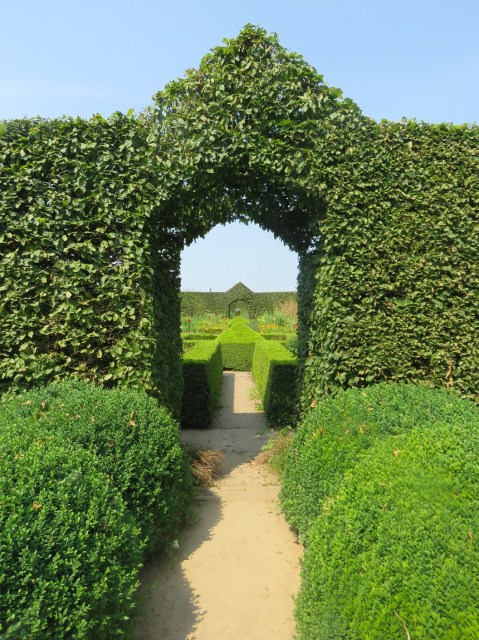 In the same garden the green walls in le jardin d’ été (the summer garden) are less unusual but still performing the dual function of both restraining and protecting extravagantly loose plantings while providing a sharp contrast in style. The hedges are the structure and form within the garden.
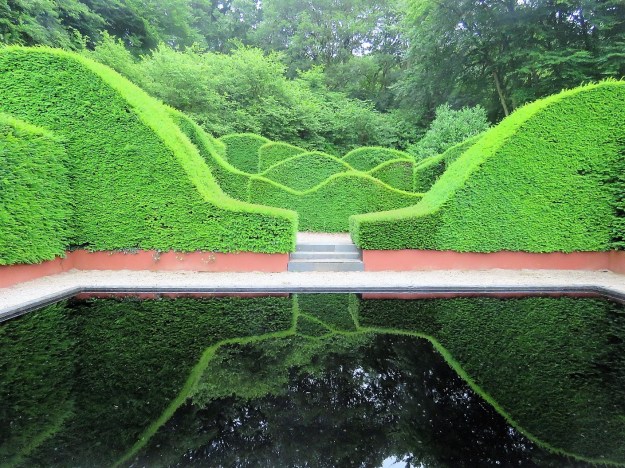
Veddw – a garden in Monmouthshire in the Welsh borderlands
We visited another heavily hedged garden in this northern summer just passed. Veddw is in the Welsh borderlands and the owners have used hedging throughout to create the form and structure they were after. In one of the hedged enclosures, they have done a gentler take on rounded shapes, evocative of their wider landscape of rolling hills. It is a sculptural approach where the interest lies in the shapes and reflections in the black pool, not in the plants themselves.
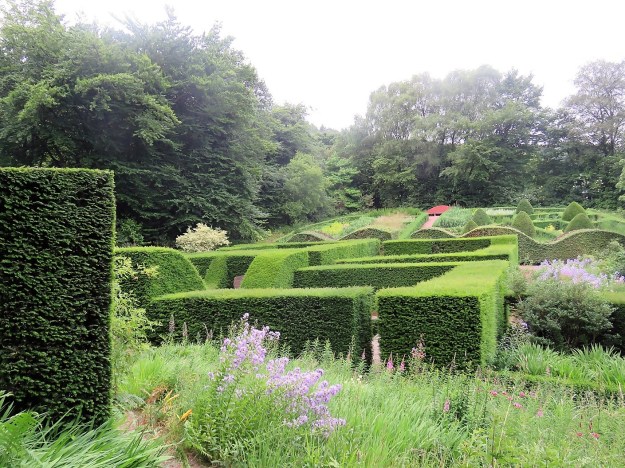
Veddw again. A garden defined by hedges
Most of these northern hedges are buxus, yew or beech. In New Zealand, we are generally less favourable towards beech because it is deciduous. Yew is deadly poisonous to stock and also does far better in drier climate than our high rainfall and humidity of Taranaki which tends to kill it off with root disease. Which leaves buxus, now much afflicted by the dreaded blight in many gardens.
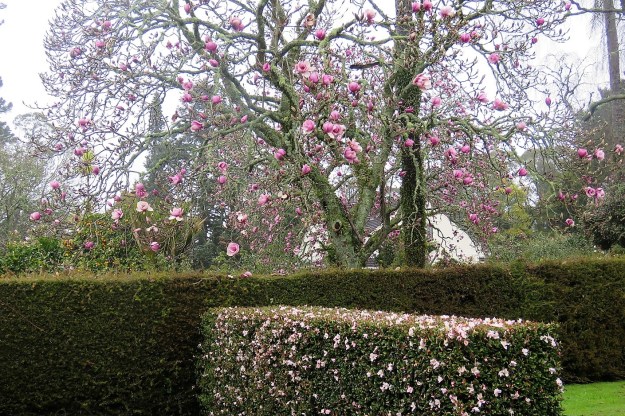
Tikorangi – the view in September of a Fairy Blush hedge and the historic totara hedge
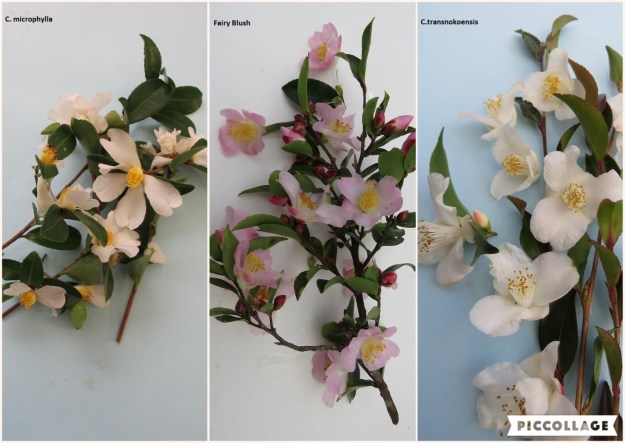
Our personal preference is for flowering hedges. Indeed, we pulled out a well-established and perfectly healthy buxus hedge to replace it with Camellia transnokoensis. It is all to do with winter blooming – the single camellia flowers provide pollen and nectar at a time when there are few other sources of this food. Our favourite camellia for clipped hedging is ‘Fairy Blush’, partly because it is our cultivar and the first camellia Mark ever named. It is also scented with the longest flowering time of any camellia we grow, coming out with the sasanquas in autumn and flowering right through to spring.
The aforementioned C. transnokoensis has a shorter flowering season but attractive dark foliage and small, pure white blooms. The third camellia we have made extensive use of for hedging is C. microphylla, even though it flowers earlier in autumn – pure white flowers again and small leaves that clip well. Both these two species set seed. If you can find them growing, you may well find seedlings germinated around their base. Or check for seed in autumn if you are a patient gardener who is willing to put a bit of effort into a free hedge.
All our hedges are flat topped affairs, lacking the panache of both Le Jardin Plume and Veddw but I am eyeing up a somewhat redundant length of buxus hedging and wondering about reshaping it to an undulating caterpillar.
I have been told that New Zealand features more hedges per average garden than most other countries. This may be to do with our being a windy country. Equally, it may be that plants are relatively cheap here and require less capital outlay than building a wall in more permanent materials. However, what may have started from pragmatic origins is a far more environmentally friendly option these days. My advice is to pick a hedging option that will only require clipping once or twice a year and if you are going to be adventurous with the plant selection, do some research first. Hedges need to be from plants that will grow back from bare wood and some less common selections like miro (instead of yew) and Magnolia laevifolia (formerly Michelia yunnanensis) can take a fair number of years before they achieve the dense appearance of a hedge.
We are pretty proud of our remaining length of totara hedge, planted around the turn of last century by Mark’s grandfather or great grandfather and kept clipped for nigh on 120 years.

First published in the September issue of NZ Gardener – my penultimate or maybe final column for this magazine.
 I have only seen the white garden at Sissinghurst once and, to be honest, it did not inspire me at the time. I need to go and have a second look but certainly leading English landscape designer, Dan Pearson’s comments on white gardens in general and Sissinghurst in particular, rang true for me. “Too many whites together in one space”, he wrote. Vita Sackville West called it her ‘grey, green and white garden’. Maybe over the years, more attention had been given to the white flowers at the expense of grey and green tones? Or maybe it was just the sheer size of it and the tight constraint of all those neatly clipped hedges and edgers that did not inspire me. And the memories of all the customers I met in the trendy nineties, mostly of the Ladies Who Lunch brigade, buying plants for their white gardens. There must have been an awful lot of such gardens going into aspirational New Zealand real estate back then.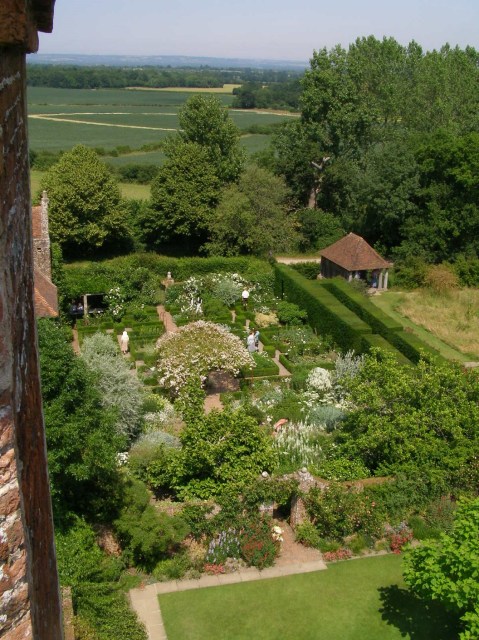
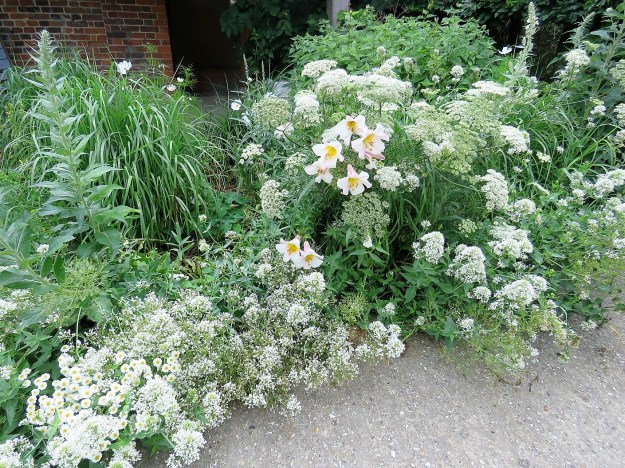
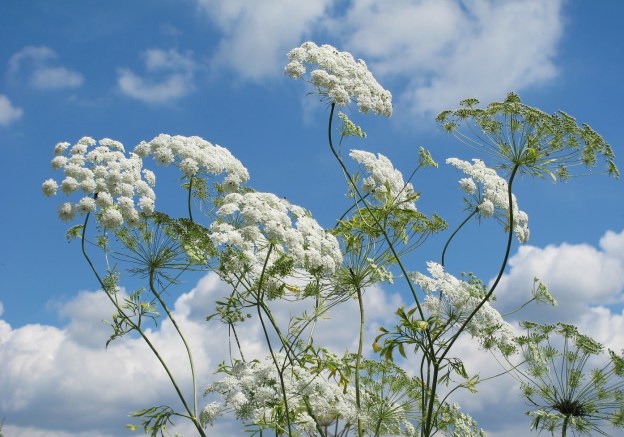
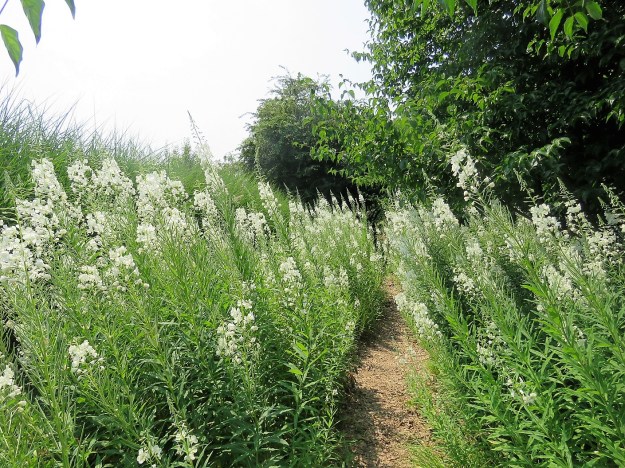 The white avenue of Epilobium angustifolium ‘Album’ at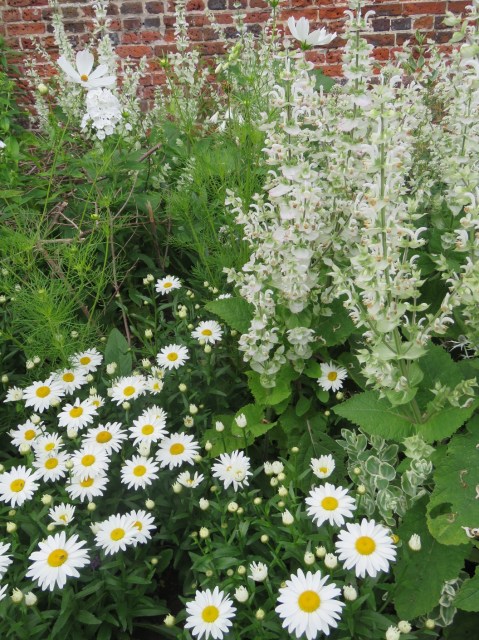
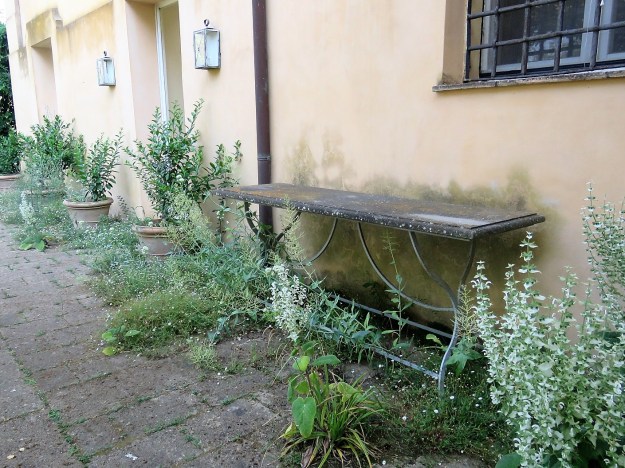
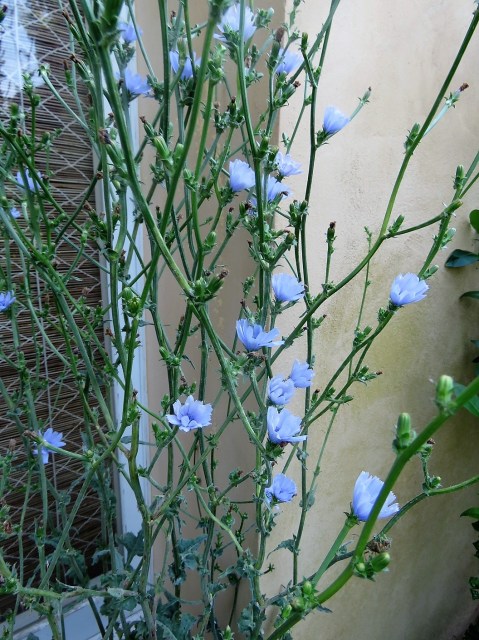

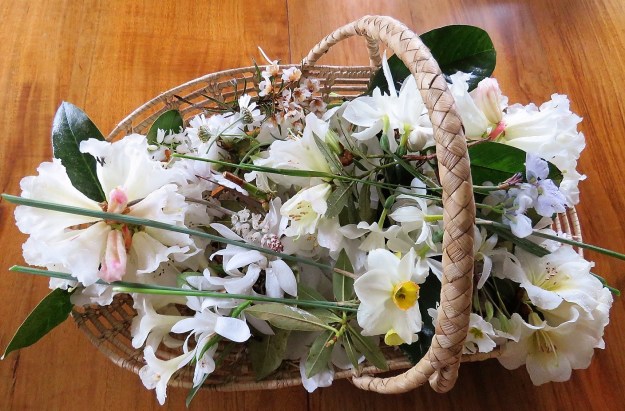 I have been drafting a piece about contemporary white gardens for a publication, so my mind has been on white blooms. Yesterday, in the post-election hiatus and the gloom of a wet, grey day, I headed round the garden with my vintage flower basket to pick a selection of white and largely white flowers.
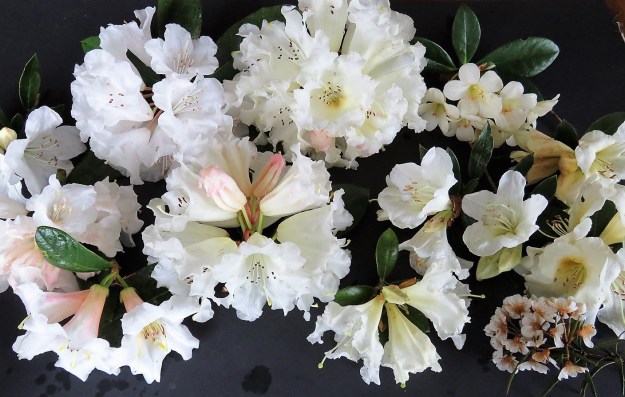 Ringing in my ears were Dan Pearson’s words above, even though I had read them so really they should have been flashing in front of my eyes – visible rather than audible, so to speak. I had not really got my head around the different shades of white before. Neither, I am sure, had the many women whom we used to describe as being of the Remuera genre back in the 1990s, but who would be known as “ladies who lunch” these days. These were the ones who were hellbent on putting in a white garden, à la Sissinghurst. They were numerous and, in our peak retail days, we met a fair number of them. I recall some for whom white flushed pink was out of the question. Candidates for their white garden had to be pure in hue. White and nothing else. I wish I had the Pearson quote back then. There are many, many plants that open from a pink bud to a white bloom.
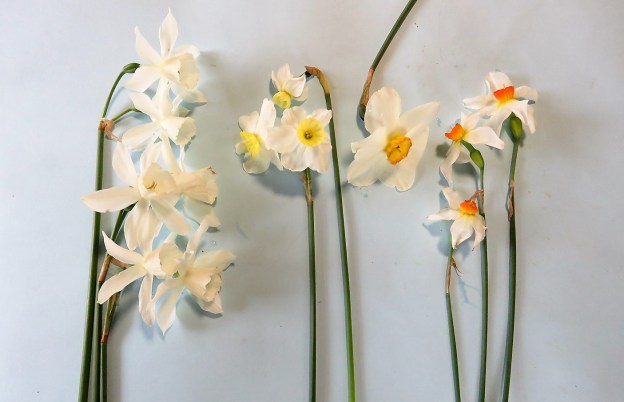 Is Narcissus ‘Thalia’ (on the left) acceptable in a white garden, though it is cream, not white? If ‘Thalia’ is acceptable, how about the narcissus with the pale lemon corona and white petals? And if that lemon corona is still okay, does this go across to ‘Beryl’ and other poeticus hybrids with white petals and small coronas which are somewhat stronger coloured and into the yellows and oranges? Where is the cut-off point? I tell you, this white garden business is fraught with problems and judgement calls.
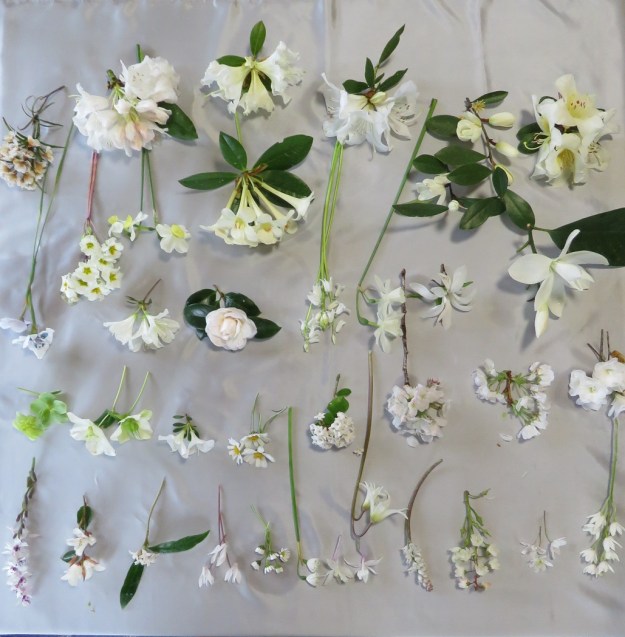 Are green flowers permissible? If so, why not the white Moraea villosa with blue peacock eye markings or Lachenalia contaminata or Onixotis triquetra which are white with maroon markings? If the latter two are not acceptable, does that rule out the white rhododendron with maroon spotting. Is it not sufficiently pure? Is it okay for a white rhododendron to open from a soft pink bud? No? How about a soft lemon bud or one with a green cast?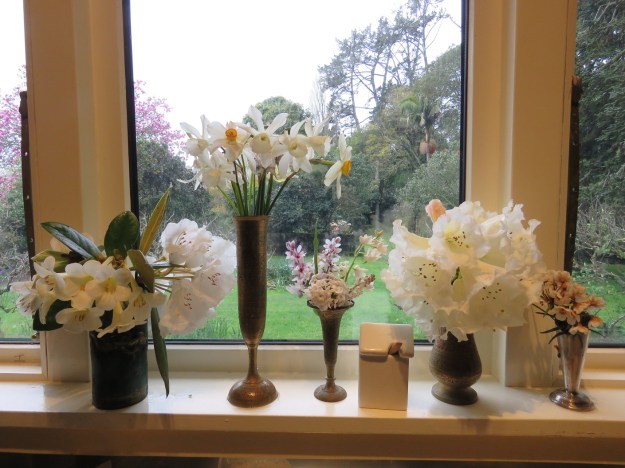
 Why so grey, New Zealand? Each time we fly somewhere, Mark looks out the plane window and winces as he sees the sea of grey roofs. It is quite a while since we had to re-roof a house, but I assume roofing is available in other colours? It is not compulsory to roof in grey, is it?



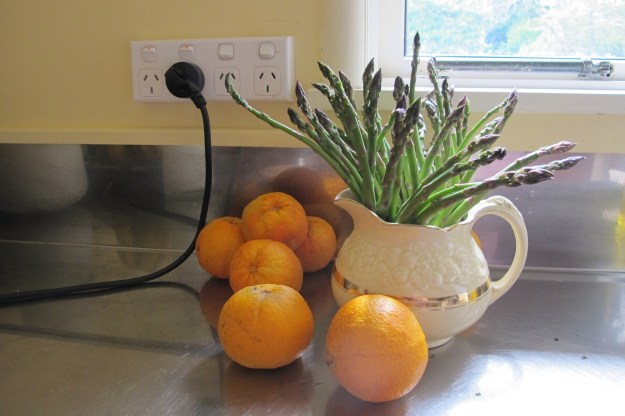
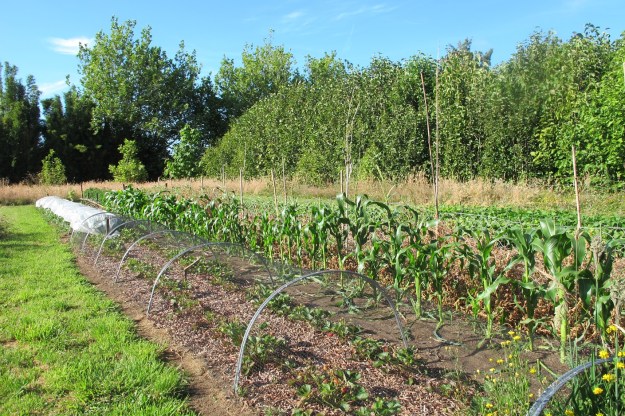
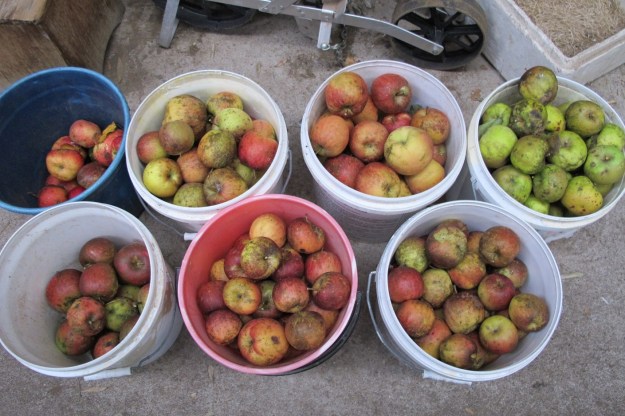
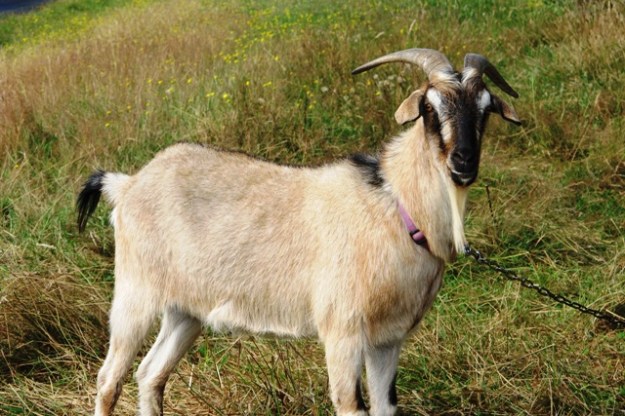 All this was eclipsed, I must say, by the gentleman from down south somewhere who took it one step further on social media. There was, he asserted, no reason for hunger in New Zealand when people could grow their own food and head out to the country to kill a wild goat for meat. I do not think he meant a tethered goat like this handsome fellow from up the road. I also suspect he did not get out much and maybe thought it was still 1950 when jolly practical young fellows could head out with the gun and shoot a rabbit or goat for the pot, all the while speaking with a fridge and freezer full of meat already paid for, packaged and ready for his wife to cook for dinner that night. Bah humbug.
 Tikorangi The Jury Garden