
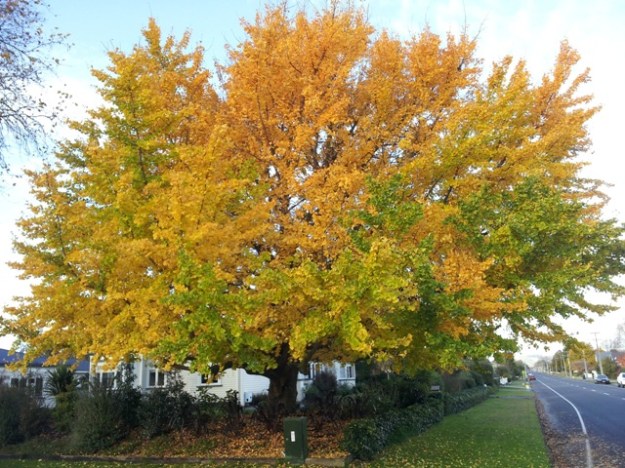
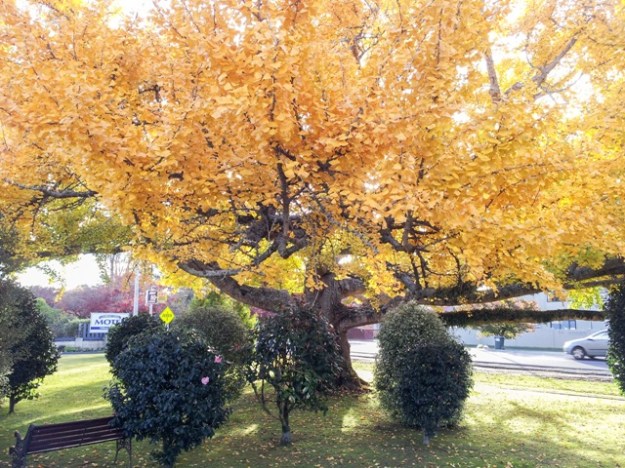
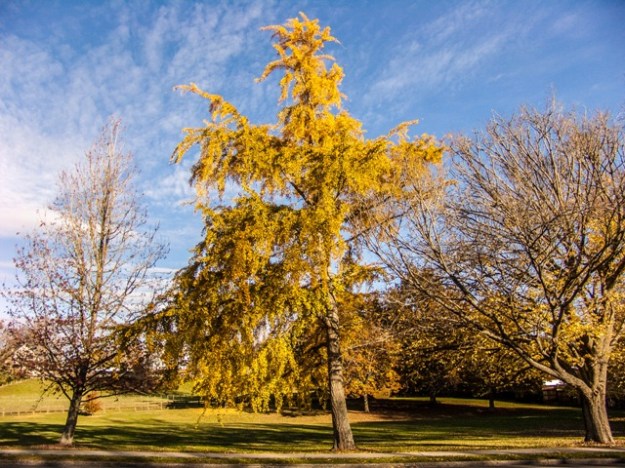
This ginkgo tree on the corner of Hall and Williams Streets in Cambridge gives lie to the 2.5 metre claim, though it is over 10 years of age. (Photo: Michael Jeans)
I am still chuckling. While I was preparing the recent column on ginkgo trees, a friend commented that she had one at the bottom of her garden and very pretty it is, too. Knowing she lives on a small town section, I replied that I hoped she had allowed plenty of room for it to grow. No, she assured me. She had looked it up and it only gets to 2.5 metres.
Raising my eyebrows, I sent her the Wikipedia link which declares ginkgo trees in the 20 to 35 metre range, with some specimens in China known to have reached 50 metres. I could feel her blench, even down the internet cable. It turns out that the internet site she drew her information from was a nursery selling the plants which stated 2.5 metres high in 10 years. Ginkgos are pretty slow growing but we would rate 2.5 metres as very conservative. We would expect that in 5 years here. And even in our nursery days, I do not think we would ever have declared a potentially huge tree as a suitable option for small, town gardens.
For as long as I can remember, the convention in this country has been to declare sizes on plant labels based on an average expectation of growth in 10 years. Problems come when the person writing the label may never even have seen the plant at 10 years of age, let alone 20, 30 or 40 years. We have always understood that the 10 year estimate came because that is the usual life expectancy of a plant in a New Zealand garden but I have no idea if that is true. The cynic in me says that it is more likely to be that customers would be frightened off purchases if they knew the real potential size of many trees and shrubs. Years ago, I wrote a series of columns on large, middle sized and small trees for gardens and a colleague chided me. I should not give mature sizes, she told me, because if customers knew those, they would never buy the plant.
As I mentioned recently in Garden Lore, it is easy enough to plant small specimens but if they outgrow their allotted space and become a problem, it can be very difficult and extremely expensive to get rid of them. It is also such a pity, particularly with trees. How much better is it to get the selection right from the start, so they can bravely grow on and reach their potential through the decades?
The problem often lies with impatient gardeners or home owners. Dear reader, Sod’s Law says that if a plant grows rapidly to the 3 metres you want, it is either very brittle and won’t last long, or it will continue growing to a much larger size, although the growth rate may slow. It is not going to reach the height you want and obligingly stay that size.
Experienced gardeners know that declared sizes are an inexact business at the best of times. A huge amount depends on conditions – sun, shade, wind, temperature, drainage, soil type and other variables. Geography plays a big part, both across the world and even within New Zealand. Plants grow more slowly and tend to stay more compact in colder climates.
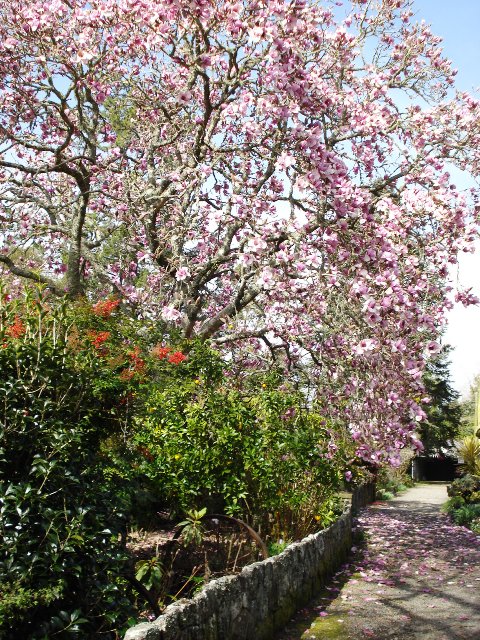
Magnolia Iolanthe is not going to stop growing when it has reached 2 or 3 metres
I suggest you seek your advice from a number of different sources. Don’t accept a 10 year height as a final height and don’t expect that to be 100% accurate in your situation. It is only a guide and some guides are more accurate than others. We once found our magnificent Magnolia Iolanthe declared as a two metre high tree in a retail outlet.
If you want a tree that is going to be a focal point, consider spending more and buying an advanced grade specimen. You are paying to get a jump of several years in growth and that can make quite a difference in a small garden if you want instant impact. But keep to the slow growing varieties which will stay smaller. It may look as if you are getting more bangs for your buck if you buy a larger, fast growing one but really, you are just buying a vegetable time bomb.
Where space is limited, take potential width into account as well as height. A multi stemmed plant will generally be much wider than one with a single leader. Width can be a greater problem than height.
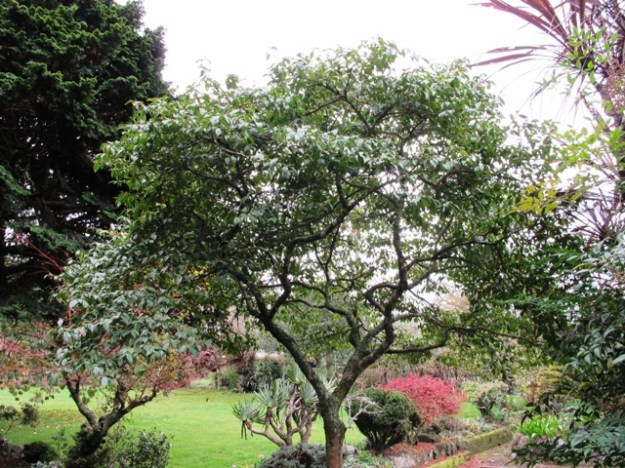
A mature Camellia Tiny Star makes an almost perfect small tree but it takes many years to get there
I would rate Camellia Tiny Star as close to perfection in a small tree – single trunked, gentle shade, evergreen, small foliage and plenty of tiny flowers, doesn’t get diseased, needs no maintenance and has reached its full potential. The downside is that it took a lot more than 5 years to get there.
First published in the Waikato Times and reprinted here with their permission.
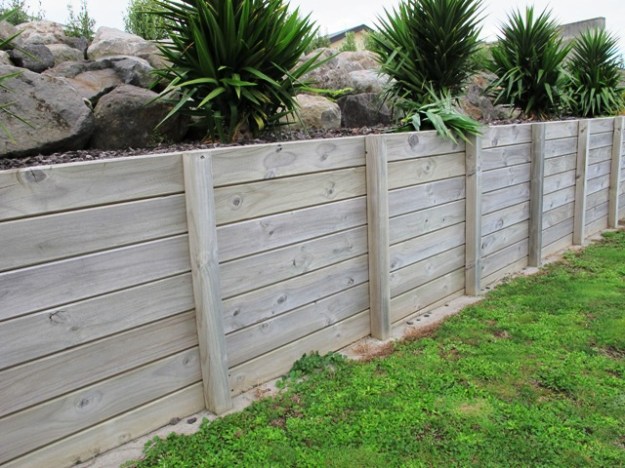 1) Timber remains the most common choice, probably based on price and the DIY ethos. It is holding back a considerable weight of soil that will be wet and exerting outward pressure, so strong construction is critical. Walk around established suburbs and you are sure to find older timber retaining walls bulging outwards. You need to get the supports right, both horizontally and vertically, to keep it all in place. Milled timber must be tanalised to ground retention grade or it will rot quickly.
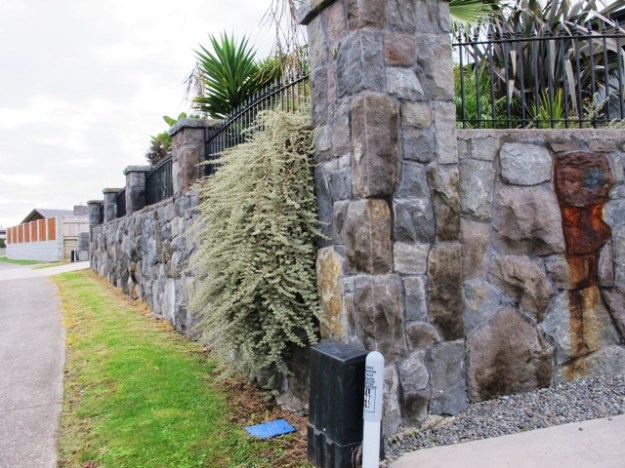 2) A cut stone wall is permanent, aesthetically pleasing and probably the most expensive option. The part-time stonemason here critiques my photos of modern stonework, pointing out that the stones should be keyed in to each other (as brickwork is). You should not be able to pick out vertical lines running down the wall because these are a point of weakness which indicate that it is the mortar holding the stones together. I mention this in case you decide to commission a stone wall of your own.
 3) Immediately next door to the attractive stone wall is the DIY option – although probably involving some lifting machinery to get the rocks in place. These have cement laid between them, which is unlikely to be structural but merely to keep out weed growth. Keen gardeners might prefer to plant between the rocks. Interestingly, some gradient has been left here rather than the vertical cut seen on the adjacent stone wall. Allowing a gradient reduces the outward pressure the retained ground will exert.
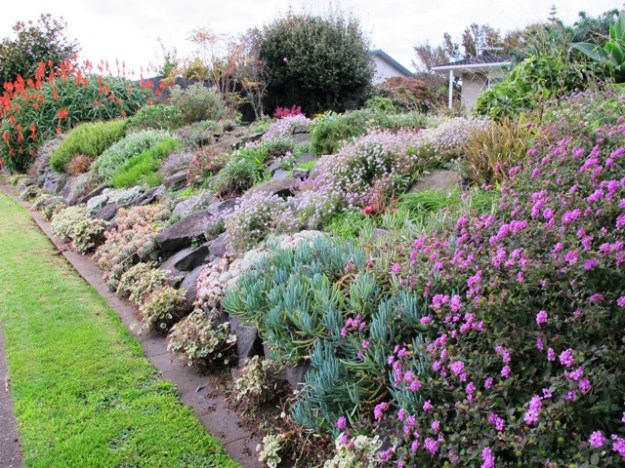 4) Further down the same street, I found the true DIY option. Smaller stones, able to be lifted by one or two people, have been placed and the area has been turned into a rockery on a sloped gradient again. Once established, plant roots will hold a certain amount of soil in place. The owner of this frontage is clearly a keen gardener.
 5) Ugly functionalism at its worst – and I can say that because this is on a property we bought. Concrete blocks have been used to retain the straight sections, poured concrete on the curves. It does the job. That is all there is to say. If I still lived in that house, I would be contemplating plastering and painting the retaining walls to try and make them a little less brutal.
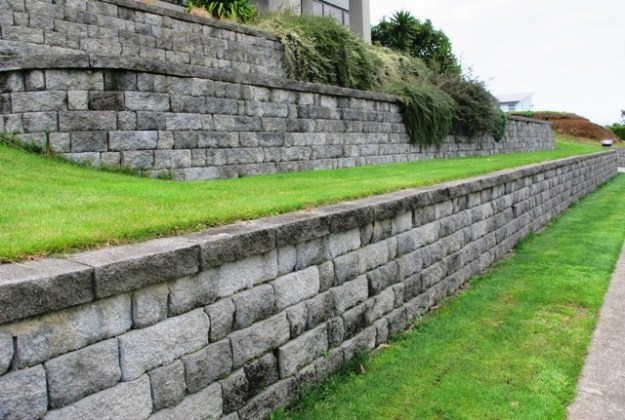 6) Faced with a similar situation to the preceding photo, this example shows what a little more thought, imagination and money can achieve. These are blocks – though whether a soft stone or aggregate, I am not sure – but a much superior look in aesthetic terms with the softer edges and random sizes. What also makes a big difference here is the flat capping on the top of the retained sections. It is a stylish finishing touch.
 7) The same bottom layer of retaining wall has been used throughout this modern subdivision. This house shows a mix of materials used in the quest for privacy, ground retention and street appeal. It was so well executed that I suspect a professional was employed to achieve this effect. The usual advice is not to mix materials but you can see the use of cobblestone bricks, timber, hedging and a relatively wide palette of plants. Prostrate plants are being used to retain the sloping bank.
 Tikorangi The Jury Garden