Author Archives: Abbie Jury

Unknown's avatar

About Abbie Jury

jury.co.nz Tikorangi The Jury Garden Taranaki NZ

Garden lore

“Woman has no seductions for the man who cannot keep his eyes off the magnolias.”

Anonymous, from Up the Garden Path by Laura Stoddart.

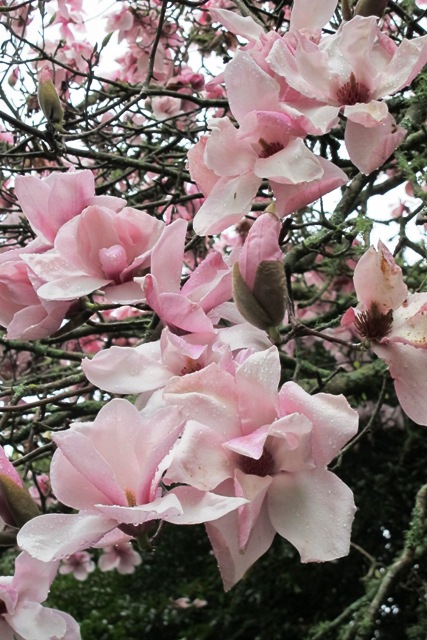
Magnolias and lawn spray do not mix. This one is Sprengeri diva

Magnolias and lawn spray do not mix. This one is Sprengeri diva

Magnolia problems
If you insist on spraying your lawns, and many do, then get onto it straight away. Many of the common lawn sprays are hormone-based. If you delay any longer, you risk causing severe damage to deciduous plants just breaking dormancy. It doesn’t matter how careful you are – spray drifts invisibly and the slightest whiff can damage other plants at critical times. Kiwifruit are particularly sensitive and so are magnolias.

There are two common questions about deciduous magnolias we are asked repeatedly, year in and year out. The first is related to malformed leaves, or sometimes defoliation on one side of the tree. Almost invariably, we find the enquirer has sprayed their lawn for moss and flat weeds. Of course, magnolias are often used as lawn specimens. So if you must spray, get it on as soon as there is a fine, calm day. It should not affect your magnolia at this time of winter. If you leave it until spring is advanced, there will be damage and it can be severe and unsightly.

The second common question is about completely malformed flowers on magnolias. Possum damage. You just need one critter who develops a taste for them and it can take out pretty much an entire season of blooms. It nibbles in from the top to eat the bud so you can’t spot the damage from below.

First published in the Waikato Times and reprinted here with their permission.

Plant Collector: vriesea

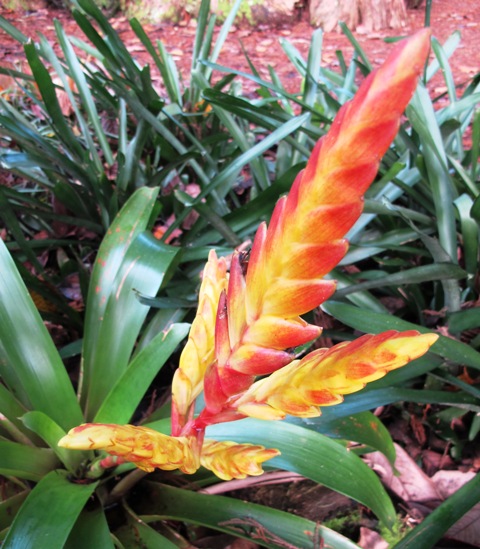
A vriesea, but we are not sure which one

A vriesea, but we are not sure which one

In the depths of winter, most of the bromeliads come into flower – an exotic counterpoint to wintery gloom. Bromeliads are a surprisingly diverse plant family. The best known brom is the pineapple but fewer realise that tillandsia or Spanish moss is also a member. The vast majority come from the warmer climes of Central America. This one is a vriesea. It will be a named cultivar but we lost the labels in the mists of time. Unlike many in the family, it is not prickly. Its foliage is just an anonymous looking green rosette, really, which holds water and also traps an abundance of falling leaves and debris. Then it puts up this flower which lasts for many weeks, stretching into a couple of months. The bloom is like a flat wax cast, almost two dimensional and of such heavy substance that it is unaffected by the weather.

Like many bromeliads, the vriesea is epiphytic and generally self sustaining. It draws all the sustenance it needs from the air and rain and will grow perched in the fork of a tree or on an old stump. This one is in the ground but it will never develop much of a root system.

We grow most of our bromeliads in protected woodland conditions with high shade from evergreen trees. It can get cold for them, but they never get any frost. We go through and pluck out debris and remove dead leaves from time to time and in return, they are totally undemanding and surprise us with the most wonderfully exotic blooms.

First published in the Waikato Times and reprinted here with their permission.

Flower Carpet Roses

Flower Carpet Appleblosson - one of the prettiest of the series

Flower Carpet Appleblosson – one of the prettiest of the series

When I wrote about roses a couple of weeks ago, I mentioned the Rose Flower Carpet series in passing at the end, noting their absence yet again from the Rose Review. One of the comments I received in reply acknowledged that absence and noted: “the Flower Carpet range is part of the rose scene here and overseas”.

For readers who don’t know the history, the Flower Carpet series of roses hit the retail scene with a roar close to two decades ago. Most roses in this country are grown by a handful of specialist nurseries and the production is tightly controlled because so many varieties can only be produced under licence. At a time when the market was starting to call out for easier care roses that could be grown without the usual recommended spraying routine, nurseries were slow to react. Their focus remained on more beautiful flowers, too often at the cost of good garden performance.
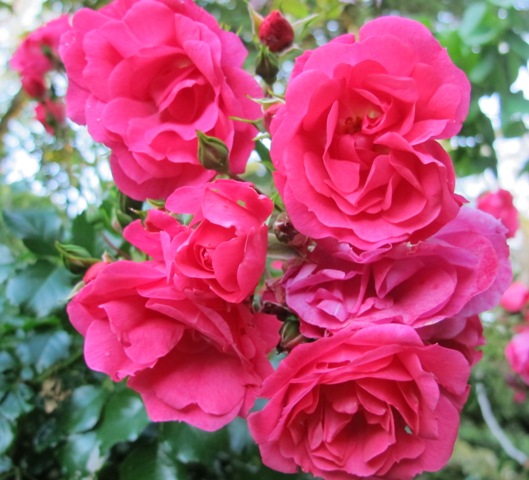
Flower Carpet Pink - rather bright but undeniably a fantastic performer which keeps wonderful foliage

Flower Carpet Pink – rather bright but undeniably a fantastic performer which keeps wonderful foliage

Flower Carpet Pink (the first of the series) was launched with an unusually strong marketing campaign and its production came through general nurseries rather than specialist growers. Sales were made through the big box stores as well as the usual retail garden centres. Gone was the traditional prestige of roses, the romance, mystique, fragrance and cut flower potential. This was a new generation of utility rose with a utility name. It was followed by the rest of the series, identified by colour, not by evocative names – Flower Carpets White, Appleblossom, Red, Yellow, Scarlet, Gold, Coral and now Amber.

The market place seized these roses with alacrity. They promised to be high health and require very little care. The purists sniffed and derided – and still do to some extent. Many looked for fault. But sales figures do not lie. While the initial spike could be attributed to an aggressive marketing campaign, the endurance of these varieties now should force a rethink from the doubters. There have been 2 million sold in NZ alone, 75 million internationally. They are here to stay and the reason is that people buy them because they make good garden plants. By now they have amassed goodly swag of international rose awards too.

Utility roses the Flower Carpets may be, but they deliver on health and performance and we all need some plants in our garden that are undemanding and reliable. Not that they are all equal. The first release, Pink, is a fantastic performer but a hard, somewhat garish colour. It creates a lovely bright spot if you situate it in a very green garden, but it lacks subtlety. It is a bit “look at me, look at me” when surrounded by other colours. With my inside info, I can tell you that it is much favoured in the UK where lower sunshine hours and lower light levels mean that people favour bright spots of colour.

Flower Carpet White growing growing through a dwarf maple

Flower Carpet White growing growing through a dwarf maple

White remains the best seller in New Zealand. I have it both grafted as standards and as a shrub rose. It flowers on and on and on. It still a few flowers right now in mid winter. It is a terrific performer and completely reliable, in my experience.

Appleblossom is arguably one of the prettiest in flower form and colour, but its flowering season is shorter and the one I have in partial shadow does tend to ball in heavy rain. If it wasn’t a big standard, I would move it because the shrub ones in full sun are much better.

I didn’t keep Red (but that may have been issues with the position I chose to plant it), and Yellow is a bit average in my experience, but Coral has been a surprise as a top performer. It is a single (just one row of petals) and the trouble with single flowers is that as soon as a petal drops, the whole flower falls apart quickly. Coral just has so many flowers that it doesn’t matter and I have found it more upright in growth than the yellow.

I am told both Amber and Scarlet are very good, but I haven’t found a place for them yet. These two are the first releases of the next generation of Flower Carpet roses. The initial six colours were all the work of the late Dr Werner Noack, a German rose breeder who started work over 30 years ago on breeding healthier garden roses. Now the mantle has fallen to his son. Look out for Pink Splash (the first bicolour and a sport of Pink) and Pink Supreme.

I would not only grow Flower Carpet roses. There are others I like too, especially for picking. But I would certainly miss them in the garden if they were removed. They are the best garden plants in terms of flowering season and health.

In the interests of disclosure, I should note that the company which manages the Flower Carpet series also manages some of our Jury plants internationally. In practical terms, what this means is that if I did not think the roses were good, I would remain silent.

White again, much favoured by New Zealanders

White again, much favoured by New Zealanders

First published in the Waikato Times and reprinted here with their permission.

Plant Collector: Cycas revoluta

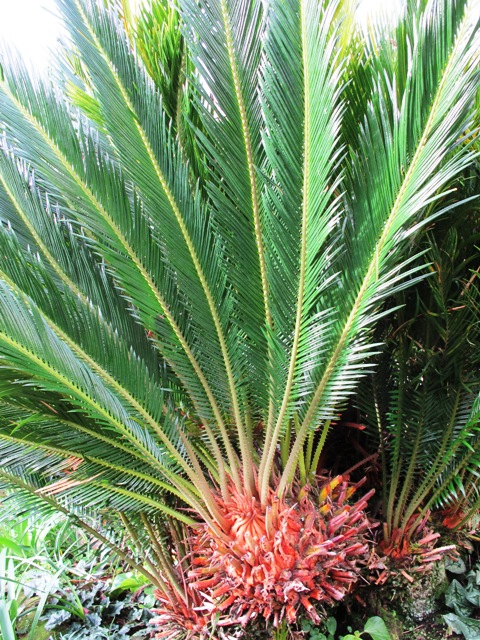
Cycas revoluta - the so-called Japanese sago palm

Cycas revoluta – the so-called Japanese sago palm

It is often referred to as the Japanese sago palm. It is from Japan but it is definitely not a palm. Cycads are different to palms with only a distant botanical connection. Apparently you can extract edible starch to make sago but the plant is so very slow growing that I am sure there are more sustainable and easier food sources should you feel the need for sago in your diet.

There is nothing rare about C. revoluta. It is probably the most widely available variety on the international market, often sold as a house plant. After several decades – five or six – ours is quite large but these are slow growing plants which are generally undemanding. As a house plant, it will want good light levels. In the garden it is one of the hardier cycads, not turning a hair at several degrees of frost but it needs a well drained situation. Ours is in the rockery, too close to a narrow path so I am forever clipping back its very stiff leaves to allow passage. It develops oversized football-like offshoots which can be grown as new plants. Over time a trunk develops – up to 6m, apparently. As the trunk of ours is sitting around 20cm at this point, it won’t be in my time. It has been taller but rotted out some years ago, re-growing from the base.

Like all cycads, C.revoluta is dioecious. Both male and female plants are needed to set seed. This is probably a good thing given that the seeds are toxic and can kill dogs.

First published in the Waikato Times and reprinted here with their permission.

Garden lore

“In a marshy spot in the garden we had excavated a pit, forming a pond, around which stood a grove of pine trees. It looks as if, in five or six years, a thousand years have left their mark here – one bank of the pond has collapsed, new trees have sprung up among the old, and such is the air of neglect that all who look are afflicted with a sense of sadness. Old memories come flooding back…”

Ki No Tsurayuki, The Tosa Diary (ca. 936, translated from the original Japanese 1955).

Espalier
Espalier is simply the exercise of keeping a plant to a flat plane so it has height and width but no depth. This makes it an ideal technique for narrow spaces. It does not have to be against a hard surface like a wall or fence, but there need to be cross wires or a frame to tie the plant to. Plants do not naturally grow in a two dimensional shape so you have to prune wayward growths and tie in branches often. It is possible to espalier any woody plant which establishes a permanent structure of trunk, stems and branches but it tends to easier if it has a central leader, is not going to grow too large and has flexible rather than brittle new growth. If it is too brittle, it can snap easily. Camellias are ideal candidates as are dwarf apples, figs or wisteria. I can’t see any reason why citrus couldn’t be espaliered but it is always easiest to start with a young plant. You can’t really rush espalier. It takes time to grow and train a plant properly.

Use a flexible tie, not string or wire which will cut into the bark of the plant. We like the balls of stockinette tie that you buy at the garden centre. Black is the least intrusive colour but they all fade with time.

First published in the Waikato Times and reprinted here with their permission.