Author Archives: Abbie Jury

Unknown's avatar

About Abbie Jury

jury.co.nz Tikorangi The Jury Garden Taranaki NZ

Grow it Yourself – oregano and marjoram

I am not alone in getting these plants confused. Marjoram is the sweeter, milder, softer option but they are all members of the origanum family and related to mint. Origanum vulgare is what is usually regarded as oregano while Origanum marjorana is marjoram (sometimes referred to as sweet marjoram). It also has smaller leaves. I grow both and tend to use them in tandem when cooking. It appears that in the wild and in harsher climates, oregano develops a much stronger taste and the flavour difference is marked. But in our soft and lush conditions, the flavours of both are very mild.

The relationship to mint gives a clue as to growth habits. These are clumping perennials, easily increased by division once established. In colder climates they are largely deciduous, but grown in a well cultivated garden border, I can harvest from them for most of the year. It is best to divide them in spring or summer when in full growth. If you are growing oregano for cooking, don’t succumb to buying the golden and variegated forms which lack the flavour. You can plant these herbs as ground cover in herbaceous borders though they can be so enthusiastic in growth they may swamp more retiring neighbours. They will grow happily in sun to part shade but the flavours will be intensified in harsher conditions – full sun and poorer soil. I have decided I am being too kind to my plants and am getting masses of lush leafy growth at the expense of flavour. Their Mediterranean origins are an indicator that they will take harder conditions. What is sold as Greek oregano is reputed to have the strongest flavour.

First published in the Waikato Times and reprinted here with their permission.

Tikorangi Diary: Friday 10 February, 2012

The bonus of summer flowers on Magnolia Black Tulip

The bonus of summer flowers on Magnolia Black Tulip

Latest Posts

1) From big picture gardening to small picture detail – Abbie’s column.

2) On the case with Ulmus “Jacqueline Hillier” in Plant Collector this week. It is not a dwarf grower as we were originally led to believe by somebody or other (probably the person we sourced the original plant from in NZ).

3) Grow it Yourself – spinach this week. Silver beet for refined tastes?

4) In the garden this fortnight – the latest instalment of our garden diary as written for the Weekend Gardener where we reference seeding and spreading plant pests (yes! Campanulata cherries, bangalow palms and Daphne bholua).

Magnolia Apollo in summer

Magnolia Apollo in summer

Tikorangi Notes:

In days gone by, the Jury name used to be synonymous with camellias. These days it is magnolias and we can chart the year by repeated requests for diagnosis. In late winter and early spring, it is always: “Help. My magnolia buds look fine but then the flower opens all distorted and misshapen.” In this country, the answer is that a possum has developed a taste for the buds and chewed out the centre at an earlier stage. They can do this without it being obvious from below. The solution is to catch the critter – we favour high velocity lead, as Mark says.

In spring and summer, the question is: “Help. The leaves on my magnolia tree are opening all yellow, distorted and sick-looking on one side. What can I do?” The answer is that somebody has used a hormone spray – usually a common lawn spray – at the time when the tree is just breaking dormancy and there is nothing you can do except wait to see if the tree can recover. Oh, and be more careful next year (or ask your neighbour to) because the slightest hint of hormone spray drift at the wrong time does major damage. Don’t spray your lawn in spring if you have magnolias nearby.

Magnolia seed pod, not a sinister growth

Magnolia seed pod, not a sinister growth

This summer, we have had repeated requests for information about alleged abnormal growths and cankers which have appeared. SEED PODS, dear Reader. There is nothing sinister. The plant has set seed and you have just noticed it. Some plants set a fair amount of seed, some none at all (they are sterile) and some only set seed occasionally. And yes, you can grow them but the chances of getting something exciting and better than the parent are extremely remote. And you need space because it may take many, many years before the seedlings get to flowering size – by which time they can be large trees. When the pod eventually turns brown and dry, it starts to crack open and release the red seed. For better germination, we rot that red coating off before planting the inner black kernel.

Out of season summer flowers on magnolias are often mentioned too. There is nothing unusual about this phenomenon. I wrote about it in Magnolia Diary 14. It is in the breeding, basically. And they are bonus flowers, not a major display.

The Tikorangi weather report is better this week – some sunny, warm, summery weather at long last though the lower than average night temperatures and sunshine hours mean the water temperature in our swimming pool remains too low to entice us in. The pool is unheated and would normally be a pleasant 26 degrees celsius by now, maybe more but it is not even close. The only consolation is that the entire country is having a cooler than usual summer. It is always nice to know that one is not alone. At least the auratum lilies don’t mind and flower on beautifully.

From big picture gardening to small picture detail

Ours is not a rockery for growing alpines

Ours is not a rockery for growing alpines

My mission to weed our stream and ponds, about which I wrote last week, has been subsumed. That is to say it has largely been taken over by the menfolk in my life and turned into something much larger but I am not complaining. I was trying to clear the water weed. They are now building an additional weir, flushing the stream and hiring a sludge pump to clear the ponds. I know my limits. I have moved up from the park and into the rockery.

Moving from the open areas to the intimacy of the rockery is going from one extreme to another. The former is big picture gardening and much concerned with giving large trees space to grow and anchoring the whole picture well into the surrounding environs. This used to be called borrowed views and vistas before those terms became so pretentious they fell into naffdom. The rockery is all about little pictures, highly detailed gardening. I wouldn’t be without either, but I really enjoy the attention the rockery requires.

Traditionally, rockeries were about creating an environment that resembled scree slopes of mountains in order to grow alpines. We cannot grow alpines. We’ve tried but it doesn’t work. Our high humidity, high rainfall and mild year-round temperatures conspire against alpines. For us the rockery has become the place to keep track of treasures and to confine dangerous but attractive bulbs. Most gardeners know how easy it is to lose bulbs in garden borders. Some get swamped out by neighbouring plants, some are so anonymous when dormant that they get pulled out with other plants, some just seem to go, we know not where. If they have their own pocket in the rockery, it is possible to label their location and restrict competition.

Rockery conditions are surprisingly harsh. All that stone and other hard material heats up in summer so the soil dries out quickly. The gentle, steady rain we had last week didn’t penetrate very far. This means you have to be pretty selective about small shrubs, perennials and other plants but the bulbs don’t usually mind. In the wild, most are used to marginal conditions.

Too much of a good thing - Cyclamen hederafolium with black mondo grass

Too much of a good thing - Cyclamen hederafolium with black mondo grass

Two summers ago, I took the rockery apart pocket by pocket. At the time, I estimated there were about 500 separate compartments and it took me a full month’s work. At least I got to know it and all its inhabitants. This time I am only concentrating on the messy bits and the areas where plants responded a little too enthusiastically to the earlier renovation. The combination of black mondo grass and pink Cyclamen hederafolium is very pretty, especially as snowdrops come through the marbled foliage of the cyclamen in the depths of winter. But you can have too much of a good thing and all three inhabitants were trying to outcompete each other. I am thinning them drastically.

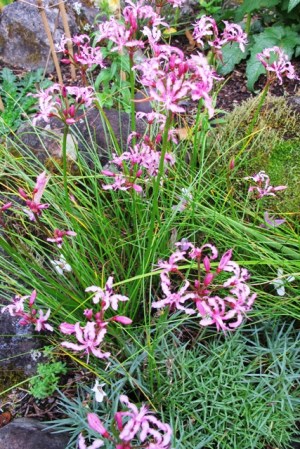
To garden in this style, you have to be willing to tolerate the messy season bulbs have, when their foliage is looking past its best. Most bulbs use the time after flowering to build strength below ground so they can flower again next year. When they have done that, their foliage dies down naturally. With some, this is a quick turnaround. Others, like nerines and colchicums, take many months. We just try and ensure that other areas of the rockery have more attractive displays to distract the viewer and leave the plants to their natural cycle.

I used to think that every pocket of the rockery should have something of interest in it all the time. This is actually a lot harder than it sounds because you then need to use a succession of maybe four different plants which can co-exist quite happily – and each compartment should have different combinations. In other words, for me this would be getting on for 500 miniature gardens. Rockeries are no place for mass planting. I flagged that idea – too hard and not necessary. Some compartments will have periods of the year when they appear empty and that is fine as long as there are no weeds. There is no place for any weeds at all in this intensive style of gardening.

Ours is an aged example – sixty years to be precise. We have some fine, gnarly, old, characterful dwarf conifers to give year round structure along with some smaller growing cycads (though somebody forgot to tell the handsome Cycas revoluta to stop growing). We have a few easy care, small perennials to soften the edges. A compact little blue campanula is one of the best of these along with a well behaved little scutellaria. We like the tall punctuation marks of some plants drifted through the rockery. The upright orange-toned orchid, Satyrium coriifolium, is the choicest one. The large flowered yellow Verbascum creticum seeds down gently to give the statement in late spring and the amaranthus (Love Lies Bleeding), similarly self seeded, is growing before our very eyes to fill the vertical accent role in autumn. These plants just provide a framework for the real stars – a succession of any and all interesting bulbs we can grow.

It means there is always something of interest to look at. I enjoy that sort of detailed gardening.


First published in the Waikato Times and reproduced here with their permission.
Plant Collector: Ulmus elegantissima “Jacqueline Hillier”

Ulmus (should that be elegantissima, minor or x hollandica?) "Jacqueline Hillier"

Ulmus (should that be elegantissima, minor or x hollandica?) "Jacqueline Hillier"

It’s an elm but from there on there seems to be some debate. We received it under the species classification of elegantissima. The Hillier Manual of Trees and Shrubs lists it under the species name of minor with elegantissima added as a synonym. A quick net search and I see others now list it as Ulmus x hollandica which is a natural hybrid of minor and glabra. In other words, nobody knows for certain so we will stick with Hillier’s own classification.

The reason nobody knows for certain is that it was found in a garden in Birmingham in the early 1960s and it was visibly different. Most elms are renowned as handsome, large trees, though they have suffered hugely in the UK and Europe since the 1970s from a major outbreak of Dutch Elm disease which kills them. “Jacqueline Hillier” is smaller growing. In fact it came to us under the descriptor of dwarf. It has tiny, sawtooth leaves and very fine tracery of branch structure whereby the leaves are held in fan shapes. This means it is extremely attractive when it is a bare skeleton in winter. It is delightful when flushed with bright spring growth and it is lovely and lush in summer until the predations of the red spider sometimes defoliate it.

Dwarf it is not. I planted a specimen in our rockery where it set out to prove it belongs to the large shrub category. We have to keep working on it extensively every year to keep it down to about 3 metres x 3 metres. It also seeds and suckers but not in a dangerous way. Had I realised it would grow to that size, I would have planted it somewhere with more space – but I would definitely still have planted it.

First published in the Waikato Times and reprinted here with their permission.

Grow it yourself: spinach

Silver beet and spinach are close relatives. Indeed, somebody very close to me claims they taste the same when cooked, which I can’t argue against because it is so long since I have eaten the former. Texturally, I much prefer the finer, softer leaves of spinach and will happily eat those. Spinach is a winter vegetable. It will continue growing in colder temperatures but as soon as the weather warms in spring, it will bolt to seed. It is not quite as amenable as silver beet to grow and while you can leave plants in the ground and just pick as much as you need, it does not have the same cut and come again characteristics.

Well cultivated, well drained soil rich in nitrogenous fertiliser and full sun are the keys. Spinach is usually direct sown from seed and most of us now know to pick the thinnings and eat them as micro greens in salads or stir fries. The final spacing is in the 10cm range. In the right conditions, it is a quick crop because it will mature within a couple of months and you may have been eating immature leaves all that time. Some gardeners like to sow successive crops every few weeks to ensure continued supply.

There are a number of different spinach varieties, including New Zealand spinach or kokihi which is a different plant altogether (though similar taste and texture) and is our one great contribution to the global world of vegetables. While most spinach are spinacia, it is Tetragonia expansa. We recommend shunning the heirloom strawberry spinach (Chenopodium foliosum), being of the opinion that the reason it has been around for over 400 years is because it seeds so freely it is nigh on impossible to eradicate once you have it. The leaves are pleasant enough but the so-called strawberry seed heads are not.

First published in the Waikato Times and reproduced here with their permission.