Stop Press
Penguin NZ have issued an immediate recall of all copies of this book.

Slight sense of deja vu here - side by side
There was a bit of a problem with the first version of the Tui NZ FRUIT Garden by Sally Cameron, published by Penguin NZ. In fact it was clearly quite a large problem, given that Penguin ordered an immediate recall within a few days of its release. It’s usually called plagiarism – rather too much cut and paste from copyrighted sources without acknowledgment. It was the third such embarrassing incident in quick succession for this publisher, the highest profile being Witi Ihimaera’s work, The Trowenna Sea. No matter. Publishers closed ranks and I was on a National Radio panel where other professionals explained that it was all the author’s fault and none of this could possibly be blamed on the maligned publisher.
To my astonishment, Penguin NZ, with the backing of their sponsor Tui Garden, ploughed ahead using the same author to rewrite the book and a year later they issued a second edition which was substantially different. No better, mind, but different and minus the sections which appeared to have been plagiarised.
Would you not think that both Penguin NZ and Tui Garden would have put the first book by the same author in the same series – The Tui NZ VEGETABLE Garden – under the microscope at the same time? I reviewed it when it came out in 2009 and I was far too kind. In my defence, all I can say is that it seemed markedly better than the other book which I was reviewing alongside it. When faced with the FRUIT book a year later, I questioned whether the earlier VEG book might suffer from similar problems related to cutting and pasting other people’s work. I even cited the garlic entry and gave its source as a copyright website belonging to somebody else.
Given the obvious inexperience of the author, did nobody involved think it warranted a closer look? We are talking the same book series, same author (Sally Cameron), same sponsor (Tui), same publisher (Alison Brook for Penguin), same editor (Catherine O’Loughlin). When the author is already under scrutiny, in the dock so to speak, it is difficult to believe that others involved can dump all the blame on her a second time.
It was only ever going to be a matter of time before somebody noticed. And two weeks ago, somebody identified a primary source for the Tui NZ VEGETABLE Garden and posted the following comment on my website:
“Not only has Dr D G Hessayon ripped off Sally Cameron’s Tui NZ Vegetable Garden, chapter and verse, but, he also had the temerity to do it four years prior to Sally being published.
Is it OK to lift entire chapters of books if you include a reference to that book at the end? Hope so, ‘cos I’m just finishing my book “Great Expectations” with a small reference at the back to Mr C Dickens.”

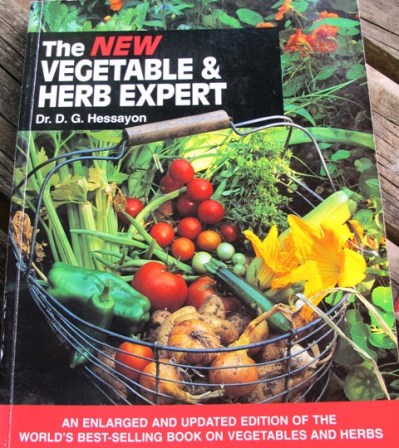
Dr Hessayon's book may look a little old fashioned but is packed full of information and is a best seller - for British gardners
My informant was working from a more recent copy of a source publication, “The New Vegetable and Herb Expert”. English horticulturist and bestselling author, Dr Hessayon actually published his book a good ten years before Sally Cameron produced hers. It took me mere minutes to track down a copy on Trade Me. I think I paid $12 for it plus P&P and it arrived in the mail this week.
Well. Oopsy. How many examples are sufficient?
1) On turnips: Hessayon: Round is not the only shape for these Early turnips – there are also flat and cylindrical ones. There is not much variation in the globular Maincrop types sown in summer, but you can choose the yellow-fleshed Golden Ball. (page 105)
Cameron: Round is not the only shape for these early turnips – there are also flat and cylindrical ones – but there is not much variation in the globular maincrop types sown in summer. (page 174 and one can do a side by side match for much of pages 174 and 175).
2) On Brussels sprouts: Hessayon: Birds are a problem – protect the seedlings from sparrows and the mature crop from pigeons. Hoe regularly and water the young plants in dry weather. The mature crop rarely needs watering if the soil has been properly prepared…. (pages 34-5)
Cameron: Birds are a problem. Protect the seedlings from sparrows and pigeons that will eat the mature crops. (Which type of pigeons, Sally?) If scarecrows don’t work, hang cutlery from a clothes hanger. (That suggestion does appear to be a Cameron original). … Hoe around the plants regularly and water the young plants in dry weather. The mature crop rarely needs watering if the soil has been properly prepared….( page 70 -71)
Even the instructions for picking are eerily identical.
Hessayon: Begin picking when the sprouts (‘buttons’) at the base of the stem have reached the size of a walnut and are still tightly closed. Snap them off with a sharp downward tug or cut them off with a sharp knife.
Cameron: Begin picking the sprouts at the base of the stem when they have reached the size of a walnut and are still closed. Snap them off with a sharp downward tug or cut them off with a sharp knife.
Similar problems exist with broccoli, celeriac, Jerusalem artichoke, the aforementioned garlic and more and I cannot claim to have done anything near a complete analysis. Given that the problems appear to be of a similar magnitude to the first version of the FRUIT book which was recalled, will we be looking at a recall of the VEG book? Maybe Tui Garden might consider whether it is a good look being affiliated to a book which claims to give good advice to New Zealand gardeners when a fair swag of it seems to have come from a book for British gardeners.
Lightning, it appears, can strike twice in the same place. It just beggars belief that editor, publisher and sponsor all appear to have failed to factor that in to their considerations.
First published in the Waikato Times and reproduced here with their permission.
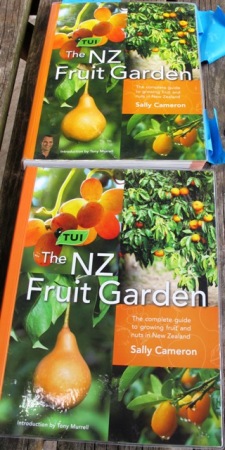
Version 1 at the top, version 2 at the bottom. Just Tony Murrell's photo has disappeared from the cover though the content was substantially rewritten
The ongoing saga (and it is developing into a saga):
1) The review of the second edition of the fruit book: The Sequel – a second coming for the Tui NZ Fruit Garden
2) Does credibility and reputation count for nothing these days, or does Penguin just think we have short memories? (written upon hearing that Penguin and Tui were using the same author to rewrite the fruit book)
3) The story that started it all and that is currently the second most read article on my website, still receiving hits every day: The Tui NZ Fruit Garden – dear oh dear
4) The lead story on the Taranaki Daily News which broke the first plagiarism story. Since then I have parted company from the Daily News and moved to the Waikato Times.
5) The original review of the Tui NZ Vegetable Garden, which was far too kind and is now embarrassing to me as a reviewer. But I leave it in place because it is a good reminder – and I am considerably more thorough at reviewing garden books in NZ than many others. The Tui book did look better than the other one I was reviewing at the same time – but it, at least, was actually written by the author, based on her experience (however limited it was). Separating the genuine enthusiasts from candyfloss fashion gardening
6) The Tui NZ Flower Garden I merely add this one to complete the set. I declined to review the companion volume on kid’s gardening but I did review the flower book (same series but different author). I would not for one minute suggest that this volume suffers from plagiarism, not at all. It could only be original, for reasons which may be obvious if you read the review.


 Latest posts Friday March 2, 2012

 reached for the camera as soon as I got out. I never tire of trees and skyscapes. The elderly pines make a pretty amazing sight even if the one leaning to the right is indeed leaning as much as it appears in the photograph below. One day it may lean beyond the point of balance.