Author Archives: Abbie Jury

Unknown's avatar

About Abbie Jury

jury.co.nz Tikorangi The Jury Garden Taranaki NZ

Gecko update

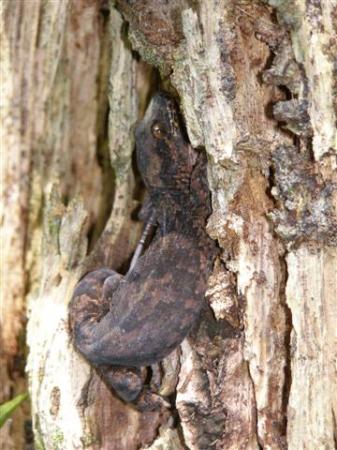
gecko-009A kind reader from the herpetological society (www.reptiles.org.nz) rang to tell us that our gecko is most likely a heavily pregnant Hoplodactylus pacificus. This is good because it must mean that we have at least two resident gecko but it did necessitate a name change. Geck, or Gok was quickly renamed Glenys (Mark’s choice). She has been out sunbathing most days but apparently when she gives birth to her live young (probably two of them), we will no longer see her because she is largely nocturnal by nature, though we may catch sight of her babies which will apparently resemble matchsticks with legs. Alas, the babies are vulnerable to every predator you can think of, including other geckos, but we have our fingers crossed that this may indicate a hitherto unsuspected resident gecko population.

The flocking kereru have now increased to more than twenty and we are none the wiser as to why they are congregating here but we are pleased to have them around. They arrive in pairs or threes. Mark’s theory is that they are either introducing their young to their uncles and aunts or they are swapping slaves, or maybe troublesome adolescents.

In the Garden: February 18, 2010

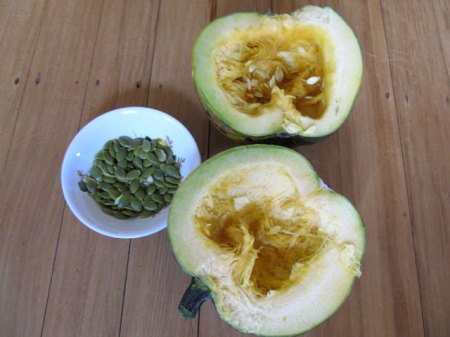
Rather too high a ratio of barely edible pumpkin to seed yield

Rather too high a ratio of barely edible pumpkin to seed yield


· Do not delay on summer pruning cherry trees as time is running out.

· Get on to planting the winter vegetables too. They need the rest of summer and all of autumn to grow because once the winter cold comes, they stop growing though they will hold in the garden so you can harvest fresh each day. Fresh veg are usually much more expensive to buy in winter and spring rather than the bountiful summer and autumn so it makes economic sense to grow your own, even aside from the pleasure and satisfaction of gathering your own produce. So get the parsnips, carrots, peas, Florence fennel, beetroot and brassicas in. The turnip family too, if you regard them as suitable food for humans.

· We have been trying out growing pumpkin for seed this year – a variety that has no hulls so needs no separation. It is an oil-seed variety. Certainly the fresh pumpkin seed is delicious but based on the first gathering, it appears that you would need a very large area to attain self sufficiency in pumpkin seeds. And alas, the pumpkin flesh itself is of no merit. If you were starving, it might be okay to eat but it is nearly as bland as marrow.

· We have been a little slow on the uptake revisiting beetroot here but, as many others have discovered, when picked young and tender (about golf ball size), they are delicious cooked in a variety of ways but especially roasted. Beetroot can be sown from seed pretty much all year.

· Rocket and mesclun bolt to seed in summer but with cooler weather just around the corner, it is fine to return to sowing these crops from seed.

· If you have been intending to spray your rhododendrons for thrips (the cause of irrevocably silver leaves and a weaker plant), now is the time. You need to use a systemic insecticide so the plant sucks it into its system. Contact insecticide only kills where it touches and as the offenders are on the undersides of the leaf, you can’t get total coverage. The alternative is bands of old carpet or similar soaked in neem oil and secured around the main trunk. This approach seems to be getting good reports though we have yet to get around to trying it ourselves. Soaking a band in Confidor or similar insecticide will also work but wear gloves when handling it.
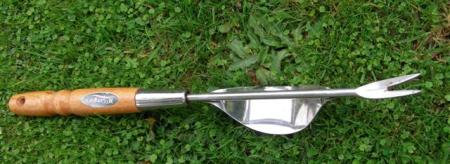
A handy implement for dealing to lawn weeds

A handy implement for dealing to lawn weeds

· Autumn is an optimum time for sowing or over sowing grass so if your lawn is looking very sad, you can start preparing it now for resowing in a few weeks time. Getting out the flat weeds is a good start. You can either dig them out (I have a very handy tool for this), sprinkle them with sulphate of ammonia or use a designated lawn spray. Don’t feed your lawn at this time. We are too dry and it is more likely to kill the remaining grass instead.

Destroying wasp nests – step-by-step

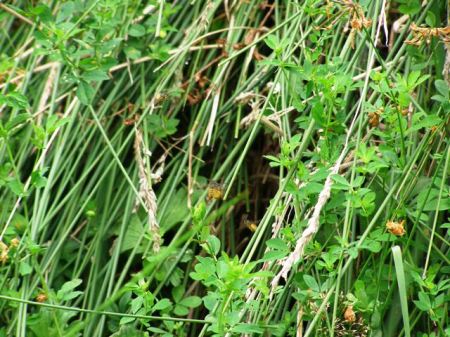
1) Wasp nests need to be killed off or they can build up to a dangerous size and over-winter. If you see a few wasps, follow them to see where the nest is. These can be in holes in the ground, in dense vegetation, in holes in walls and, on occasion, in your house roof. It is probably best to call the professionals for any inside your house, but garden nests can be dealt to safely and easily.

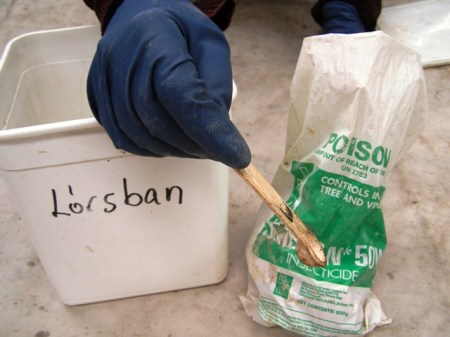
2) We use a very small quantity of Lorsban (available to approved handlers only) but any powdered insecticide will work. Carbaryl is widely used. The critical detail is that it needs to be in powder form because you are relying on the wasps unwittingly transferring the powder into the nest. Use gloves whenever handling insecticide as a safety precaution.

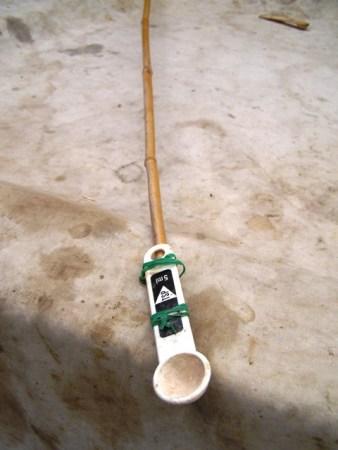
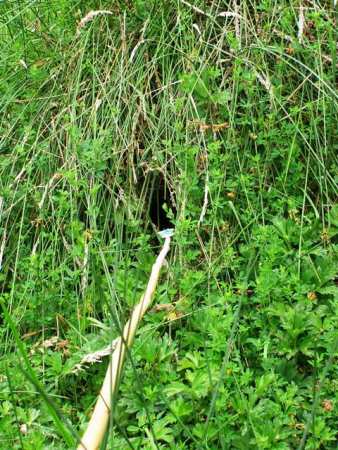
3) Mark has a measuring spoon wired to a pole about two metres long. You need a steady hand but this means he never has to get near the nest and he has never been stung using this approach. It takes under half a teaspoon to kill most nests, depending on the accuracy of your placement.

4) Morning is the best time. The wasps are a little dozy because they have not yet warmed up and most are out foraging. As they return they will take the powder in. We do not recommend evening or dusk. You are far more vulnerable to attack when they are all in residence. Move lightly and quietly to sprinkle the poison around the entrance, ideally on the inward side. Heavy footed stomping or noise will put the wasps on alert. It only takes a matter of an hour or two to kill the nest out if you get your placement of the insecticide right.

5) If you want to avoid using insecticide, you can kill them with petrol fumes but you have to get closer and the risk of being stung is higher. Partially fill a small bottle with about 200ml of petrol and plug the top of it into the hole so the fumes and liquid flow in and it blocks the exit. The biggest drawback here is that you need to do this on dusk or at night when all the wasps are in residence. It is the fumes that kill them. Do not set fire to it. Move very quietly and lightly. Generally nests have guard wasps which will fly straight at you. For this reason, Mark strongly favours the insecticide in the morning.

In memory of Christmas 2010

Altogether too reminiscent of a dead sheep to a New Zealander, alas

Altogether too reminiscent of a dead sheep to a New Zealander, alas

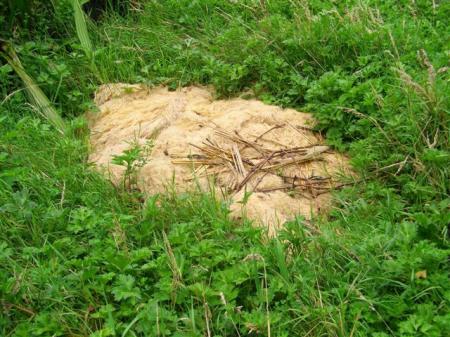
Regular readers may recall the DIY Christmas tree we showed in December, constructed from toetoe grass (or possibly pampas in other countries). I found its remains today where Mark had dumped it – looking uncomfortably like a dead sheep, alas. Maybe some toetoe plumes will rise from its remains in the future, if it has seeded down in our wild garden as Mark hoped.

Kevin, Sharon and our Christmas tree

Kevin, Sharon and our Christmas tree

Tikorangi Notes: Friday 11 February, 2011

The gecko - a first for us to find a live one in our garden

The gecko - a first for us to find a live one in our garden

LATEST POSTS: Friday 11 February, 2011

1) Gecko (singular but rare), many kereru and a mass of monarch butterflies in Abbie’s column this week. I admit that the photograph of the kereru was staged. It is not easy to get close enough to them and I had lost my one good image. In desperation we got one out of the freezer where Mark stores dead native birds he finds (all from natural causes) to pass on to a local kuia to pluck for use in making korowai or Maori feather cloaks. We had to partially defrost it to mould it, hold it in position and then hastily refreeze it as it was starting to smell rather high.

2) Amaryllis belladonna – often seen as rather coarse and common roadside flowers in this country but worth a second look. Plant Collector.

3) Garden tasks for this week though there is not a whole lot one can do at this time of the year beyond dividing bearded irises, daffodils and bluebells.

4) Not your ordinary everlasting flower – Helichrysum Silver Cushion in Plant Collector last week.

5) A little after the event now – garden tasks for the first week of February in an antipodean summer.

6) The second in our Outdoor Classroom series on making compost – step by step hot compost mixes with an impressive shot of our compost heap resembling an attraction at a thermal reserve.


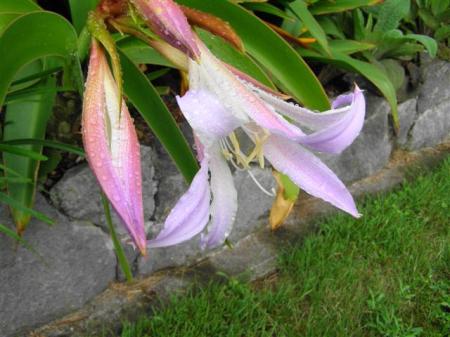
Worsleya rayneri in the garden, just starting to open its blooms

Worsleya rayneri in the garden, just starting to open its blooms

TIKORANGI NOTES: Friday 11 February, 2011There weren’t any Tikorangi Notes last week. I think I was feeling uninspired and having a great deal of trouble focussing my eyes on the computer screen – the result of not seeking help earlier for what turned out to be part of a seed head embedded in one eye. Such are the dangers of gardening. But this week was marked by two events – finding that we have a resident gecko in the garden (the gecko being a rarely sighted native lizard) – written about in Latest Posts 1, and the opening of not one but two Worsleya rayneri blooms in different locations in the garden. The worsleya flowering is not quite as rare as the sighting of a live gecko – it has happened twice before – but to manage this feat with bulbs planted out in the garden rather than kept in controlled conditions in a container is a reasonably significant triumph.