Author Archives: Abbie Jury

Unknown's avatar

About Abbie Jury

jury.co.nz Tikorangi The Jury Garden Taranaki NZ

Sculpture in the garden

The large chicken netting peacocks in the meadow at Hilliers were both whimsical and charming

The large chicken netting peacocks in the meadow at Hilliers were both whimsical and charming

Would we consider having an exhibition in our garden during Rhododendron Festival, the sculptor asked. It is pretty last minute but we replied in the affirmative, though rather regretting the missed opportunities in the official programme which had long since been printed.

We have tended to be a bit iffy and sniffy about sculpture in gardens and it wasn’t until we saw it at Hilliers and at Wisley in England that we found a perspective we could live with.

The key issue is quite simple. In our eyes, gardens are about plants and they should be the stars. Even garden design is primarily a vehicle to carry the plants and to enhance the viewing experience. Drop a sculpture into a garden and in most cases the created object made by a human becomes the dominant feature. The plants and garden become the backdrop. That is fine if sculpture is your interest and you merely want a pleasing outdoor venue to display a collection. As long as the piece is placed well, the garden setting can enhance it considerably. But the reverse is rarely true and takes a great deal more skill.

Gardens are more usually dominated or taken over by the sculptural statement. If you doubt this claim, walk around a garden which has a significant sculptural installation. Do you look at the sculpture or the garden? I bet your bottom dollar that you look at the sculpture first (and longest) and the garden setting second but the detail of the garden slips into the background.

Sputnik shapes in a bed of vinca at Hilliers

When we visited Hilliers famed gardens and arboretum near Winchester earlier this year, there was a sculpture exhibition in place. And even we, pretty dedicated as we are to the plants and gardening side, looked in the first instance at the sculptures. Don’t get me wrong. We really liked some of them and it was here that we figured that our personal tastes lean more to the organic forms which represent shapes in nature. This was a large exhibition with many artists involved so it lacked the cohesion and vision which are part of a solo display. It was also temporary and that was when we decided that there is a world of difference between permanent installations and short term exhibitions. The latter can add a great deal of interest to the experience of the visitor (which is why we said yes to the sculptor who approached us) without the commitment of permanence.

Ephemeral whimsy in willow at Wisley

The RHS Wisley gardens just outside London had some charming, large, woven willow creations placed strategically in parts of the garden which were otherwise a little empty, almost barren. There is something about the ephemeral nature of woven willow which ages gently and will in time disappear entirely, making it fit easily to the surroundings. The whimsical nature of these works added appeal. But these were hardly Serious Sculpture or High Art – large woven toadstools and pieces of fruit don’t quite rank up alongside massive Henry Moore pieces.

In the end, garden sculpture is about personal taste and our personal tastes lean more to smaller scale, environmentally sympathetic whimsy which can gently blend in to our garden, rather than dominate. Others prefer much bolder pieces which shout out a statement and where the garden and environment curtsey to the power of the piece.

From what I can see from his list, Rangitikei artist Steuart Welch from Cannock Forge is bringing to us pieces from both ends of the spectrum – big bold statement pieces which require a truck to move and some which represent the whimsical aspect of his nature. We are really looking forward to seeing the effect of placing such strong pieces in our garden and learning first hand how to tread that line between enhancing a vision and dominating it. The works will remain in place throughout our Rhododendron Festival until the second week of November.

Flowering this week – Veltheimia

More likely to be veltheimia bracteata than capensis

More likely to be veltheimia bracteata than capensis

Indubitably veltheimia, but whether bracteata or capensis for the species is a bit open to debate. In fact we may even have hybrids between the two though that does not seem to be widely mentioned as an option. The flowers can look a little like a cross between a red hot poker (kniphofia) and a lachenalia on steroids. The pink form is more common and it is such a robust performer that I am inclined to think it is the easier bracteata. The yellow form with pink blush, called Rosalba, is much rarer and sought after. We had thought that this was the species capensis but it flowers at the wrong time and is such a reliable and strong performer that it is more likely to be predominantly bracteata. We also have a creamy yellow veltheimia which is touchy, difficult, fussy and doesn’t thrive at all which is a shame because the colour is purer than Rosalba.

Whatever, these big bulbs from South Africa (members of the Hyacinthaceae family) are a little tender in constitution for cold areas because they are in growth during winter. For many years, they have been perfectly happy in the narrow dry house border which gets all the morning and midday heat but only occasional rain. In recent times we have found that they can be successful grown in open woodland and indeed bracteata is referred to as a forest lily in South Africa. It is truly remarkable how many wildflowers of that country have come to form the majority of interesting bulb material grown in our gardens here. If you acquire veltheimia seed, it germinates easily but is best sown fresh

October 16, 2009 In the Garden

  • In the vegetable garden, the end of October signals the time for the major plant out for summer crops. The soils are warming up by then and for all but the most extreme areas, the threat of a late frost is over. Even minor late frosts can be devastating to plants with tender, young growth. It is not critical that you time it for Labour Weekend – a week or two either side is fine. But if you have your garden all dug and ready and waiting, keep raking it regularly to expose any germinating weeds to the sun and air and to keep it well tilled and fluffed.
  • The only reason to raise a vegetable bed any more than about 20cm above the ground is to save your back. As vegetables rarely go much deeper than that, any additional depth is wasted soil which will compact over time. But raising the bed a little does stop you walking on it and compacting it. If you do not have permanent paths to keep you off the soil, you can use wooden boards that you move around. Pavers are also a good option that can look attractive and you can lay yourself at moderate cost.
  • Mounding rows of the vegetable beds on an east-west axis has been proven to accelerate growth, particularly when soils are heavy, damp or cold. Mark routinely mounds his vegetable rows here. The east-west axis is to ensure maximum and even exposure to the sun.
  • Keep sowing a few lettuce seeds each week to ensure continued supply. One of the skills of good veg gardening is managing successional sowing to keep a range of vegetables available in the garden, rather than feast or famine. A diary is very helpful to record what you have done, as long as you remember to refer to it next year. While it is getting late for main crop onions, those sown now can be harvested as spring onions later.
  • In the ornamental garden, give top priority to planting out woody trees and shrubs before we get too warm and dry, pruning evergreens, dividing perennials and feeding anything that looks needy. Time is fast running out for all these tasks. It is already too late for moving trees and shrubs. Wait until autumn to carry out further relocations.
  • If you are currently enjoying clivias, especially the highly desirable lemon or even peach toned varieties, you can increase the chances of your plant producing good seed by hand pollinating. This involves transferring the pollen from one plant to the anthers of another plant. Usually a paint brush is used to carry out this process. If you carried out this operation as we advised last year, the seed is probably still on the plant and it is fine to collect and sow it now.
  • Lawns are currently showing their weaknesses including major weed infestations. You can green up sad, yellow or starved looking lawns with fertiliser (the locally produced Bioboost can be spread any time without risk of burning dry lawns). Keep shunning hormone sprays for a few weeks longer to avoid any risk to surrounding plants coming into growth. While we normally advocate cutting lawns reasonably long (leave at least 2.5cm in length), scalping a lawn at this time can deal death to some of the seasonal weeds. The one weed we think you can justify spraying is the highly undesirable and prickly Onehunga weed. Seek advice from your local garden centre as to what is currently recommended to deal to this menace to bare feet. If you have children in your life, you will need to take action on this one.

Flowering this week – Prunus Pearly Shadows

The flowers on Pearly Shadows are at least two weeks early this season

The flowers on Pearly Shadows are at least two weeks early this season

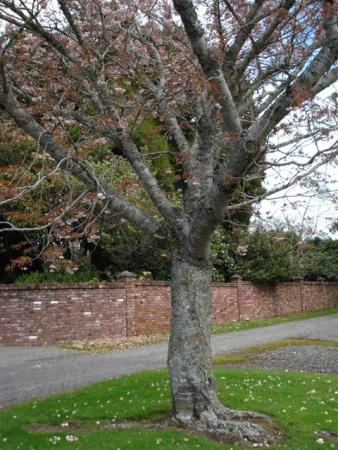
The disconcerting aspect about the pale pink froth of Prunus Pearly Shadows this week is that it normally happens around Labour Weekend which is still two weeks away. The flowering is early all round the garden this spring. So the drifting pink petals like snow flakes on a breeze may all be over by the time our garden festival starts at the end of the month. At least the new growth is an attractive and distinctive bronze though hardly as pretty as the flowers.

Pearly Shadows is a Japanese cherry with very full, fluffy double flowers. While Felix Jury named it, he did not breed it. The tree is too good just to be a chance seedling so it is a fair bet that it may have a proper Japanese name in Japan but nobody has ever been able to tell us what it is.

Pearly Shadows has a very useful shape as a tree, being like a capital Y which gets the upper branches out of the way. Some other Japanese cherries tend to grow more in the shape of capital T with low, spreading branches. A Y shape makes a better tree to line a driveway than a T shape.

Japanese cherries are pretty as a picture and make a quick growing impact tree but they are rarely long-lived in local Taranaki conditions. We are too damp and they can develop root problems and up and die unexpectedly. They also have a tendency to develop witches broom which can be seen as very dense foliar growth with no flowers. The witches broom will take over the tree if you don’t stay on top of it and cut it out in summer. By that stage, the entire tree is in full leaf and unless you have marked the offending sections, you will probably have forgotten which bits to take out.

A useful Y shape for a driveway tree

A useful Y shape for a driveway tree

October 9, 2008 In the Garden

  • We had a cold snap around the same time last year although we do not recall it being quite as cold as last Sunday and Monday. But this is why you don’t rush out to plant tender vegetables such as tomatoes, aubergines, capsicums, kumara and the like for another two weeks or so.
  • On a freezing cold jaunt around a few garden centres last Sunday morning, we noticed deciduous azaleas (azalea mollis) in stock. These are not always easy to find so if you have been wanting some, don’t delay – get out and buy them while they are available. Deciduous azaleas are more tolerant of poorer soil conditions than their aristocratic rhododendron cousins (they will even take quite wet conditions in heavy soils) and will smother themselves in flowers before any sign of leaves. Some, but not all, are the most outrageous colours in shades of burnt orange, cerise, saffron yellow and tangerine. Others are more demure but have wonderful fragrance.
  • If you have formal hedges, now is the time to get out and give them a light prune to keep sharp lines. The hedge clipping expert here (which is neither of us) uses a string line to keep even short lengths of hedges straight. He has also just clipped our one surviving yew tree. Yew are the classic clipping plant in England but, like flowering cherries, they find our rainfall levels too high and develop root problems which are nearly always terminal. If you are after the longevity and class of the English yew tree in this area, plant our native totara or miro instead.
  • Deadhead hellebores to stop aphids from setting up camp in the spent blooms. Sometimes even whitefly will join the gatherings and because the flowers face downwards, you may not notice the assembling hordes until you have a real problem. Removing the host is a pre-emptive move. If you are saving hellebore seed, sow it straight away. It doesn’t last long before it gets considerably more difficult to germinate.
  • Sow seeds of basil in pots or a tray for planting out in a few weeks but keep them somewhere warm and sheltered. If you want to grow melons of the rock, water or cantaloupe types, it pays to start these in pots as early as possible. They need a long, hot growing season and you want to make the most of every day if you want a good crop in our marginal conditions.
  • Most people will need to spray potatoes with copper from time to time, starting now. Taties are vulnerable to blight (the cause of the Irish potato famine) and if you get a bad case of it, the whole crop will succumb. Some modern varieties are a great deal more resistant and do not believe the myth that heirloom or heritage potatoes are by definition healthier and more resistance. This does not apply to potatoes (ask the Irish). We have a touch of blight showing here on the Jersey Bennes but Liseta is looking clean.
  • Plant Florence fennel, climbing and dwarf beans, carrots, peas, cauli, broc, beetroot, spinach and salad veg. These can all go directly into the garden as seeds or plants. If you want to hurry them along, use a cloche.